WB

Wendy Bounds

Things Wendy Says on Podcasts

Where to Find Them

Wendy Bounds has been a guest on WSJ Tech News Briefing and Two Percent with Michael Easter .

Recently: “#65: The Health Benefits of Gathering | Wendy Bounds” on Two Percent with Michael Easter (November 2026); “AI Boom Creates Blind Spot in Big Tech Accounting” on WSJ Tech News Briefing (February 2026).

What They Said

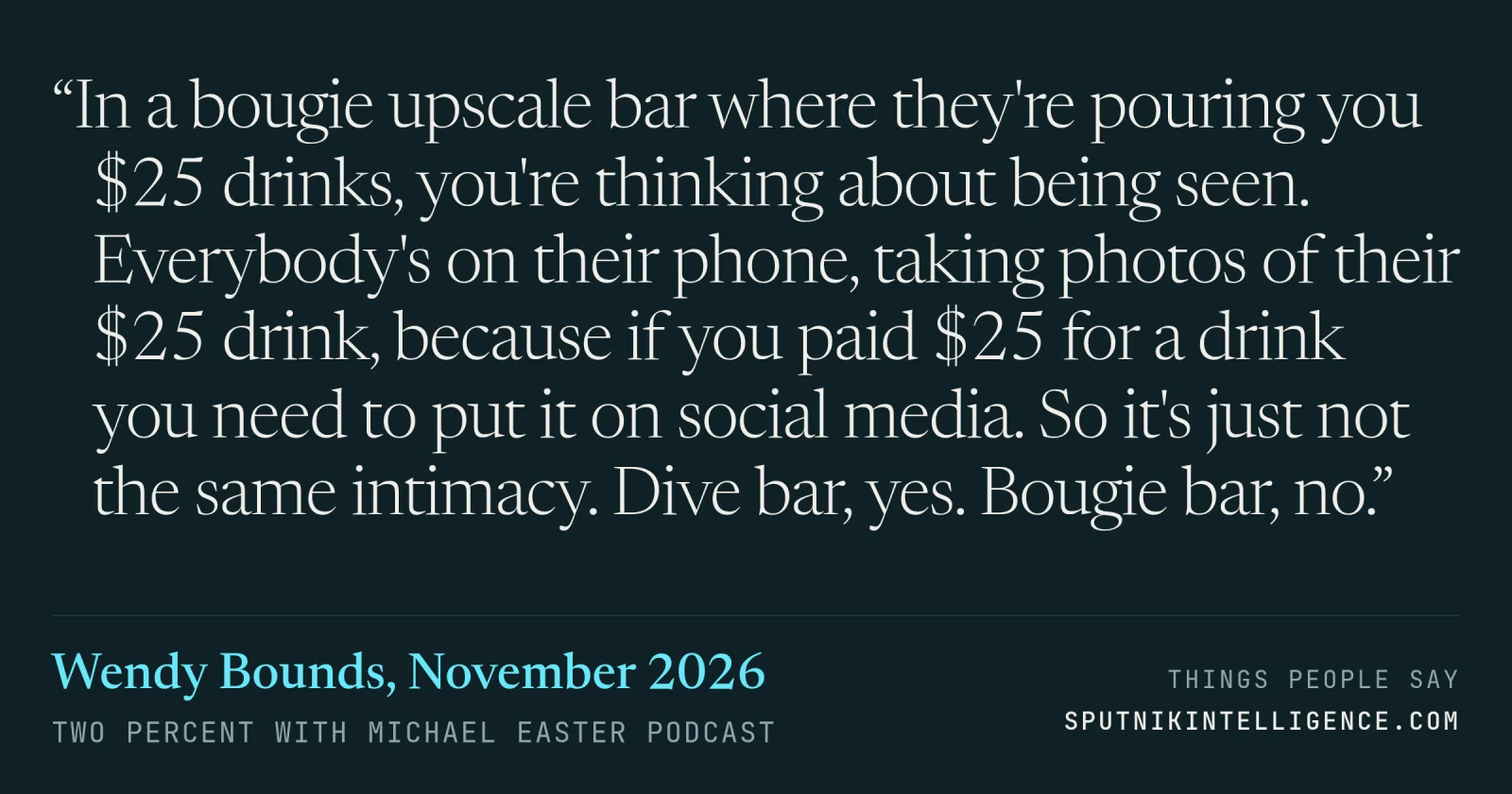
“In a bougie upscale bar where they're pouring you $25 drinks, you're thinking about being seen. Everybody's on their phone, taking photos of their $25 drink, because if you paid $25 for a drink you need to put it on social media. So it's just not the same intimacy. Dive bar, yes. Bougie bar, no.” — Wendy Bounds, Two Percent with Michael Easter

Easter had said dive bars work best as neutral ground. Bounds agrees, after failing to find anything but scene-y, reservation-only places near Grand Central for a work meeting.

Two Percent with Michael Easter · 2026-11-19 Permalink → Listen →
Two Percent with Michael Easter Around 23:34 into the episode
Wendy Bounds

…I think that's why a lot of bars have existed and thrive so much and people come there because it's a relaxation moment. Not to say you can't get there without alcohol, but I think sometimes it's. It is faster for some people, but I'm interested in, I'm particularly interested in what you think.

Michael Easter

…having a cigarette with them. Now, that wouldn't be good for my lungs. At the same time, I'm sure we'd be having a great conversation and it would be an excellent time. And so it really is like when I look back on it, I miss the connection I think that bars can bring people, if that makes sense.

Wendy Bounds

There's a big one of the things you said early on was a dot kind of a divey bar, right? And for me, I couldn't agree more. Now, I don't think this is just unique to you, you and I, but like in a bougie upscale bar where they're pouring you, you know, $25 drinks, I'm not feeling like, I mean, maybe I'm there, but you're thinking about being seen. What are people? People are looking at what everybody's wearing. Everybody's on their phone. They're taking photos of their $25 drink. Because if you paid $25 for a drink, you need to put it on social media. So it's just not, yeah, it's not the same intimacy. I just went to make a, I was trying to make a reservation to have, to meet somebody for work yesterday. I was trying to find a bar near Grand Central in New York where we could go. And I was looking online and all these places where you can make reservations, it was just like these banquettes. And it's like the scene, you have to get the banquet in the middle in the center to be in the middle of the scene. But if you want to have a real conversation, go to the side. And this is, and…

Michael Easter

just got to find some dump that doesn't have a website. Just walk around until you see a place where people are, enough people are smoking outside of it. And there are a range of people. You got kind of like the guys who just got off work, the bankers who were off work, the, you know, et cetera, et…

Wendy Bounds

Yeah, I mean, look, the health stats, I mean, the health data that we are looking at right now, the truth is it shows like no amount of alcohol is really good for you. Okay. So I tend to probably think that's true. Good for you on the levels that we think of like from a physical health standpoint.…

Michael Easter

I think, and I definitely don't think that bars are the only place that this can be found. I pulled some stats and I think there's a lot of places, but I think you do tend to find that most of those places are declining. So to start with bars, 2004, there were 72,000 local bars in the United…

Speaker names come from our own diarization. The position is estimated from where the line sits in the episode.
“I was on the train and one of the conductors came around to take our tickets. Tickets are digital now, so everybody just flashed a barcode and went back down. I looked up and said, good morning, how are you? And the look on his face, it was as if the skies had opened up. I thought, oh my God, this is what it's come to.” — Wendy Bounds, Two Percent with Michael Easter

Bounds is explaining her "look up" idea: that even brief contact with strangers has been lost to phones. Her point is that one ordinary greeting was rare enough to stun the conductor.

Two Percent with Michael Easter · 2026-11-19 Permalink → Listen →
Two Percent with Michael Easter Around 40:24 into the episode
Wendy Bounds

…imagine what my life would have been like had I not been looking up that day. So you mentioned the people earlier who aren't even sort of in the, what did you call it, the middle ground? You said there's the people we're closest to, the people in the middle state. What did you call them? Column

Michael Easter

ties, weak ties. And I made up a new word, middle ties.

Wendy Bounds

Middle ties. I like middle ties. So the weak, even with the weak ties, though, I was on the train maybe like two weeks ago, and one of the conductors was coming around to take our tickets. Tickets, of course, are digital now. So everybody's got their, you know, barcode on their phone to show him. And he was so effusive. He's like, good morning, good morning, and smiles. And most everybody was just like, you know, they flashed it up and then they're back down. And I remember I looked up and I smiled at him and I said, good morning. How are you? And the look on his face that I had looked up and just done this like

Speaker 3

tiny thing of saying good morning and looking at him in the eye and acknowledging and not just like burying my face back down in my, it was as if like the skies had opened up. And I thought, oh my God, like this is what it's come to. We have got to start, even the people who are the weak ties, we…

Wendy Bounds

t-shirt with the rock band and we're missing out. And I do think this social isolation is this, what I, the stats I read you before, it's going to get worse potentially before it gets better, but there's got to be a turn. And part of that turn can be about looking up.

Michael Easter

I agree. And I love that idea of looking up. And I think what's interesting is probably in the past, you just would have looked at the person and made eye contact and said, oh, hey, good morning. Good to see you. Every single person would have done that without effort. And now it's almost like you…

Speaker names come from our own diarization. The position is estimated from where the line sits in the episode.
“Community was not the way we think about building digital communities. Community was about when you get in a room with someone, and you agree and you disagree and you have your grievances, but you have shared rules of behavior where it can only go so far. Those spots are fast disappearing, and have been replaced by digital community. I think we've really lost something when we've lost those places where we gather in person.” — Wendy Bounds, Two Percent with Michael Easter

Easter asked why a small-town pub mattered beyond selling beer and newspapers. Bounds says places that are neither home nor work used to supply information, safety and a place to meet.

Two Percent with Michael Easter · 2026-11-19 Permalink → Listen →
Two Percent with Michael Easter Around 16:50 into the episode
Wendy Bounds

…to me, you want to save it. And I think that was, that was right. Certainly writing a book can't save something that was the families to do, but I wanted to save at least the essence of it. And so, yeah, that's, I spent about a year and a half doing that part-time and working on a book about it.

Michael Easter

…So why, I guess, why was the place like so important? And we'll get into how things are changing now, but like, why was it so important for people, the people who went there? Like, what, what purpose did it serve beyond just, hey, here's a beer, here's where you get your newspaper and your coffee?

Wendy Bounds

Well, it's interesting that you have to ask that question, right? Think about the fact that you're asking me that question. Because at that moment, I mean, in time, these quote third places that we gather, third place not being your place of work, not being your home, whether it was church or a pub or a community center. I mean, these were really still staples of American life and I think world life worldwide. And you needed these places because, again, it's where you got information. It's where you would go to be safe. It's where you would go to convene after moments of import. And it was, you know, talking to each other, the screen epidemic, which you have written about a lot about and I have as well, hadn't sort of taken hold in the way it has now. And so that is what community was. Community was not the way we think about building digital communities. Community was about when you get in a room with someone and agree and you disagree and you have your grievances, but you have shared rules of behavior where it can only go so far. And that is why it mattered. And it wasn't the only spot like that, but those spots are fast disappearing, if not altogether almost gone in some ways and have been replaced by…

Michael Easter

Yeah. So the, so first place, there's three places. First place is home. Second place is work. Everyone still does that. But the third places are what's disappearing. And these are these like spaces that are the church, the bar, the whatever where people tend to hang out. So there's this researcher…

Wendy Bounds

You just, I mean, you just described Guynans in a checklist. I like playful a lot. Regulars, it certainly had, I mean, everything on that list. Playful is very interesting, right? I like that.

Michael Easter

I also, the idea of neutral ground, and you were kind of mentioning how you go in, there'd be people who are kind of more right-leaning and left-leaning. In the book, you talk about an old Vietnam veteran. I think he's more right-leaning. And then there was this lawyer who was just super…

Speaker names come from our own diarization. The position is estimated from where the line sits in the episode.
“We all know the epidemic of digital cowardice. You can be a coward because no one's sitting there in front of you, and you don't have to look their spouse in the face at the grocery store the next day. It's really easy to just shut the computer, drop your comment, your bomb, and go, versus sitting there face to face, and then you just clink beers and you buy them another beer at the end of it.” — Wendy Bounds, Two Percent with Michael Easter

Easter asked about the pub Bounds wrote about, where regulars with opposite politics argued daily and stayed friends. She contrasts that with how people argue online.

Two Percent with Michael Easter · 2026-11-19 Permalink → Listen →
Two Percent with Michael Easter Around 19:32 into the episode
Wendy Bounds

You just, I mean, you just described Guynans in a checklist. I like playful a lot. Regulars, it certainly had, I mean, everything on that list. Playful is very interesting, right? I like that.

Michael Easter

…I think he's more right-leaning. And then there was this lawyer who was just super left-leaning. But these two people would talk. They would give each other shit, go back and forth, but it was good-hearted. Whereas now I think you see politics is a lot more divided. So talk to us about that.

Wendy Bounds

Yeah. I mean, look, they would go at it as about as hard as you can imagine two people would. But like, there was always this sort of softness at the bottom of it, right? So you knew if they were going at it and then one of them walked out and his car like ran into a ditch, the other one was going to go pull him out. I mean, there just was a, there was a bottom to like how far they would ever go with each other. And that bottom was we're neighbors and we're a community and we can agree to disagree on some issues, but uh we have a lot more common in as humans and neighbors than we do otherwise. And so I find that, I mean, that is one of the things we've we've lost quite a bit because look, there's we all know the epidemic of digital cowardice. It is so much easier. I'm sure you sometimes see it in comments, even in your own probably posts on Substack. I mean, there's, I mean, if people can find something to get angry about with your community, think what they can do with politics, right? I mean, people, and you have a, you can be a coward because no one's sitting there in front of you and you don't have to go and look their spouse in line at the grocery store the next day and…

Michael Easter

Yeah. And I think too, when a person becomes the icon in the comments, they're not really a person. And you're not, you're not interacting with them in the same way. You're not going to see their humanity. Not to mention if you're having a conversation with someone at a bar or at church, you're…

Wendy Bounds

I, you know, the, the relationships sort of begin. Began and ended at the door of the pub or in the country of the store. And that's what you're describing. And it's, it's, I think it's important to point out that while there was a pub, alcohol was not the main point here. The conversation was the…

Michael Easter

Tracking your food is a giant pain in the ass. You have to mess around on your phone and do a bunch of math before you can eat. And that takes the joy out of eating. Now, at the same time, I know that if I don't track my food, I'm going to eat enough food to feed a freaking hippopotamus. Then I…

Speaker names come from our own diarization. The position is estimated from where the line sits in the episode.
“We took a poll among 800-plus C-suite members, and nearly a quarter of them said they think daily AI use has diminished moral judgment and the ethics of employees in their department. That's pretty significant when we're this early in.” — Wendy Bounds, Two Percent with Michael Easter

Same answer on AI and the workforce. Bounds cites a survey of executives to back her point that companies are rethinking team models, for example pairing seasoned staff with juniors who need to learn to judge AI output.

Two Percent with Michael Easter · 2026-11-19 Permalink → Listen →
Two Percent with Michael Easter Around 44:26 into the episode
Wendy Bounds

…that. But boy, just the physical act of looking somebody in the eye, smiling, asking them something, it will bring you joy. It will bring them joy. And it may lead you down a path to something you never expected. And I think that's, that's worth the like few seconds it took for you to just look up.

Michael Easter

…of them will probably get the idea that, hey, if workers interact and they get along, they're going to do better. At the same time, they're also dealing with, well, can we offload some of this to AI? Would we be more efficient with AI? How are you seeing companies think about ties between workers?

Wendy Bounds

Yeah. Well, for the past year, year and a half, we were kind of in the phase one, which was the knee-jerk of how much cost cutting can we do, right? How many jobs can AI save? How can we be more efficient? With the most progressive companies, the tide is turning. I think we're into a phase two. And it is interesting. And what I hear more and more is this concern, deep concern about cognitive. Atrophy. The concern about how the next generation of workers is going to learn judgment and learn how to think and be leaders. Because if so much of what they're doing and learning is being outsourced to AI versus human to human interaction and teams, they're not going to get that. Like they won't have the ethics background. They're not going to be able to know how to make good decisions. You know, if you're older, you can look at the output from AI and you can know whether it's good or whether it's not good and make decisions about that. But they can't see it because if you haven't done it or built it, you don't know. And so…

Michael Easter

And so then the face-to-face almost comes in with: we need people who have been in the trenches pre-AI to be working with those just coming into the workforce. And you get some of that human-to-human contact there. And then in turn, those younger generations are learning, okay, here's how I can…

Speaker 3

Yeah, I mean, 100%. We have this, I'll give you this live example

Wendy Bounds

at the Leadership Institute.

Speaker names come from our own diarization. The position is estimated from where the line sits in the episode.
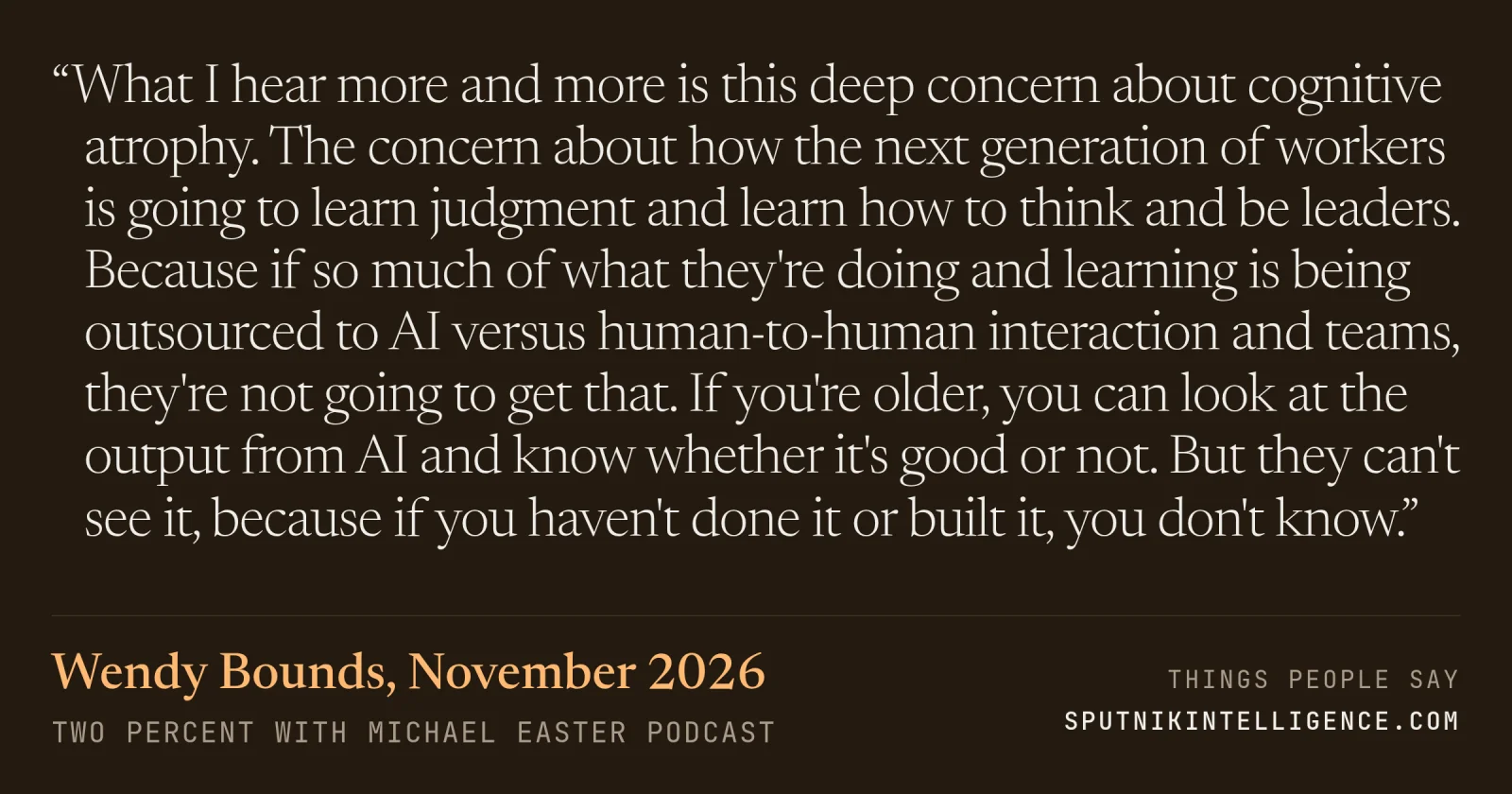
“What I hear more and more is this deep concern about cognitive atrophy. The concern about how the next generation of workers is going to learn judgment and learn how to think and be leaders. Because if so much of what they're doing and learning is being outsourced to AI versus human-to-human interaction and teams, they're not going to get that. If you're older, you can look at the output from AI and know whether it's good or not. But they can't see it, because if you haven't done it or built it, you don't know.” — Wendy Bounds, Two Percent with Michael Easter

Michael Easter asked how the companies she works with are weighing in-person teamwork against offloading work to AI. Bounds says the more advanced firms have moved past pure cost-cutting, and their worry now is how junior staff will learn judgment.

Two Percent with Michael Easter · 2026-11-19 Permalink → Listen →
Two Percent with Michael Easter Around 44:26 into the episode
Wendy Bounds

…that. But boy, just the physical act of looking somebody in the eye, smiling, asking them something, it will bring you joy. It will bring them joy. And it may lead you down a path to something you never expected. And I think that's, that's worth the like few seconds it took for you to just look up.

Michael Easter

…of them will probably get the idea that, hey, if workers interact and they get along, they're going to do better. At the same time, they're also dealing with, well, can we offload some of this to AI? Would we be more efficient with AI? How are you seeing companies think about ties between workers?

Wendy Bounds

Yeah. Well, for the past year, year and a half, we were kind of in the phase one, which was the knee-jerk of how much cost cutting can we do, right? How many jobs can AI save? How can we be more efficient? With the most progressive companies, the tide is turning. I think we're into a phase two. And it is interesting. And what I hear more and more is this concern, deep concern about cognitive. Atrophy. The concern about how the next generation of workers is going to learn judgment and learn how to think and be leaders. Because if so much of what they're doing and learning is being outsourced to AI versus human to human interaction and teams, they're not going to get that. Like they won't have the ethics background. They're not going to be able to know how to make good decisions. You know, if you're older, you can look at the output from AI and you can know whether it's good or whether it's not good and make decisions about that. But they can't see it because if you haven't done it or built it, you don't know. And so chief people officers in particular, along with CEOs, are thinking, what's going to be the next model of team? Is it not going to be team, but it might be a master apprentice model where you have people who are more seasoned in the workforce taking some human apprentices under their…

Michael Easter

And so then the face-to-face almost comes in with: we need people who have been in the trenches pre-AI to be working with those just coming into the workforce. And you get some of that human-to-human contact there. And then in turn, those younger generations are learning, okay, here's how I can…

Speaker 3

Yeah, I mean, 100%. We have this, I'll give you this live example

Wendy Bounds

at the Leadership Institute.

Speaker names come from our own diarization. The position is estimated from where the line sits in the episode.

Collections They Appear In