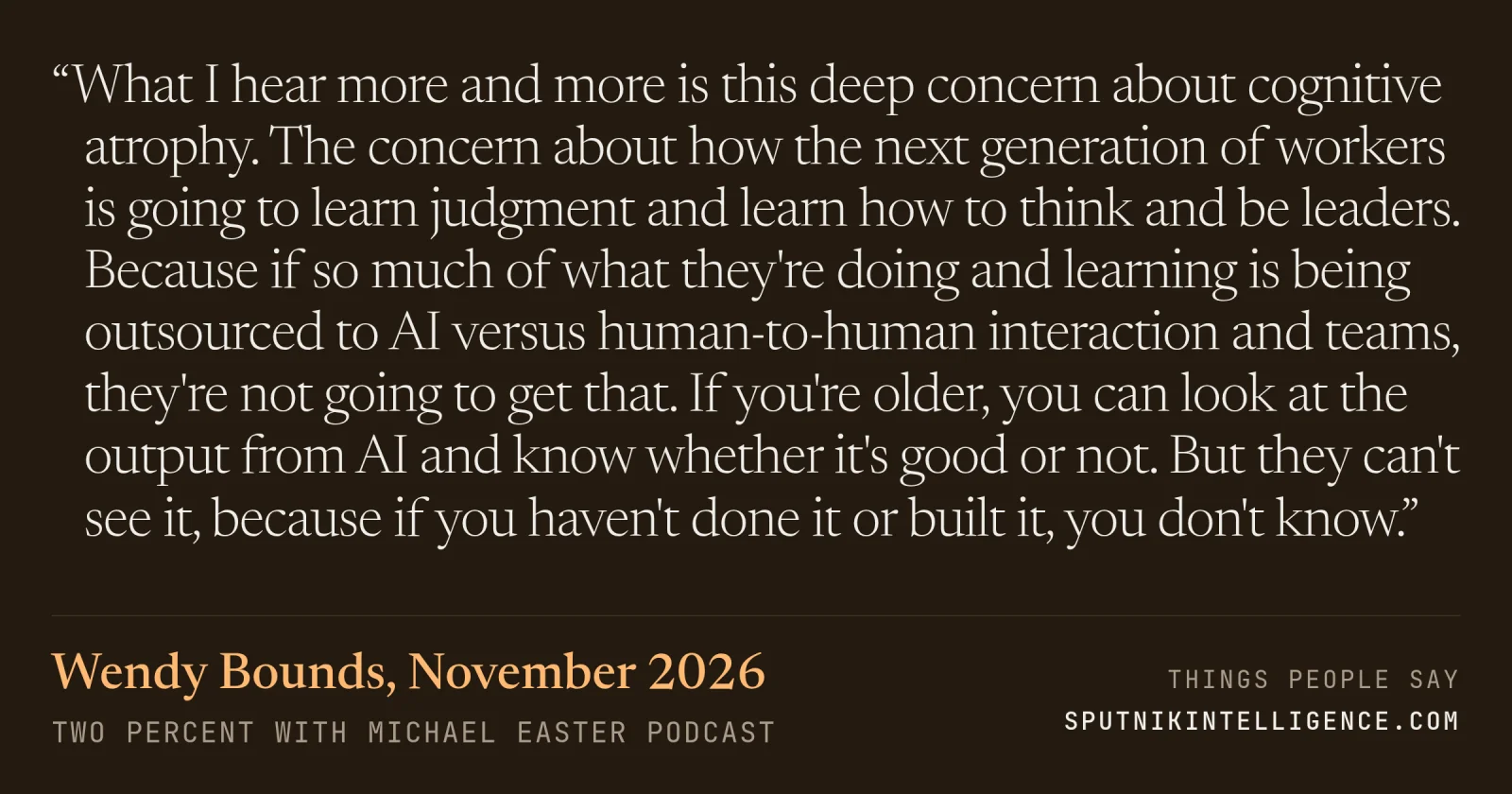
“What I hear more and more is this deep concern about cognitive atrophy. The concern about how the next generation of workers is going to learn judgment and learn how to think and be leaders. Because if so much of what they're doing and learning is being outsourced to AI versus human-to-human interaction and teams, they're not going to get that. If you're older, you can look at the output from AI and know whether it's good or not. But they can't see it, because if you haven't done it or built it, you don't know.”
Two Percent with Michael Easter · Health & Longevity · November 2026
Context
Michael Easter asked how the companies she works with are weighing in-person teamwork against offloading work to AI. Bounds says the more advanced firms have moved past pure cost-cutting, and their worry now is how junior staff will learn judgment.
Transcript
…that. But boy, just the physical act of looking somebody in the eye, smiling, asking them something, it will bring you joy. It will bring them joy. And it may lead you down a path to something you never expected. And I think that's, that's worth the like few seconds it took for you to just look up.
…of them will probably get the idea that, hey, if workers interact and they get along, they're going to do better. At the same time, they're also dealing with, well, can we offload some of this to AI? Would we be more efficient with AI? How are you seeing companies think about ties between workers?
Yeah. Well, for the past year, year and a half, we were kind of in the phase one, which was the knee-jerk of how much cost cutting can we do, right? How many jobs can AI save? How can we be more efficient? With the most progressive companies, the tide is turning. I think we're into a phase two. And it is interesting. And what I hear more and more is this concern, deep concern about cognitive. Atrophy. The concern about how the next generation of workers is going to learn judgment and learn how to think and be leaders. Because if so much of what they're doing and learning is being outsourced to AI versus human to human interaction and teams, they're not going to get that. Like they won't have the ethics background. They're not going to be able to know how to make good decisions. You know, if you're older, you can look at the output from AI and you can know whether it's good or whether it's not good and make decisions about that. But they can't see it because if you haven't done it or built it, you don't know. And so chief people officers in particular, along with CEOs, are thinking, what's going to be the next model of team? Is it not going to be team, but it might be a master apprentice model where you have people who are more seasoned in the workforce taking some human apprentices under their…
And so then the face-to-face almost comes in with: we need people who have been in the trenches pre-AI to be working with those just coming into the workforce. And you get some of that human-to-human contact there. And then in turn, those younger generations are learning, okay, here's how I can…
Yeah, I mean, 100%. We have this, I'll give you this live example
at the Leadership Institute.
More from Two Percent with Michael Easter