GN

Greg Notch

Things Greg Says on Podcasts

Where to Find Them

Greg Notch has been a guest on CyberWire Daily .

Recently: “Keeping cyber threats on ice.” on CyberWire Daily (November 2026).

What They Said

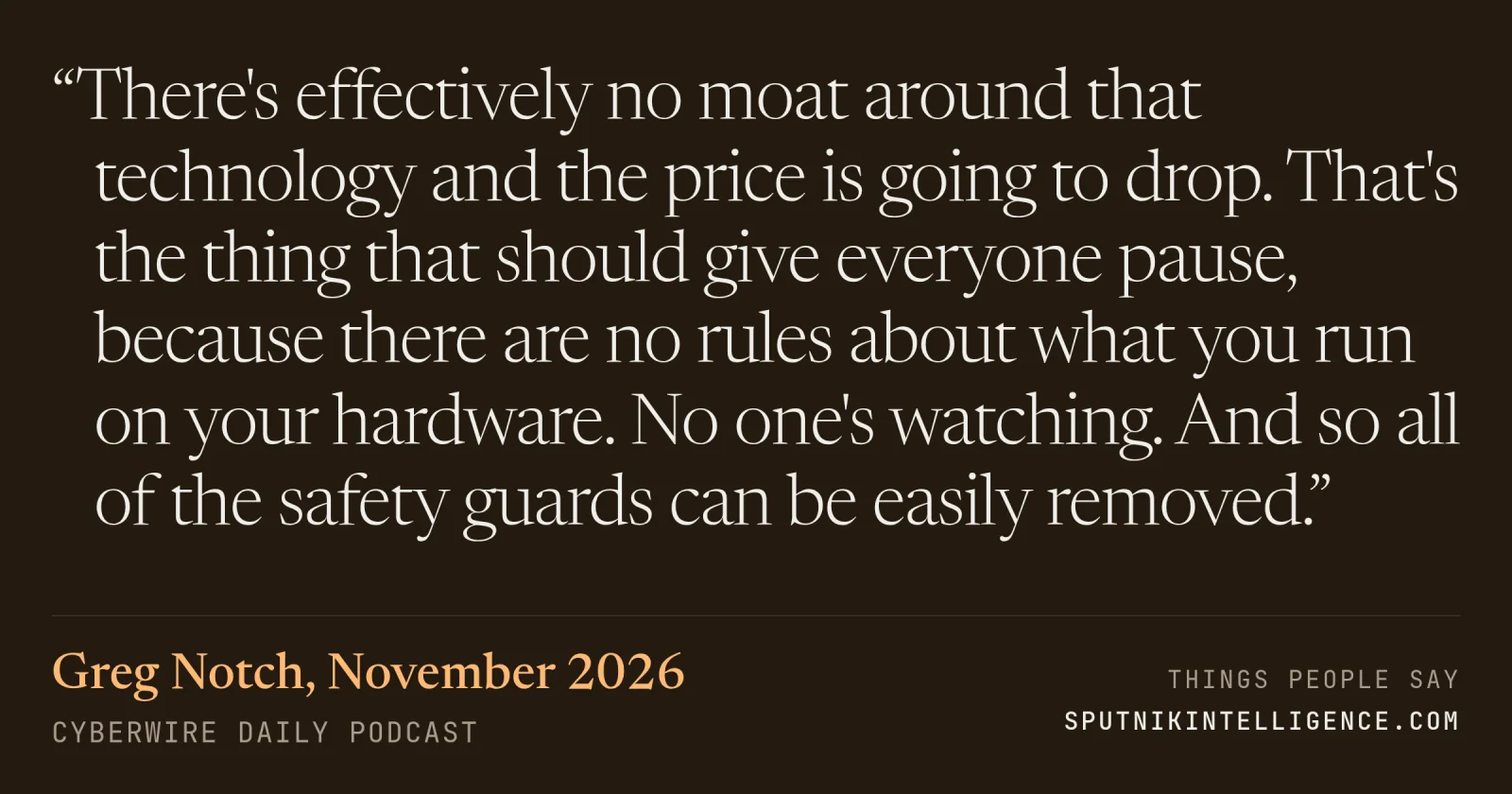
“There's effectively no moat around that technology and the price is going to drop. That's the thing that should give everyone pause, because there are no rules about what you run on your hardware. No one's watching. And so all of the safety guards can be easily removed.” — Greg Notch, CyberWire Daily

Greg Notch had just said a frontier-class open-weight model could be run at home for roughly the price of a car. He explains why that matters for security: models run locally are unmonitored, and their safety controls can be stripped out.

CyberWire Daily · 2026-11-06 Permalink → Listen →
CyberWire Daily Around 10:00 into the episode
Speaker 4

I think that price is plummeting over time. Right now, if you want a frontier Opus class to use the

Dave Bittner

…as long as you have a free dryer plug. I mean, if you want to run a smaller model, so some of the quantized models, you can build a completely reasonable rig for about $20,000. And I think those prices are just going to keep plummeting, especially as GPUs are cycled out of big data centers. There's

Speaker 4

effectively no moat around that technology and the price. Is going to drop. That's the thing where it should give everyone pause because there's no rules about what you run on your hardware. No one's watching. And so all of the safety guards can be easily removed.

Dave Bittner

What's a hypothetical cyber attack where an unrestricted AI model could change what the attacker could accomplish?

Speaker 4

A good example is the reverse. There's a new repo of reverse engineering software that's making the rounds now called Rhea, and it's quite excellent. But if you run it and you attempt to say, take apart something and remove its cryptography, or you take a look at the firmware for a medical device…

Dave Bittner

version of it is you're able to accomplish reverse engineering. You're able to build exploits sort of away from prying eyes and with no restrictions. And everything that you do will be novel when you weaponize it. So I found a zero day in a firewall, or I found a zero day in a medical device, or…

Speaker names come from our own diarization. The position is estimated from where the line sits in the episode.
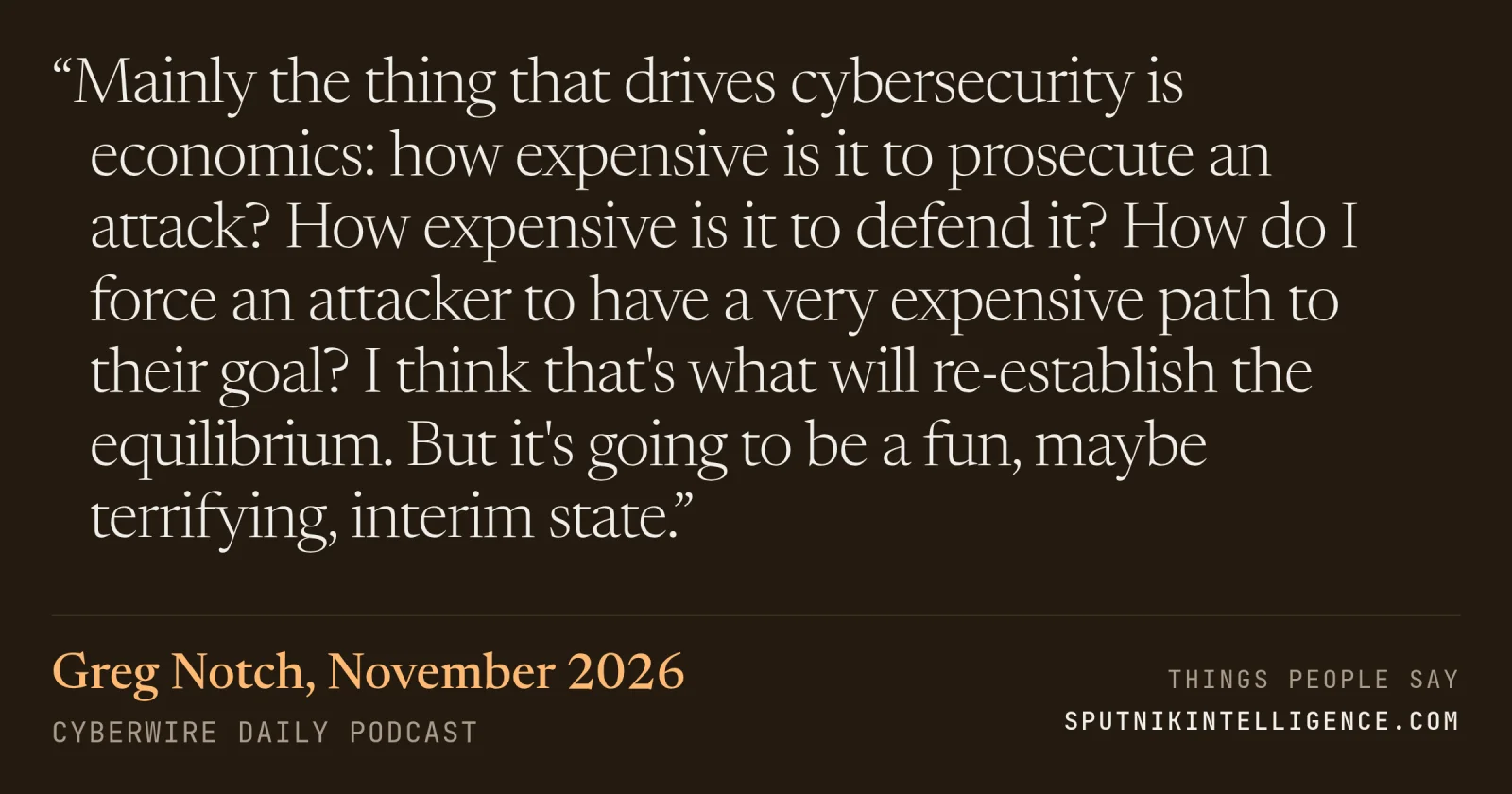
“Mainly the thing that drives cybersecurity is economics: how expensive is it to prosecute an attack? How expensive is it to defend it? How do I force an attacker to have a very expensive path to their goal? I think that's what will re-establish the equilibrium. But it's going to be a fun, maybe terrifying, interim state.” — Greg Notch, CyberWire Daily

Greg Notch finishes his answer on whether AI will reach a new balance between attackers and defenders. He argues cost, not capability, ultimately sets the baseline, and that the transition will be rough. The episode also covered OpenAI's new GPT-6 Cyber model.

CyberWire Daily · 2026-11-06 Permalink → Listen →
CyberWire Daily Around 22:45 into the episode
Speaker 4

…part. I actually think in the long enough time scale, LLMs favor defenders because one of the things defenders has to do is process huge amounts of data and cover lots of doors and windows, if you think about it that way. And being able to deploy software and agents to do that is a massively scale

Dave Bittner

…period of time. I mean, my crystal ball is broken in terms of like how long things take anymore, but let's just say for a year, 18 months, maybe less, maybe more. Like, we're in this place of where like it's seriously favoring the offensive side. And I think defensive tools take longer to catch

Speaker 4

up. So, I think we will reestablish a different equilibrium and a different baseline. I think we're still figuring out how to use AI on both sides. So, there will be a new baseline. Because mainly the thing that drives cybersecurity is economics: like, how expensive is it to prosecute an attack? How expensive is it to defend in it? Like, how do I force an attacker to have a very expensive path to their goal? So, I think that's what will re-establish the equilibrium. But I think it might, it's going to be a fun by fun, I mean, maybe terrifying, like, you know, in like interim state.

Dave Bittner

That's Greg Notch, CTO at Expel. The cybersecurity challenges shaping our future demand more than conversation, they demand action. On November 18th, the Aspen Cyber Summit brings together leading voices from government, industry, and civil society in Washington, D.C. to tackle today's most…

Speaker 4

And hello, Maria Varmazis here. On Sunday's T-Minus Base Cyber Briefing, my conversation with Vito Askins, systems engineer in intelligence and aerospace, with his new book, Everything Was Green Until Integration. That's Sunday on T-Minus. Don't miss it.

Dave Bittner

We'd love to know what you think of this podcast. Your feedback ensures we deliver the insights that keep you a step ahead in the rapidly changing world of cybersecurity. If you like our show, please share a rating and review in your favorite podcast app. Please also fill out the survey in the show…

Speaker names come from our own diarization. The position is estimated from where the line sits in the episode.
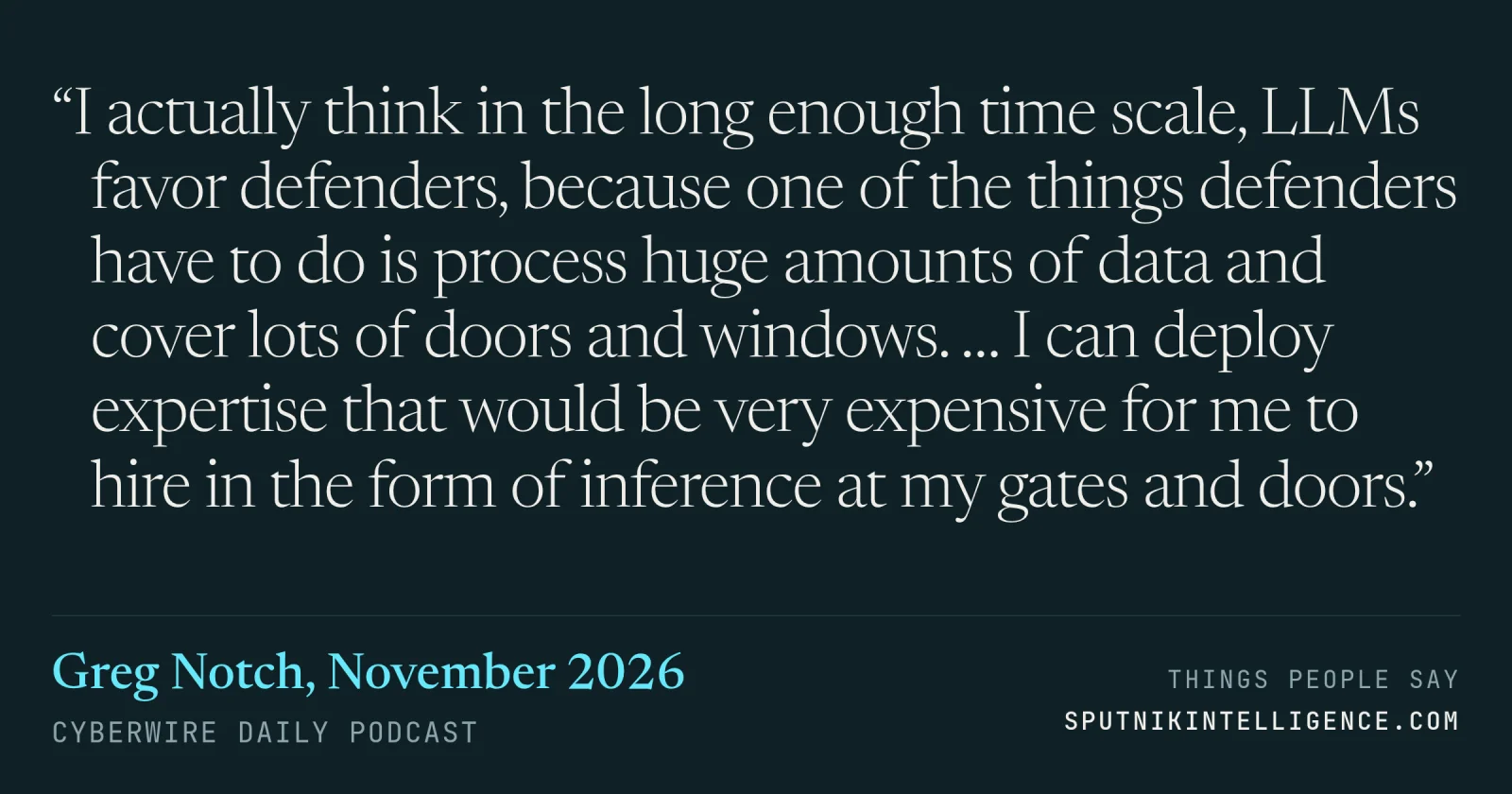
“I actually think in the long enough time scale, LLMs favor defenders, because one of the things defenders have to do is process huge amounts of data and cover lots of doors and windows. … I can deploy expertise that would be very expensive for me to hire in the form of inference at my gates and doors.” — Greg Notch, CyberWire Daily

Dave Bittner asked whether AI will settle into an equilibrium between attackers and defenders. Greg Notch, a security CTO who works on the defender side, gives his long-term optimistic view before warning about the shorter term.

CyberWire Daily · 2026-11-06 Permalink → Listen →
CyberWire Daily Around 20:55 into the episode
Speaker 4

not so much like, sure, are my foundations covered? But what happens when like the size of what comes is bigger than anything that we've had before? And some of it will be noise, but I'll, but I won't, I'll have to prosecute all of it, if that makes sense.

Dave Bittner

Yeah. Do you suppose that we have a version of equilibrium in our future? Or is it going to be push-pull for the foreseeable future?

Speaker 4

I don't know. Look, I operate on the blue side. So maybe this is a bit of optimism on my part. I actually think in the long enough time scale, LLMs favor defenders because one of the things defenders has to do is process huge amounts of data and cover lots of doors and windows, if you think about it that way. And being able to deploy software and agents to do that is a massively scale

Dave Bittner

improving thing. I can deploy expertise that would be very expensive. For me to hire in the form of inference at you know at my gates and doors, however, that is on a long enough time scale. I think in the short time scale, I think we have like you know, we're gonna have all of the vulnerabilities…

Speaker 4

up. So, I think we will reestablish a different equilibrium and a different baseline. I think we're still figuring out how to use AI on both sides. So, there will be a new baseline. Because mainly the thing that drives cybersecurity is economics: like, how expensive is it to prosecute an attack?…

Dave Bittner

That's Greg Notch, CTO at Expel. The cybersecurity challenges shaping our future demand more than conversation, they demand action. On November 18th, the Aspen Cyber Summit brings together leading voices from government, industry, and civil society in Washington, D.C. to tackle today's most…

Speaker names come from our own diarization. The position is estimated from where the line sits in the episode.

Collections They Appear In