Build a Better Agency PodcastAround 39:56 into the episode
Niall Cotter
Right.
Drew McLellan
If an agency is going to sell in three to five years, what do buyers find in the books that hurts the deal?
Niall Cotter
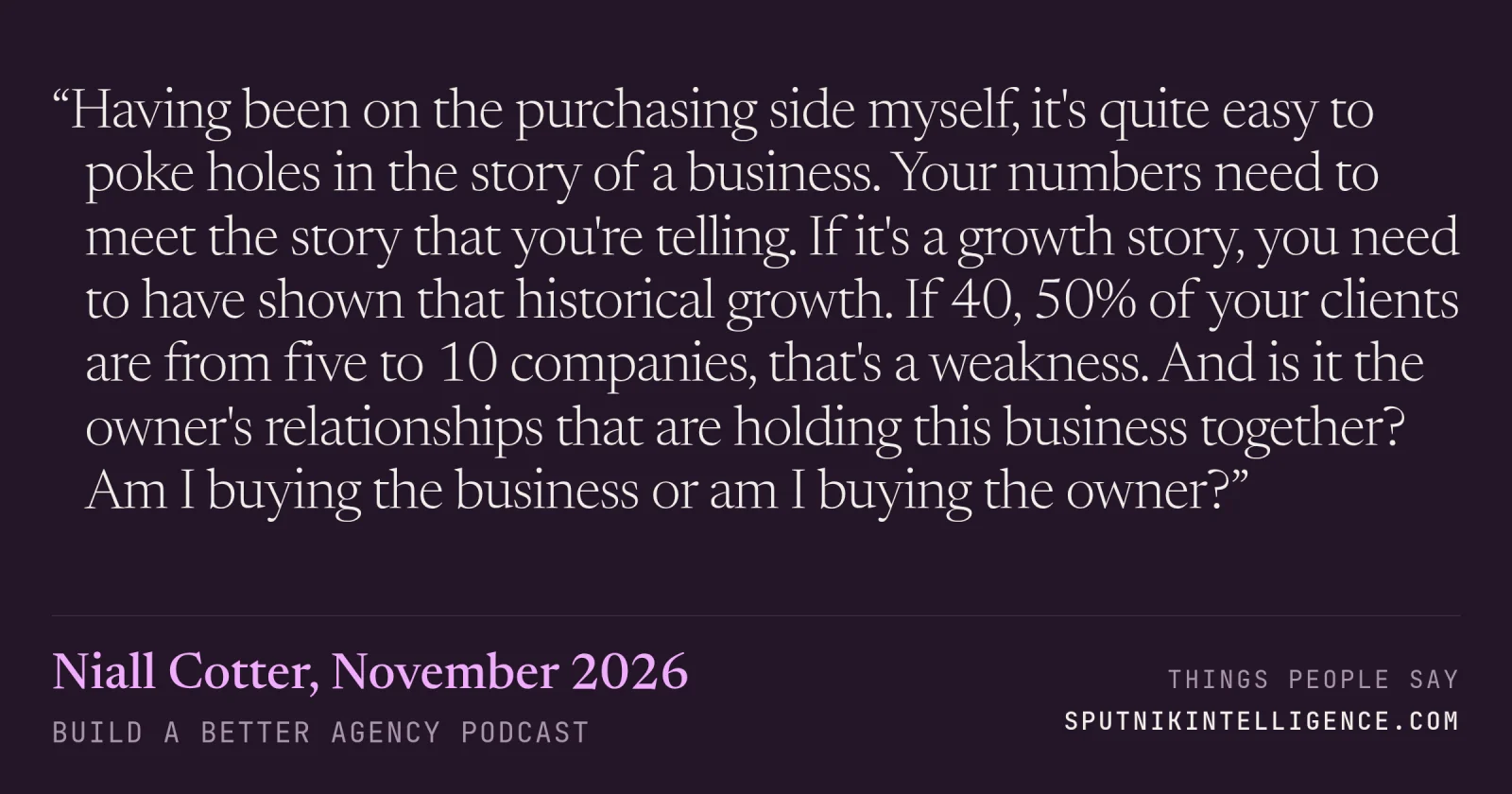
Oh, well, having been on the purchasing side myself, I can tell you that sometimes it's quite easy to poke holes in the story of a business. Your numbers need to meet the story that you're telling. And if it's a growth story, you need to have shown that kind of historical growth or at least hitting the metrics that provide evidence that you're going to grow in future. However, there's other things. So if there's a high concentration of high-value clients, so for example, if 40, 50% of your clients are from five to 10 companies, then that's a weakness that needs to be to be ironed out. The other component is, is it the owner's relationships that are holding this business together? Or has it been truly passed on to the business itself? So am I buying the business or am I buying the owner?
Drew McLellan
Right. And if I'm buying the owner, he or she's got to stick around, which at that point they probably don't want to do, right?
Niall Cotter
Sure. But again, all I hear is discount, discount, discount, right? I mean, it's it. And if you're not collecting, you know, your receivables, I wrote a recent post where I say it'll hit you twice. Not only are you keeping working capital in the business that you would, you know, would preferably…
Drew McLellan
Right.
Speaker names come from our own diarization. The position is estimated from where the line sits in the episode.
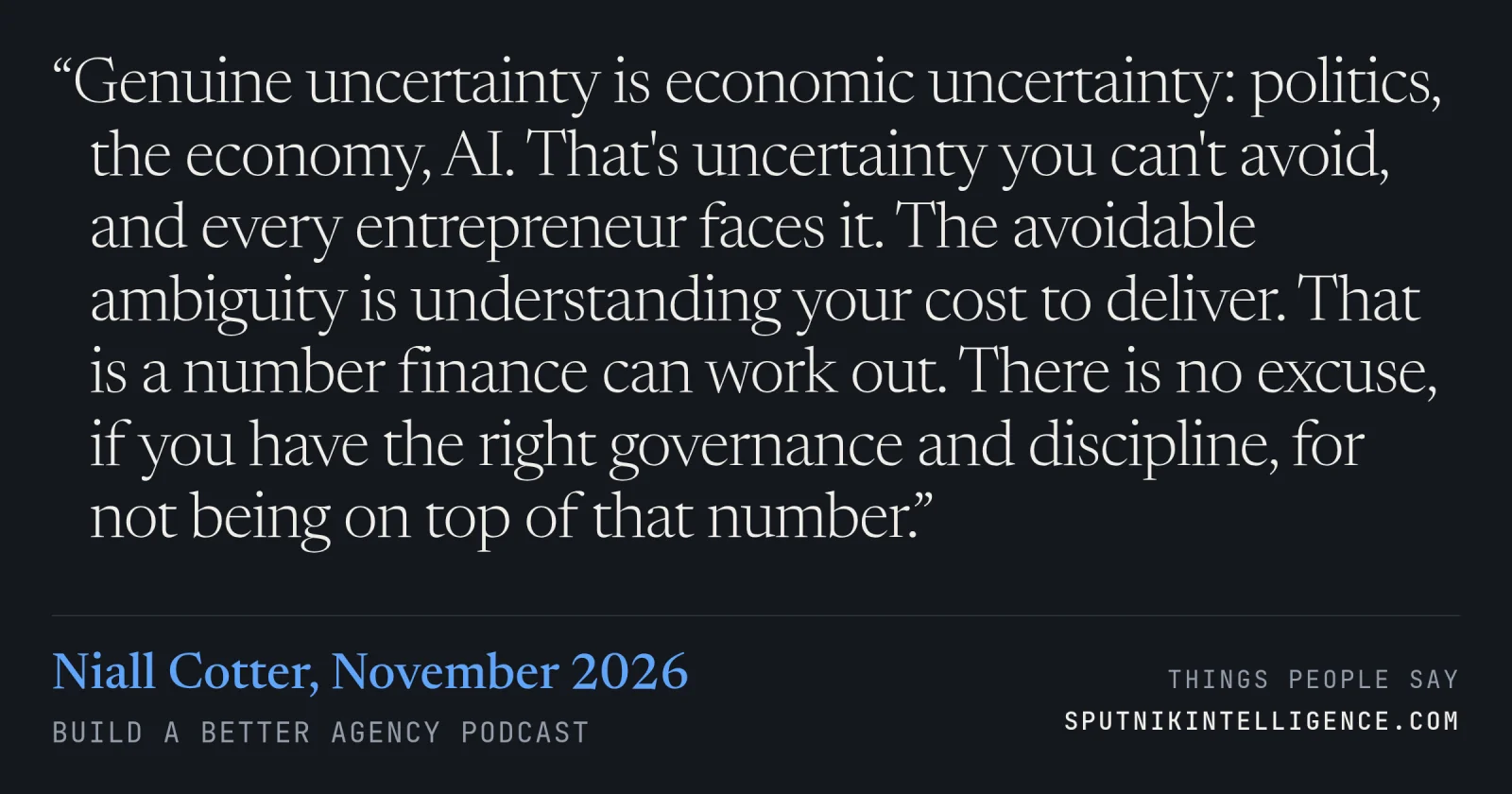
Asked to explain for a non-finance owner the difference between avoidable ambiguity and genuine uncertainty, he separates external risk from internal costs that can be known.
Build a Better Agency PodcastAround 13:18 into the episode
Niall Cotter
…at it constantly as to how it's impacting your bottom line, is your margin higher temporarily? Do you know exactly how many hours are being spent? Are you doing revisions? If you're not on top of that, then you will get bad data. And again, there's nothing finance can really do at that point.
Drew McLellan
…which of course I am, but explain it to me like I'm an agency owner that does not have a finance background. I'm a, I'm a, I actually am a writer by trade. So explain it to me like you know, I don't really get finance. What's the difference between avoidable ambiguity and genuine uncertainty?
Niall Cotter
So genuine uncertainty is economic uncertainty. You know, when you grow your business, you don't know there's so many things that can happen, either, you know, politically, economy-wise, AI, the AI impact, AI impact, there are so many things that are out of your control. And that's what I mean that that is, you know, that's uncertainty that you can't avoid. Every entrepreneur faces that. The avoidable ambiguity side of things is understanding your cost to deliver. That is a number finance can work out. There is no excuse if you have the right governance and discipline for not being on top of that number and ensuring that your decisions are consistent with that number or knowing when something has to be done. That's what I mean by unavoidable ambiguity.
Drew McLellan
So why don't we all know that number? Like if that's the, if that's the critical number to know, what gets in the way of us knowing it?
Niall Cotter
Typically growth, because you get complexity. When you move to 100, you know, let's say 100 person marketing firm, you have different layers underneath that. You have managers managing managers, right? You have department budgets. You've got targets that are, you're being told by other folks, you…
Drew McLellan
So you're saying that a small agency of less than 10 people, the founder knows all the numbers they need to know.
Speaker names come from our own diarization. The position is estimated from where the line sits in the episode.
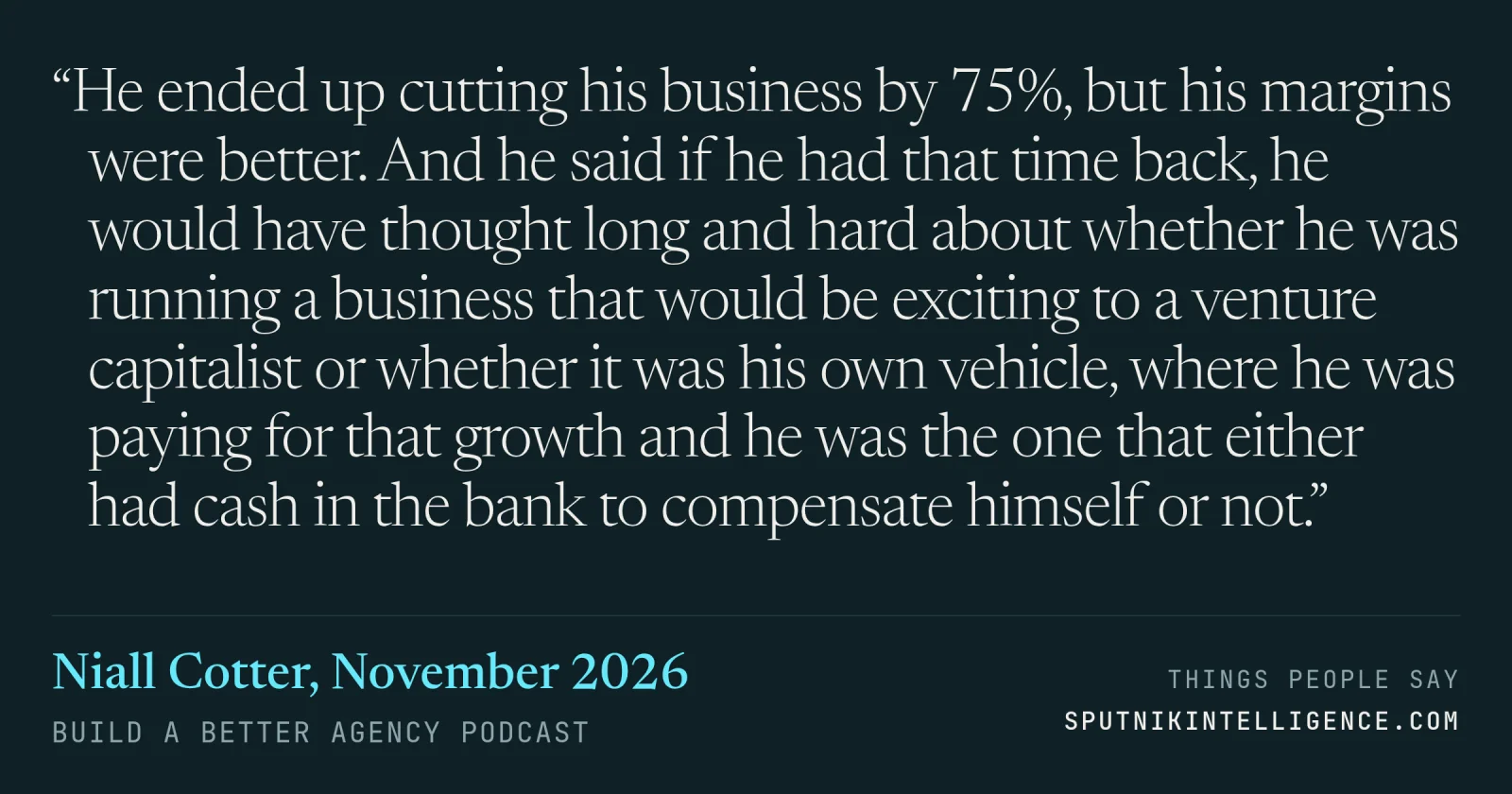
He describes an agency owner who spent ten years growing while profit slid to break-even. When revenue fell, the owner repriced, dropped clients and shrank the business.
Build a Better Agency PodcastAround 07:48 into the episode
Niall Cotter
…across all of his clients and renegotiating his margins. And to his surprise, he found that there was actually more room than he expected. And the other decision that he made was that if Brian, if clients didn't accept that price, then it wasn't really businesses that he wanted in the first place.
Drew McLellan
Right.
Niall Cotter
So he ended up cutting his business by 75%, but his margins were better. And he said if he had that time back, he would have thought long and hard about whether he was running, you know, kind of a business that would be exciting to a venture capitalist or whether it was his own vehicle where he was paying for that growth and he was paying for that margin. And he was the one at the end of the day that either had cash in the bank to compensate himself or not.
Drew McLellan
Right. Right. So back in the 90s, you were an accountant at a marketing communications firm in Toronto. What did you learn back then about how agencies make and lose money that you still are seeing today?
Niall Cotter
So my background is professional services and consulting. My exposure to the agency world was as a CFO of a strategic communications company that was owned by MTC Partners. I don't know if you remember MBC. I'm sure a lot of people will know that company. So I had a lot of exposure to the CFOs…
Drew McLellan
What mistake do you see founders make in agencies that a big company would never make?
Speaker names come from our own diarization. The position is estimated from where the line sits in the episode.
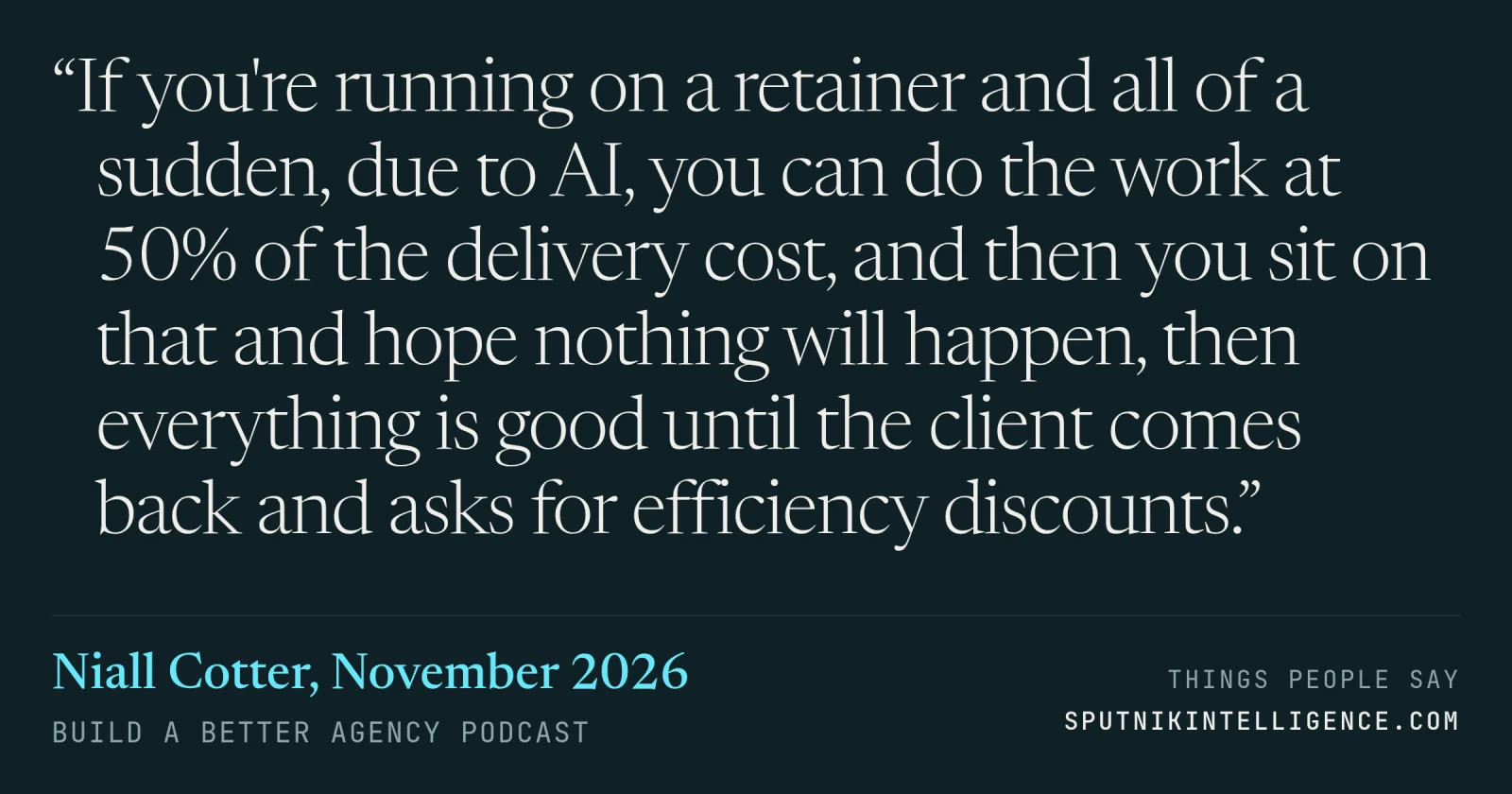
On why agencies need to know profitability by client and service line, he gives an example of how AI-driven savings on a retainer can evaporate if the agency doesn't track them.
Build a Better Agency PodcastAround 17:54 into the episode
Niall Cotter
Right.
Drew McLellan
…understand is profitability by client and by service line. So if you anecdotally think that you are losing your shirt every time you take a web project, and yet you keep taking web projects because it's cash flow and you don't really look at the numbers, it's pretty hard to run your business well.
Niall Cotter
Right, right. Or if you're running on a retainer and all of a sudden, due to AI, you can do the work at 50% of the delivery cost, and then you sit on that and hope nothing will happen, then everything is good until the client comes back and asks for efficiency discounts.
Drew McLellan
Or on the flip side, you are running a retainer and you're not tracking your people's time because you don't price out every project. But every month you've given them 20 or 30 or 40 extra hours and you think it's profitable. Again, without the raw data, I don't know how you run your business well…
Niall Cotter
Sure. Well, here's some of the, maybe for your listeners, here are the kind of, there's three ratios that I kind of always recommend that agency owners look at. The first one is payroll as a share of AGI.
Drew McLellan
Right.
Speaker names come from our own diarization. The position is estimated from where the line sits in the episode.
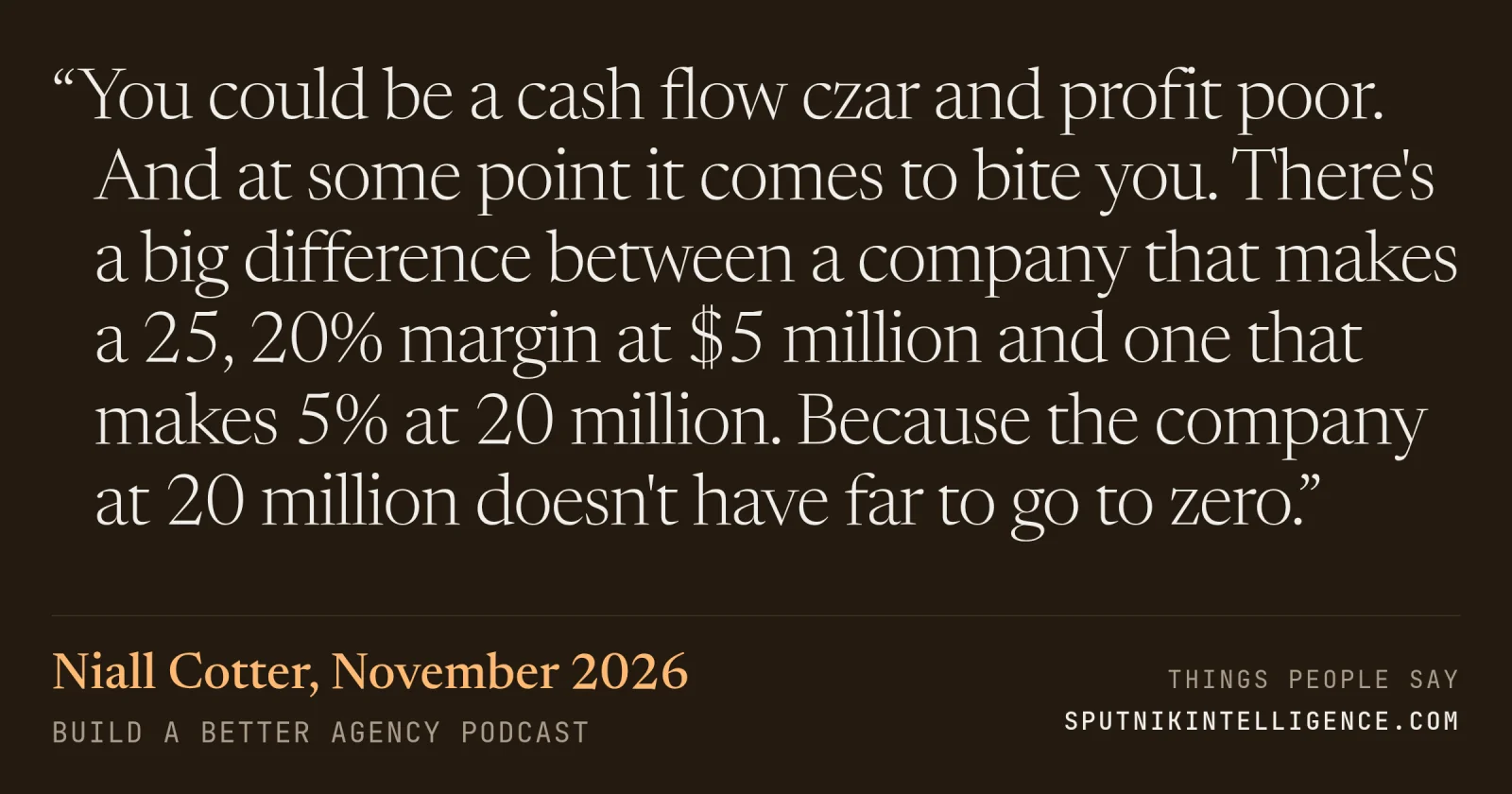
They were discussing agencies that bill retainers in advance, so the bank balance looks healthy while margins are thin. He explains why a thin margin on a big revenue base is fragile.
Build a Better Agency PodcastAround 23:24 into the episode
Niall Cotter
Yes.
Drew McLellan
Yeah.
Niall Cotter
Yeah. You could be a cash flow czar and profit poor. And at some point it comes to bite you because I'll go back to my earlier example. So there's a big difference between a company that makes a 25, 20% margin at $5 million and one that makes 5% at 20 million. Because the company at 20 million doesn't have far to go to zero.
Drew McLellan
Right.
Niall Cotter
Right. Five goes to four, goes to three, goes to two, goes to one. If you're at a 20% margin, you can go to 15%. And that's kind of the caveat that I'm kind of always preaching to. Make sure that you keep an eye on that compensation over AGI number at all times. And if you get to a point where you…
Drew McLellan
Yeah. I want to talk about that, figuring out profitability by. Client and service line. Let's take a quick break and then let's come back and talk about sort of the right way to do that and then the poor man's way of doing it. So let's take a quick break and we'll come back and dig into that. Hey…
Speaker names come from our own diarization. The position is estimated from where the line sits in the episode.
The host asked a fractional CFO why growing service firms struggle with their finances if reporting isn't the problem. His answer: polished financial models rest on untested assumptions.
Build a Better Agency PodcastAround 03:13 into the episode
Niall Cotter
…to their own numbers and I fix that. Before this, I spent 17 years at SCB Canada in controllership and financial planning and analysis positions, then nearly nine years as a full-time CFO, most of it in professional services. So I've sat at the seat where numbers have to answer owners' questions.
Drew McLellan
Beautiful. So I know one of the things that you believe is that most service firms, particularly growing service firms, it's not that they don't have enough reports or dashboards. It's not a reporting problem. So what do you think the problem is?
Niall Cotter
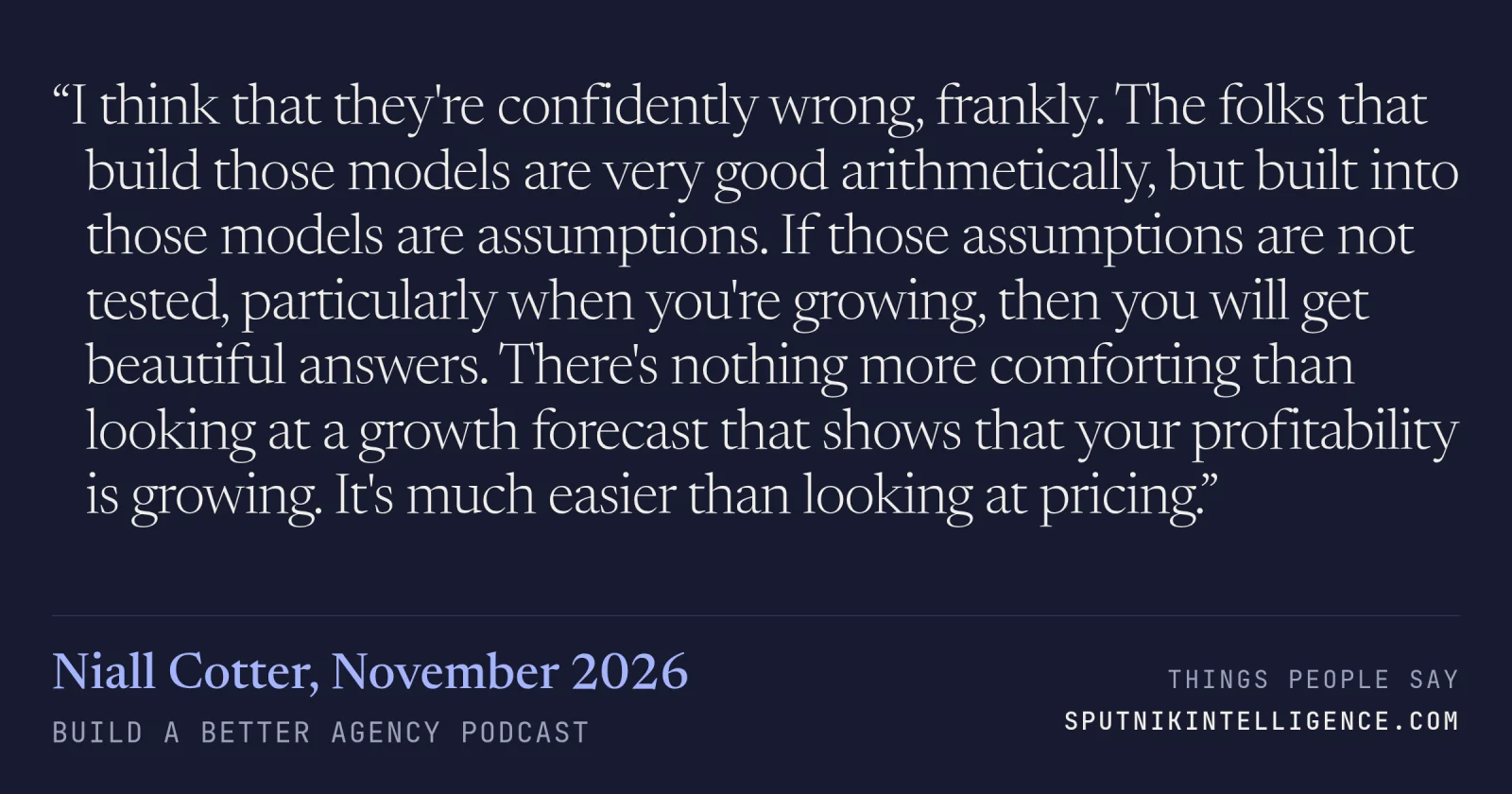
I think that they're confidently wrong, frankly. So the folks that build those models, you know, and these are my finance folks, they're very good arithmetically, but built into those models are assumptions. And if those assumptions are not tested, particularly when you're growing, then unfortunately, you will get beautiful answers. And there's nothing more comforting than looking at a growth forecast that shows that your profitability is growing. It's much easier than looking at pricing.
Drew McLellan
Right. Right. So give me an example of when you have been brought in and a report was beautiful, but as you said, confidently wrong.
Niall Cotter
Well, I can actually reach back to my SCP days. And just to be clear, although SCP is a big company, it was made up of multiple business units with VPs in charge of between 25 and 100 employees. So one example was where we were bringing on average about 200 foreign consultants, mostly from India…
Drew McLellan
them. So as you know, everybody listening to this show works at an agency or owns an agency. So take me back into an agency when you saw this problem. What was the owner asking? And what were the numbers saying back that would have led them either to not making a decision or making a wrong decision?
Speaker names come from our own diarization. The position is estimated from where the line sits in the episode.