Mishkin, a former Fed governor, was asked what characterised Alan Greenspan's cryptic style of central banking. He grants that Greenspan was a maestro and that it may have worked for him, then makes the case that this is exactly the wrong thing to design around. The formulation is his argument for why transparency rules matter more than the quality of whoever currently holds the job.
…central banks to do is to be transparent about their reaction process reaction function because it helps actually stabilize the markets. I don't know where he's going to come out on this. What worries me a little bit is that he talks as if he wants to go back to what was true under Alan Greenspan.
For those who weren't around at that time, what characterized Alan Greenspan? I mean, like cryptic communication, sort of, just trust me, I'm the expert. I know how the Fed should react.
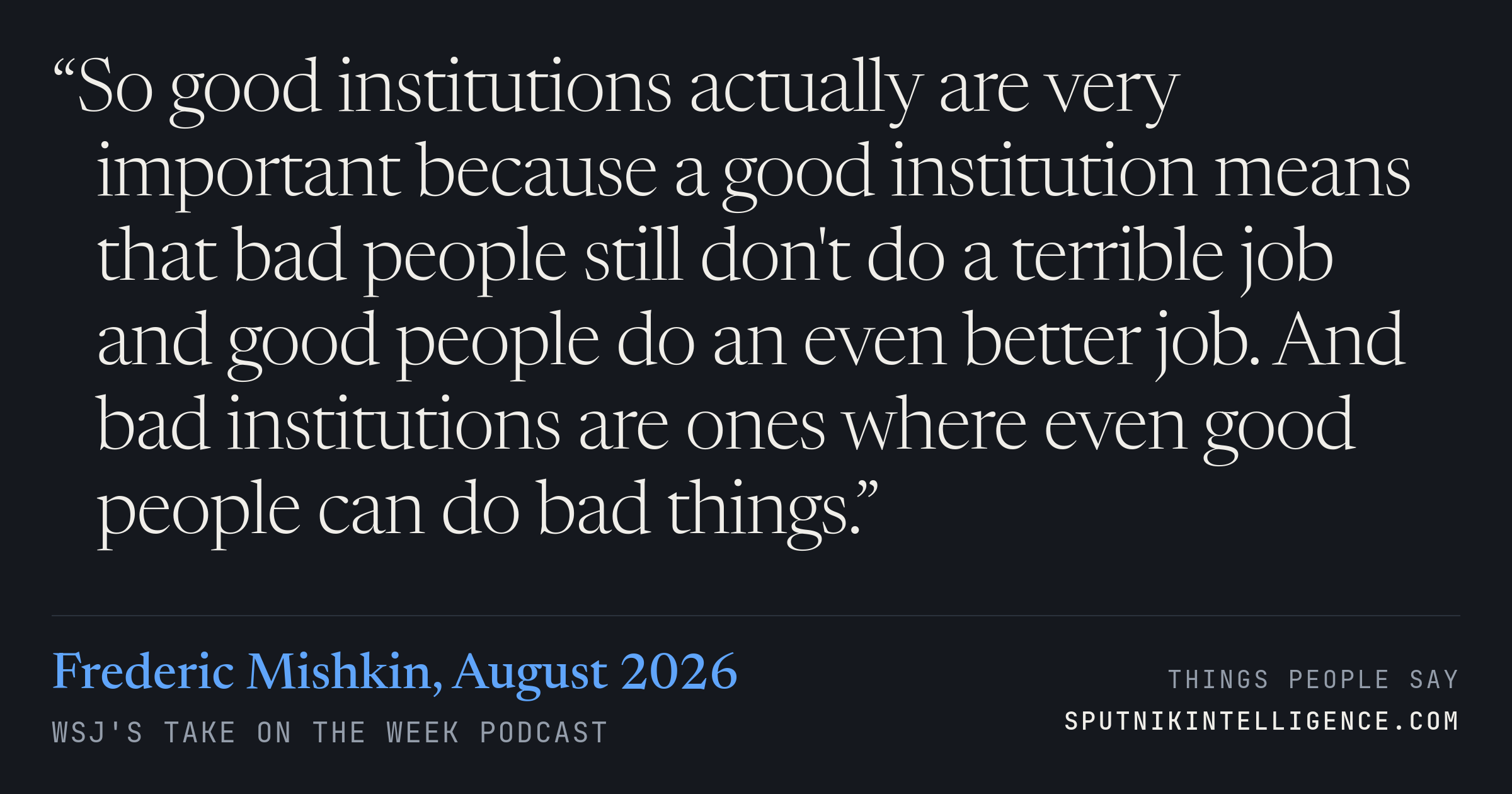
He was very opposed to transparency. He liked the old-style central banking. Greenspan was a master. He was a maestro. He basically felt that if he didn't have people looking over his shoulder, it was going to be easier for him and he'd do better. And in fact, in my research, particularly with Ben Bernanke, we talked a lot about why that was not a great idea. It might work under Greenspan, but you actually want to have good institutions. So good institutions actually are very important because a good institution means that bad people still don't do a terrible job and good people do an even better job. And bad institutions are ones where even good people can do bad things. This is super important now what's happening in the United States. There's an issue about how our institutions are going to evolve after the Trump presidency. It's super important in terms of economic growth. I've done a lot of research on this, that when you look at why countries are rich and other countries are poor, it's all about the institutions.
Professor Mischin, it's only been three months, but so far, it sounds like Kevin Worsch wants to go more back to the 90s or early 90s greenspan than what you and Ben Bernanke pushed the Fed to do when you were there. What do you make of what he's attempting to do by fuzzing up the framework?
Well, I think there are a lot of issues. One of the things is Kevin is one of the smartest, most capable political guys I've ever seen. He's just brilliant. He's charming. As Trump says, he's good looking. Ever hurts. I think that a lot of this is that he puts a stamp on. He'd love to be the next…
And we also know that Donald Trump wants lower interest rates, right? And