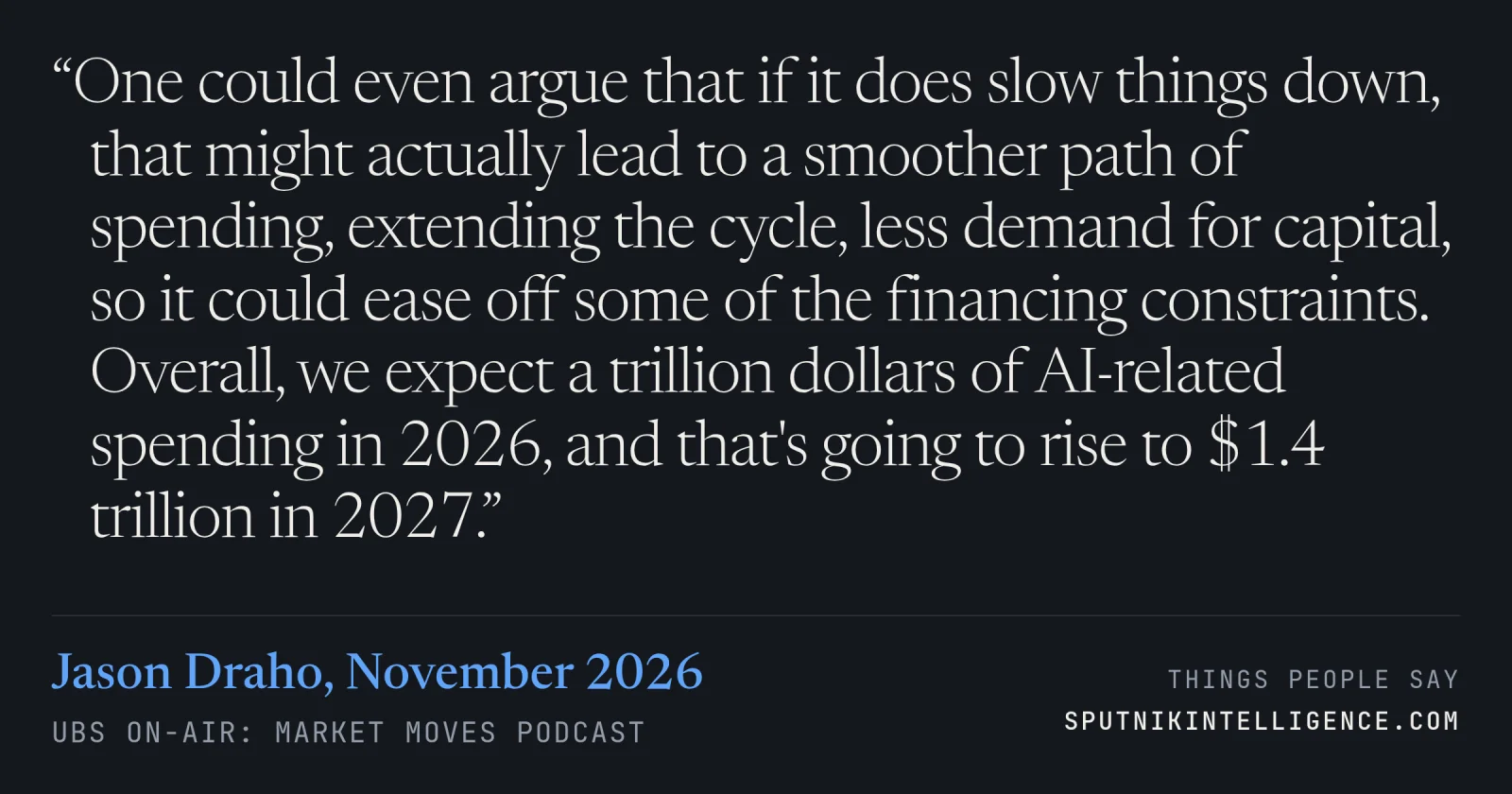
Draho closes his answer on state-level data center restrictions with a contrarian point: slower buildouts could help the AI investment cycle last longer. He then gives UBS's forecast for AI capex.
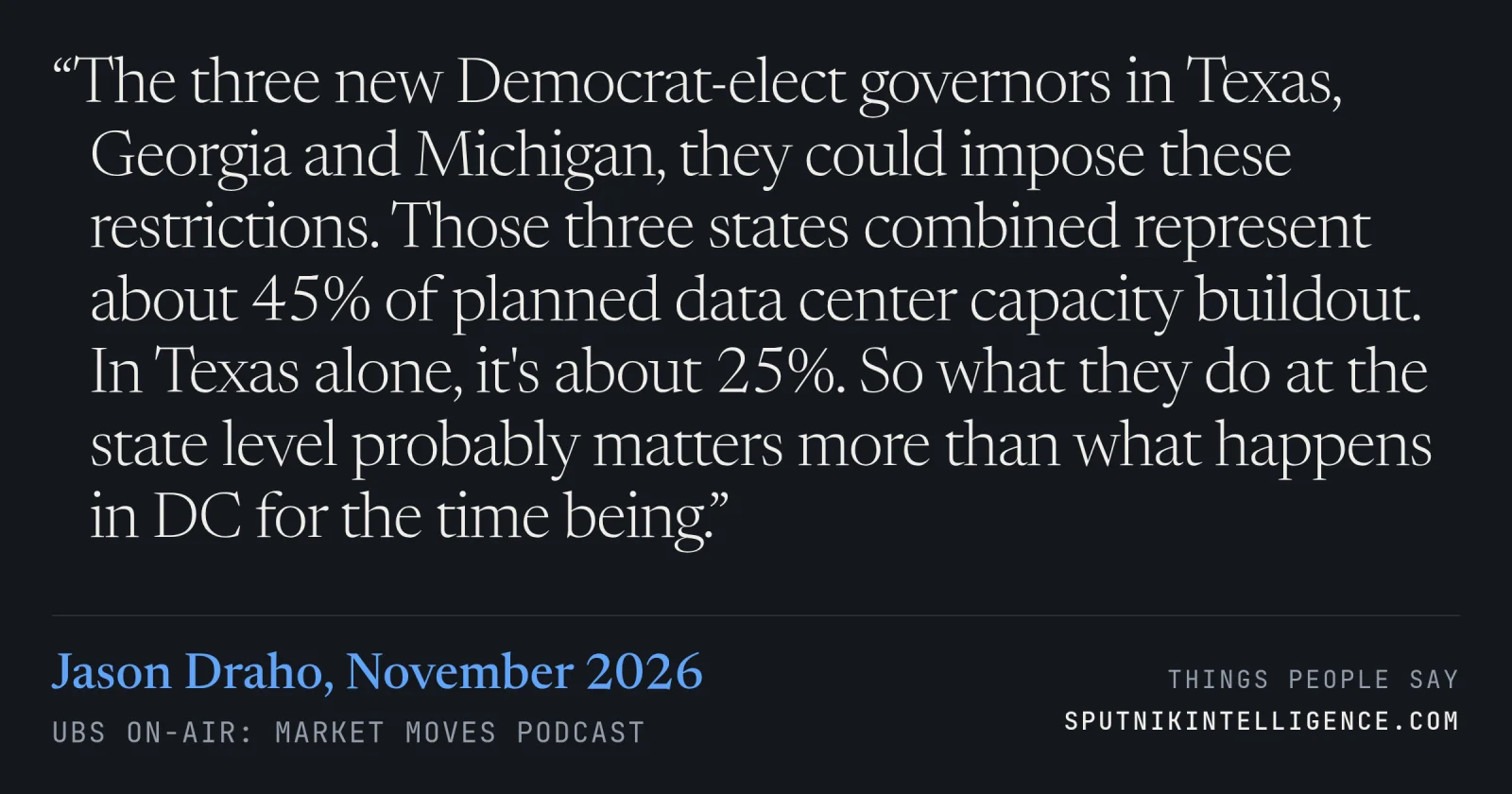
…could impose these restrictions. Those three states combined represent about 45% of planned data center capacity buildout. In Texas alone, it's about 25%. So what they do at the state level probably matters more than what happens in DC for the time being, what it means for the AI investment thesis.
Now, the AI sell-off, Jason, to single that out, raised more questions about the pace of AI investment. And now there is the risk of new state restrictions on building data centers, as you just pointed out. How much could that restrict AI investment?
So I think it's important to kind of look at this and say, you know, let's not misinterpret efforts at the state or local level to regulate data center development with attempts to stop it entirely. I think even among most Democrats, the policy objective in most of these cases is to make data centers more self-reliant, particularly with respect to electricity generation, grid infrastructure, and water consumption. And so it's not so much say no, but they have to provide something for the community. Texas governor-elect Gina Inohosa had her first press conference on Friday. No mentions of AI or data centers. She had explicitly said in the past that all currently permitted data centers in Texas will be allowed to be completed or complete their construction. That should cover most of what's set to be built in 2027 into 2028. Hanosa has admitted that her options for a war time are somewhat limited. And in the weekend interview with the New York Times, basically he said as such, in Texas, there is something called the Texas Commission on Environmental Quality, and that has a board with six appointed members. They have…
Now, Jason, if we turn focus to the broader economy, October's payroll report, labor data came in stronger than expected this past Friday. What does that tell you, Jason, about the underlying health of the U.S. economy and the Fed path from here?
Well, the economy remains fundamentally solid heading into 2027. Just looking at the payrolls report for October, the non-farm payrolls increased to $165,000. That was well above expectations. August and September, payrolls were both revised higher. Combined, this lifted the three-month average…
Against that backdrop, Jason, where does that leave the investment outlook and what should investors be doing right now? Look,