AC

Andrew Chan

Things Andrew Says on Podcasts

Where to Find Them

Andrew Chan has been a guest on My Food Job Rocks! .

Recently: “Inside the Mind of a Venture Capitalist Who's Good at TikTok, with Andrew Chan, Managing Partner and Founder of ATAS VC” on My Food Job Rocks! (November 2026).

What They Said

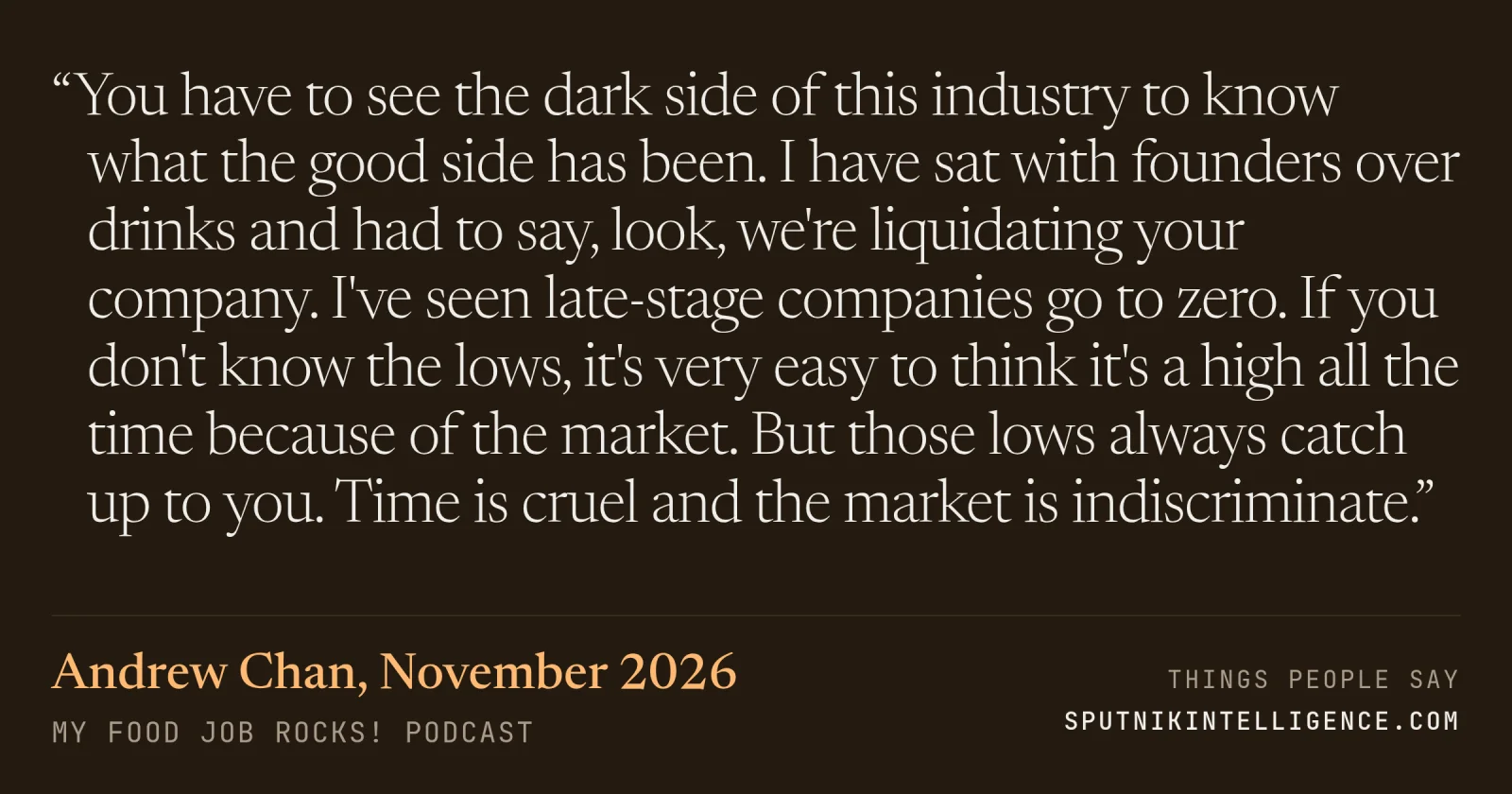
“You have to see the dark side of this industry to know what the good side has been. I have sat with founders over drinks and had to say, look, we're liquidating your company. I've seen late-stage companies go to zero. If you don't know the lows, it's very easy to think it's a high all the time because of the market. But those lows always catch up to you. Time is cruel and the market is indiscriminate.” — Andrew Chan, My Food Job Rocks!

Talking about the changing venture market, Andrew says funds raised in recent years by people without investment-management experience will be tested when the market turns.

My Food Job Rocks! · 2026-11-05 Permalink → Listen →
My Food Job Rocks! Around 39:01 into the episode
Andrew Chan

I mean, even under Biden, I don't think the SEC was ever going to start hunting down there. It's for better or for worse. Tech has some pretty deep pockets, which means that people control a lot more politics than you'd care to see here sometimes.

Adam Yee

I mean, it is good to know that basically LPs have a way to get out early. Yeah, but again, people saying the time arises. Most

Andrew Chan

VCs don't do that, right? And that's an industry-wide problem. It's also a lot of people have false confidence where they'll see these updates. And I don't know, like the trend you saw kind of in 2022, 2023 were people entering the venture capital ecosystem raising funds who didn't have investment management experience before. One of my beliefs is that you have to see the dark side of this industry to be able to know what the good side has been. I have sat with founders over drinks and had to say, look, we're liquidating your company. We're winding this down. I've seen late stage companies go to zero. In our own portfolio, I've seen great success too, right? You have to know the highs and you have to know the lows. If you don't know the lows, it's very easy to think that it's a high all the time because of the market. But those lows always catch up to you. And that's the lesson you learn with ventures. Time is cruel and the market is indiscriminate. And a lot of things that you think will go well won't. So, but that's why I think a lot of people keep cashing in companies when they really shouldn't against their own judgment.

Adam Yee

I see.

Andrew Chan

Because they see that upside. They see the Sequoia X thing Apple too early. But realistically, that's not your job as a venture capitalist. Your job is to return if you're in the top 10% of 3 to 5x tax advantaged. And your job is not to shoot for a 30%. If you shoot for a 30, odds are you're going…

Adam Yee

Good to know that you said it's your job. And I think that's really important to really distinguish. You have a job to give investment back to your limited partners, right? From what I understand.

Speaker names come from our own diarization. The position is estimated from where the line sits in the episode.
“The number of people who gaslight themselves into thinking things taste good that do not is really high.” — Andrew Chan, My Food Job Rocks!

The host said leadership teams at plant-based startups often convince themselves their product tastes better than it does. Andrew agrees, drawing on teaching taste and flavor in a university cooking class.

My Food Job Rocks! · 2026-11-05 Permalink → Listen →
My Food Job Rocks! Around 23:52 into the episode
Andrew Chan

…agriculture is still a broken business. We can talk about that separately too. But when you look at just like the dollar cost, what you have to get down to from a science and tech side, combined with the flavor, the texture, all of the above, it's just very difficult to make a competitive product.

Adam Yee

…about taste is being in these rooms, in these like plant-based company rooms, like I think the leadership. Team and like the scientists get into this weird loop that they're eventually convinced that whatever they're serving is tastes better than they think. Yes, absolutely. So I hated it. Yeah.

Andrew Chan

No, I mean, so we used to coach tastes and flavors at Caltech, right? That's the first unit you do, the Caltech cooking classes. You would teach about tastes and flavors. And the number of people who gaslight themselves into thinking things taste good that do not is really high. Now, unfortunately, and why I've struggled as a food investor, I do better. So I will tell you, I have one investment in alcohol that's done really well so far. Where I struggle with food is I have weird taste in food. I eat a lot of weird food. I was really into it. Tell me, tell me.

Adam Yee

Oh my god. I

Andrew Chan

was really into Soylent. I'm a huge Soylent fan. I'm a huge Soylent supporter. Do you know

Adam Yee

the C, the founder of that company did that media firm that got caught up on the bottom? Yeah, I ate a TVPN. I did not know this. I did not know this at all. I was like, what the heck? He

Speaker names come from our own diarization. The position is estimated from where the line sits in the episode.
“I think everything's been eaten up by AI investments. I think it's almost impossible to justify a SpaceX valuation at 1.6 trillion, and that money would normally go elsewhere.” — Andrew Chan, My Food Job Rocks!

Asked whether biotech's brutal funding market was due to AI absorbing the money, Andrew says it has hurt every other sector, and points to the SpaceX valuation as his example.

My Food Job Rocks! · 2026-11-05 Permalink → Listen →
My Food Job Rocks! Around 18:33 into the episode
Andrew Chan

For no reason. I mean, even the Publix trade, some of them are trading below cash on hand, which is when you see that, you're like, well, that doesn't make a ton of sense. But

Adam Yee

do you think it's been eaten up by AI investments, essentially?

Andrew Chan

I mean, I think everything's been eaten up by AI investments. I think it's almost impossible to justify a SpaceX valuation at 1.6 trillion. It's not, and that money normally would go elsewhere if it right there.

Adam Yee

For sure. God. Okay. So speaking of kind of biotech and other things and moonshots, I'm in the food tech space. So I've been in contact and worked with a lot of GFI, Good Food Institute. It's a nonprofit that focuses a lot on kind of replacing animal meat with other types of meat, like plant-based…

Andrew Chan

Alternative meat is something I have probably more familiar with than any of the above. So the group I was a part of previously, Builders VC, was the other half of Formation 8, which had been in, I believe it's now called Unicorn Meats, but Memphis Meats at the time. Okay,

Adam Yee

no, upside foods. Upside

Speaker names come from our own diarization. The position is estimated from where the line sits in the episode.
“Late-stage venture firms tend to underwrite biotech and a lot of the deeper science plays as if the risk has been written off, when it often has not. You see these massive rounds and valuations for things that still contain a fair bit of risk. Because no one's doing technical diligence past 'could this theoretically work', not 'does this work in practice and does it scale', they'll get funding until the day that they don't. And by then, most of your early investors have sold out.” — Andrew Chan, My Food Job Rocks!

The host, who worked at a plant-based meat startup that raised heavily during the boom, said scientists get punished for mistakes at venture-backed companies. Andrew explains how late-stage money misprices science risk.

My Food Job Rocks! · 2026-11-05 Permalink → Listen →
My Food Job Rocks! Around 10:59 into the episode
Andrew Chan

Yeah.

Adam Yee

Let's start with that statement first.

Andrew Chan

Yeah. I mean, look, I think venture is a high-risk asset class. And especially when you get into biotech, the outcomes tend towards binary. And for better or for worse, late-stage venture firms tend to underwrite biotech in a lot of the deeper science plays as if the risk has been written off when it often has not. And so you'll see these massive rounds and massive valuations for things that still contain a fair bit of risk. I'd look at, you know, Motif is a great example of that. Another one, like Relativity Space, for example, is a perfect look at saying, okay, look, there's promising technology. There's great science here, but it doesn't quite have the same stability. And venture at a growth stage, your investors are optimizing for something a little bit different. They still want that high upside. But if you're taking these massive bets, you know, you have to have a portfolio that you can construct around it. Oftentimes, people don't manage the portfolio construction game very well, which means that there's not cash available to keep things afloat when things go wrong. And if you manage that poorly or you don't underwrite it well to start, and there are technologies, I mean, I'm not going to say that on the podcast. There are one or two businesses which have…

Adam Yee

Yeah, that's what I know. I think the time horizons, which I won't go into a lot more detail, I have a hunch about time horizons in this current state. Well, obviously they expanded, but I'd like to still talk about diligence. I guess you have a thesis on kind of deep tech, for lack of a better…

Andrew Chan

hard tech, not deep tech. I talk about science. Science risk. I tend to take a lot of engineering risk. I don't invest in quantum. I don't invest in fusion.

Adam Yee

So to hard tech, what does that mean? Is it just applied robotics? Complex AI, anything

Speaker names come from our own diarization. The position is estimated from where the line sits in the episode.
“Open source has caught up a lot, which leads me to believe this is going to be a hardware battle, not a software battle. I think there's probably a place for an OpenAI and an Anthropic in that world. However, I've come to the conclusion that Apple will be the big winner here, because their hardware is already the most advanced, especially for on-device. My MacBook runs most of your good open-source models. As those models get better and cheaper, Apple is incredibly well positioned to beat everyone.” — Andrew Chan, My Food Job Rocks!

Continuing his answer on AI, Andrew explains why he thinks strong open-source models shift the advantage to hardware makers, and to Apple in particular.

My Food Job Rocks! · 2026-11-05 Permalink → Listen →
My Food Job Rocks! Around 49:37 into the episode
Andrew Chan

Chinese, even the Facebook, like meta LLMs are performing a lot better these days.

Adam Yee

Okay.

Andrew Chan

Which leads me to believe this is going to be a hardware battle, not a software battle. I think there's probably a place for an OpenAI and an Anthropic in that world. However, I've come to the new conclusion that I think Apple will be the big winner here because their hardware is already the most advanced, especially for on-device. I mean, my MacBook runs most of your good open source models. And as those models get better with smaller context windows and cheaper, Apple, and as their hardware increases in position too, they're incredibly well positioned to beat everyone. So that's my hardware guy, too. Yeah, I do a lot. I do a lot more hardware. I don't do a lot of like LLM-based AI. I don't think I do anything that you would call a rapper in any capacity. I do think data will be incredibly important in the next 10 years. I continue to have that belief, proprietary data to do traditional AI. And that was always my belief when I set out to build the firm is that the LLM AI wave catalyzes the adoption of a bunch of AI technologies that we really should have adopted 10 years ago, but didn't.

Adam Yee

You know, that's the beauty of, I think, technology catalysts is that you, it just happens. Everything gets uplifted in a sense, right? So I think there's not that bad anymore.

Andrew Chan

Yeah.

Adam Yee

Yeah. I look a lot of freezing technology and I always find the cold chain really interesting as a technology. And now we got there. Cold

Speaker names come from our own diarization. The position is estimated from where the line sits in the episode.
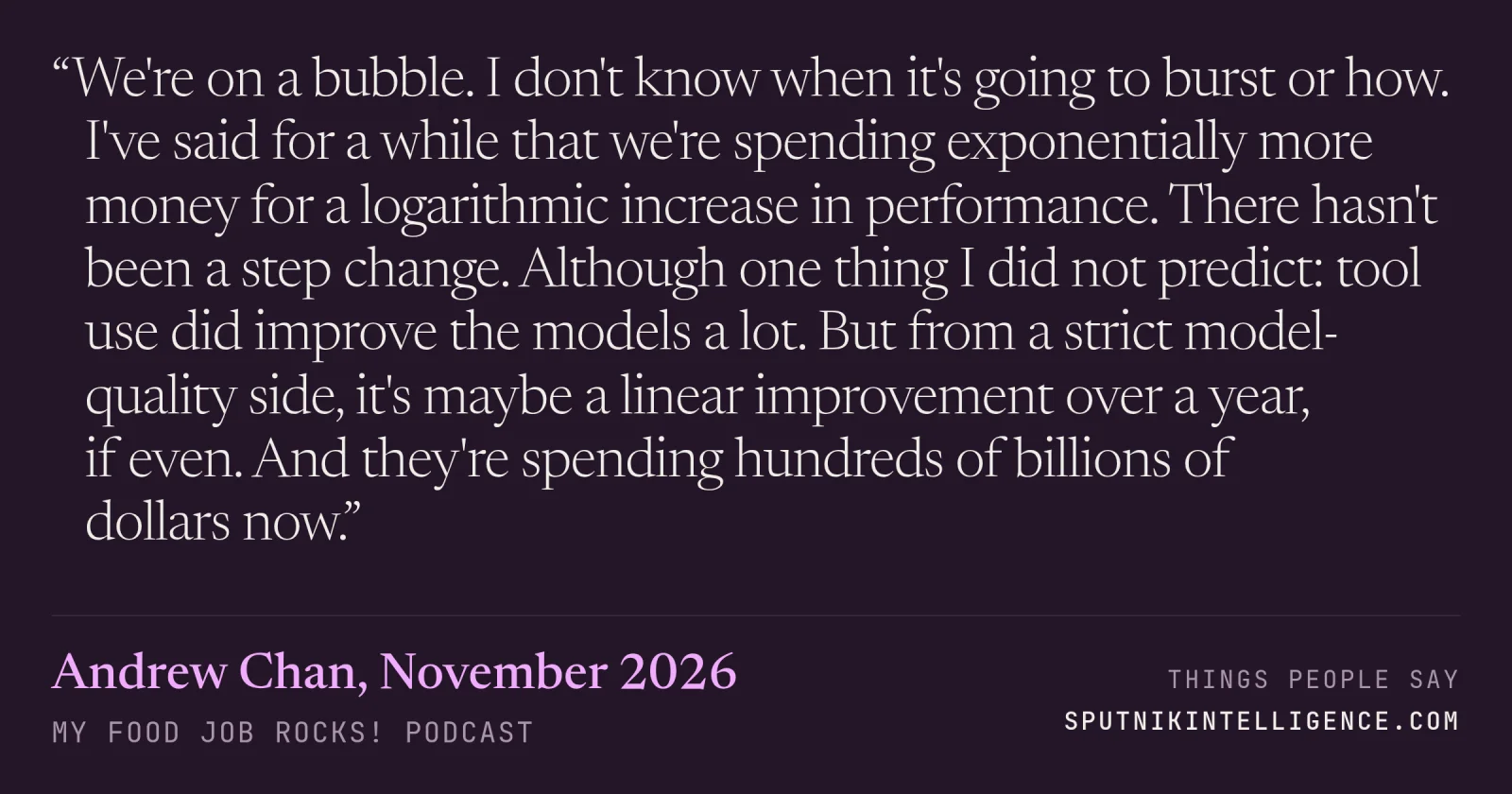
“We're on a bubble. I don't know when it's going to burst or how. I've said for a while that we're spending exponentially more money for a logarithmic increase in performance. There hasn't been a step change. Although one thing I did not predict: tool use did improve the models a lot. But from a strict model-quality side, it's maybe a linear improvement over a year, if even. And they're spending hundreds of billions of dollars now.” — Andrew Chan, My Food Job Rocks!

Asked for his thoughts on AI, Andrew, a pre-seed venture investor, gives the short version. He credits tool use and integrations for the practical gains rather than the raw models.

My Food Job Rocks! · 2026-11-05 Permalink → Listen →
My Food Job Rocks! Around 48:06 into the episode
Andrew Chan

But yeah, people are always going to troll you on the internet. I get a lot of hate comments. It's part of being an influencer.

Adam Yee

…a lot on LinkedIn over the years. I get maybe one or two posts a year on hate comments for me specifically. But obviously, it's a different platform and all that, right? So yeah. Anyways, thoughts on AI? I'd like to go there. I know you're going to have a lot. It's probably too much. Yeah, I'll

Andrew Chan

give the two-second version, which is we're on a bubble. I don't know when the bubble is going to burst. I don't know how it's going to burst. I have said for a while that we're spending exponentially more money for a logarithmic increase in performance. I think you're seeing that firsthand. There hasn't been a step change in performance. Although, I'll be honest, and one thing I did not predict, tool use did improve the models a lot. And the ability to use- What do you mean by that? Just like web search integrations, the integrations that OpenAI has with, like, I, God, I love Codex. This is not part of the sponsorship here. I use it for literally everything. It integrates with Adobe Premiere. Like, I've used it to added videos. And because they've just spent so much time doing the computer use, the integrations, it does increase the power a lot. Now, from a strict API side and from a strict model quality and response side, it is a maybe linear improvement over a year, if even. They're spending hundreds of billions of dollars now. So I've had that thesis for a while. And then similarly, and this is, again, not something I necessarily predicted, but had something because open source has caught up a lot more, which…

Adam Yee

the Chinese LLMs, you mean? I mean, not just

Andrew Chan

Chinese, even the Facebook, like meta LLMs are performing a lot better these days.

Adam Yee

Okay.

Speaker names come from our own diarization. The position is estimated from where the line sits in the episode.

Collections They Appear In