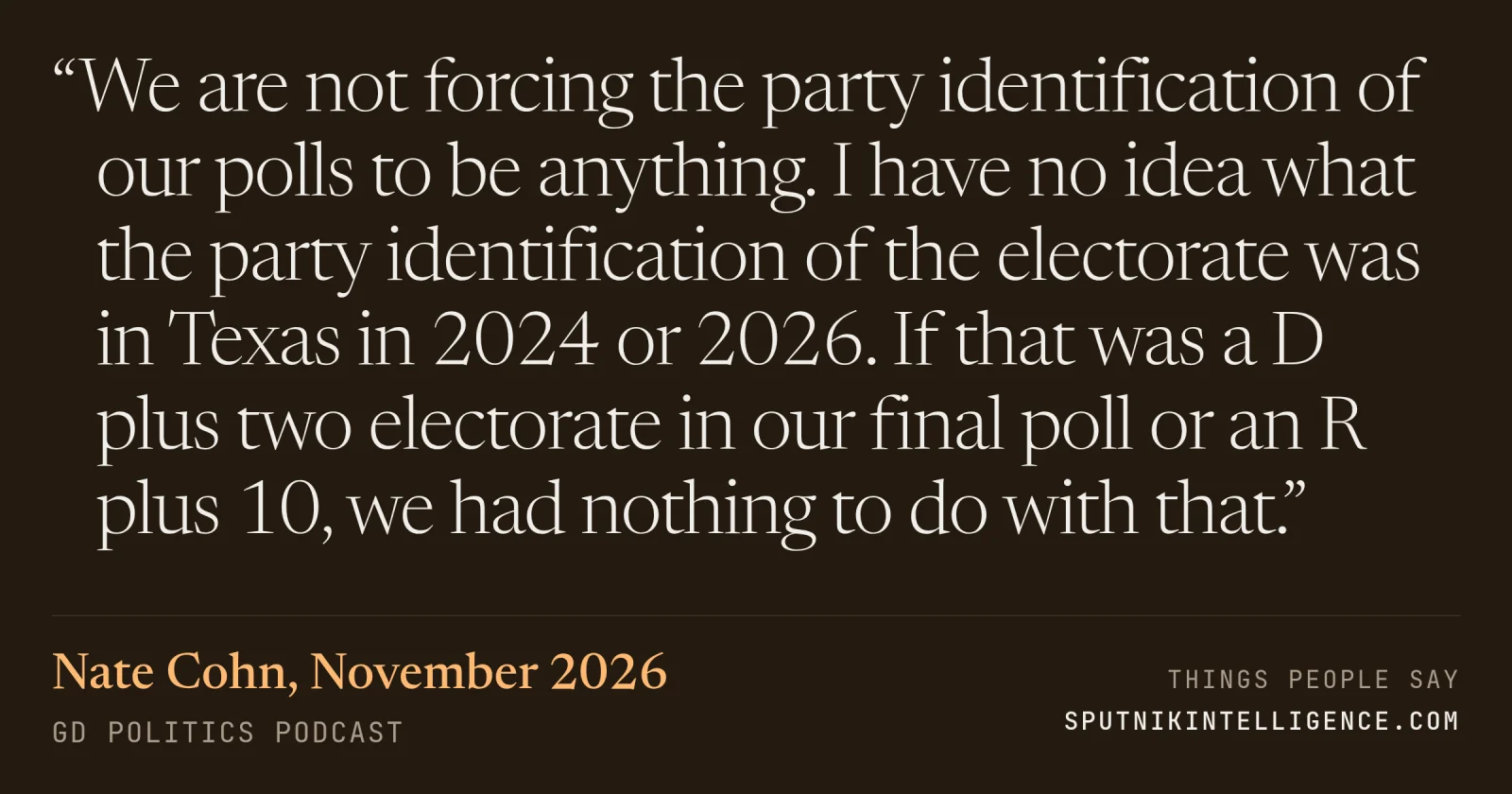
Asked whether weighting on past elections leaves pollsters flat-footed when coalitions shift, Nate Cohn explains that the Times/Siena poll deliberately avoids forcing party ID to match the last election. He credits that choice with catching shifts among new voters.
…of our polls to be anything. I have no idea what the party identification of the electorate was in Texas in 2024 or 2026. I don't even remember what it was in our last poll, but we, if that was a D plus two electorate in our final poll or an R plus 10, we had nothing to do with that. That's just
based on party identification.
I think that's a main, that's one critical difference. And another is recall vote. We use recall vote in a kind of loose way. We've branded it synthetic past vote because, you know, 20% of people are getting a different answer for our waiting purposes than what they actually reported in recall vote. But the bottom line is that this allows the recall vote in the electorate to differ and potentially significantly from the result of the last election. And I think that's also really important. If you were waiting the Hispanic vote in Texas by recall vote to be whatever your estimate was for 2024, I think you would have been way off. And we weren't.
Yeah. How did you come to that conclusion? Because I think a lot of folks in the middle of the Trump era were saying, okay, we keep underestimating Republicans. We don't love the idea of waiting to recall to vote, which, you know, to lay it out for folks, I think a lot of listeners know, but is you…
So stepping back, the reason why we haven't followed the industry down this path is because when we try and use it on our election, our previous data, it doesn't help. If we, and I think that when other pollsters wait on recall vote, it does a lot more for them than it's done for us. I don't know…
And so that's a change that you made between 2024 and 2026.