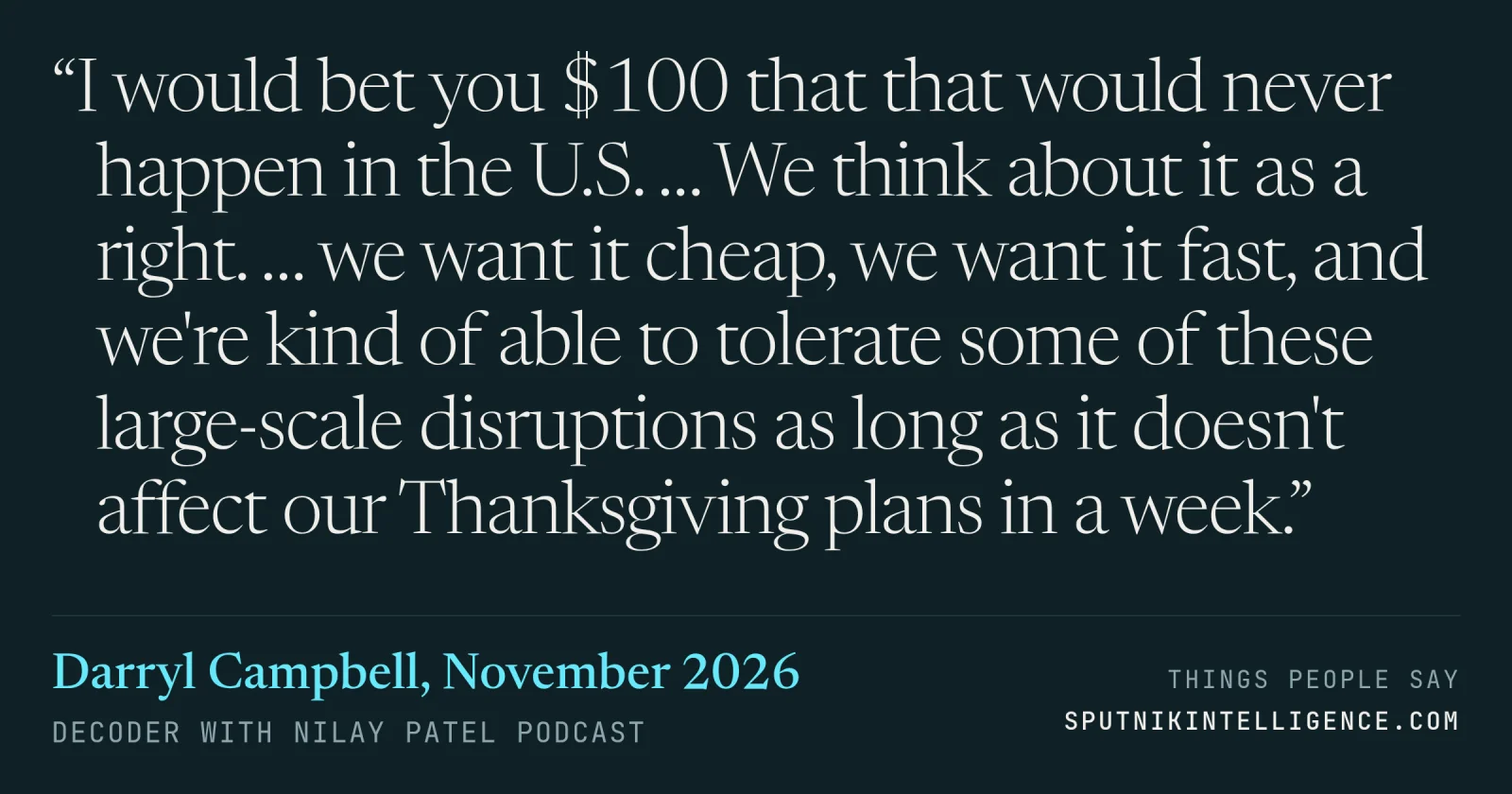
Asked whether the US could build a more automated air traffic system from scratch, Campbell says China might, but America won't, partly because Americans treat cheap air travel as a right and put up with disruption.
Yes. Absolutely.
…right? Like there's it's a closed ecosystem where everyone wants to participate. Everyone has aligned incentives. You would just say, okay, the robots are going to fly on planes for us and they're going to be perfectly safe. But it doesn't seem like there's a pathway from here to there at all.
…bet you $100 that that would never happen in the U.S., at least not until something materially changes in the way that the U.S. conceives about air travel. I mean, we think about it as a right. We think about it as the primary way that we get from point A to point B other than driving a car for 100 miles. And we think about it as something that everybody should have access to. And so that means we want it cheap, we want it fast, and we're kind of able to tolerate some of these large-scale disruptions as long as it doesn't affect our Thanksgiving plans in a week. So I think that also just kind of keeps the system the way it is in ways that maybe are not the case in some other countries that are newer to large-scale aviation.
I like that you made reference to the cliché. You can have it cheap, fast, or good, too, right?
Or maybe none.
Or in this case, maybe none. The other argument, and I've heard this, it's in Project 2025. You mentioned the industry has a lot of incentives to figure this out, to make it good, to make sure people feel safe. In Project 2025, the idea that we should privatize air traffic control exists. At the…