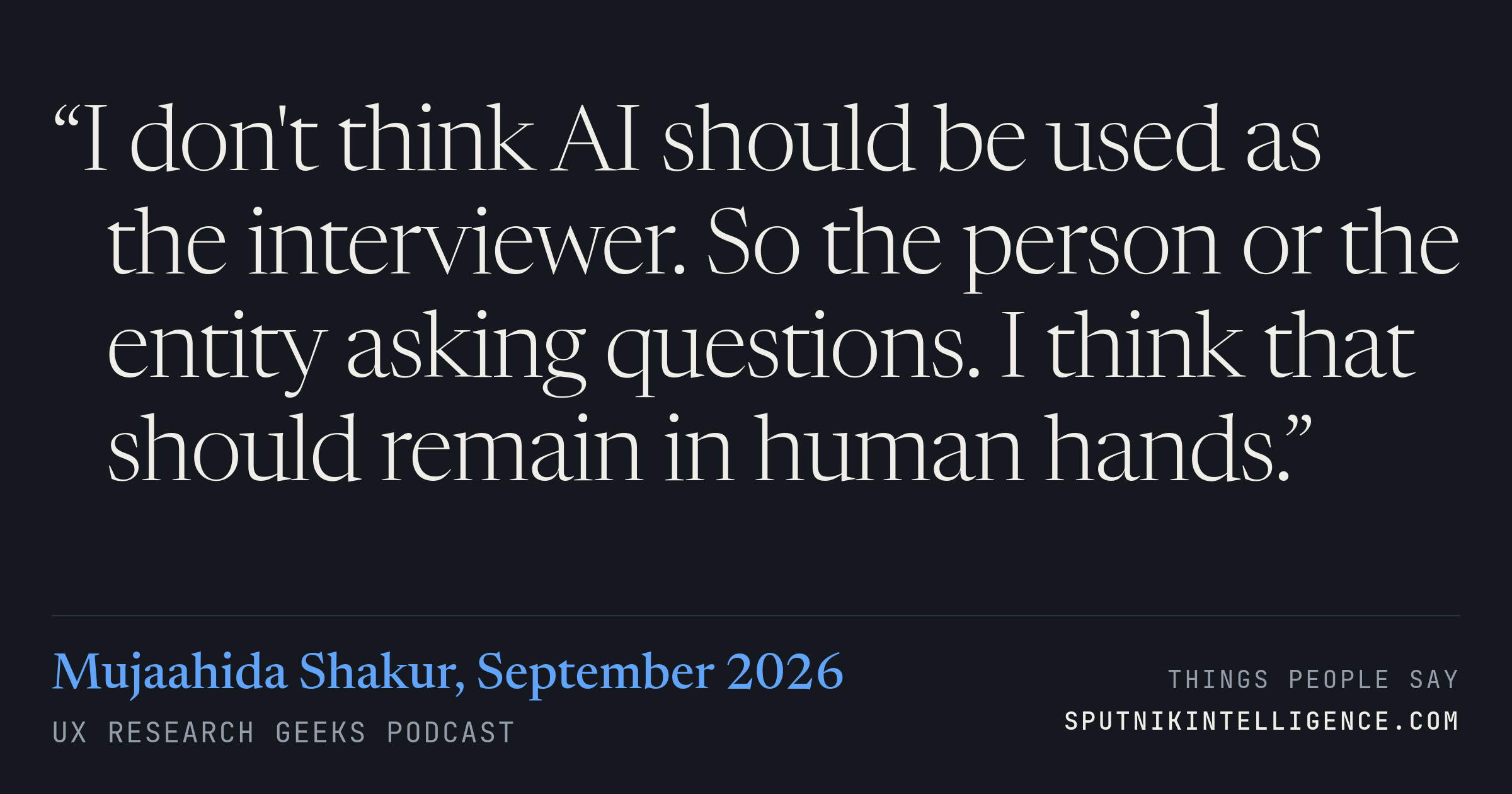
Shakur opens the episode by drawing a line on where AI belongs in research and in hiring. She is comfortable with AI transcribing or taking notes as a backup, but not asking the questions: in her own experience the tools struggle with accents and with anyone speaking quickly, and a stumble can send the session back to the start.
Welcome to UXR Geeks, where we geek out with researchers from all around the world on topics they are passionate about. I'm your host, Petra, a senior UX researcher and a research advocate, and this podcast is brought to you by UX Week, the UX research platform for recruiting, conducting, analyzing, and sharing insights all in one place. Today's guest is Mujahida Shakur, a behavior scientist and UX researcher with 10 years of experience across big tech and public health. She holds a Master of Public Health from Emory University and worked as a senior UX researcher at AWS, where she focused on benchmarking and building more accessible, inclusive digital experiences. And currently, she is on the job market. Today we are getting into mechanics of career pivots. How you translate a background that doesn't fit the mold. How you position yourself when the market is skeptical and what it actually takes to get through it. Hi everyone, welcome to the UXR Geeks podcast again. We are happy that you are listening to us and today's topic will be career pivots. And we have Mujahida Shakur with us on the podcast. So hi Mujahida. Hello Petra. It's quite relevant topic to me because from the talks that I have been having with other researchers, it's quite common that most of the researchers didn't start in research. It's not a topic that they have studied. They usually started in computer science. They started in the psychology and then they kind of transitioned into UXR. So there is a path that we all share, but every path is unique. So we will be talking about that and how you can navigate changing the different industries, changing different fields, and how does it play? What impact does it have on the skills and the language you use? You have started in the public health sector and most recently you have been working for the Amazon Web Services, which is highly technical organization, as I imagine. And now you are at the job market. And you had an interesting post on LinkedIn talking about the interview process. So let's talk about that and interview process with AI because AI is everywhere. So how do you feel about having AI in the interview process?
I think there is a time and place. I don't think AI should be used as the interviewer. So the person or the entity asking questions. I think that should remain in human hands. If you want to use AI to like note take, transcribe, you know, as part of the process, I'm totally okay with that. But my experience with AI as an interviewer or as a researcher has been not great. I would say it struggles to understand different accents. It struggles to understand if you're not speaking super clearly. If you're speaking too fast, you might have to start all over from the beginning. You don't get the reaction necessarily. So you don't know if they heard everything that you said. It's hard to get that like live feedback. Like, you know, in a face-to-face conversation, you can always be like, hey, I didn't quite catch that. Or the connection was bad. I didn't really hear, can you say that again? But AI hasn't caught up with the ability to do that yet. So I think it's really important to keep humans in that process as much as we can.
You made the connection between AI as an interviewer in the hiring process and then AI as a moderator in the research process. Can you imagine using AI in the research process in any use cases or anywhere?
Absolutely. There are definitely applications for AI in the research process. Like I mentioned, if you want to use it for note-taking, it's an excellent backup. Usually I work with two. I'll usually be interviewing as a moderator and then I'll have a note-taker, like a physical note-taker as well, just in case I miss anything. So AI as a backup note-taker is super helpful in case someone's not available. Using it to transcribe interviews after the fact can be very helpful. I would say check it because I've definitely seen some hallucinations happen, but it definitely speeds up the process. I'm not in any way opposed to AI being incorporated where it is appropriate. I think we need to be incredibly careful about safeguards, be very aware of the climate impact of AI and really think, is this a necessary use case? Is this worth risking the planet? It seems like a large leap, but honestly, it is that serious. So like, think about is it Really worth risking the planet? Is it worth risking our climate for this?
It might sound like it's so far off, but I don't think that enough people is talking about the impact that AI can have on our planet, on the sustainability that organizations are talking about. But are they that serious? So I like that you brought it up because it's something that needs to be repeated and to have it as part of our DNA as we are using the AI products and developing the AI products. So definitely. But let's talk about your journey. As I said at the beginning, you have started in the public health sector. Was there a moment when you realized that you want to switch the industries or how did you transition into the big tech?