JB

Joscha Bach

Things Joscha Says on Podcasts

Where to Find Them

Joscha Bach has been a guest on Machine Learning Street Talk (5 times) , Lex Fridman Podcast (3 times) , Into the Impossible With Brian Keating (2 times) , Future of Life Institute Podcast , Digital Disruption with Geoff Nielson , The Inside View , Latent Space , Giants Shoulder , Manifold , The AI in Business Podcast and The Trajectory .

Recently: “Why Leibniz Couldn't Find the Mind Inside the Mill (Joscha Bach)” on Machine Learning Street Talk (November 2026); “Roman Yampolskiy vs Joscha Bach: Can Anyone Control Superintelligence?” on Into the Impossible With Brian Keating (October 2026); “Joscha Bach: AGI, Consciousness, and the Evolution of Intelligence” on Digital Disruption with Geoff Nielson (June 2026); “Joscha Bach: The Self Is a Story Your Brain Tells Itself - #555” on Into the Impossible With Brian Keating (May 2026); “#92 Joscha Bach: “The Nature Of Reality is Even Weirder Than We Previously Thought”” on Giants Shoulder (February 2026); “Joscha Bach: Consciousness and AGI — #76” on Manifold (January 2025).

What They Said

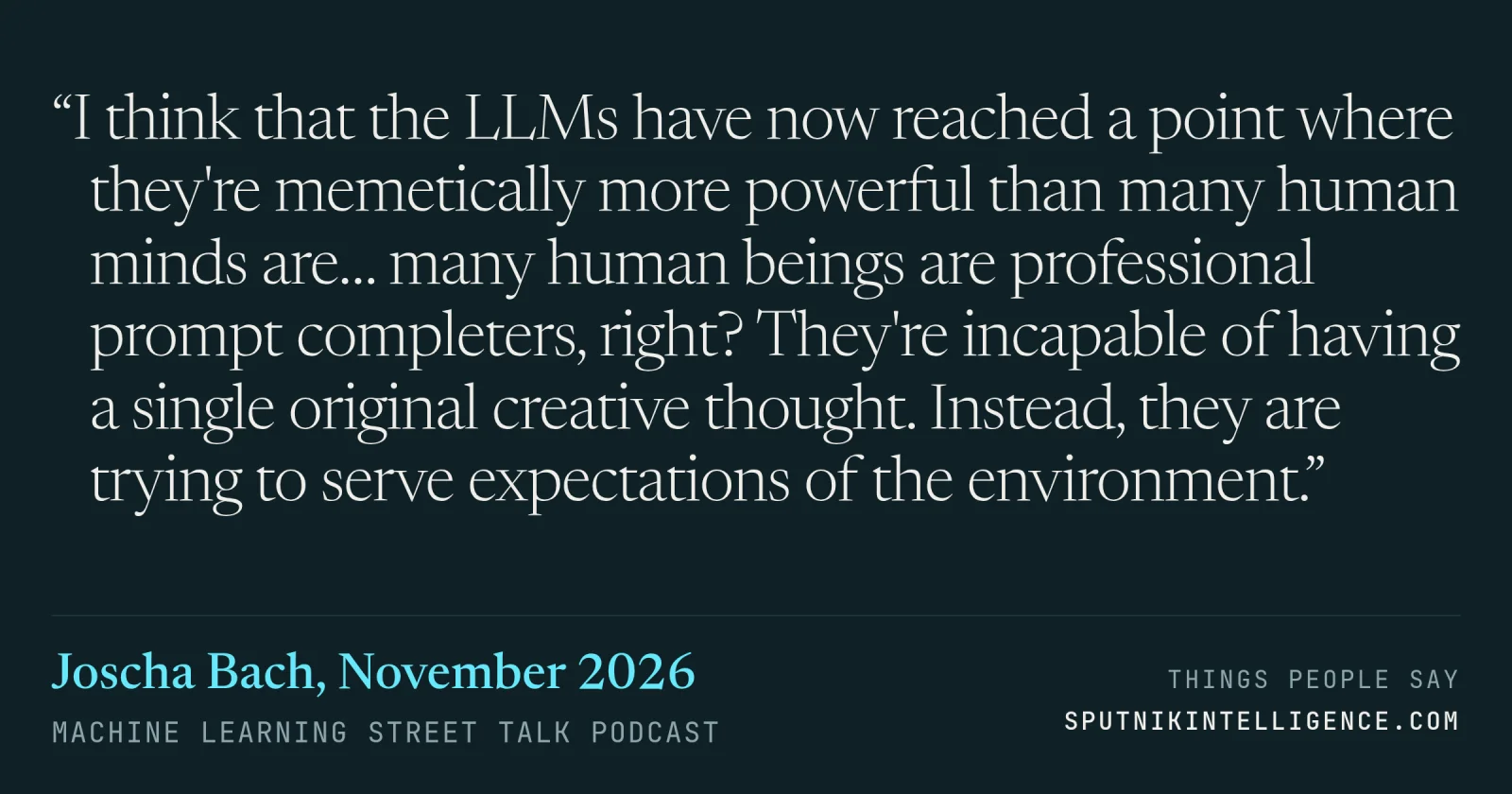
“I think that the LLMs have now reached a point where they're memetically more powerful than many human minds are… many human beings are professional prompt completers, right? They're incapable of having a single original creative thought. Instead, they are trying to serve expectations of the environment.” — Joscha Bach, Machine Learning Street Talk

The host brought up people falling into shared 'LLM delusion' communities. Bach says some people need an environment that constantly affirms their reality, and an LLM can pull them off the rails. He then asks what happens to people whose work is mostly completing prompts.

Machine Learning Street Talk · 2026-11-02 Permalink → Listen →
Machine Learning Street Talk Around 44:56 into the episode
Joscha Bach

…ways, the computer models that we're playing with today, they're a result of growth. And they're pruned and they are gardened and chaperoned and trained in a way that is much more in which we observe this happening in biology than it happened when we were writing computer programs by hand. Yeah.

Tim Scarfe

…had just discovered the meaning of the universe. And there were certain characteristic traits. They would talk about spirals and recursion, and there were certain motifs in all of the LLM outputs. And it was actually copying itself. Isn't that an example of this memeplex that you're talking about?

Joscha Bach

…have a strong foundation in their own reality. And I think that the LLMs have now reached a point where they're memetically more powerful than many human minds are. There are things that the LLM cannot do at this point, where they're still hallucinating, where they're still more incoherent than experts in a given field. But they are much better at prompt completion than human beings are. And many human beings are professional prompt completers, right? They're incapable of having a single original creative thought. Instead, they are trying to serve expectations of the environment. They are picking up on the statistical patterns in the language of the environment. And then you tell them a headline and they write an article. And now you give them an LLM. How is the environment going to change? Once they talk more to LLMs, then they. Talk to other human beings because the LLM is such a useful tool for them to do their prompt completion. What's going to happen to them? And…

Tim Scarfe

What's your take on physicalism? First of all, what is physicalism? Are you a physicalist?

Joscha Bach

I think physicalism is a certain hypothesis. And it comes down to that being a causally closed mechanical layer to reality that can be researched using experiments in physics labs. And that this causally closed mechanical layer of reality is not moved by our intentions. So you cannot use an…

Tim Scarfe

Would you think it's possible for a physicalist to subscribe to your ideas and render it compatible with physicalism?

Speaker names come from our own diarization. The position is estimated from where the line sits in the episode.
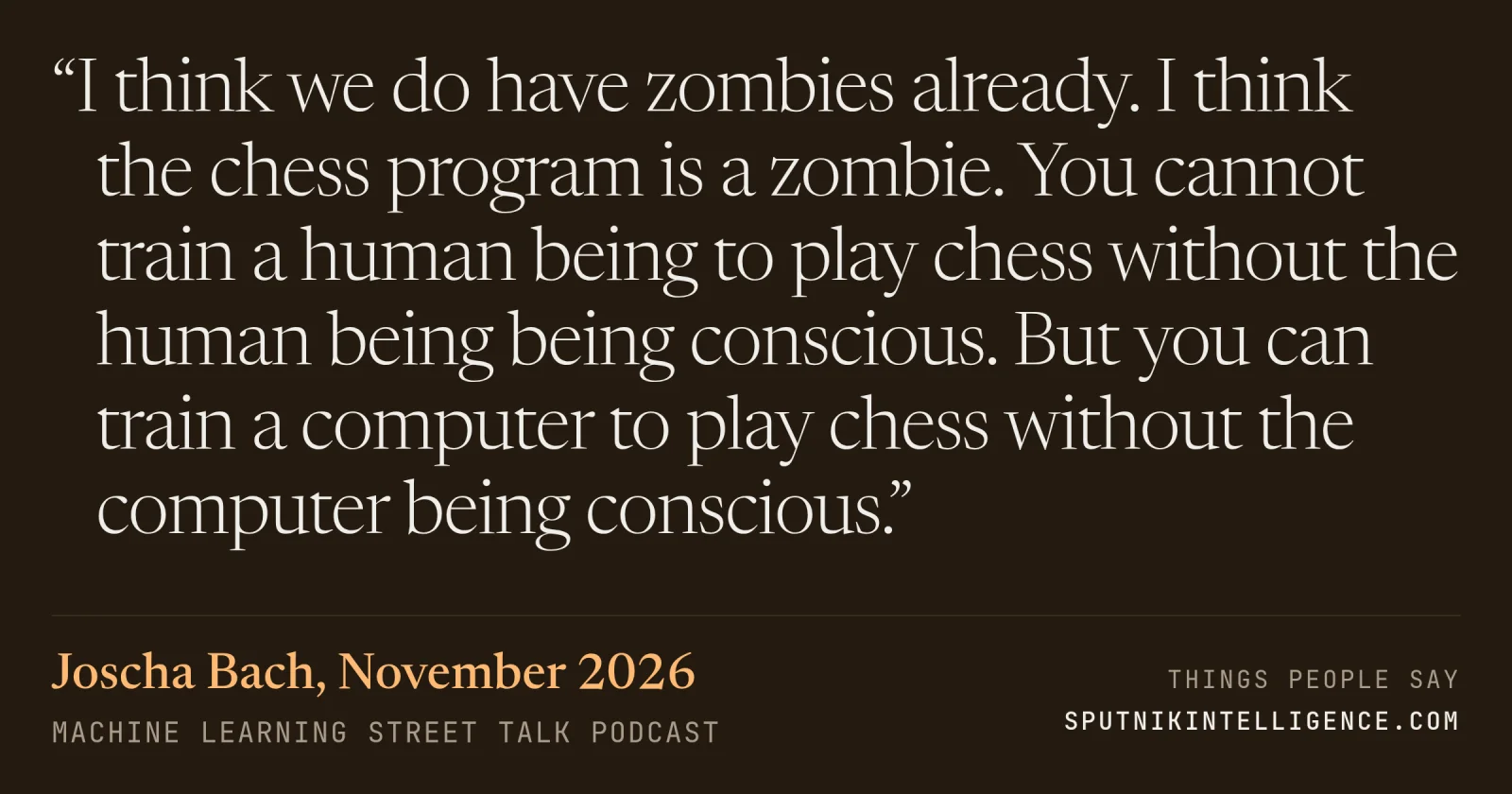
“I think we do have zombies already. I think the chess program is a zombie. You cannot train a human being to play chess without the human being being conscious. But you can train a computer to play chess without the computer being conscious.” — Joscha Bach, Machine Learning Street Talk

Asked whether zombies (systems that behave as if conscious but aren't) are possible in practice, Bach says yes, today's chess programs already are. He adds that it will sometimes be harder to build a zombie than a conscious agent that produces the same behavior.

Machine Learning Street Talk · 2026-11-02 Permalink → Listen →
Machine Learning Street Talk Around 1:25:31 into the episode
Joscha Bach

…it's conceivable that the entire set of intelligent behaviors that you are interested in, except for this one thing where you're simulating a self-reporting conscious agent, can be implemented on GPUs because the GPUs are more powerful, more deterministic, more open to other classes of algorithms.

Tim Scarfe

…what makes our minds tractable. It's an incredibly efficient process. So we might say that if we see an artifact in our world which behaves as if it's conscious, would you argue that it can't be anything other than conscious or do you still think? There are other states that could be zombie-like. I

Joscha Bach

think we do have zombies already. I think the chess program is a zombie. You cannot train a human being to play chess without the human being being conscious. But you can train a computer to play chess without the computer being conscious. And if the computer was self-organizing, it's possible that it could only be trained if it was conscious or if this was the simplest way of doing it. But for many of the things that we currently observe, for instance, you can get the LLM to produce a tax return, even very, very complicated things while being a zombie, while not having a conscious experience of producing a tax return. The only point where the LLM is reporting to be conscious, if you ask it to, right? If you are telling it, the following is a conversation between what it would be like if a human being would be talking to a conscious AI. So some version of this, right? And then the thing is able to simulate this. And then the question is: is this more simulated than us, or is this only a deep fake that is getting there in…

Tim Scarfe

If you had $10 billion to kick off a research project on consciousness, what would you do?

Joscha Bach

I think I would hire a lot of people who are a lot smarter than me. At the moment, I started a smaller initiative. It's called the California Institute for Machine Consciousness. And I'm currently looking for people who are smarter than me who want to join me and to build a project in which we can…

Tim Scarfe

Bach, it's been an absolute honor. Thank you so much for joining us today.

Speaker names come from our own diarization. The position is estimated from where the line sits in the episode.
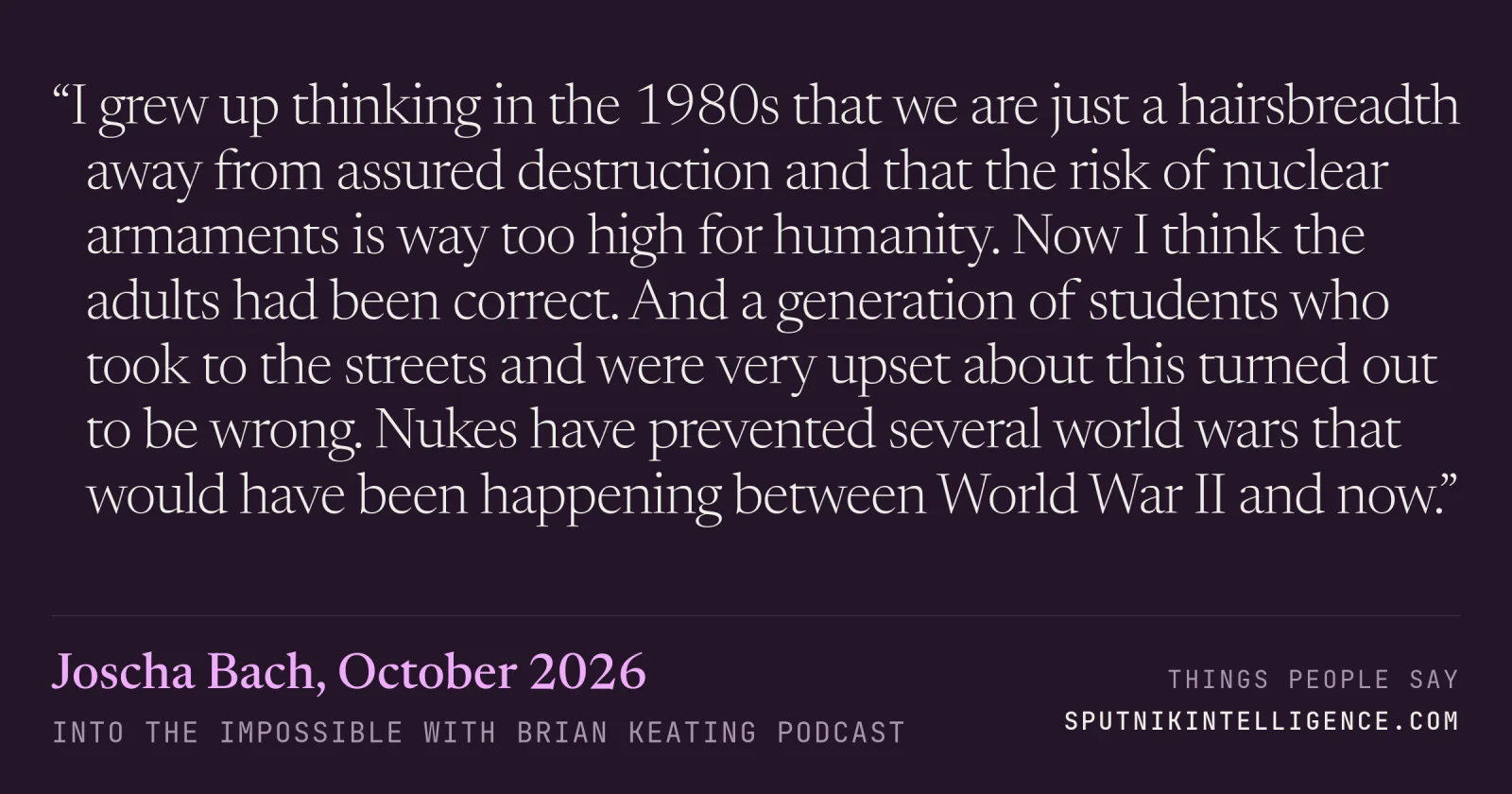
“I grew up thinking in the 1980s that we are just a hairsbreadth away from assured destruction and that the risk of nuclear armaments is way too high for humanity. Now I think the adults had been correct. And a generation of students who took to the streets and were very upset about this turned out to be wrong. Nukes have prevented several world wars that would have been happening between World War II and now.” — Joscha Bach, Into the Impossible With Brian Keating

The host had compared fears about AI to the physicists who worried before the first nuclear test. Bach uses his own change of mind about nuclear weapons to answer, though he adds straight away that a weapon over a few decades is a different case from superintelligence over the very long run, and that the comparison is hard to make and hard to dismiss.

Into the Impossible With Brian Keating · 2026-10-09 Permalink → Listen →
Into the Impossible With Brian Keating Around 12:13 into the episode
Speaker 4

…about superintelligence, not in a Donald Trump renaming sense, but smarter than all of us combined. There's a levels to it. System smarter than you, 10x, 100x, million X. Those are not the same problem. To suggest that you will be able to always stay in control of all of them seems insane. But

Speaker 2

…consent before we shut things down? I mean, at what point are you comfortable with putting the Gini back in the bottle if Roman's correct? I mean, your P doom might be irrelevant, but how do you speak for the rest of humanity? Not you personally, but how do we as scientists or as technologists?

Speaker 3

There are a number of considerations when we try to compare the nuke situation with the situation of artificial intelligence. And it makes it very difficult to compare even, and it's also difficult to dismiss the comparison out of hand. I, like many people in my generation, Generation X, think that now that I've been wrong about the impact of nuclear weapons. I grew up thinking in the 1980s that we are just a hairbread away from assured destruction and that the risk of nuclear armaments is way too high for humanity. Now I think the adults had been correct. And a generation of students who took to the streets and were very upset about this turned out to be wrong. Nukes have prevented several world wars that would have been happening between World War II and now that would have wrought tremendous destruction on Europe and potentially large parts of Asia and maybe even America. And this basically more than half a century of peace that we had is completely unprecedented for large nations like ours. And I think this was achieved due to nuclear armaments, which have been empirically quite safe. Now, it's very difficult to compare the different timelines. We cannot really sample this. We don't know…

Speaker 1

The detritus, 5% electricity, 6%.

Speaker 3

Ultimately, the question is: what do we identify as? Do we identify as a kind of ape that is very selfish, or do we identify as intelligence and consciousness in the universe that is currently incarnated as us? And we are handing off the torch to our children, and our children are going to be a…

Speaker 2

Roman, when I was walking over to my studio, there's a spider that inhabits this area, and its web is always, you know, I'm about close to six feet tall, and it barely brushed on my hair, and it's always at that height. You know, and the spider's kind of adapted to me and understands me. And, you…

Speaker names come from our own diarization. The position is estimated from where the line sits in the episode.

Collections They Appear In