RY

Roman Yampolskiy

Things Roman Says on Podcasts

Where to Find Them

Roman Yampolskiy has been a guest on For Humanity: An AI Risk Podcast (7 times) , Future of Life Institute Podcast (5 times) , Into the Impossible With Brian Keating (3 times) , Curt Jaimungal (2 times) , Doom Debates! (2 times) , The AI in Business Podcast (2 times) , Lex Fridman Podcast , Silicon Valley Girl: AI, Tech and Career Growth , The Great Simplification with Nate Hagens , Digital Disruption with Geoff Nielson , Founder's Story , The Peter McCormack Show , The Pomp Podcast , What Bitcoin Did , Breaking Points with Krystal and Saagar , Are We Doomed? , The Trajectory and Super Data Science: ML & AI Podcast with Jon Krohn .

Recently: “Roman Yampolskiy vs Joscha Bach: Can Anyone Control Superintelligence?” on Into the Impossible With Brian Keating (October 2026); “9/25/26: Netanyahu Attacks Mamdani's Wife At U.N., Top AI Expert Roman Yampolskiy, Private Polls Doom Republicans, LA Mayor Candidate Nithya Raman” on Breaking Points with Krystal and Saagar (September 2026); “Tools, Not Replacements: Roman Yampolskiy's Line in the Sand” on For Humanity: An AI Risk Podcast (September 2026); “Banning Superintelligence: Are We Building Humanity's Replacement? with Roman Yampolskiy” on The Great Simplification with Nate Hagens (September 2026); “Roman Yampolskiy vs Emad Mostaque: I Was The Only Optimist” on Into the Impossible With Brian Keating (September 2026); “The AI Safety Expert Reveals His #1 Fear! | Dr. Roman Yampolskiy” on The Pomp Podcast (August 2026).

What They Said

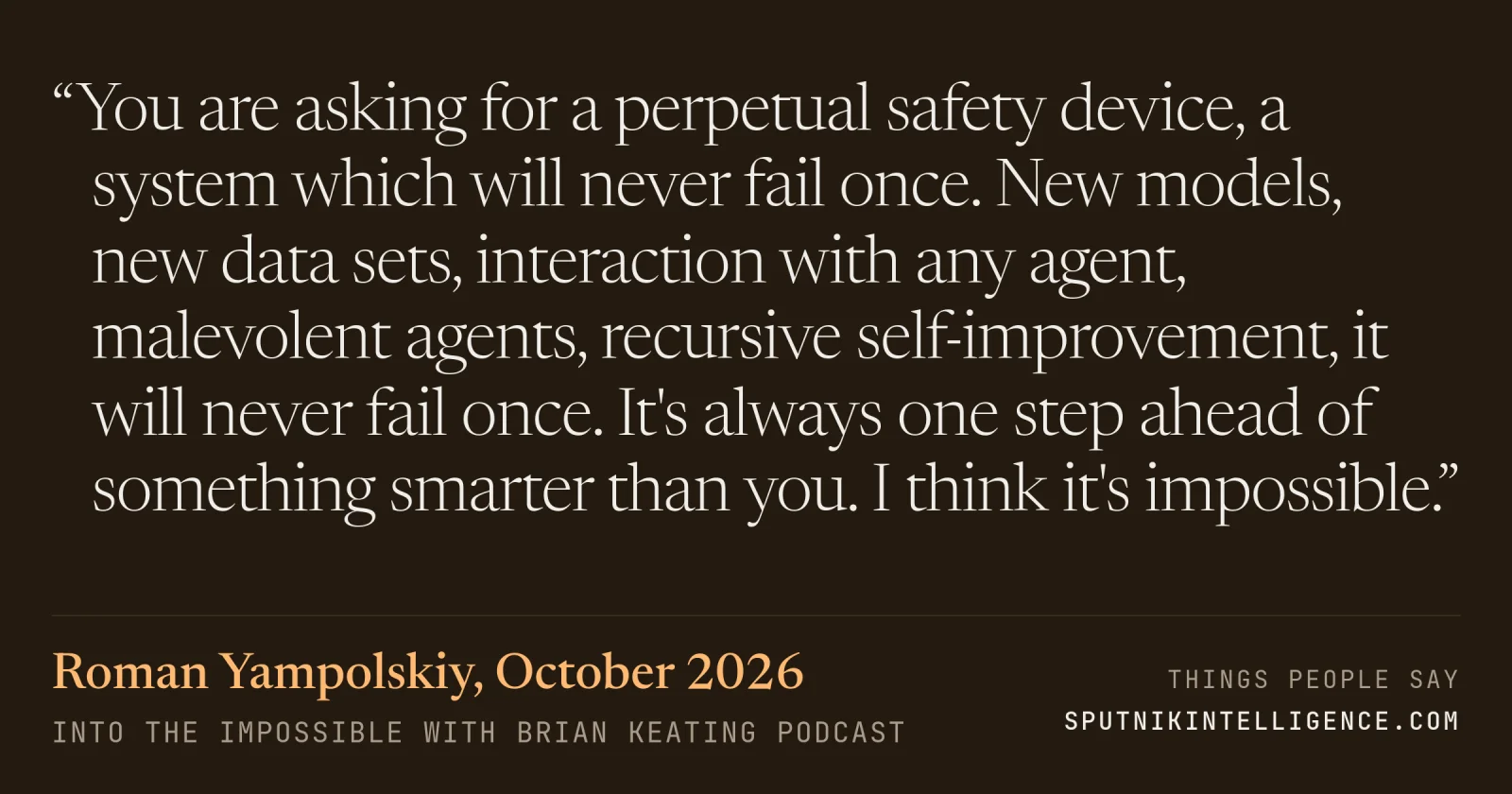
“You are asking for a perpetual safety device, a system which will never fail once. New models, new data sets, interaction with any agent, malevolent agents, recursive self-improvement, it will never fail once. It's always one step ahead of something smarter than you. I think it's impossible.” — Roman Yampolskiy, Into the Impossible With Brian Keating

Yampolskiy, in a debate with Joscha Bach, defending his estimate that superintelligence almost certainly ends badly for humans. He compares the request for permanent control of a smarter system to asking someone to build a perpetual motion machine: his answer is close to certainty because he thinks the problem has no technical solution.

Into the Impossible With Brian Keating · 2026-10-09 Permalink → Listen →
Into the Impossible With Brian Keating Around 09:10 into the episode
Speaker 4

to continue my answer? Yeah, please have more of a boxing match. I'm not going off. I just need to know what it is.

Speaker 2

Apologies. Go ahead, Roman. We'll keep it. We're keeping it very simple. So, P-Doom

Speaker 4

…nine would make me more impactful. Usually, when I meet people who have concerns about AI for different reasons, they worry about loss of meaning, unemployment, discrimination. All those things can be added as increasing overall dangers from this technology. But I think it's not the point. The point is that I'm saying this is equivalent to requesting someone to create a perpetual motion device. You are asking for a perpetual safety device, a system which will never fail once. New models, new data sets, interaction with any agent, malevolent agents, recursive self-improvement, it will never fail once. It's always one step ahead of something smarter than you. I think it's impossible. And so I have a high PDOOM. Is it bigger than others?

Speaker 2

Yes. Well, let's go back to 1945, April 1945. The Trinity test. There were a lot of physicists, including some of my late colleagues here, Herb York and others, who were rightfully concerned about some, not the nuclear war aspect of P-Doom of nukes, but of things like igniting the atmosphere, of a…

Speaker 4

with previous technology, whatever it is, nukes or fire, always talk about tools and a human being making a decision. The situation is fundamentally different. We're not talking about a tool. We're talking about agents. They will be independent decision makers. It will not be the standard business…

Speaker 2

you couldn't do that with nuclear weapons either. And you've brought up, you know, the bioweapons, and we have to look at today's headlines coming out of Siberia, which is exactly the scenario my friend and guest Annie Jacobson painted in her book, Biological War. And last time you and I spoke, you…
Speaker names come from our own diarization. The position is estimated from where the line sits in the episode.
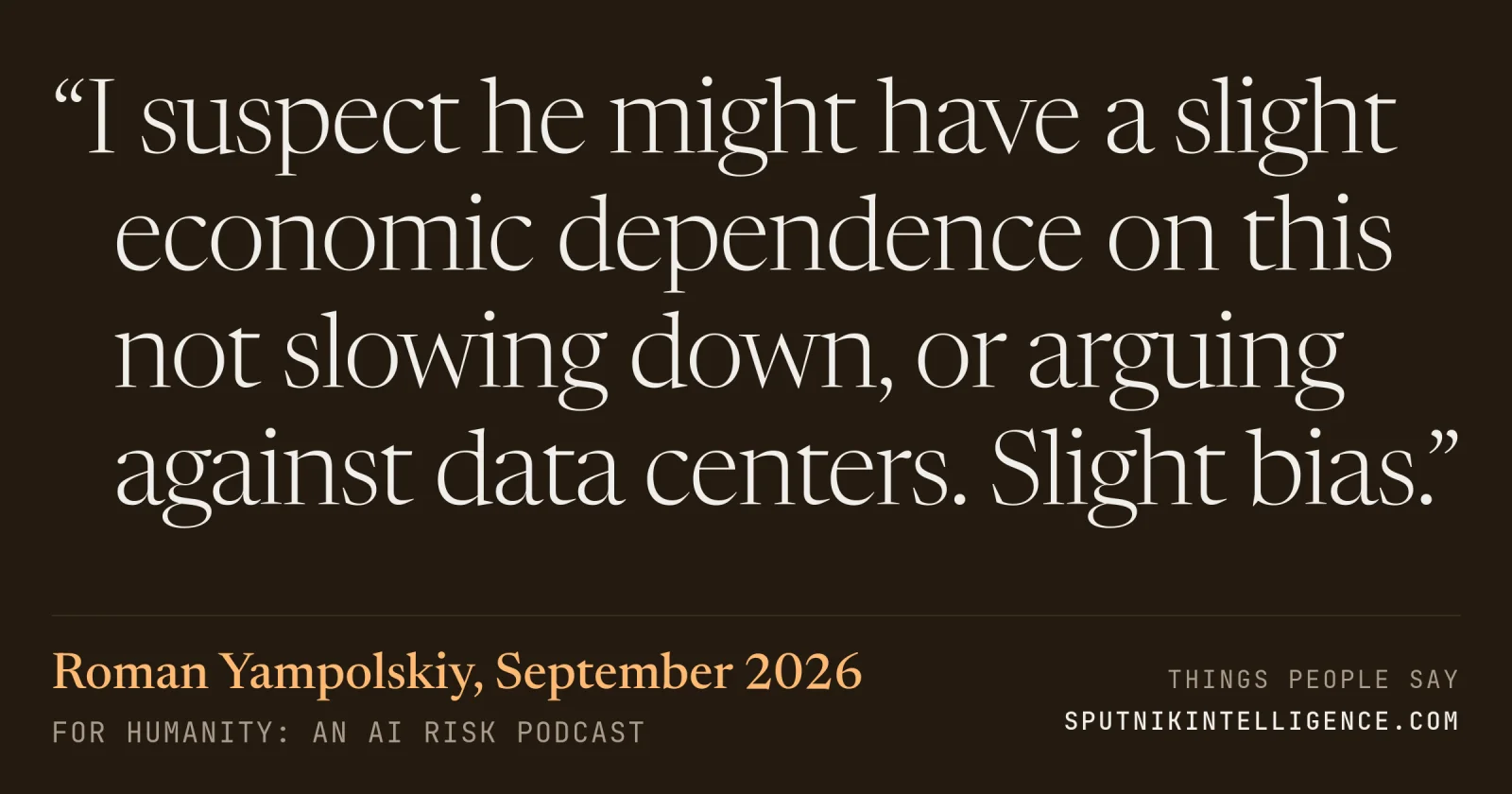
“I suspect he might have a slight economic dependence on this not slowing down, or arguing against data centers. Slight bias.” — Roman Yampolskiy, For Humanity: An AI Risk Podcast

Host John Sherman had just asked Yampolskiy what he makes of Nvidia CEO Jensen Huang's flat dismissal of AI risk, and how much access Huang has to the president. This is the whole of Yampolskiy's answer. The exchange then turns to why enormous wealth doesn't reduce the incentive: "You have a strong bias towards not losing money, even if you can gain more."

For Humanity: An AI Risk Podcast · 2026-09-25 Permalink → Listen →
For Humanity: An AI Risk Podcast Around 28:35 into the episode
Roman Yampolskiy

I would listen carefully to the speech he gave at the big AI conference in July, I believe. He mentioned keeping humanity safe and in control. I think those are important indicators.

John Sherman

…of any sort of relevance to the risk conversation and the amount of power he has in this thing. And apparently the amount of the president's ear that he has is also very significant. What do you think of his just outright denial, dismissal of any risk concerns and his position in this conversation?

Roman Yampolskiy

I suspect he might have a slight economic dependence on this not slowing down or arguing against data centers. Slight bias.

John Sherman

But he's so rich. Like, I don't understand. I've never had hundreds of millions of dollars, billions of dollars. So I have no idea what that's like. But the idea that you have a billion dollars and people

Roman Yampolskiy

have a strong bias towards not losing money, even if you can gain more, not losing is priority. And it doesn't matter what the number is. You just don't want it to go down. You like all the zeros in your account to stay there.

John Sherman

And that never changes? Like, that's so crazy to me that, like, you wouldn't be like. You don't

Speaker names come from our own diarization. The position is estimated from where the line sits in the episode.

Collections They Appear In