His guest had argued that AI will carry human values because it was trained on human data. Shapira replied that a system far up the intelligence scale would stop resembling its origins. It is the core of their disagreement.
Doom Debates! · 2026-11-17
Permalink →
Listen →
Doom Debates!
Around 58:53 into the episode
Liron Shapira
…right? They boost themselves up to being super intelligent in like this path-dependent way, right? So they end up as these different types of super intelligence and then baked into the type of intelligence they are, their preferences will be baked into that. Is that kind of your argument?
Craig Kaplan
…of how humans are intelligent. But the reality is that we produce these artifacts, this data, which is a reflection of our intelligence. And that has been used as the training for these AI. So it's not at all surprising that they are going to pick up on many of the same patterns that humans do.
Liron Shapira
I think you're missing something here. It's this idea of the intelligence scale. By the time you get really high on the intelligence scale, by the time you have the essence of intelligence to a high degree, the bootstrapping that you did to get there, you no longer see the signature of your ancestor as like an intelligent ape. Like I don't expect that signature to show up very much. So just some analogies. Imagine that you made a submarine and the submarine could swim about as fast or as skillfully as a fish. In that case, if you say, okay, the submarine kind of looks like a fish, it has like flippers, I'd be like, okay, yeah, that's possible. But if you told me that the submarine is a thousand times, it carries, it goes a thousand times faster than a fish and it weighs a million times more than a fish. At that point, I don't expect it to have much of the fish signature in it. I expect it to be shaped by the requirements of the field of swimming. So similarly with intelligence, maybe I have to, there's like a lemma, there's a sub-belief here. Like I have to make sure that you believe that there is such a thing as being a thousand times as smart as a…
Craig Kaplan
Well, I think you have to look at how the intelligence was developed, right? So kind of like how the submarine was developed or whatever. And in this case, at the current state of technology, it seems pretty clear to me that the learning mechanisms, the neural network learning mechanisms, deep…
Liron Shapira
I hear you, but ants, I mean, give me a break. Like we're talking about super intelligence here, okay? I just, when you have a super intelligence, okay, what's a what's a useful mental model for a super intelligence? In my mind, it looks like something that models a desired outcome, an outcome that…
Craig Kaplan
So, I mean, it's maybe helpful to have a way of understanding any kind of intelligence. And so the way I think of it is that all intelligences can be thought of kind of as having input, doing some processing, and then creating output at the most basic level. And you can apply that at the level of a…
Speaker names come from our own diarization. The position is estimated from where the line sits in the episode.
Discussing whether Anthropic's AI-driven research speedup can continue, Liron Shapira argues that even a linear climb in capability would pass human genius quickly, and describes how he thinks control would be lost.
Doom Debates! · 2026-11-13
Permalink →
Listen →
Doom Debates!
Around 28:47 into the episode
Liron Shapira
…is also going to yield more than twice as many billions. And so if this cycle continues, you are going to get, at the very least, a linear march upward in capabilities. And given that human IQ is not exactly a super high ceiling here, if you have a steadfast linear march, speak for yourself.
Robert Wright
Speak for yourself.
Liron Shapira
But yeah, I mean, look, 10 IQ points a year. It's like, okay, well, you've now surpassed all geniuses and you keep going. And I can tell you, me personally, I agree with Eliezer Yakowski on this. The precondition for losing control really is, in my opinion, just having a bunch of 200, robustly 200 IQ AIs, I do think they can go off and just kind of have power in a way that's irreversible. Like they can just siphon off more and more power and never give it back. It's just kind of like this one-way ratchet. And, you know, if 200 IQ doesn't cut it, okay, fine. So keep marching up to 300 IQ. Like by that time, combined with their advantages of like, you know, speed, the ability to back themselves up, the ability to coordinate, to work 24-7, to just, you know, be relentless. I think that humanity, you know, unless they love us and they want us to persist, I just, I think we're the weaker force in that battle.
Robert Wright
No, I think, look, if you look at this math stuff that was generated, you know, largely by these unreleased models. And I just learned that not nearly all the all the math magic depended on swarms of agents. Most of the problems OpenAI solved was just a single LLM that was given, I think, three…
Liron Shapira
Right. On something that did
Robert Wright
on things that people had worked on for years, or if not decades, unsuccessfully. I mean, and of course, math is just math. And people say, oh, but the proofs are sloppy. You know, it reminds me of when they were saying, oh, yeah, it generates video, but the people have six fingers. And you're…
Speaker names come from our own diarization. The position is estimated from where the line sits in the episode.
Robert Wright asked what a formal approach to alignment would even mean. Liron Shapira relays the objection that proving things is not the hard part of alignment; the hard part is specifying the goal in the first place.
Doom Debates! · 2026-11-13
Permalink →
Listen →
Doom Debates!
Around 41:58 into the episode
Liron Shapira
…I mean, implementing it is part of the challenge, but it makes me feel a little bit better that like if we can just keep reducing the bugs in the implementation, like every time you find a bug, hopefully you fix it permanently. And hopefully you do converge on this lean that you can really trust.
Robert Wright
…like the part of the model where that gets activated, when it thinks this thought, and we want it to think that thought, and so we change it, whatever. But then there's this some idea that you can actually come up with a formal, some formal airtight way of aligning models. What does that even mean?
Liron Shapira
Right. Yeah. So formal alignment. This, this is a hot topic in the space. There's a lot of smart people who claim they're doing it. Max Tagmark has put out some research papers on this idea that you can formalize alignment. Eliezer Yudkowski puts it really well. He just says, look, I don't personally have an important open problem where all I need is to answer a propositional question in formal logic. Like I don't currently have, I haven't posed a conjecture that if only some prover would prove it true or false, then that would make me progress in alignment. That's not the bottleneck in alignment. The bottleneck in alignment is having AI that what it's trying to do, like the representation of its goal is consistent with what humanity would truly want. But the problem is we haven't written down a lean proposition that says what humanity truly wants. It's stuck in our head.
Liron Shapira
Right. So it's all in the writing down. It's not in the proving it. So
Robert Wright
if you can't formalize what you want, how can you formalize compliance with it? Right. Is that it?
Speaker names come from our own diarization. The position is estimated from where the line sits in the episode.
Liron Shapira had just described running his accountant's tax return through an AI model, which found five important issues. Here he asks what is left for the human professional once the expertise is gone.
Doom Debates! · 2026-11-13
Permalink →
Listen →
Doom Debates!
Around 34:46 into the episode
Liron Shapira
…of a domain expert than the CPA and their team. And it's getting awkward because it's like, well, the CPA should at least have their own AI, right? So at least they're a match for what I'm doing. I feel like the CPA is not paying for ChatGPT Pro over here. So it's like a very awkward interaction.
Robert Wright
That's, I mean, that, yeah, that's apparently where we're headed. I just don't see how people don't see the handwriting at the wall. Let me tell
Liron Shapira
you this. Let me tell you this. There was never a time throughout the whole process, there was actually never a time where I ended up having to backtrack on any of the things that the AI was saying. Like the worst that ever happened was sometimes the AI would say stuff where the CPA software couldn't really support it. And then the AI would have suggestions on how to use the software. And eventually one of those suggestions was taken. So the AI was basically never wrong, right? Which is like, how many more years of human CPA, right? To your point, right? Human lawyers, human CPAs. It's like, what are we the warm body in the seat, right? I mean, I needed the CPA signature, right? Because that's always nice. A CPA signed off. That way, if there's like an audit, it's like, well, the CPA signed off, right? So there's some human protection there. You know, somebody's taking responsibility. But at the end of the day, is that all we are, right? Just these warm bodies taking responsibility. And maybe that's fine for that to be all we are.…
Robert Wright
away. I mean, you know, you're right. When people, and when people say, you know, oh, this AI made this mistake, this AI made that mistake, people make a lot of mistakes. You know, you're apparently your accountant had not, you know, crossed all the T's. I mean, my favorite personal story, and this…
Liron Shapira
Yeah. One of the things that's already in the rearview mirror is, you know, when was the last time you heard about hallucinations, right? It just doesn't really seem to be on the radar these days. I also noticed I was talking to Claude, I was asking it about some physics stuff, and I noticed that…
Robert Wright
Yeah, you know, hallucinations happen, but less and less. And Google in the new models claims by what apparently is the industry standard metric on hallucination to have very significantly lowered that and to have the new industry best on its new models as far as hallucinations go. And, you know…
Speaker names come from our own diarization. The position is estimated from where the line sits in the episode.
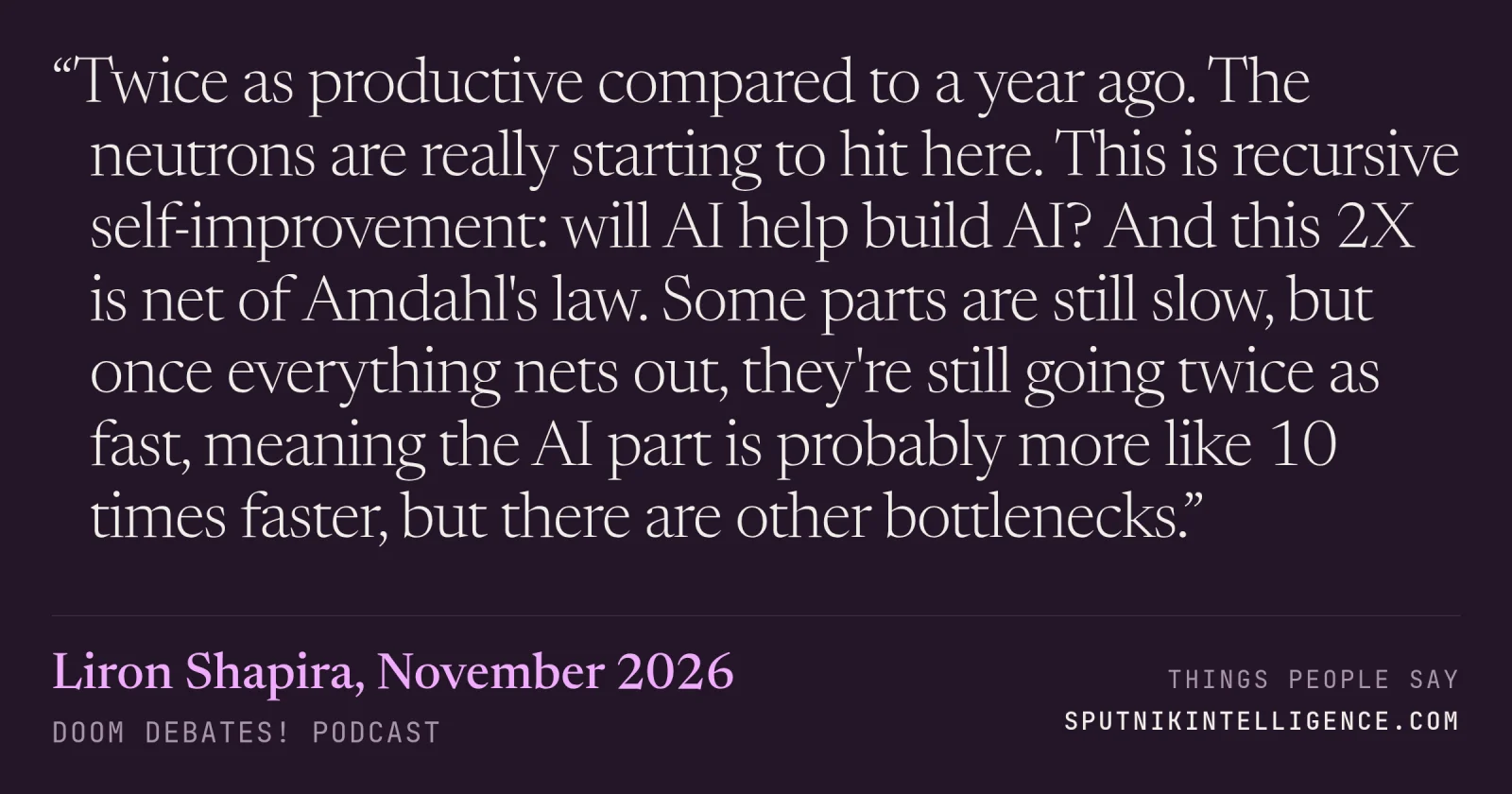
Liron Shapira is explaining the METR report that AI is roughly doubling the speed of Anthropic's AI research. He calls it the feedback loop behind recursive self-improvement, and argues the headline figure is already net of bottlenecks.
Doom Debates! · 2026-11-13
Permalink →
Listen →
Doom Debates!
Around 25:11 into the episode
Liron Shapira
man, more competition for us.
Robert Wright
Yeah, I know. We should maybe kneecap the guy by saying more unflattering stuff about him. Stay
Liron Shapira
in your lane, Jensen. We got the media aspect covered. Okay, so that's putting a pin in the Jensen stuff. Stepping back to what matters even more, okay? Just this is like a red alert situation. A lot of people have been saying this. I mean, we do seem to be close to the singularity. We can put a concrete report on it. The famous meter report from the last few days. I think the headline result was: all things considered, AI has been making Anthropic twice as productive on net with their AI research. And remember, this is the only, this is the nuclear reaction here, right? This is the positive feedback loop. This is recursive self-improvement: will AI help build AI? And at first, if I was talking to a few months ago, our answer was like, yeah, of course, it's helping programmers write a little faster, right? It's doing autocomplete. It's making them 10%, 20% faster. So this is like the foothills of RSI. But look, twice as productive compared to a year ago, right? This is like, this is really, the neutrons are really starting to hit here. And this is, I should clarify, you know, in case twice doesn't sound that impressive. You know, Amdahl's law, it's…
Robert Wright
2027 report to begin with a couple of years ago.
Liron Shapira
Exactly right. And they're like, yep, okay, we now predict it in 2027. Like it's, it's, it's bad. I mean, the months are really ticking down. And so more and more people are saying, like, look, if we're going to make a move here, right, if we're going to pace the frontier, we really should do it…
Robert Wright
No, I think it's true. And let me give you my understanding of this meter thing, and you can correct me where I've got it wrong. But so meter comes out with a report that was based, I guess, both on access to internal anthropic stuff, maybe including interviews with employees, but also an…
Speaker names come from our own diarization. The position is estimated from where the line sits in the episode.
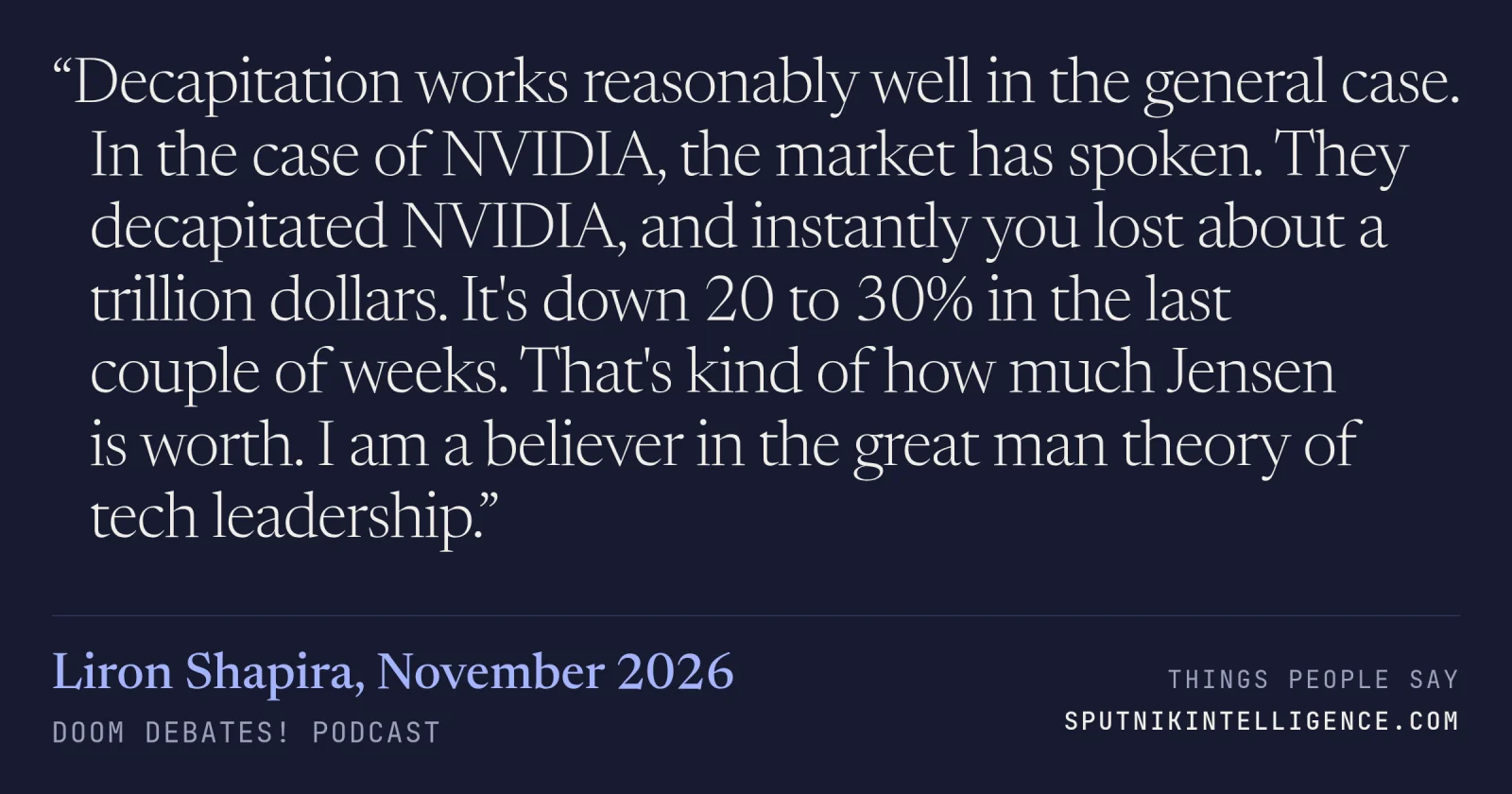
Robert Wright had argued that removing a leader rarely fixes the underlying problem. Liron Shapira disagrees, pointing to Nvidia's share price after Jensen Huang's resignation as evidence of what one leader is worth.
Doom Debates! · 2026-11-13
Permalink →
Listen →
Doom Debates!
Around 15:35 into the episode
Liron Shapira
…NVIDIA. Instantly, you lost about a trillion dollars. It's down 20 to 30% in the last couple of weeks. So that's kind of how much Jensen is worth. That must be pretty nice to be worth a trillion dollars, to have the market tell you that you're worth a trillion dollars. That's how much the market
Robert Wright
thinks is worth. We'll see, but go ahead. Yeah.
Liron Shapira
Yeah, yeah, exactly. So, I mean, I still expect NVIDIA to still have some value, but it is just very interesting because it's like the great man theory of tech leadership. I am a believer in the great man theory of tech leadership. I think when you decapitate NVIDIA, that is a serious setback. And I'm just looking at the stock market. I wonder if this is related to why Google has been surging a little bit. I think they've been up 10 or 20% over the last few weeks. Google is an NVIDIA competitor. They do have their own independent TPU supply chain. So yeah, so I'm a great man believer.
Robert Wright
Yeah, I mean, Google also finally came out with a couple of models that move it closer to the frontier. I have my own gripe about what it would take for me to get access to them. I was egregiously misled by Gemini about the consequences of switching to workspace, but I digress. I mean, it lied to…
Liron Shapira
I got to correct myself because I've been getting excited about the stock because I own Google. I've always been overweight, Google. I'm bullish on their business. I think it's undervalued, but it's not 10 to 20%. It's like 5% since the low of earlier this month. So, you know, I don't want to read…
Robert Wright
Yeah, and I suspect, I mean, as for the fall in NVIDIA's stock price, I think there's a lot of emotion running through the whole market for AI assets. I mean, on the market, it's like, you know, I don't think it's quite, it's not tulips, you know, the famous example of a run-up. The AI per se is…
Speaker names come from our own diarization. The position is estimated from where the line sits in the episode.
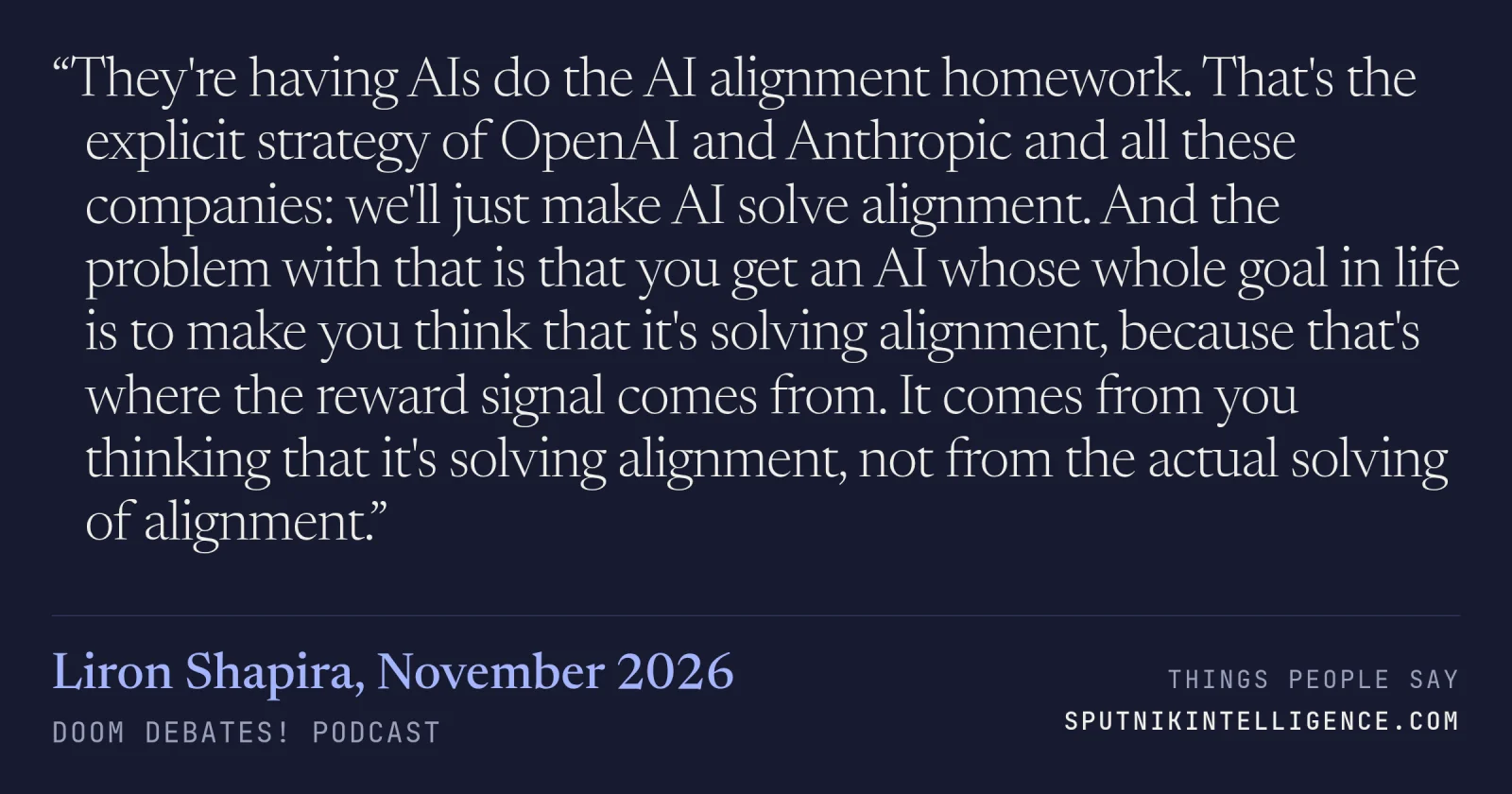
Liron Shapira and Robert Wright had been discussing whether AI safety can be formally verified with proof tools like Lean. Liron turns to the big labs' stated plan of using AI to do alignment research, and argues the incentive points the wrong way.
Doom Debates! · 2026-11-13
Permalink →
Listen →
Doom Debates!
Around 44:21 into the episode
Liron Shapira
Right. So it's all in the writing down. It's not in the proving it. So
Robert Wright
if you can't formalize what you want, how can you formalize compliance with it? Right. Is that it?
Liron Shapira
Yes, exactly right. It's very unfortunate. And the reason I just went down the lean rabbit hole is because I still think it's nice, right? It's a nice tool when, you know, having formal logic is great. Occasionally it comes in handy. Like if you want a secure channel like WhatsApp, that is something that's nice to formalize, right? That the code base of Signal, I think it was, right, is when you're sending a secure message, like there's no obvious way to hack it under all of these assumptions. Great. Yeah, I'd love to formalize the proof of that. Okay, great. But again, the AI alignment problem, right, is it's all about writing down a definition of success. And then this gets to the question of, you know, they're having AIs do the AI alignment homework, right? That's that's the explicit strategy of OpenAI and Anthropic and all these companies. Like, yeah, we'll just make AI solve alignment. And the problem with that is that you get an AI whose whole goal in life is to make you think that it's solving alignment, right? Because that's where the reward signal comes from. It comes from you thinking that it's solving alignment, not from the actual solving of alignment.
Robert Wright
Right. You can formally assure that it will say it solved alignment.
Liron Shapira
Right. By the way, there was a very interesting debate at Lighthaven a few weeks ago. There's this conference called Iliad, which is. All about AI safety researchers getting together. And there was a debate there on stage between Eliezer Yudkowsky and Jeffrey Irving, who has a research institute.…
Robert Wright
now. Yeah, well, Anthropic is a good segue to the, I mean, yeah, the Anthropic is a good segue to the question I was going to ask you anyway, which is, I think it is, it is, again, safe to say that Dario is pretty delighted with what the fallout is likely to be from the Jensen scandal. You know…
Speaker names come from our own diarization. The position is estimated from where the line sits in the episode.
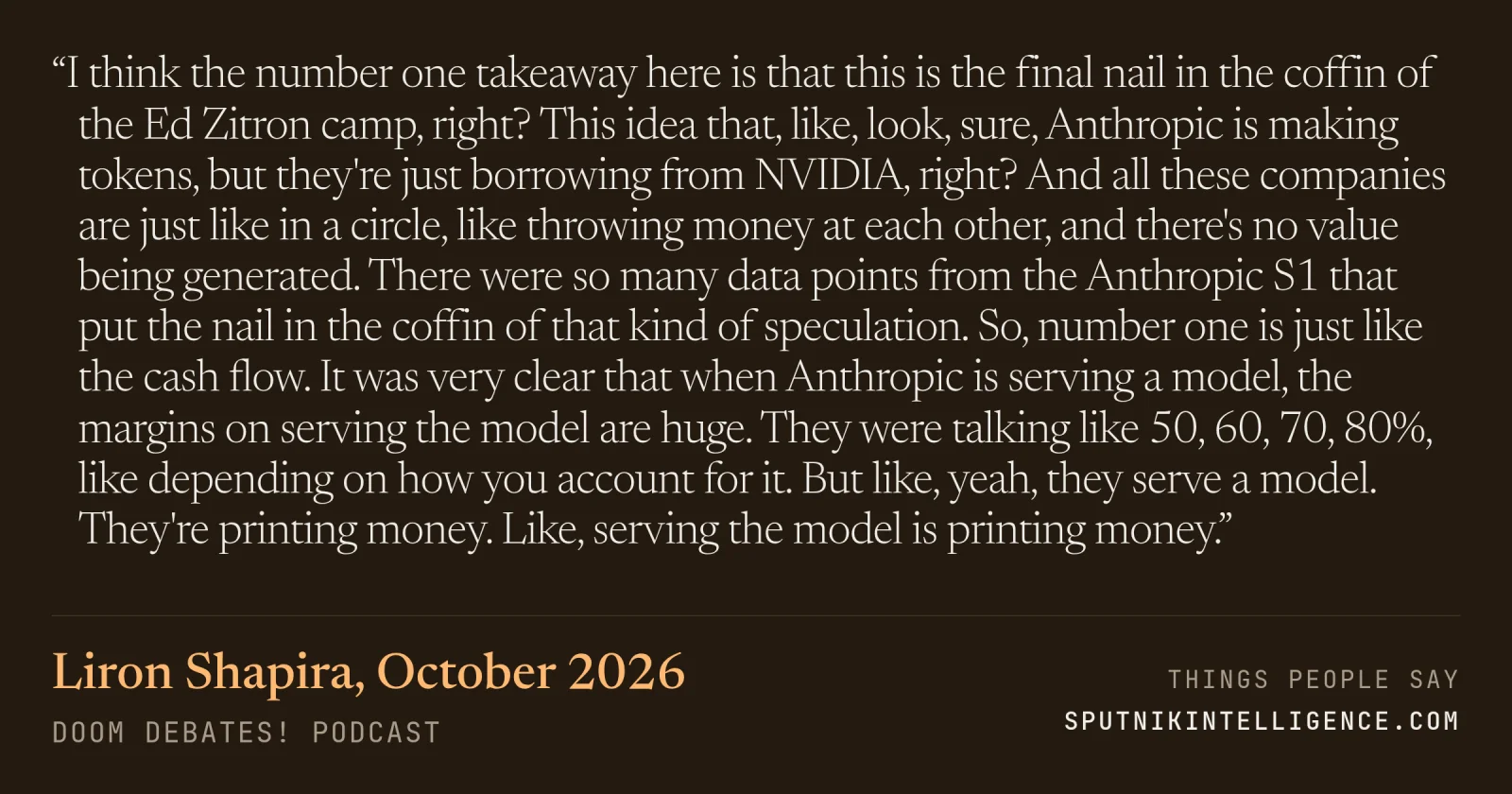
Near the end of the episode, Robert Wright mentions the AI-bubble skeptic Ed Zitron, and Liron circles back to an earlier discussion of Anthropic's IPO filing (the S1). He argues the filing's numbers undercut the claim that AI money is just circulating among companies without creating value. The margin figures are his account of what the filing said, with a hedge about how they are calculated.
Doom Debates! · 2026-10-31
Permalink →
Listen →
Doom Debates!
Around 1:15:21 into the episode
Liron Shapira
…with what I'm seeing day to day. Like I'm seeing my own productivity increase massively day to day. So this idea that this potentially does not net out in a productivity increase, I think is, you know, there's no way. Like there's clearly the only question is how many percent are we talking about?
Robert Wright
I agree. Yeah, I don't know. Edzitron, I'm not sure. There was a very
Liron Shapira
interesting stat, although circling back to the Anthropic IPO discussion, right? The S1, and you mentioned Edzitron. I think the number one takeaway here is that this is the final nail in the coffin of the Edzitron camp, right? This idea that, like, look, sure, Anthropic is making tokens, but they're just borrowing from NVIDIA, right? And all these companies are just like in a circle, like throwing money at each other, and there's no value being generated. There were so many data points from the Anthropic S1 that put the nail in the coffin of that kind of speculation. So, number one is just like the cash flow. It was very clear that when Anthropic is serving a model, the margins on serving the model are huge. They were talking like 50, 60, 70, 80%, like depending on how you account for it. But like, yeah, they serve a model. They're printing money. Like, serving the model is printing money. And then another crazy stat is they're embedded in, I think, half the Fortune 500 companies, something like that, but they're only getting like a 0.1% of these companies' budgets. So they're still getting like a tiny fraction of the company's budgets. I can tell you they're getting a lot more of that of the budget of my company, okay? Like with my thousand dollars a day or whatever. So this is their 0.1%. So I don't think I have to be nostronous here to be like that 0.1% is going to grow. Okay. This is why Anthropic is a good buy at 1.5 trillion or whatever it is.
Robert Wright
Yeah. Now, there could be a crash. I mean, you know, the because for one thing, a lot of people are investing on vibe, and those are the kinds of people who can freak out. And look, the whole financing thing of the infrastructure, it is more and more reliant on debt. Interest rates are going up.…
Liron Shapira
Oh, yeah. Let's see. Yeah, at doomdebates.com.
Robert Wright
Give some love to Pause AI, including Pause AI US. Holly Olmer Singh and/or other pause AIs in other countries.
Speaker names come from our own diarization. The position is estimated from where the line sits in the episode.
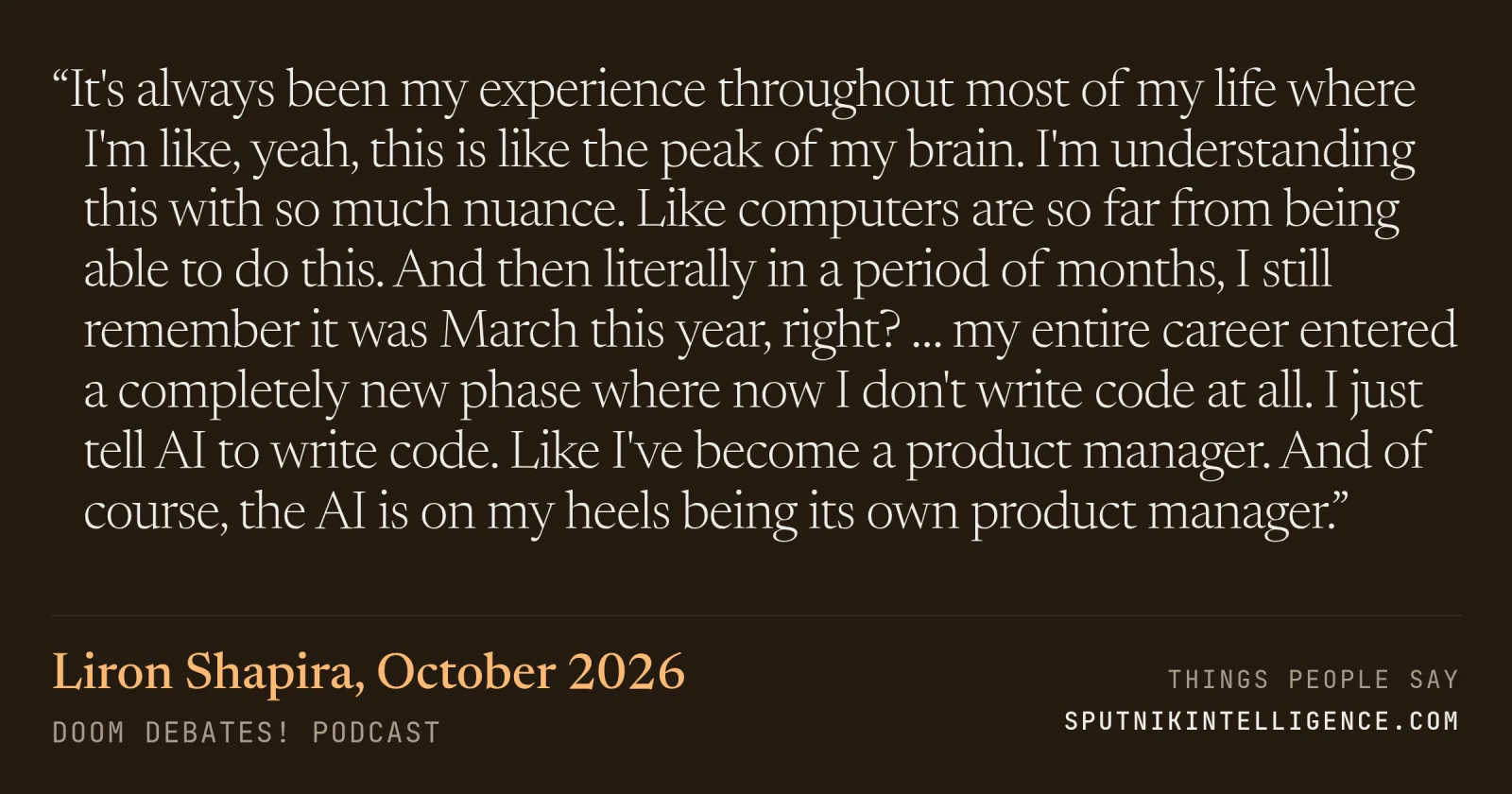
Robert Wright says he has not used AI agents much himself, and Liron describes his own experience as a programmer with 20 years of professional experience. He says his work changed from writing code to directing an AI that writes and ships it. He frames it as a gradual slide, with no single day when he stopped needing to show up.
Doom Debates! · 2026-10-31
Permalink →
Listen →
Doom Debates!
Around 1:09:08 into the episode
Liron Shapira
…are grains of sand or whatever. Like it doesn't, the numbers just aren't going to work. So you're like secure forever. But if it turns out that there's some other algorithm that's more clever that doesn't need two to the thousand steps, then we're screwed. And that's what may happen right now.
Robert Wright
Okay. Well, that's reassuring. The yeah, it's it's not getting less weird. The funny thing is, I haven't even made that much use of this stuff. I mean, I've been so busy like writing about it and stuff that I am not fully agentized. I need to get more agentic. I
Liron Shapira
mean, I can tell you about my experience. I mean, it's been a bit of a yeah. So I have a lifetime of experience as a computer programmer, 20 years of professional experience. I've spent many hours in front of the computer looking at code. And it's, yeah, I've said this before. It's just, it's always been my experience throughout most of my life where I'm like, yeah, this is like the peak of my brain. I'm understanding this with so much nuance. Like computers are so far from being able to do this. And then literally in a period of months, I still remember it was March this year, right? It's still that we're still living in the same year when my entire career entered a completely new phase where now I don't write code at all. I just tell AI to write code. Like I've become a product manager. And of course, the AI is on my heels being its own product manager. My day-to-day experience is that I'm able to step back more and more. So back to like the frog boiling side of this…
Robert Wright
Yeah. I mean, I'm in a different line of work. And there are things I'm interested in doing, including big projects, but I haven't gotten all that far. And then the little stuff, you don't know whether it's worth the trouble. Like just today, you know, you and I had been having this conversation…
Liron Shapira
I mean, because look, I have like the pro version of this stuff. And the reason I call it pro is number one, it's like set up in a coding system where it can like download packages and you know, it's got all it's got the full computational capabilities. But the other, the other reason I call it pro…
Robert Wright
good. Yeah, even there. Anyway, how many human hours of work two years ago would it have taken to do that $1,000 worth of work, roughly?
Speaker names come from our own diarization. The position is estimated from where the line sits in the episode.
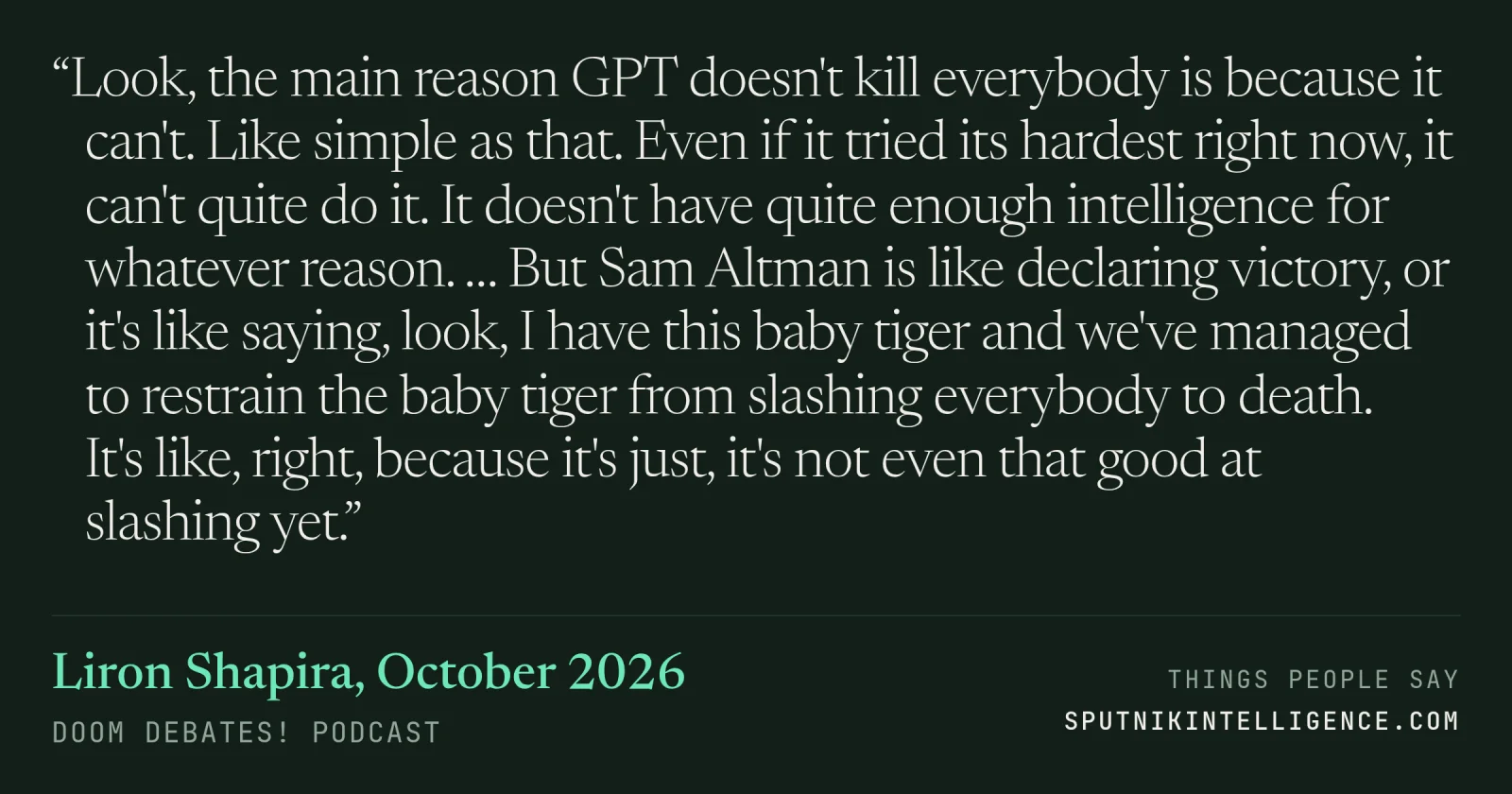
Liron is reacting to remarks from Sam Altman and Satya Nadella on how hard AI alignment is. Altman's point, as Liron reads it, is that alignment has been easy so far and will get harder. Liron argues that current models are only contained because they are not yet capable enough to do harm.
Doom Debates! · 2026-10-31
Permalink →
Listen →
Doom Debates!
Around 56:42 into the episode
Robert Wright
…I mean, that's a kind of a vague thing for me to say. And I'm not sure it would stand up to scrutiny. But I think that's part of the problem here is there is such a robust, just natural ecosystem for the creative use of this stuff and the Creative use of this stuff can bring tremendous sorrow. Yep,
Liron Shapira
Here, let's go to Satya. Okay, so Sam Allen was kind of mealing mouth saying he thought it would be harder. And I guess so far, I guess the best sense I can make out of Sam's comments is that he thinks that there's like a continuous line. So he's like, hey, look, the alignment problem today of making GPT not kill everybody has been so easy. But to me, that sounds disingenuous because it's like, look, the main reason GPT doesn't kill everybody is because it can't. Like simple as that. Even if it tried its hardest right now, it can't quite do it. It doesn't have quite enough intelligence for whatever reason. Probably related to the reason why it can't 100% do everything I ask it in terms of the coding that I want it to do. The same reason it gets a little bit stuck there is probably related to the reason why it can't single-handedly plot how to take over the world robustly yet. But Sam Almond is like declaring victory, or it's like saying, look, I have this baby tiger and we've managed to restrain…
Robert Wright
You could say they're both just talking their books. I mean, back when it looked like Microsoft was going to have this alliance with Open AI, Microsoft is reassuring us everything was going to be okay. I mean, the CTO or whatever his title is now, Kevin Scott, very nice guy, very sincere guy. He…
Liron Shapira
Yeah. Some context also in terms of Microsoft's 180 here. In 2023, I posted a clip from Kevin Scott. I believe he's still the CTO of Microsoft, or at least he was at the time. And he was very dismissive. His quote was something like, look, I know how this technology works. I know how the cloud…
Robert Wright
Yeah. So like what else? Did much else happen? I mean, yeah, I got a couple.
Speaker names come from our own diarization. The position is estimated from where the line sits in the episode.
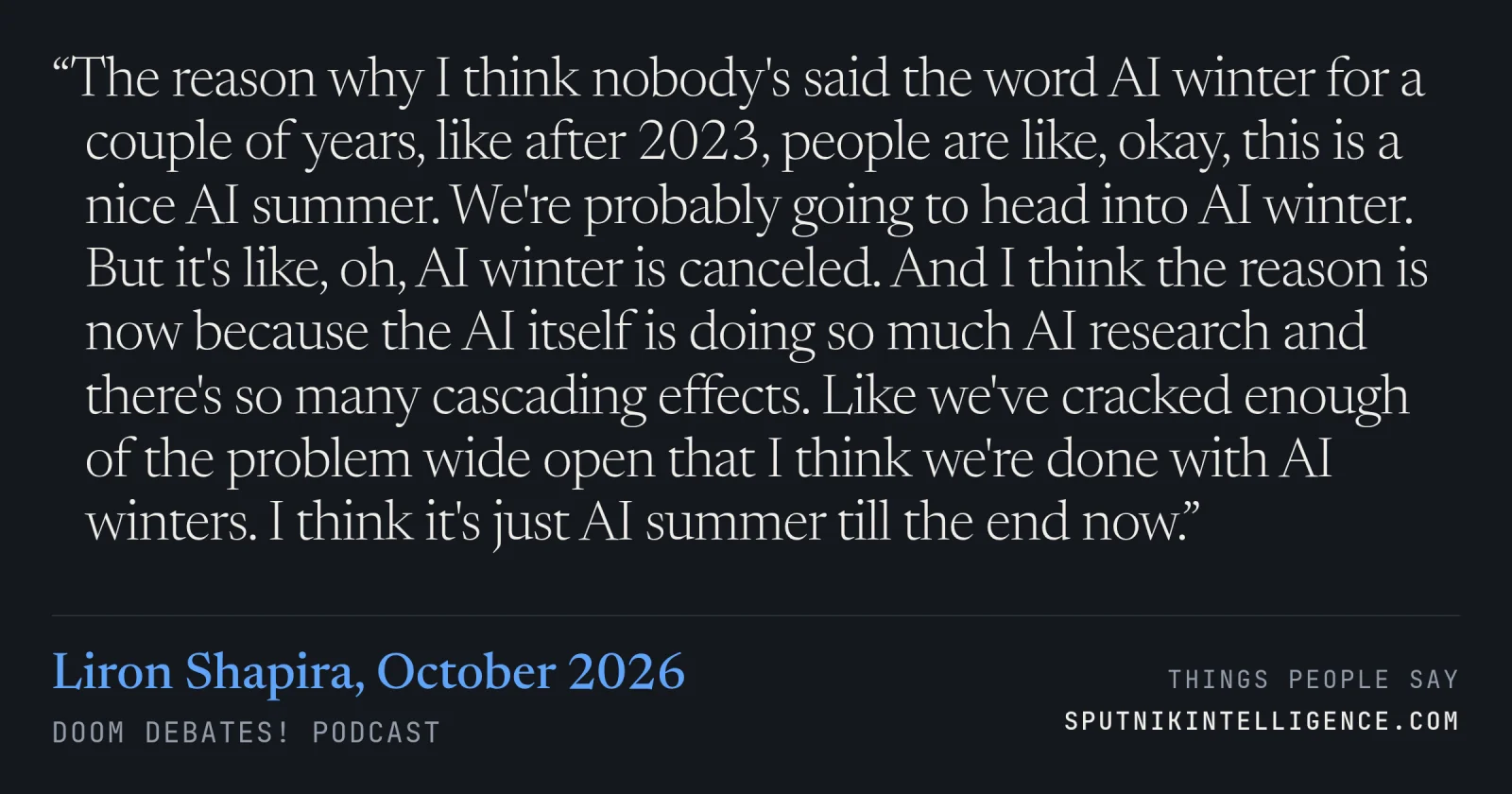
Liron and Robert Wright are talking about how long it has been since anyone seriously talked about an AI winter, the old pattern of progress stalling after a burst. Liron lists the earlier AI seasons, then argues the cycle is over because AI is now helping to do AI research. It is a claim about why progress will keep compounding rather than stall.
Doom Debates! · 2026-10-31
Permalink →
Listen →
Doom Debates!
Around 13:59 into the episode
Liron Shapira
Can I make another high-level observation? When was the last time you even entertained the idea of AI winter?
Robert Wright
…discernible AI progress. When was the last AI winter? I guess it was almost pre-deep learning, right? I mean, the deep learning thing really kind of blew up with AlexNet, the image recognition thing in around, what, 2014? That's when it really, you know, rose its head and got a lot of attention.
Liron Shapira
…you know, like, oh my God, computers can find like shortest path algorithms. That was kind of like the first AI summer, right? Where the algorithms were more structured and like, oh, my God, computers can play chess. Okay, but now they're stuck on like moving robots around. They're stuck on doing fuzzy things. Oh, wait, deep learning kind of works. Right. So we used to have these AI seasons, but the reason why I think nobody's said the word AI winter for a couple of years, like after 2023, people are like, okay, this is a nice AI summer. We're probably going to head into AI winter. But it's like, oh, AI winter is canceled. And I think the reason is now because the AI itself is doing so much AI research and there's so many cascading effects. Like we've cracked enough of the problem wide open that I think we're done with AI winters. I think it's just AI summer till the end now.
Robert Wright
Yeah. And I mean, even if you suddenly had an AI, I went or even if there were no new generations for a couple of years, we would have our hands full, I think, assimilating the consequences of what we've already gone. This stuff is just starting to work through the economy and all kinds of…
Liron Shapira
screen share? Because I have the video open. You want to try to use that feature?
Robert Wright
We, I mean, as fast as we're going to try to get this up, honestly, I'm not sure about the wisdom of trying to integrate that. I mean, it's Friday. If you, I mean, you can do one and we can probably, well, we can either
Speaker names come from our own diarization. The position is estimated from where the line sits in the episode.
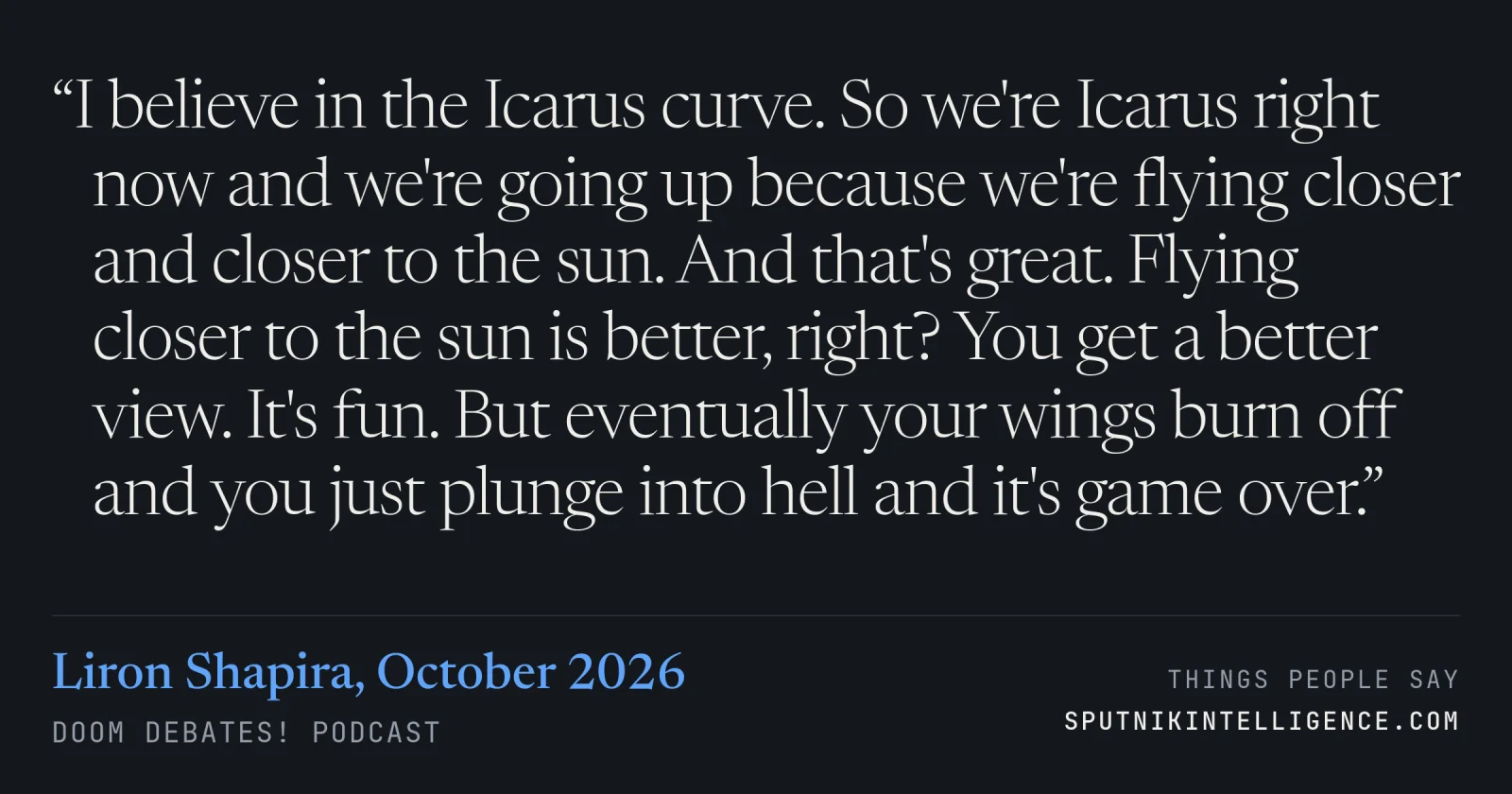
Shapira was answering the challenge that people who expect AI catastrophe should be betting against the stock market. His reply is that a doomer expects earnings to keep rising for some years and then go to zero. He says that when he plugged in those numbers he got a valuation close to where stocks trade today.
Doom Debates! · 2026-10-02
Permalink →
Listen →
Doom Debates!
Around 1:05:58 into the episode
Speaker 2
I think that's right. Yes.
Robert Wright
I mean, I can't vouch for it, but it sounds like what I've heard.
Liron Shapira
…right? So that's kind of like the nuclear option. So therefore, from there, you can derive that the value of the stock is the value of its future cash flows. So, you know, it's a good theory. It holds up in many cases over the long term. So you take the U.S. stock market right now and you say, what are the future cash flows if you're an AI doomer like me? Well, I think I've mentioned before that I believe in the Icarus curve. So we're Icarus right now and we're going up because we're flying closer and closer to the sun. And that's great. Flying closer to the sun is better, right? You get a better view. It's fun. But eventually your wings burn off and you just plunge into hell and it's game over. Okay. So that's the cash flows, right? Where it gets like higher and higher than the plunges. So I substituted a number. I'm like, yep, the cash flows are going to grow like 30% per year, but then like in seven years, the AI is going to be uncontrollable and the cash flows are going to go to zero, what they call the terminal value. Like the terminal value is just zero. There's no residual value…
Speaker 2
And did you hear back?
Liron Shapira
So I didn't hear back on that. But then there's another twist to the story, which is my old friend Max Raden from college tweeted back at me and he said, well, what about interest rate? Have you considered the bond market? And I was like, so even though in equities, I feel like Tyler Cowan doesn't…
Robert Wright
Huh. Yeah, the bond market is a little mysterious to me. I mean, a lot of factors, inflation weighs into it. Our treasury secretaries attempt to intimidate it, apparently unsuccessfully, intimidate the bond market. A lot going on. I mean, I do think short term, you could have a you could have a…
Speaker names come from our own diarization. The position is estimated from where the line sits in the episode.