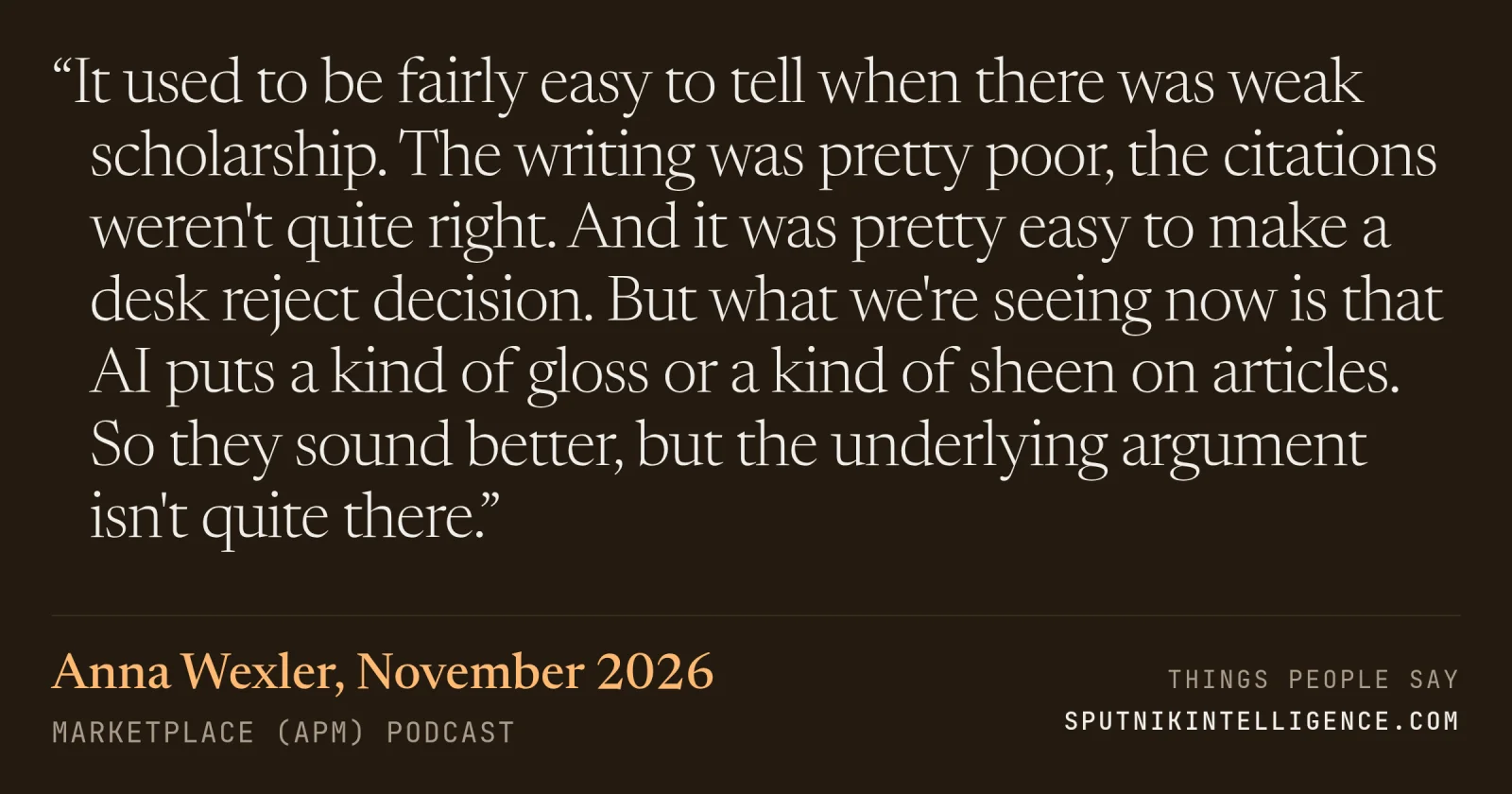
Wexler, a medical ethics professor and journal editor, was asked how submissions have changed. She says AI-assisted papers now read well but are hollow underneath, which makes weak work harder to screen out.
Thank you.
So you teach medical ethics and you're an editor at a bioethics journal. Tell me about how you've seen submissions change.
Yeah, so I think I've noticed a change just in the last few years. So what we're seeing is a lot more AI-assisted submission. So it used to be fairly easy to tell when there was weak scholarship. You know, the writing, you know, the writing was pretty poor, the citations weren't quite right. And it was pretty easy to make a desk reject decision for an article. But what we're seeing now is that AI puts a kind of gloss or a kind of sheen on articles. So they sound better, but the underlying argument isn't quite there.
Yeah, tell me about how this impacts your time, your work. What is it like to sift through all this?
It's really time consuming. I would say at a deeper level, it's also a little bit depressing and disheartening as an academic just to see, you know, some of my colleagues are submitting articles that are like this. Maybe, you know, I don't know how much they realize. And in academic scholarship…
What do you think this means for the credibility of published research?