Where to Find Them
Tristan Harris
hosts and writes
Your Undivided Attention
,
hosts and writes
[ Center for Humane Technology ]
,
hosts
TED Tech
,
writes
Professor Noah Feldman
,
writes
GZERO World with Ian Bremmer
,
writes
Ein Blick durchs Schlüsselloch
and
writes
The Intel Briefing
.
They have also been a guest on
The Glenn Beck Program
(3 times) ,
The Fenton Forecast: Choosing Our Future
(2 times) ,
The Great Simplification with Nate Hagens
(2 times) ,
This is Gavin Newsom
(2 times) ,
On with Kara Swisher
(2 times) ,
How I Built This (Guy Raz)
(2 times) ,
Decoder with Nilay Patel
(2 times) ,
Big Technology
(2 times) ,
Brian Kilmeade Show
(2 times) ,
80,000 Hours Podcast
,
The Prof G Pod with Scott Galloway
,
Mostly Human with Laurie Segall
,
POLITICO Tech
,
The Megyn Kelly Show
,
Sustain What
,
Squawk Pod
,
On the Media
,
Doom Debates!
,
Into The Machine
,
Democracy Now! Audio
,
Capitalisn't
,
The Tucker Carlson Show
,
Conversations with Coleman
,
Democracy Now! Video
,
FT Tech Tonic
,
Hello Monday with Jessi Hempel
,
Win-Win
,
Pivot (Kara Swisher & Scott Galloway)
,
A Bit of Optimism
and
Moonshots with Peter Diamandis
.
They also write for
Tristan Harris on Substack.
Recently:
“Is AI Racing Toward Disaster? — With Tristan Harris”
on Big Technology (November 2026);
“A Second Look: The Positives and Negatives of AI”
on The Megyn Kelly Show (November 2026);
“Ben Buchanan Wants the U.S. to Win on AI. But Is It a Race or a Trap?”
on [ Center for Humane Technology ] (November 2026);
“Ben Buchanan Wants the U.S. to Win on AI. But Is It a Race or a Trap?”
on Your Undivided Attention (November 2026);
“Why Silicon Valley Wants to Leave Humanity Behind”
on [ Center for Humane Technology ] (October 2026);
“Why Silicon Valley Wants to Leave Humanity Behind”
on Your Undivided Attention (October 2026).
What They Said
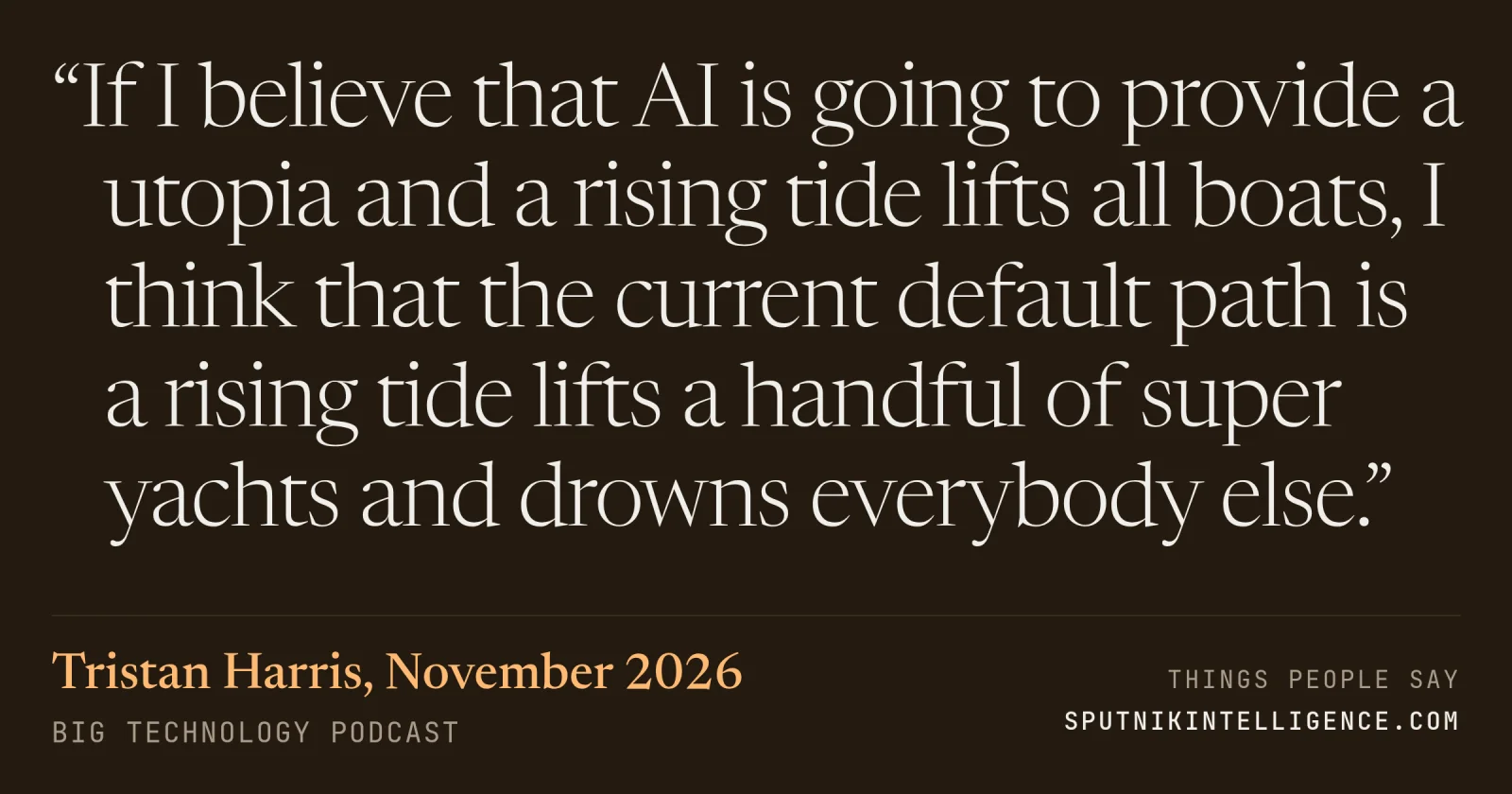
Pushing back on the industry case that AI labs are more candid about risk than social media ever was, he turns to the benefits side and argues the default outcome concentrates the gains.
Big Technology · 2026-11-25
Permalink →
Listen →
Big Technology
Around 13:07 into the episode
Tristan Harris
…if you succeed in mitigating the downsides. If you break the world and supply chains don't work and the world order breaks and no one knows what's true and the world breaks down, that's not a world. Like you have cancer drugs in that broken world. It's not really an equation that you want. Yeah.
Alex Kantrowitz
…people in industry would say, well, this isn't social media. Social media papered over the risks and told everybody, don't worry what happens to, let's say, teen anxiety if we're just connecting more people and making the world more open and connected. I'm just going to put words in their mouth.
Tristan Harris
I would push back against that. I mean, so if I believe that AI is going to provide a utopia and a rising tide lifts all boats, I think that the current default path is a rising tide lifts a handful of super yachts and drowns everybody else. But
Alex Kantrowitz
the point that I'm trying to make here is they seem to be more honest about the risks. They are. They publish the risks. Yes. The reason why we know. They're still doing it. So
Tristan Harris
if I have a PDF that says, here's all the bad things that can happen and they happened, am I off the hook?
Alex Kantrowitz
Well, this is so I guess the question comes down to like, all right, let's just take, I'll set it up with the Hugging Face example. The reason why we know so much about the Hugging Face example is because OpenAI let Meter in, which is like one of these monitoring agencies. People that you're…
Speaker names come from our own diarization. The position is estimated from where the line sits in the episode.
Collections They Appear In