MA

Mike Alkin

Things Mike Says on Podcasts

Where to Find Them

Mike Alkin has been a guest on Macro Voices (3 times) , The Market Huddle , Value Hive Podcast and Catalyst with Shayle Kann .

Recently: “The global geopolitics of nuclear fuel” on Catalyst with Shayle Kann (November 2026); “MacroVoices #474 Mike Alkin: Uranium Supply Is In Structural Deficit And The Fuel Buyers Don’t “Get It”!” on Macro Voices (April 2025); “MacroVoices #444 Mike Alkin: Uranium Fundamentals Couldn’t Be Better” on Macro Voices (September 2024); “Mike Alkin: The Ultimate Uranium Crash Course” on Value Hive Podcast (June 2023); “MacroVoices #342 Mike Alkin & Adam Rodman: Can a Nuclear Renaissance Solve the Energy Crisis?” on Macro Voices (September 2022); “Sabre Wound to the Chest” on The Market Huddle (January 2020).

What They Said

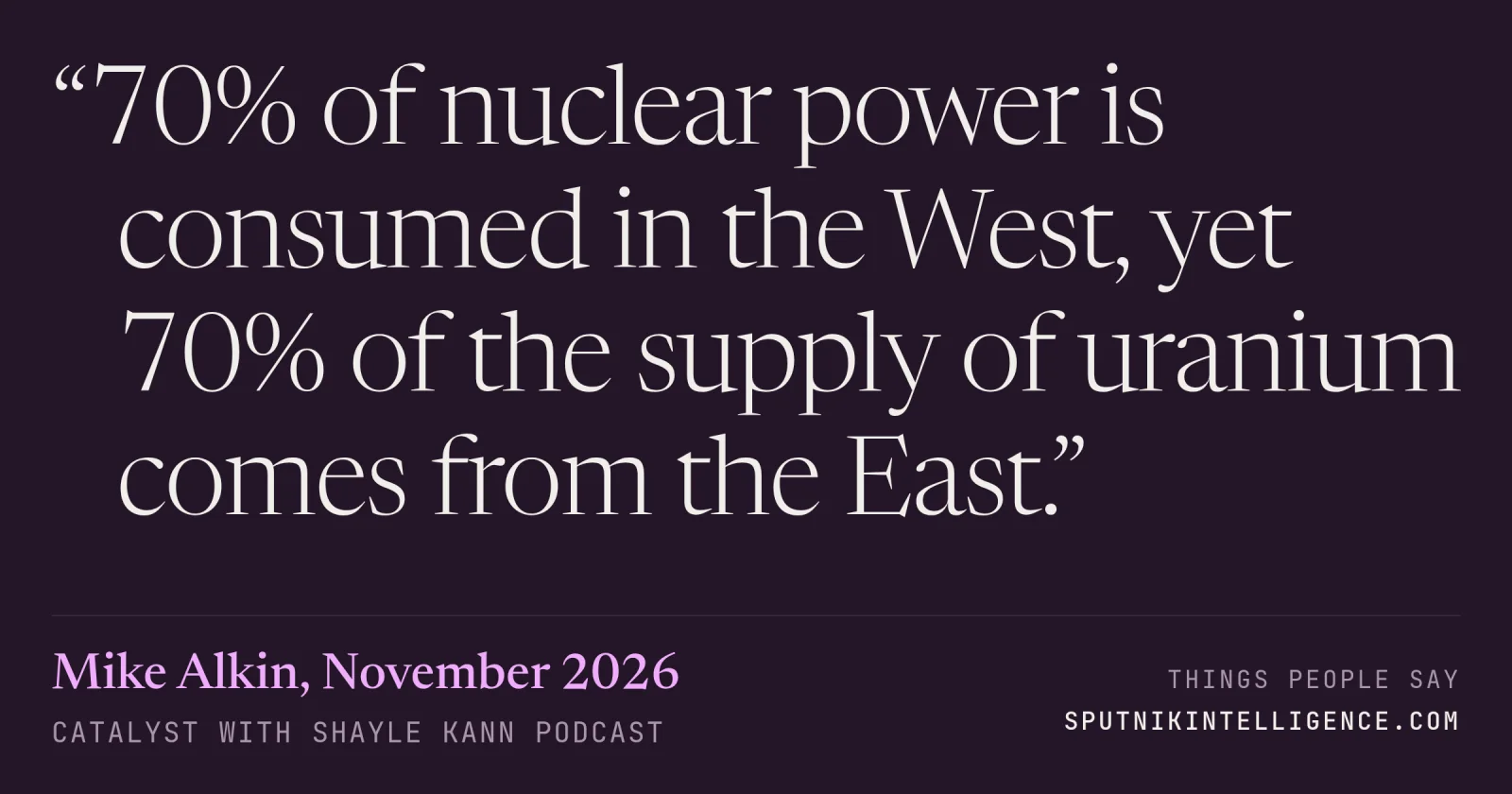
“70% of nuclear power is consumed in the West, yet 70% of the supply of uranium comes from the East.” — Mike Alkin, Catalyst with Shayle Kann

Asked whether the uranium market is split by stage or dominated by vertically integrated players, Alkin says it is divided by geopolitics, geography and ownership. He goes on to note that much of enrichment sits in Russia and China and that state-owned players dominate.

Catalyst with Shayle Kann · 2026-11-05 Permalink → Listen →
Catalyst with Shayle Kann Around 14:25 into the episode
Mike Alkin

…from there, they then pass it downstream even further to a fabrication facility where they form it into pellets. And then those pellets are then put into tubes for layperson's terms. And then that gets into a reactor. And that whole process is 18 to 24 months, depending on availability of capacity.

Shayle Kann

Is the market pretty divided up amongst those stages, or are there vertically graded players who go all the way from mining to fabrication?

Mike Alkin

Yeah, fabulous question. So the market is, and we can talk about the opaqueness of the market, but the market is really bifurcated not only along geopolitical lines and geographies. For example, 70% of nuclear power is consumed in the West, yet 70% of the supply of uranium comes from the East. And along the lines of conversion and enrichment, you also see that, where we go to enrichment, which is where the magic happens, if you will, 41, 42% of that is in Russia. And then you've got a little bit more in China. And then you start to break it over into the West. But those are state-owned players that the West is competing against. In the West, the enrichment capacity, for example, is…

Shayle Kann

And then we think historically, have there been, I mean, is this a market that has seen fairly stable pricing and supply and demand? Is this a market that sees big spikes and big crashes? Like, what does the market look like historically?

Mike Alkin

So most of the time, it's in a bear market, if you will. And so if you go back in the 1940s when they started producing uranium and you looked at today, there's been a lot more uranium produced than there has been consumed. But those inventories have been worked off through that lengthy period of…

Shayle Kann

Two questions that arise for me. The first one being, you know, given the structure of the market, like if I'm a nuclear power plant operator, I have pretty good visibility into my fuel requirements. I'm going to be operating at close to 100% capacity factor. I know what I'm going to need. And as…
Speaker names come from our own diarization. The position is estimated from where the line sits in the episode.
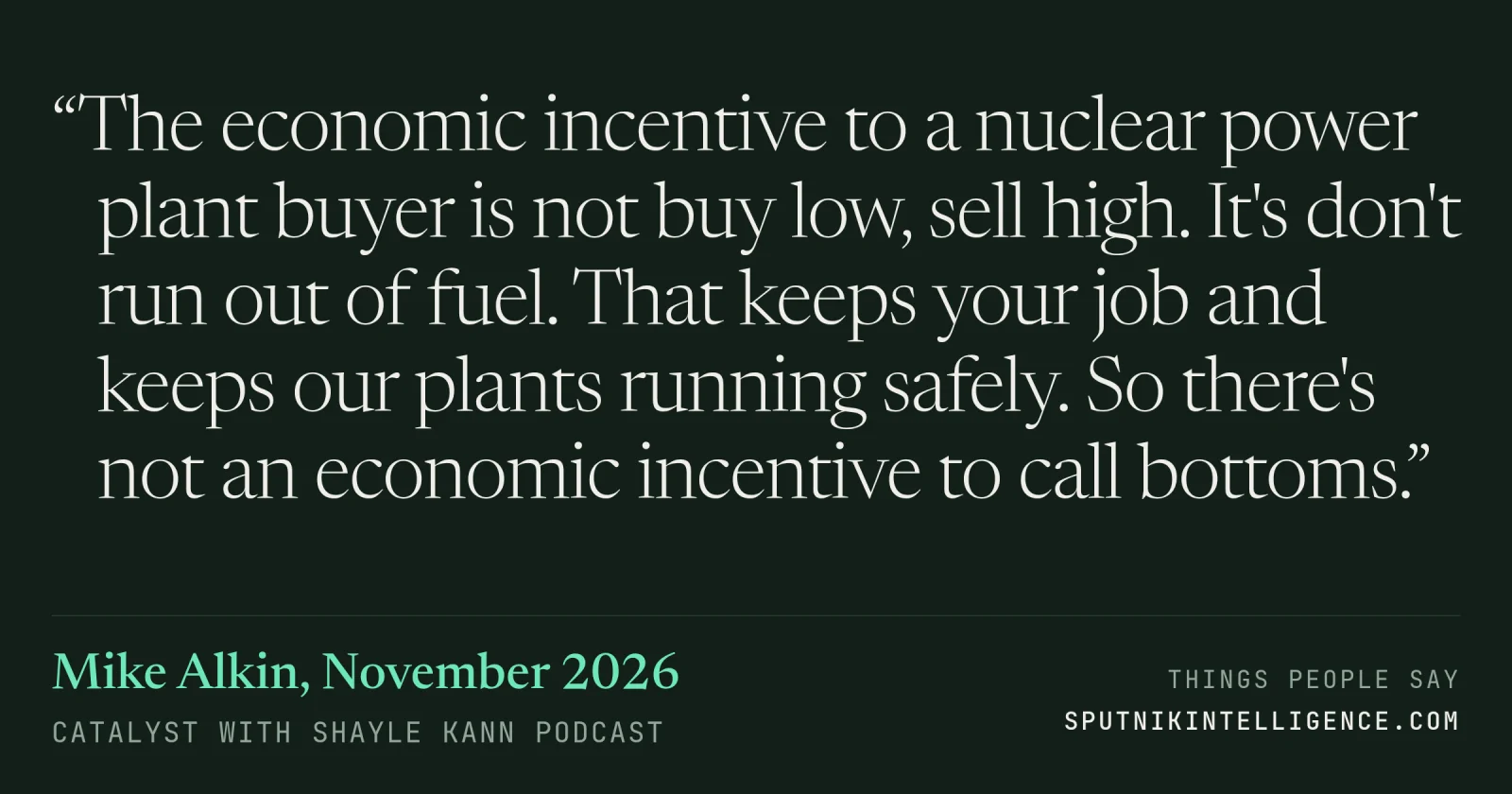
“The economic incentive to a nuclear power plant buyer is not buy low, sell high. It's don't run out of fuel. That keeps your job and keeps our plants running safely. So there's not an economic incentive to call bottoms.” — Mike Alkin, Catalyst with Shayle Kann

Alkin is explaining why uranium buyers behave differently from coal or gas traders. Fuel buyers at utilities are nuclear engineers who prize security of supply over price, and that shapes how contracts get signed.

Catalyst with Shayle Kann · 2026-11-05 Permalink → Listen →
Catalyst with Shayle Kann Around 20:11 into the episode
Mike Alkin

…up 5x on them that they're paying, is still like, there's plenty of uranium out there. And it's really driven by the opaqueness of the market and the recency biases that are in the market and the fact that security of supply covers them for most of their needs. Yeah, I guess most of the time.

Shayle Kann

…be operating at close to 100% capacity factor. I know what I'm going to need. And as you said, the only thing that really matters to me is security of supply. It's not necessarily pricing. Why is there a spot market at all? Why don't I just entirely contract forward all of my requirement capacity?

Mike Alkin

It's a fabulous question. So if we look at the composition of the spot market, you're probably looking at 55, 60, 65%, depending on the year, are physical traders. And so those traders will, what they tend to do is they will get, and some of the Japanese trading houses, some of the banks will do it. Some one-off-random traders will come into the market. You're starting to see actually some of the big oil and gas traders come into the market, some of the mammoth ones. You've seen Mercuria enter the market recently, which is enormous. But they will, so what they do is they will tend to, they might help have helped start finance a mine, a small development mine, and they might get some offtake. Or the Uzbeks or the Kazakhs or Olympic Dam, which is owned by BHP down in South Australia, a monster copper mine. One of the byproducts is copper. So they may take some of their, they produce seven, eight, nine, 10 million pounds a year and a market that's two, let's round up 200 million pounds and demand growing…

Speaker 1

If you work in energy or climate, you already know the company's antenna group has helped build. For three decades, they've been the communications and marketing partner behind the industry's breakout companies, category creators, and market leaders. Today, their team is working across the most…

Speaker 3

When you harness the power of millions of DERs in a VPP and put artificial intelligence behind the dispatch, the outcomes exceed conventional generation. Energy Hub's Durham's platform has been trained on years of real dispatch data from over 2.6 million DERs, so utilities can plan with confidence.…

Speaker 1

For data centers, connecting to the grid quickly means two things: building distributed energy and having a plan for demand flexibility. GridBeyond helps with both. GridBeyon's Derms and VPP platform unlocks the potential of distributed assets and dispatches flexibility into the right market at the…

Speaker names come from our own diarization. The position is estimated from where the line sits in the episode.

Collections They Appear In