HS

Henry Shukman

Things Henry Says on Podcasts

Where to Find Them

Henry Shukman has been a guest on The Tim Ferriss Show (9 times) , The Blog of Author Tim Ferriss (2 times) , Kevin Rose and Flow Radio .

Recently: “The Tim Ferriss Show Transcripts: Zen Master Henry Shukman on Love and Grief, Jhana 101, Ambition, and Poetry as a Shortcut” on The Blog of Author Tim Ferriss (November 2026); “Zen Master Henry Shukman on Love and Grief, Jhana 101, Ambition, and Poetry as a Shortcut (#891)” on The Blog of Author Tim Ferriss (November 2026); “#891: Zen Master Henry Shukman on Love and Grief, Jhana 101, Ambition, and Poetry as a Shortcut” on The Tim Ferriss Show (November 2026); “#850: The Peace That's Always Within You — Guided Meditation by Zen Master Henry Shukman” on The Tim Ferriss Show (January 2026); “#848: From Stress to Stillness — Guided Meditation with Zen Master Henry Shukman” on The Tim Ferriss Show (January 2026); “#846: Permission to Do Nothing — Guided Meditation with Zen Master Henry Shukman” on The Tim Ferriss Show (January 2026).

What They Said

“Poetry sort of broke its contract with the reading public sometime around the First World War.” — Henry Shukman, The Tim Ferriss Show

The host said he'd been put off by poetry that seemed written to impress other literati. The poet and Zen teacher agrees and dates the break.

The Tim Ferriss Show · 2026-11-25 Permalink → Listen →
The Tim Ferriss Show Around 53:26 into the episode
Henry Shukman

I know. Well, of course it doesn't with

Tim Ferriss

their, you know, the anointed few poetry literati. I was like, this is just too much. I was just like, yeah, I don't want any part of this.

Henry Shukman

I know. I mean, poetry sort of broke its contract with the reading public sometime around the First World War. You

Tim Ferriss

know, I want to give credit where credit's due. Another book that brought me back into poetry after I got fed up with the sort of self-appointed tastemakers with the unintelligible poetry as the kind of the limits test. I was at a checkout. I remember where I was. I was in Union Square in New York…

Henry Shukman

Right, right, right. That's beautiful. And, you know, there's something very, I don't know, ethically good about that kind of empathizing, you know, where it sort of breaks down our sense of separateness, just to feel through reading somebody else's life. You know what I mean? It's sort of, it's…

Tim Ferriss

Dashing my hopes upon the rocks.

Speaker names come from our own diarization. The position is estimated from where the line sits in the episode.
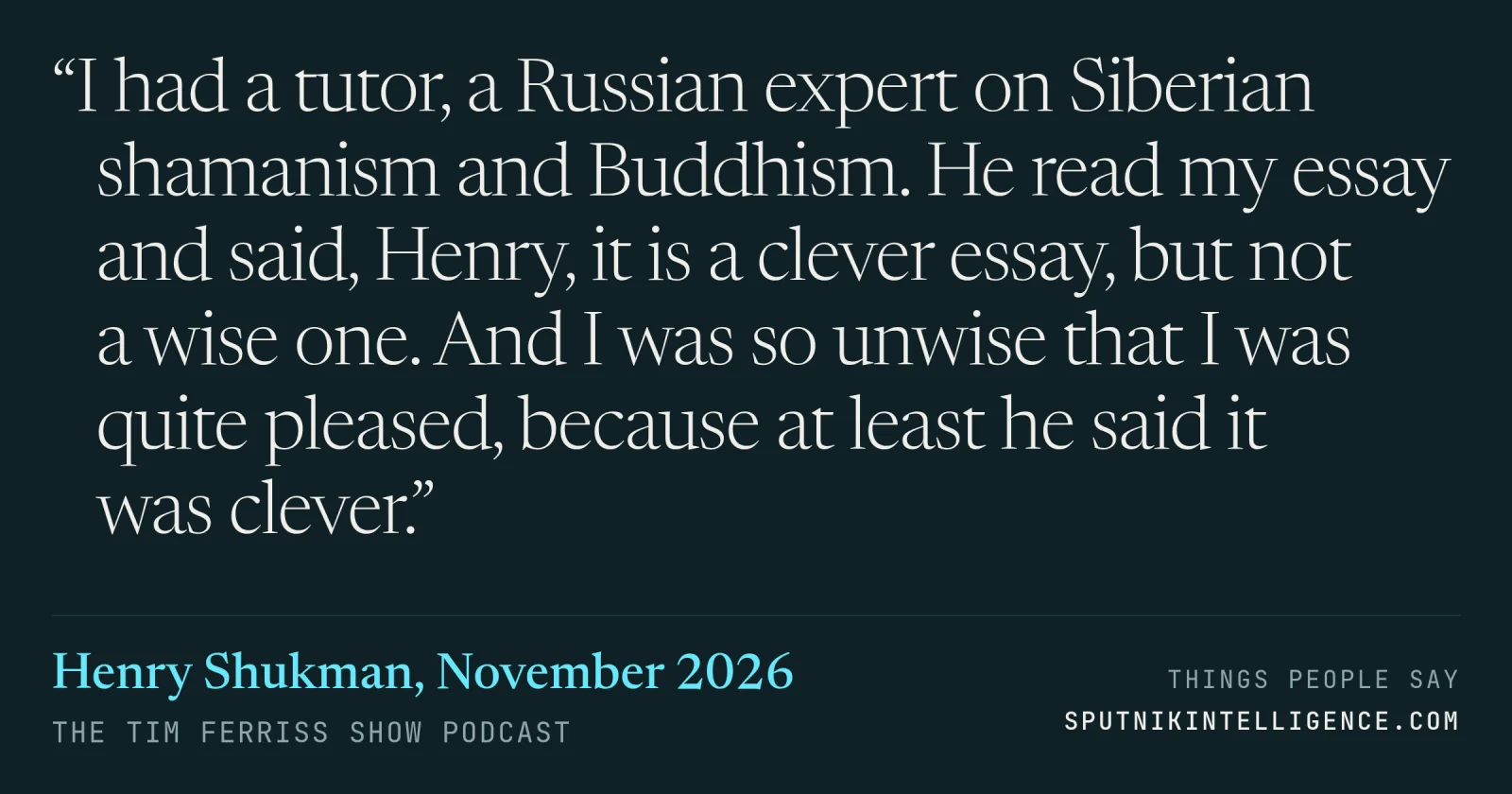
“I had a tutor, a Russian expert on Siberian shamanism and Buddhism. He read my essay and said, Henry, it is a clever essay, but not a wise one. And I was so unwise that I was quite pleased, because at least he said it was clever.” — Henry Shukman, The Tim Ferriss Show

The host brought up a line from Siddhartha about being careful of being too clever. He answers with a story from his abandoned PhD.

The Tim Ferriss Show · 2026-11-25 Permalink → Listen →
The Tim Ferriss Show Around 1:31:54 into the episode
Henry Shukman

Yeah.

Tim Ferriss

I think about that a lot.

Henry Shukman

You know, I had a tutor way back in the day when I was working on my PhD, which I abandoned, by the way, after a year. There was a thesis I'd written previously. He was this Russian guy who was an expert on Buryat, Siberian shamanism, and Buddhism, which have woven together in an interesting way. And he was a Soviet emigrant, come to fled, come to England in the 70s. Good friend of my mother's. And he said, he read this essay. He was this beautiful guy, Sasha Piatigorsky. He was at the SOAS, the School of Oriental African Studies in London. Anyway, he said, Henry, Genry, it is a clever essay, but not a wise one. That's good. And I was so unwise that I was quite pleased because at least you said it was clever.

Tim Ferriss

You're like, so you're saying I'm clever. All right, I'll take it. That's

Henry Shukman

how dumb I was.

Tim Ferriss

I do have a prompt here for myself, so I'm going to use it just in case there's something to mine here. Judeo-Christian time versus Buddhist/slash Vedic time. Anything to elaborate on there?

Speaker names come from our own diarization. The position is estimated from where the line sits in the episode.
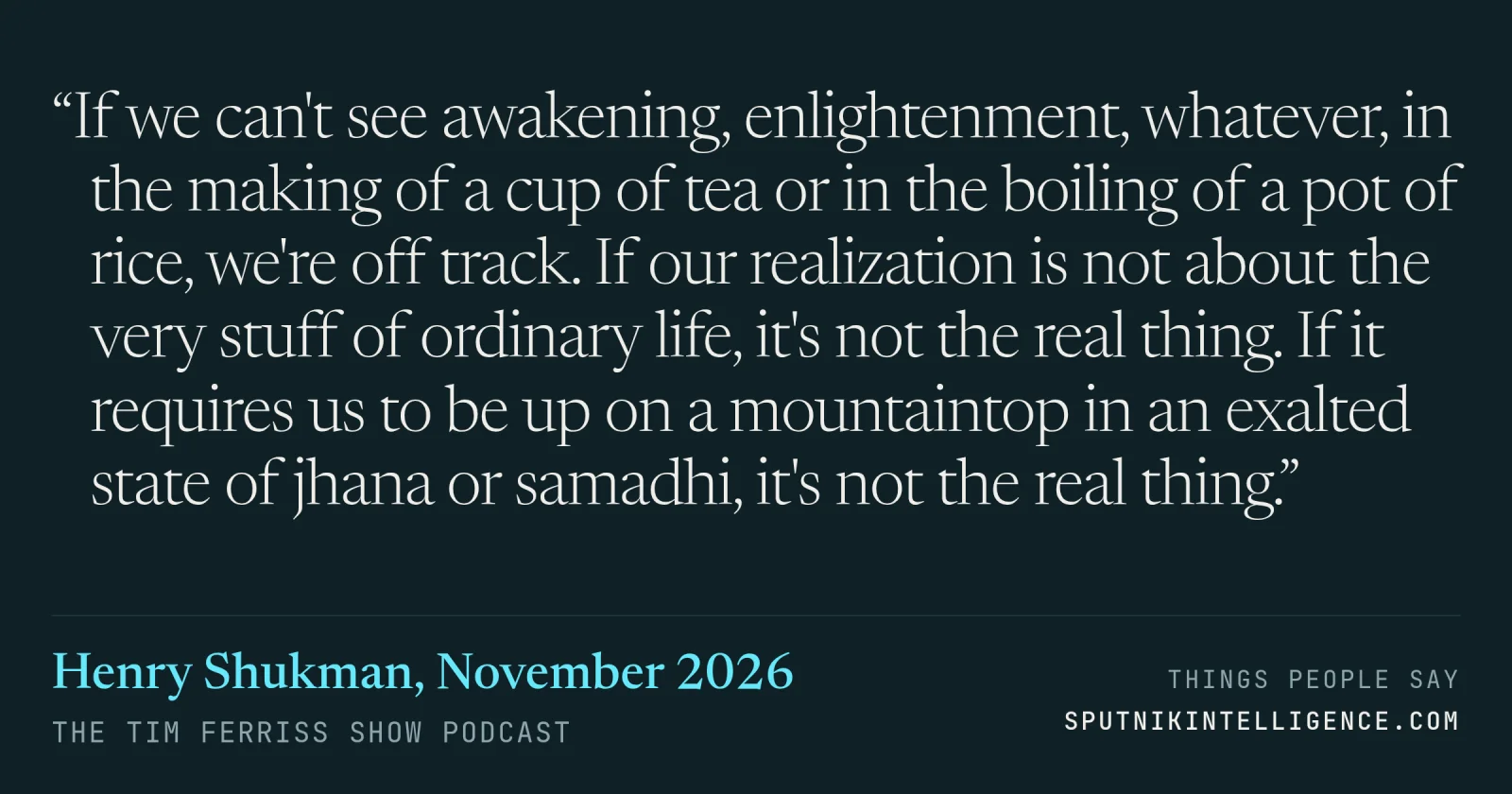
“If we can't see awakening, enlightenment, whatever, in the making of a cup of tea or in the boiling of a pot of rice, we're off track. If our realization is not about the very stuff of ordinary life, it's not the real thing. If it requires us to be up on a mountaintop in an exalted state of jhana or samadhi, it's not the real thing.” — Henry Shukman, The Tim Ferriss Show

After telling a classic Zen koan about rice in the bowl and water in the bucket, he says what it teaches about deep meditation states versus ordinary life.

The Tim Ferriss Show · 2026-11-25 Permalink → Listen →
The Tim Ferriss Show Around 2:13:48 into the episode
Henry Shukman

…quiet retreat center, you notice you're hearing, it almost seems like you're hearing a single leaf stirring in a wind. It gets very fine-grained. So it might mean something like that. And his answer is: okay, what is moment by moment samadhi? The Yunman says, rice in the bowl, water in the bucket.

Tim Ferriss

That's when the students are like, come on, you always do that. All right. Rice in the bowl, water in the bucket.

Henry Shukman

But you're right, actually. You always do that. It's exactly right. Zen is sort of, you know, it doesn't like to make a distinction. But it comes back to what we've been talking about. Doesn't like to make a distinction between whatever we might sort of realize, experience in meditation in our Zen training, between that and ordinary life. Ordinary life is actually the great teacher. If we can't see awakening, enlightenment, whatever, in the making of a cup of tea or in the boiling of a bowl of pot of rice, we're off track. If our realization is not about the very stuff of ordinary life, it's not the real thing. If it requires us to be up on a mountaintop in an exalted state of jhana or samadhi, it's not the real thing. There's actually some Zen poetry that's explicit about this. It says, if you've got it in a hermitage on a mountain, that's one thing. But until you've got it in a busy city street, you haven't really got it. Again, what I was saying earlier, like if we don't realize it's here right now, if we need to be in a special place in order to realize what the whole practice is about, we haven't fully got it.…

Tim Ferriss

It makes me think of this really funny portion of a Dharma talk that I was sitting in the audience for at Spirit Rock, and Jack Kornfield was telling the story. And I won't do it justice, but he was talking about this particular meditation retreat. And there was some really hot-headed guy who was…

Henry Shukman

Yeah. And, you know, I'll tell you what, one other thing about this cohen, rice in the bowl, water in the bucket, is that I feel when I say that phrase to myself in meditation, I drop down a gear. And I've heard that reported by many students. Just something about the simplicity of the words and of…

Tim Ferriss

What do you think is happening there?

Speaker names come from our own diarization. The position is estimated from where the line sits in the episode.
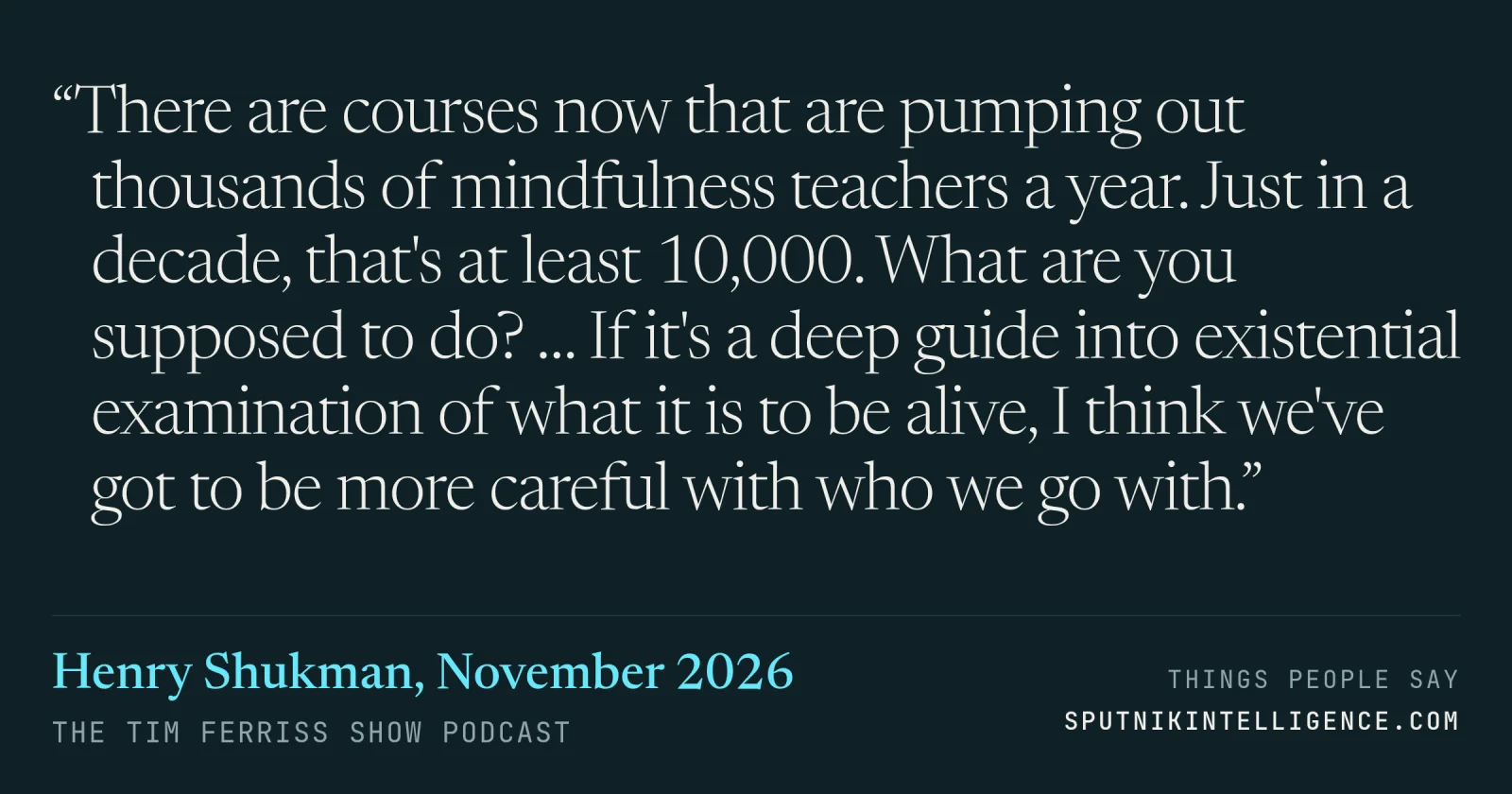
“There are courses now that are pumping out thousands of mindfulness teachers a year. Just in a decade, that's at least 10,000. What are you supposed to do? … If it's a deep guide into existential examination of what it is to be alive, I think we've got to be more careful with who we go with.” — Henry Shukman, The Tim Ferriss Show

Asked how you can judge a meditation teacher when you can't audit anyone's inner life, he separates low-stakes stress-reduction teaching from teaching that goes deep.

The Tim Ferriss Show · 2026-11-25 Permalink → Listen →
The Tim Ferriss Show Around 15:49 into the episode
Henry Shukman

Yes, sorry, I veered off the point of the question. How do you check for that? Probably

Tim Ferriss

pushed you pretty hard off of the track. You think after 850 episodes, I'd be more subtle about it.

Henry Shukman

…10,000. You know, what are you supposed to do? I mean, first of all, it really, there really are different kinds of practice. You know, to have somebody train you in sort of simple mindfulness to de-stress at the end of the day or once a week or something or at the end of a yoga class, whatever, that's not high stakes, really, you know, and probably lots of people could learn to do that. But if it's a deep guide into existential examination of what it is to be alive, I think we've got to be more careful with who we go with. There's no easy answers to this because I could say, like, it's better if they've got some tradition behind them that they've been trained in that's proven over millennia to have some sort of track record in this. But then again, there's all kinds of hazards with lineage and priesthoods and inherited power, spiritual authority. It's not a simple thing. So what I tend to feel is that if you can…

Tim Ferriss

Yeah, sure. I think it can be high stakes. I also think that, on one hand, you don't want to be forced into joining a community. But if you're this itinerant traveler who's dabbling, dipping their toe into 20 different approaches, it doesn't always add up to something useful. No,

Henry Shukman

well, that's true. Yeah, but I mean, I would say you shouldn't have to join a community just to do a practice more deeply. And I mean, to be honest, that's what attracted me to the Zen Master I wound up in is that there really wasn't anything to join. They met once a week for two hours, and four…

Tim Ferriss

if someone comes up to me and says that now, I would still be pretty skeptical.

Speaker names come from our own diarization. The position is estimated from where the line sits in the episode.
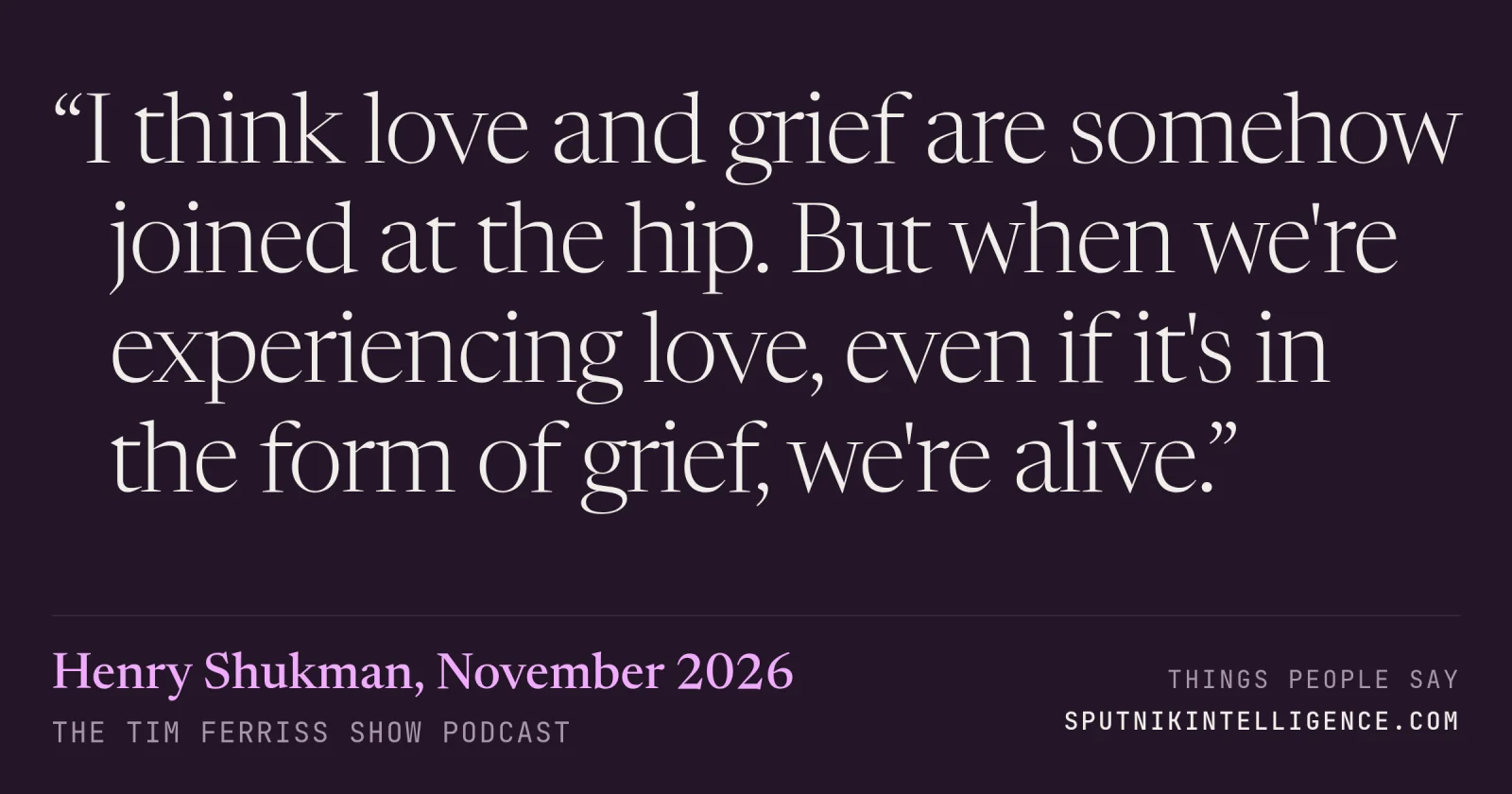
“I think love and grief are somehow joined at the hip. But when we're experiencing love, even if it's in the form of grief, we're alive.” — Henry Shukman, The Tim Ferriss Show

He was describing a painful period when someone he loves was gravely ill, and why he still calls the feeling place he lived in then a good place to be.

The Tim Ferriss Show · 2026-11-25 Permalink → Listen →
The Tim Ferriss Show Around 38:03 into the episode
Henry Shukman

…immediately brought into the present moment. And I'm feeling connected with this present moment because my heart's engaged. I don't know quite how to put it. It's a little bit nebulous, but it's unmistakable to me now. The difference between living in my head and my heart is unmistakable. I guess

Tim Ferriss

it's very hard to be stuck in the past or future trip if you're in your body.

Henry Shukman

That's right. Exactly. So that's part of it. But there's also something about the sort of the capacity for love, you know, both in its pleasant face of sort of joy and connection and in its more harsh or harder face of grief. I think love and grief are sort of somehow joined at the hip, I think. But when we're experiencing love, even if it's in the form of grief, we're alive. To me, it feels like I'm sort of then the sort of a more authentic me. I don't like to use the word soul very much, really, but it's sort of whatever soul might mean, not in some immortal sense, you know, but just a kind of more authentic, deeper self somehow is alive, is present. And that's why I started writing poems again. I think there was one particular morning when it really happened. We had to move down to Southern California to support family members having a hard time. I didn't really want to live in the outskirts of LA. I'd always been a…

Tim Ferriss

Let's do it.

Henry Shukman

It's called Slow. So that's the setup. I've literally just walked in the door back from the beach at dawn and recognized that I've been on a sort of autopilot to get home. So slow. The other me moves slowly. He looks at things a long time until he understands what he's looking at. Like this morning…

Tim Ferriss

I remember this poem from one of our retreats, Santa Fe. And the animal hide. I remember the animal hide. I remember a number of pieces of that poem. What part came to you first? I mean, there was the experience. So presumably that was the impetus for capturing that. And then it came in. But like…

Speaker names come from our own diarization. The position is estimated from where the line sits in the episode.
“Quite often you can see this with poets and writers: the thing they're best at is their second best thing. Housman was totally into Latin texts. That was his real thing. The poems were a sideshow, so they freely came, and they're still read 130 years later.” — Henry Shukman, The Tim Ferriss Show

His theory of where great work comes from: when the serious ambition sits elsewhere, the side project is free to become the best thing someone does.

The Tim Ferriss Show · 2026-11-25 Permalink → Listen →
The Tim Ferriss Show Around 1:13:06 into the episode
Henry Shukman

…bad place to wind up. That we should still honor the world and how it works. I mean, while also perhaps being activists and trying to make it a happier, fairer place, you know. But there's another point here that I want to make that I want to just explore, see if you're interested in it. It's okay.

Tim Ferriss

Sure.

Henry Shukman

It's this thing that quite often, not universally, but you can see this with a number of poets and writers and so on. That actually the thing they're best at is their second best thing. Now, what I mean by that is that, like, Hausman was totally into these Latin texts. That was his real thing that really mattered. The poems don't matter. They're a sideshow. So they freely come and they're marvelous and they live on 150 years later. People are still reading them or 130 years later. Wordsworth is a great example. He wanted to write this magnum opus, three-volume philosophical work in verse called The Recluse. And he wanted to start it with a little introductory thing called The Prelude because it was a prelude to the magnum opus. And the prelude just got bigger and bigger and better and better. And he never got to the three philosophical volumes. He only wrote the prelude, which has come down as one of the great works in the English language, Wordsworth's Prelude. But it wasn't the real thing. Leonard Cohen wanted to write the great Canadian…

Tim Ferriss

What do you do with that? I like this idea. Well,

Henry Shukman

I think that makes some

Tim Ferriss

sense to you. You see what I mean? But how do you harness that? How do you harness

Speaker names come from our own diarization. The position is estimated from where the line sits in the episode.
“I think this is where some quote-unquote enlightened teachers can go off the rails. It's all empty. So why shouldn't I abuse my students? … I'm enlightened, so I can do it. I've seen through the game, so I can just do whatever I want. I think that's a really bad place to wind up. We should still honor the world and how it works.” — Henry Shukman, The Tim Ferriss Show

In the same answer about seeing life as a game, he names the risk in the idea that everything is empty: teachers who use it to excuse harm.

The Tim Ferriss Show · 2026-11-25 Permalink → Listen →
The Tim Ferriss Show Around 1:12:15 into the episode
Henry Shukman

what should we do?

Tim Ferriss

I'm more curious how you think about it.

Henry Shukman

…way he put it, things appear as if they're appearing. We don't really know if they're really appearing, but they're appearing as if they're appearing. And we must treat them as if they're appearing. In other words, this world appearing the way it does, we may see through it in some way, and it's not quite what it seems, but we must still treat it on its own terms. Do you see what I mean? Like, I think this is where some quote-unquote enlightened teachers can go off the rails. It's all empty. So why shouldn't I abuse my students? And, you know, and all that bad stuff can happen because it's all empty. And, you know, and I'm enlightened. So I can do it. I've seen through the game. So I can just do whatever I want. I think that's a really bad place to wind up. That we should still honor the world and how it works. I mean, while also perhaps being activists and trying to make it a happier, fairer place, you know. But…

Tim Ferriss

Sure.

Henry Shukman

It's this thing that quite often, not universally, but you can see this with a number of poets and writers and so on. That actually the thing they're best at is their second best thing. Now, what I mean by that is that, like, Hausman was totally into these Latin texts. That was his real thing that…

Tim Ferriss

What do you do with that? I like this idea. Well,

Speaker names come from our own diarization. The position is estimated from where the line sits in the episode.
“If I dare to speak for Zen, it would be: just because it's a game, you still play it. Another Zen master in the lineage I'm in said that just because this whole world is a dream doesn't mean we shouldn't still work to make it a happier dream.” — Henry Shukman, The Tim Ferriss Show

The host described founders who have an awakening experience, realize their work is only a game, and then wonder how to go back to it on Monday. The Zen teacher answers by quoting a teacher from his own lineage.

The Tim Ferriss Show · 2026-11-25 Permalink → Listen →
The Tim Ferriss Show Around 1:12:15 into the episode
Henry Shukman

what should we do?

Tim Ferriss

I'm more curious how you think about it.

Henry Shukman

Yeah, if I dare to speak for Zen, it would be sort of like, just because it's a game, you still play it. Or as Yamado Cohen wrote she, another Zen Master Henry the lineage I'm in 20th century ago, he said, just because it's a dream, just because this whole world is a dream, doesn't mean we shouldn't still work to make it a happier dream, is what he said. And another Sheng Yen is a great Chan, 20th century Chan master. He said, just because things are arriving or appearing as if they're appearing, this is the way he put it, things appear as if they're appearing. We don't really know if they're really appearing, but they're appearing as if they're appearing. And we must treat them as if they're appearing. In other words, this world appearing the way it does, we may see through it in some way, and it's not quite what it seems, but we must still treat it on its own terms. Do you see what I mean? Like, I think this is where some quote-unquote enlightened teachers can go off the rails. It's all empty. So why shouldn't I abuse my…

Tim Ferriss

Sure.

Henry Shukman

It's this thing that quite often, not universally, but you can see this with a number of poets and writers and so on. That actually the thing they're best at is their second best thing. Now, what I mean by that is that, like, Hausman was totally into these Latin texts. That was his real thing that…

Tim Ferriss

What do you do with that? I like this idea. Well,

Speaker names come from our own diarization. The position is estimated from where the line sits in the episode.

Collections They Appear In