LN

Lindsey Nyx Walker

Things Lindsey Says on Podcasts

Where to Find Them

Lindsey Nyx Walker writes StarTalk Radio .

Recently: “Facts for Navigating the Universe with Charles Liu” on StarTalk Radio (November 2026); “Lost in Space Game Night” on StarTalk Radio (September 2026).

What They Said

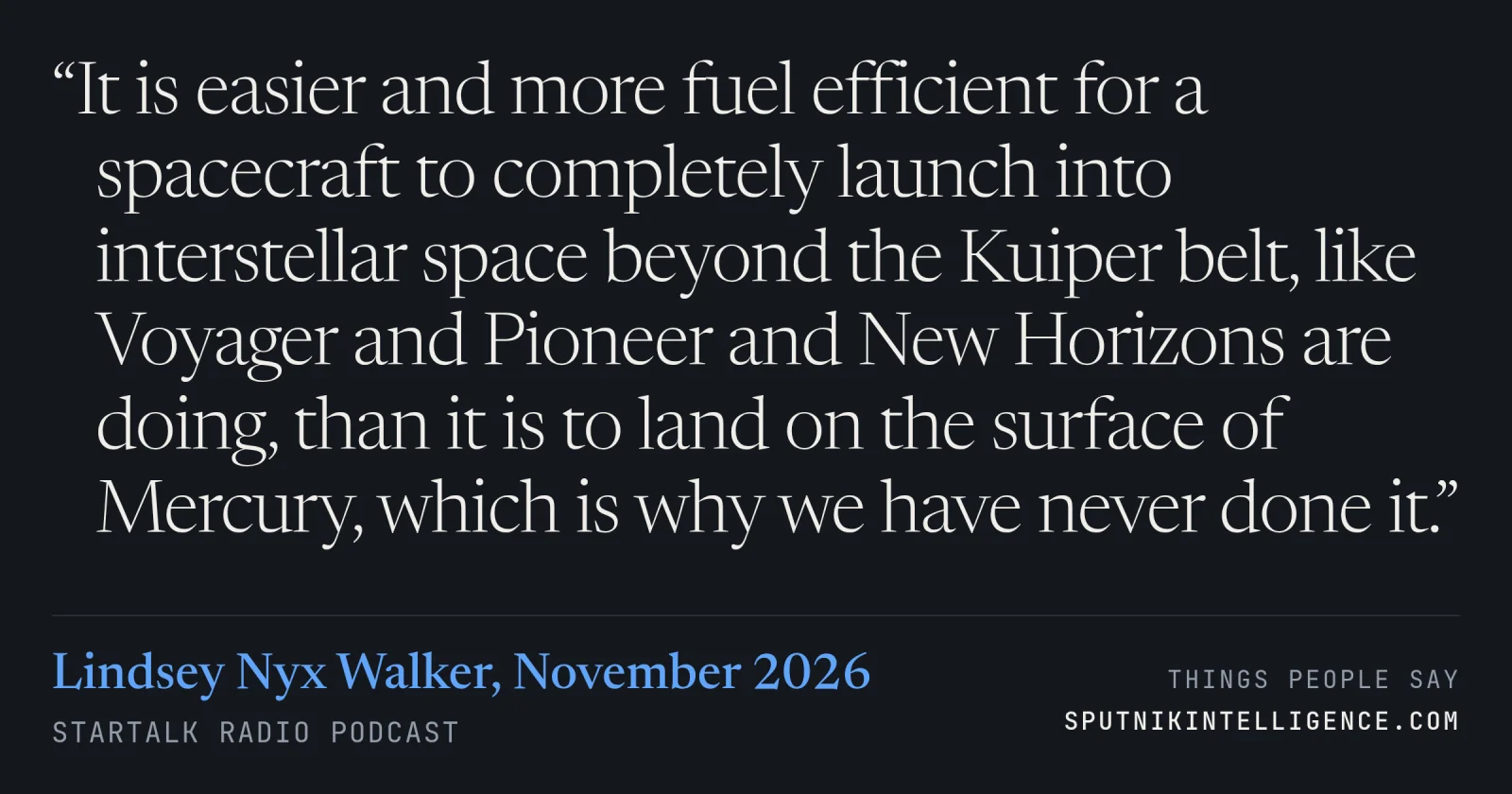
“It is easier and more fuel efficient for a spacecraft to completely launch into interstellar space beyond the Kuiper belt, like Voyager and Pioneer and New Horizons are doing, than it is to land on the surface of Mercury, which is why we have never done it.” — Lindsey Nyx Walker, StarTalk Radio

Asked which facts in the book still make her think "I cannot believe that's true," Lindsey picks Mercury. Spacecraft have to burn huge amounts of fuel braking against the Sun's pull to slow down enough to land.

StarTalk Radio · 2026-11-17 Permalink → Listen →
StarTalk Radio Around 27:32 into the episode
Neil deGrasse Tyson

…it would cycle back and forth, move through Earth like Swiss cheese, cutting holes through it until our entire Earth were consumed, and the black hole that started it would now be about twice the diameter for having consumed the entire Earth. Have a nice day. So avoid black holes, I think, is the

Paul Mecurio

between that and what's in my intestines. I'm really freaked out. So let's move to another theme in the book. And there's just so many wonderful ones here, which is surprise. What kind of facts make you think? I cannot believe that that's true. Lindsay, anything that hits you?

Lindsey Nyx Walker

I guess like what I'm hesitating about is that writing this book, the more, and the last book as well, and working at Star Talk for 12 years and being in the room with such brilliant people all the time, I hear incredible things about the universe constantly to the point where I'm like, why not? Why wouldn't it be like that? Like, how surprised should I be by this thing? And, but there are a few facts that I think, for whatever reason, struck me as just really strange. And one of them is: speaking of upcoming missions, we can keep on that theme. Missions to Mercury. Beppi Colombo should be arriving in Mercury's orbit in a couple of months. But here's the outstanding fact: it is easier and more fuel efficient to completely exit the solar system for a spacecraft to completely launch into interstellar space beyond the Kuiper belt, like Voyager and Pioneer and New Horizons are doing, than it is to land on the surface of Mercury, which is why we have never done it. And there are no plans to do it because it is that hard. It is really, really…

Neil deGrasse Tyson

Yeah, it's an inverse gravity assist. We normally think of gravity assists as propelling you. That's if you come in from behind, you sneak up behind the planet and you fall towards the planet, you eat up some of its orbital energy when you come out the other side. See,

Paul Mecurio

when you hear the word breaking in this context, it seems counterintuitive, but that's what you have to do. Yeah,

Neil deGrasse Tyson

exactly. So in this case, if you come towards the planet, you can eat up your energy to slow yourself down. So you can... Well, here's the problem. You're leaving from Earth. Earth has this orbital energy. So do you if you just left Earth? But
Speaker names come from our own diarization. The position is estimated from where the line sits in the episode.
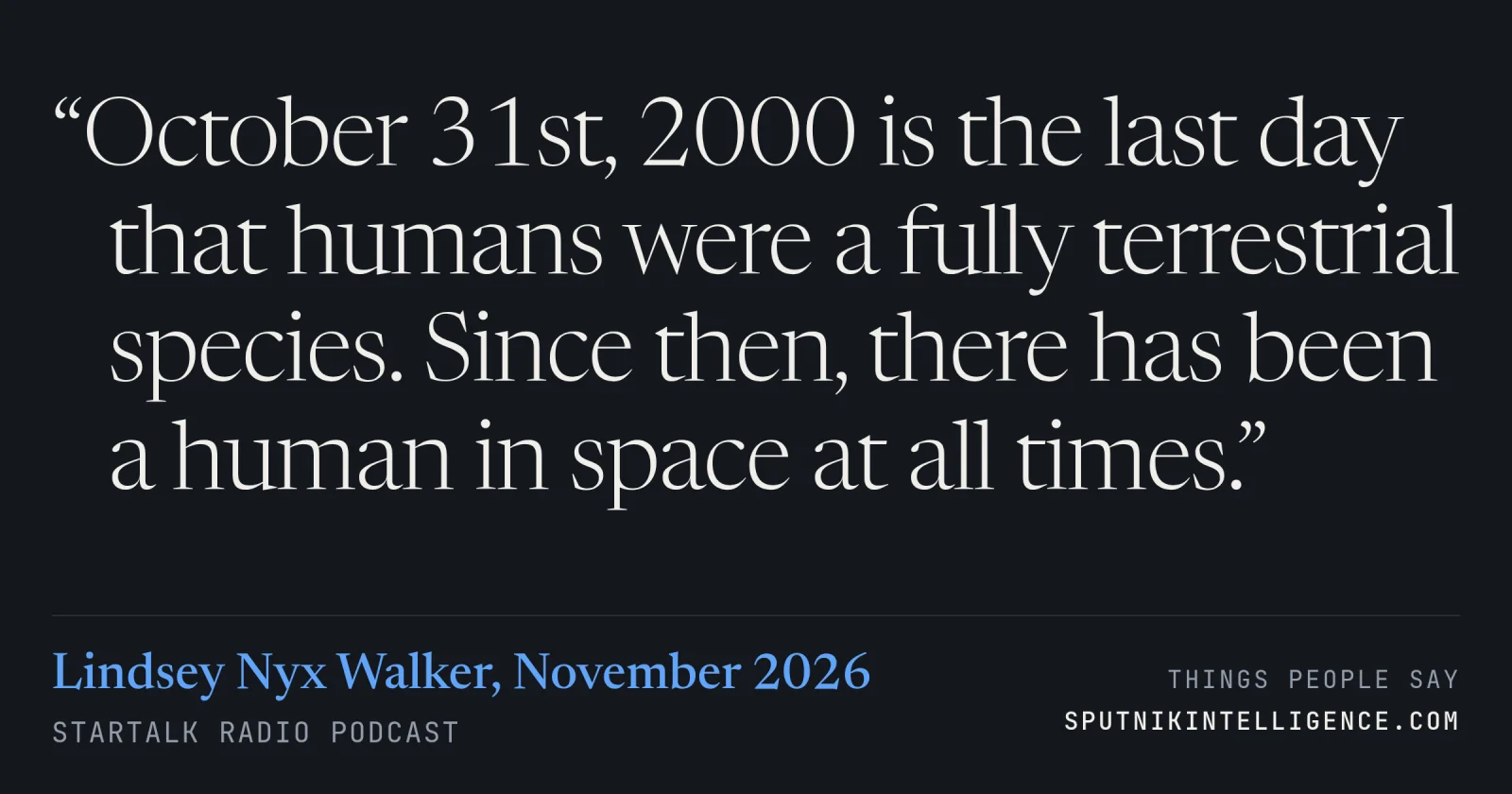
“October 31st, 2000 is the last day that humans were a fully terrestrial species. Since then, there has been a human in space at all times.” — Lindsey Nyx Walker, StarTalk Radio

Lindsey was showing how to turn a plain fact (the International Space Station has been inhabited since 2000) into one that says something about us. Neil said he hadn't heard it put this way.

StarTalk Radio · 2026-11-17 Permalink → Listen →
StarTalk Radio Around 05:56 into the episode
Lindsey Nyx Walker

…where am I in the universe? Why should I care about this? And what does it say about humanity in general? It has meaning, and so it's more than just true. And I think an example that comes to mind is you could say, it is a true fact that since the year 2000, the ISS has been inhabited by people.

Neil deGrasse Tyson

The International Space Station.

Lindsey Nyx Walker

Thank you. The International Space Station in orbit around Earth right now. But here's what that means. October 31st, 2000 is the last day that humans were a fully terrestrial species. Since then, there has been a human in space at all times. That's what that means. And that's a more StarTalkian fact.

Neil deGrasse Tyson

If you knew to ask that of Google or chat, it would give you that answer. But this book is ahead of you on that, taking you to places that you didn't even know you could have asked. So I didn't know that fact. Thanks for bringing it back to the table.

Charles Liu

Way to read your own book.

Paul Mecurio

But you can get your money back outside every day.

Speaker names come from our own diarization. The position is estimated from where the line sits in the episode.

Collections They Appear In