Nd

Neil deGrasse Tyson

Things Neil Says on Podcasts

Astrophysicist and director of the Hayden Planetarium at the American Museum of Natural History, who explains physics, cosmology and astrobiology to general audiences. Author of Astrophysics for People in a Hurry, Death by Black Hole and Space Chronicles. Hosts StarTalk as a podcast and National Geographic talk show, and hosted Cosmos: A Spacetime Odyssey and Cosmos: Possible Worlds. Appears as a guest on Moonshots with Peter Diamandis, Radiolab and The Michael Shermer Show.

Where to Find Them

Neil deGrasse Tyson hosts StarTalk Radio , writes The Michael Shermer Show , writes The Beat with Ari Melber , hosts and writes The StarTalker and writes Clock It with Symone & Eugene . They have also been a guest on Moonshots with Peter Diamandis (3 times) , Into the Impossible With Brian Keating (2 times) , Conversations with Coleman (2 times) , Barry Kibrick - Between the Lines (2 times) , The Origins Podcast with Lawrence Krauss (2 times) , Radiolab (2 times) , HBR IdeaCast , Why Should I Trust You? , Houston We Have a Podcast , Waveform: The MKBHD Podcast , PBS Space Time , Wild Thing , The Interview , Dan Harris , This Past Weekend w/ Theo Von , FranklinCovey On Leadership , Discovery , Within Reason and Skeptics Guide to the Universe .

Recently: “Cosmic Queries – Curiosity, Conspiracies & the God Particle with Jordan Klepper” on StarTalk Radio (November 2026); “Neil deGrasse Tyson On: Happiness, Seeking Friction, Getting Your Mind Blown, and Why Casinos Hate Physicists” on Dan Harris (November 2026); “The Habitable Worlds Observatory with Evgenya Shkolnik” on StarTalk Radio (November 2026); “Are We Living in an Ancestor Simulation? ft. Neil deGrasse Tyson | Space Time” on PBS Space Time (November 2026); “The Game Theory of AI with Aza Raskin” on StarTalk Radio (October 2026); “Bose-Einstein Condensate, Collisions, The Physics of Fire –TYTYK” on StarTalk Radio (October 2026).

What They Said

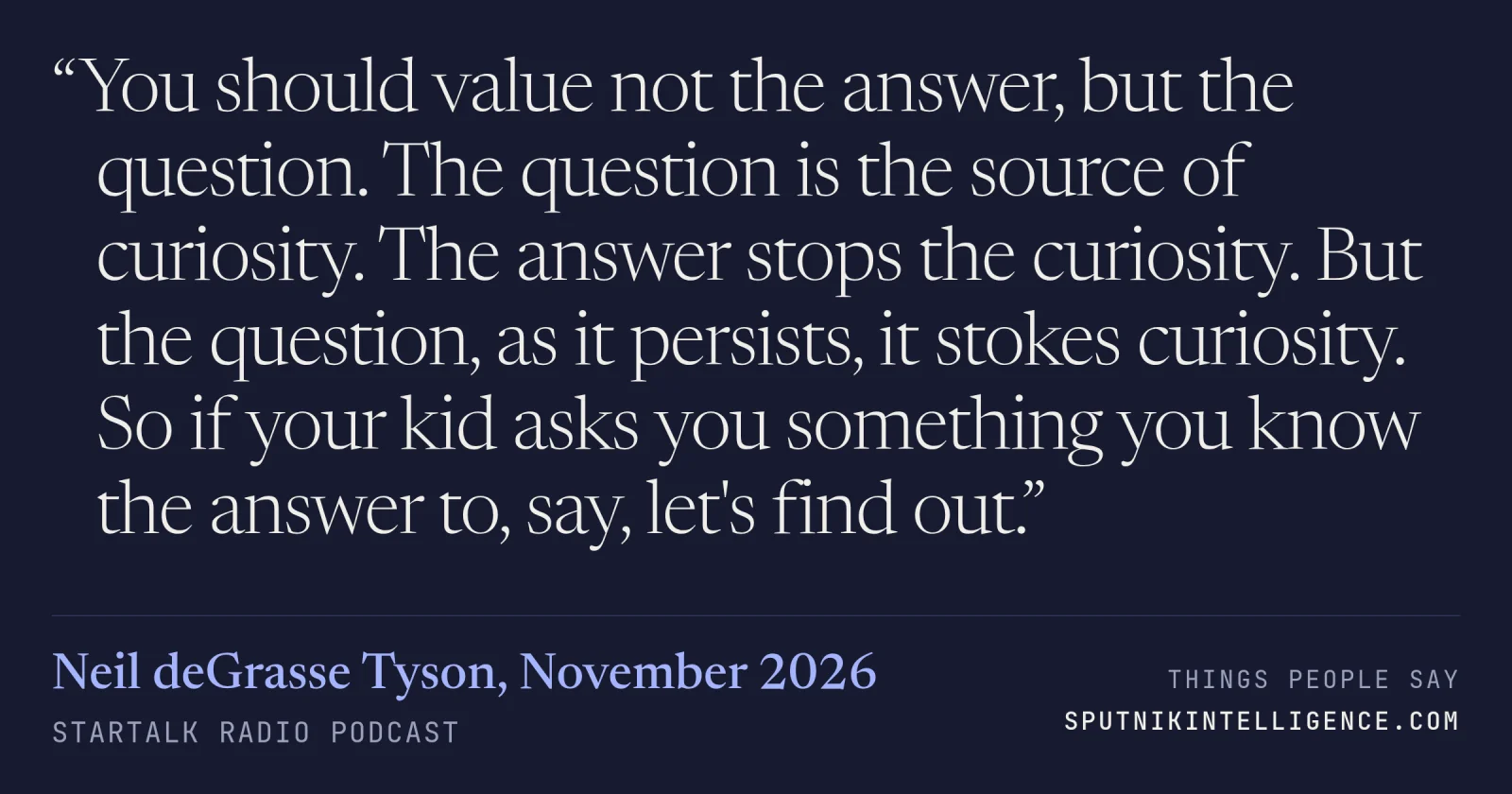
“You should value not the answer, but the question. The question is the source of curiosity. The answer stops the curiosity. But the question, as it persists, it stokes curiosity. So if your kid asks you something you know the answer to, say, let's find out.” — Neil deGrasse Tyson, StarTalk Radio

Klepper said he is raising a young child and asked what toolkit the child will need in an AI-heavy world. Tyson answered that the toolkit is curiosity, then gave this advice on how a parent can protect it.

StarTalk Radio · 2026-11-10 Permalink → Listen →
StarTalk Radio Around 42:05 into the episode
Neil deGrasse Tyson

agreement with your wife. Yes, that information stays here. It does not get out.

Jordan Klepper

Do not tell my child. Do not tell my child. I think my child is figuring that out. Yes. All

Neil deGrasse Tyson

right. So you should value not the answer, but the question. The question is the source of curiosity. The answer stops the curiosity. But the question, as it persists, it stokes curiosity. So if your kid asks you something you know the answer to, say, let's find out. What would be a way to find out? And get in the car and drive there? What color is the sun when it sets? Get in the car, go to a sunset and observe and think about it and do things that feed the curiosity with your five and a half year old. And if your five and a half year old remains curious through those turbulent hormonal years, they'll come out the other side as a scientist or as a minimum scientifically literate. So they will never be exploited ever by someone who is ignorant of the laws of physics trying to sell you something to the contrary.

Jordan Klepper

How do I make my kid a venture capitalist? Do you have that answer? Because I think that's going to be much more literally. You want to secure

Neil deGrasse Tyson

retirement as they support you. Yeah, I can't help you there.

Jordan Klepper

Your thing sound nice. That sounds nice as well. So
Speaker names come from our own diarization. The position is estimated from where the line sits in the episode.
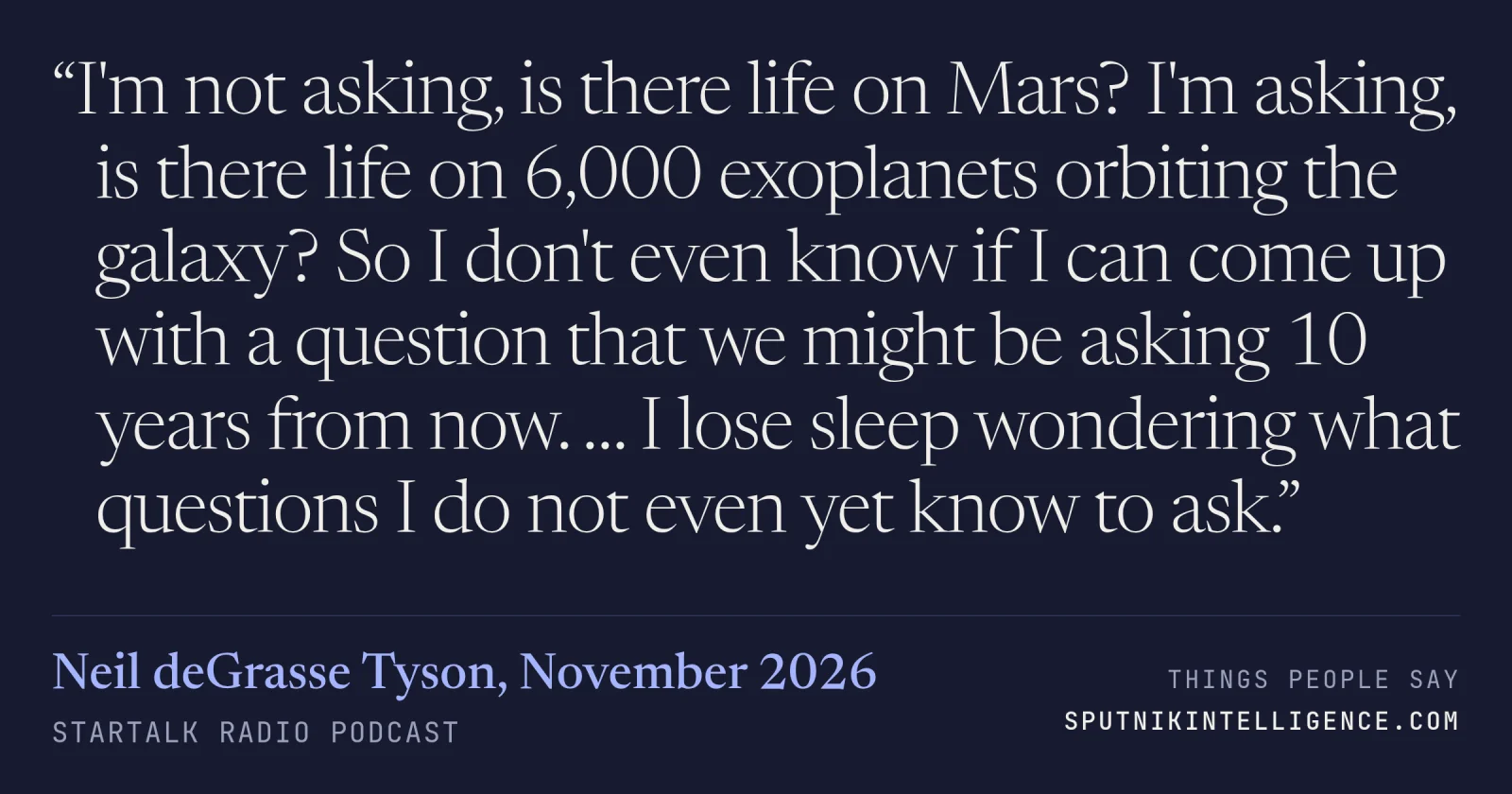
“I'm not asking, is there life on Mars? I'm asking, is there life on 6,000 exoplanets orbiting the galaxy? So I don't even know if I can come up with a question that we might be asking 10 years from now. … I lose sleep wondering what questions I do not even yet know to ask.” — Neil deGrasse Tyson, StarTalk Radio

Tyson's closing reflection after a conversation about the planned Habitable Worlds Observatory. He argues each generation's answers open up questions the previous one could not imagine.

StarTalk Radio · 2026-11-03 Permalink → Listen →
StarTalk Radio Around 50:26 into the episode
Neil deGrasse Tyson

Probably science. It's been a treat. But I wanted you to change the name while I was on the show to be certainly science.

Speaker 4

We'll do it for you. Just for you.

Neil deGrasse Tyson

…of the universe and we say, wait a minute, we are now standing on a new precipice, seeing where no one has seen before, because the information and the knowledge and the wisdom and the models took us to a new place. And now I can think questions undreamt of before we arrived there. And so now I'm not asking, what's the size and age of the universe? I'm asking, is there more than one universe? I'm not asking, is there life on Mars? I'm asking, is there life on 6,000 exoplanets orbiting the galaxy? So I don't even know if I can come up with a question that we might be asking 10 years from now. It's frustrating, but that's a good fact. It's a good fact because, no, I can't. can't predict where our next paths of curiosity will take us. Because as I've said before, as the area of our knowledge grows, so too does the perimeter of our ignorance. And it may be that this is an endless frontier, never ending, never coming to a stop. If it ever comes to a stop, I would be joyous and…

Speaker names come from our own diarization. The position is estimated from where the line sits in the episode.

Collections They Appear In