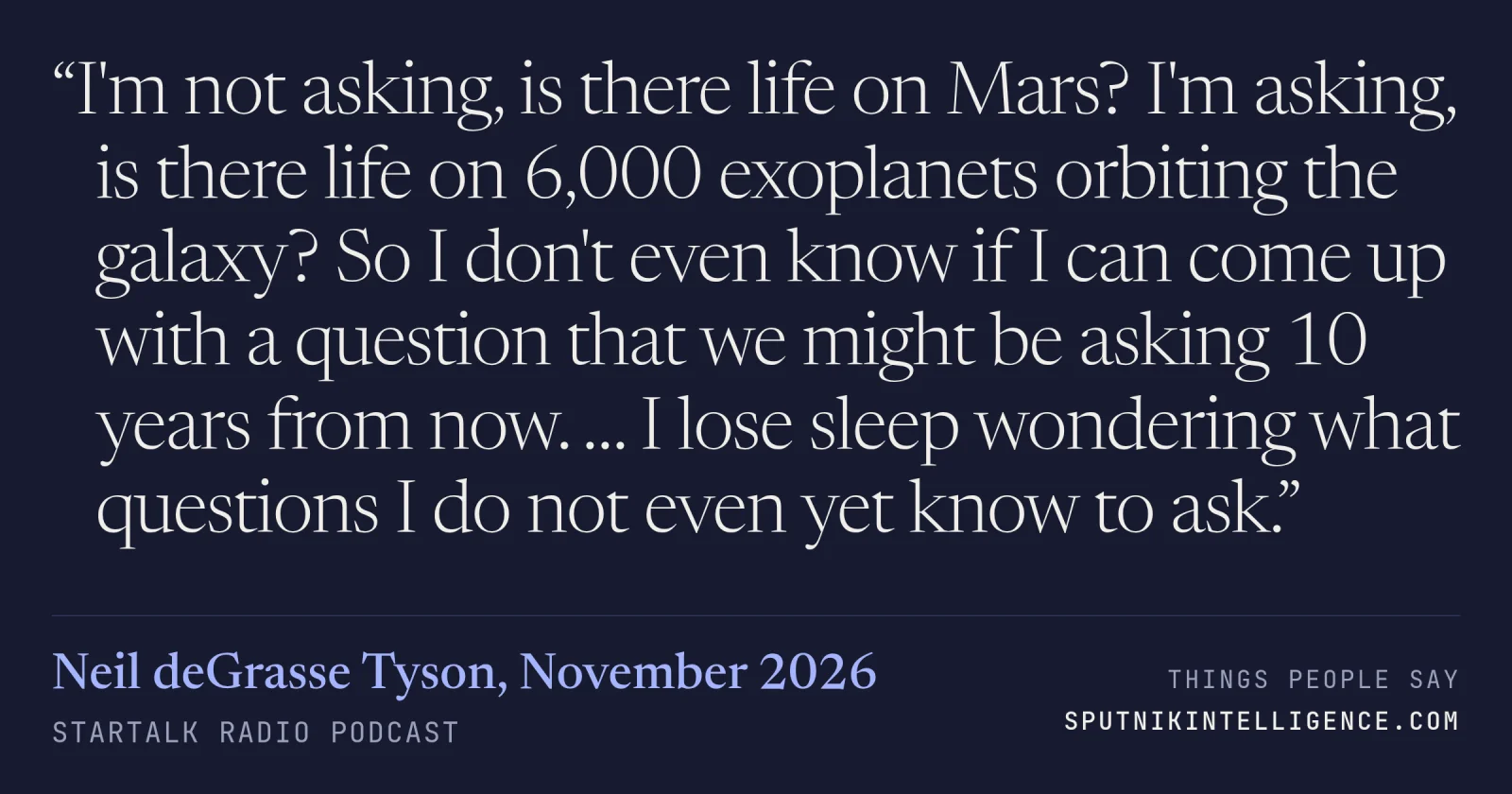
“I'm not asking, is there life on Mars? I'm asking, is there life on 6,000 exoplanets orbiting the galaxy? So I don't even know if I can come up with a question that we might be asking 10 years from now. … I lose sleep wondering what questions I do not even yet know to ask.”
StarTalk Radio · Ideas & Essays · November 2026
Context
Tyson's closing reflection after a conversation about the planned Habitable Worlds Observatory. He argues each generation's answers open up questions the previous one could not imagine.
Transcript
Probably science. It's been a treat. But I wanted you to change the name while I was on the show to be certainly science.
We'll do it for you. Just for you.
…of the universe and we say, wait a minute, we are now standing on a new precipice, seeing where no one has seen before, because the information and the knowledge and the wisdom and the models took us to a new place. And now I can think questions undreamt of before we arrived there. And so now I'm not asking, what's the size and age of the universe? I'm asking, is there more than one universe? I'm not asking, is there life on Mars? I'm asking, is there life on 6,000 exoplanets orbiting the galaxy? So I don't even know if I can come up with a question that we might be asking 10 years from now. It's frustrating, but that's a good fact. It's a good fact because, no, I can't. can't predict where our next paths of curiosity will take us. Because as I've said before, as the area of our knowledge grows, so too does the perimeter of our ignorance. And it may be that this is an endless frontier, never ending, never coming to a stop. If it ever comes to a stop, I would be joyous and…
More from StarTalk Radio