RS

Robert Steen

Things Robert Says on Podcasts

Where to Find Them

Robert Steen has been a guest on Suspicious Minds: AI and the Apocalypse (2 times) .

Recently: “The Hidden Life (Part Two)” on Suspicious Minds: AI and the Apocalypse (November 2026); “As Real As Anything (Part One)” on Suspicious Minds: AI and the Apocalypse (November 2026).

What They Said

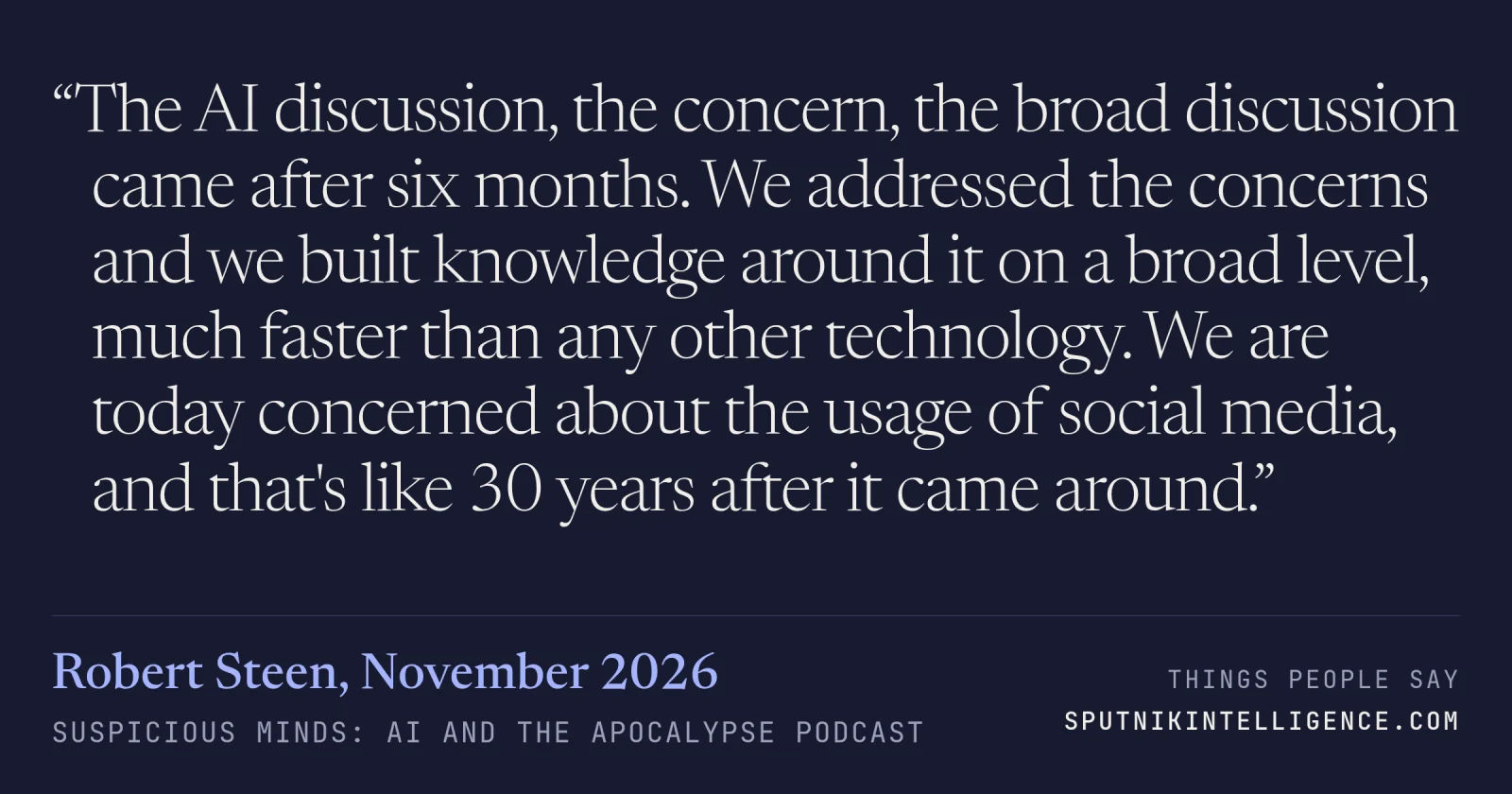
“The AI discussion, the concern, the broad discussion came after six months. We addressed the concerns and we built knowledge around it on a broad level, much faster than any other technology. We are today concerned about the usage of social media, and that's like 30 years after it came around.” — Robert Steen, Suspicious Minds: AI and the Apocalypse

Asked whether AI will cause the apocalypse, he becomes the first of the show's many guests to say no. His reason is how quickly society started worrying about AI compared with earlier technologies.

Suspicious Minds: AI and the Apocalypse · 2026-11-25 Permalink → Listen →
Suspicious Minds: AI and the Apocalypse Around 1:17:49 into the episode
Speaker 1

…you should go over to that neighbor and give him some of your time. Be curious and talk to him or her. And maybe you will have an insight and understanding that was different from what you anticipated. And by that, making both of you richer. That is what Matz did. Nobody asks actually about that.

Sean King O’Grady

…a lot we can all learn from Matz. And now we are to my last question about AI and the apocalypse. The one I ask everyone. You heard Frank Wilchick's answer in the last episode. Robert is the 69th person I've asked and the first to say what he said. Do you think AI will cause the apocalypse? No.

Speaker 1

That's the short answer. Human beings have a very strong ability to conquer all kinds of challenges that have been thrown our way. And I strongly believe that we will also conquer the challenges of AI. And they are big and they will be bigger and they will come. But at least from my observation, it seems like we are faster adopters of knowledge when it comes to AI than any other technology that has been delivered to us before. We are today concerned about the usage of social media. And that's like 30 years after it came around. We are today concerned about online gaming. Again, 30 years after it came around. The AI discussion, the concern, the broad discussion came after six months. We addressed the concerns and we built knowledge around it on a broad level, much faster than any other technology. That is the positive

Sean King O’Grady

thing that I think should also be understood and given credit. You're the 69th person that I've asked that question and the first person to have anything even remotely close to that response. It's a good thing we cracked it before 70. Many of you listening probably didn't expect this series to go…
Speaker names come from our own diarization. The position is estimated from where the line sits in the episode.
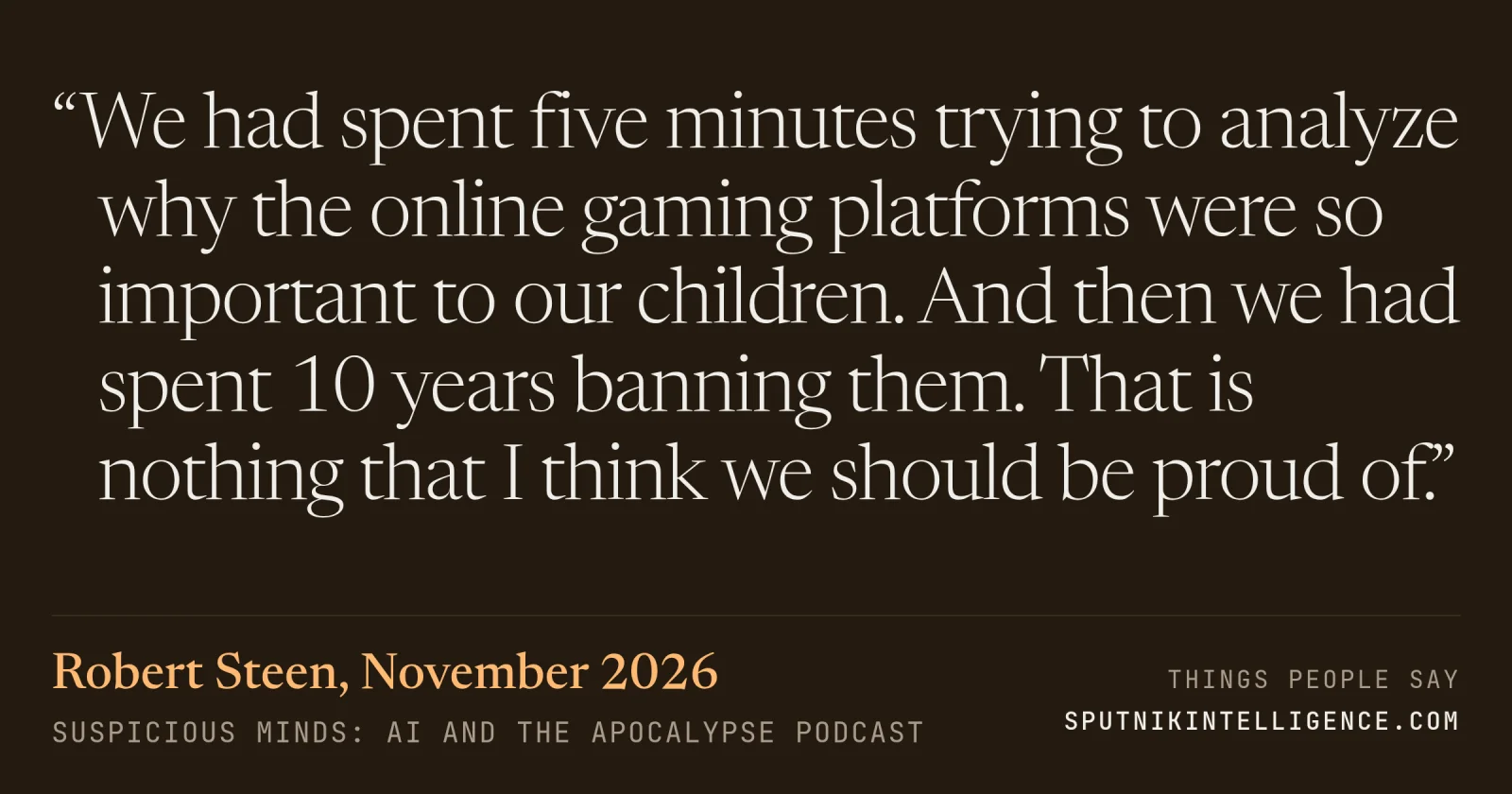
“We had spent five minutes trying to analyze why the online gaming platforms were so important to our children. And then we had spent 10 years banning them. That is nothing that I think we should be proud of.” — Robert Steen, Suspicious Minds: AI and the Apocalypse

A father looking back on how he and other parents handled their children's gaming, before he learned about his late son's rich hidden life in World of Warcraft.

Suspicious Minds: AI and the Apocalypse · 2026-11-25 Permalink → Listen →
Suspicious Minds: AI and the Apocalypse Around 48:10 into the episode
Barry Dainton

…in ways that maybe we older people find difficult to imagine, but not like completely natural ones. I mean, it's possibly some kind of social schism where some parents would just think something unnatural about kids interacting with AIs and sort of ban them like about drugs or something.

Sean King O’Grady

Robert has more at stake on this, at least emotionally, than most fathers. Here's something he told me that you didn't hear in the last episode.

Speaker 1

Our approach was to win the competition on who are the parents who can limit the screen time as much as possible. That was what we were actually discussing. To put it honestly, we had spent five minutes trying to analyze why the online gaming platforms were so important to our children. And then we had spent 10 years banning them. That is nothing that I think we should be proud of. This is something we should learn from. And this I learned also from Anne. She told me earlier that there is a saying in England where we say that you should always

Speaker 2

first try to understand for them to make yourself understood. We as parents, we forgot to understand before we started to make ourselves understood.

Sean King O’Grady

The man who, by his own account, spent 10 years banning screens, went on to chair the Norwegian government's committee on screen use. So here's what the chair of the screen committee would do about all of it. And it's the single most counterintuitive and surprising screen time plan I've ever seen.…

Speaker 1

I have been a politician in my life. I was the health minister of Oslo, the capital of Norway, during the COVID pandemic. I've been heading the Norwegian government's committee on screen usage. And I strongly believe that if we are to make some restrictions on usage of technology, Sean, we should…

Speaker names come from our own diarization. The position is estimated from where the line sits in the episode.

Collections They Appear In