The host describing his first days playing Grand Theft Auto VI, in response to the idea that immersive games could occupy people who lose their jobs to AI.
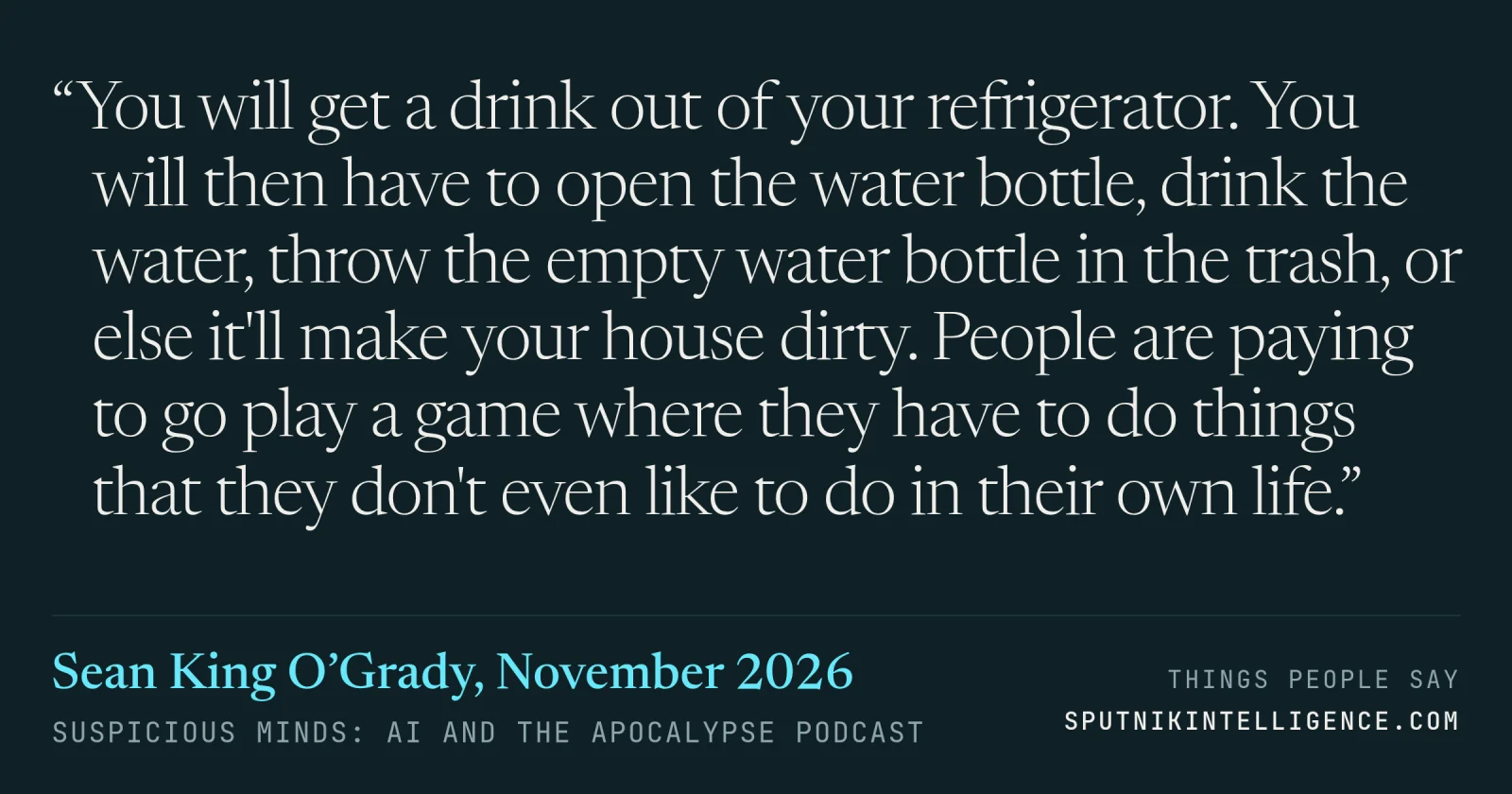
…that immersive video games could be a way to keep the unemployed masses at bay if AI takes most of the job. As someone who spent the last few days lifting weights, stealing yachts, and scuba diving for buried treasure in GTA 6, I don't think he's necessarily wrong. I also don't think you understand the level of tedium that people enjoy engaging with in the game. This is not an exaggeration. You will get a drink out of your refrigerator. You will then have to open the water bottle, drink the water, throw the empty water bottle in the trash, or else it'll make your house dirty. People are paying to go play a game where they have to do things that they don't even like to do in their own life. But this is a real risk that's being considered along with the other risks being discussed, like the ever-present threat of nuclear war, climate catastrophe, and uncontrollable critical infrastructure destroying AI-enabled hacking sprees. Perhaps the best argument that we're living in a simulation is that we're still living it all. We're in a world that hasn't ended yet, despite what sometimes…
I've even suggested in my own work that all of quantum mechanics is evidence that we're in a simulation because quantum mechanics is really weird. It says that every particle is in many places at once, but we always observe them being in a single spot. I've developed a model called the peer-to-peer…
I am absolutely ready to buy that argument. But what about Marcus's own concern about the underdetermination of evidence? How can we ever prove or disprove simulation theory with a test?
You know, there have been different proposals about how to test the simulation theory, such as like, you know, whether quantum collapse sort of works like computer rendering.