
Nate Berkopec

Things Nate Says on Podcasts

Where to Find Them

Nate Berkopec writes Maintainable . They have also been a guest on Remote Ruby (3 times) and The Bike Shed .

Recently: “Vulnerabilites & AI with Nate Berkopec” on Remote Ruby (November 2026); “Managing Open Source with Nate Berkopec” on Remote Ruby (November 2025); “296: Speedy Performance with Nate Berkopec” on The Bike Shed (June 2021); “Talkin' Puma and the Rails Performance Workshop with Nate Berkopec” on Remote Ruby (January 2021); “Nate Berkopec: Why You Should Treat Performance Problems as Bugs” on Maintainable (September 2019); “Nate Berkopec: Why You Should Treat Performance Problems as Bugs” on Maintainable (September 2019).

What They Said

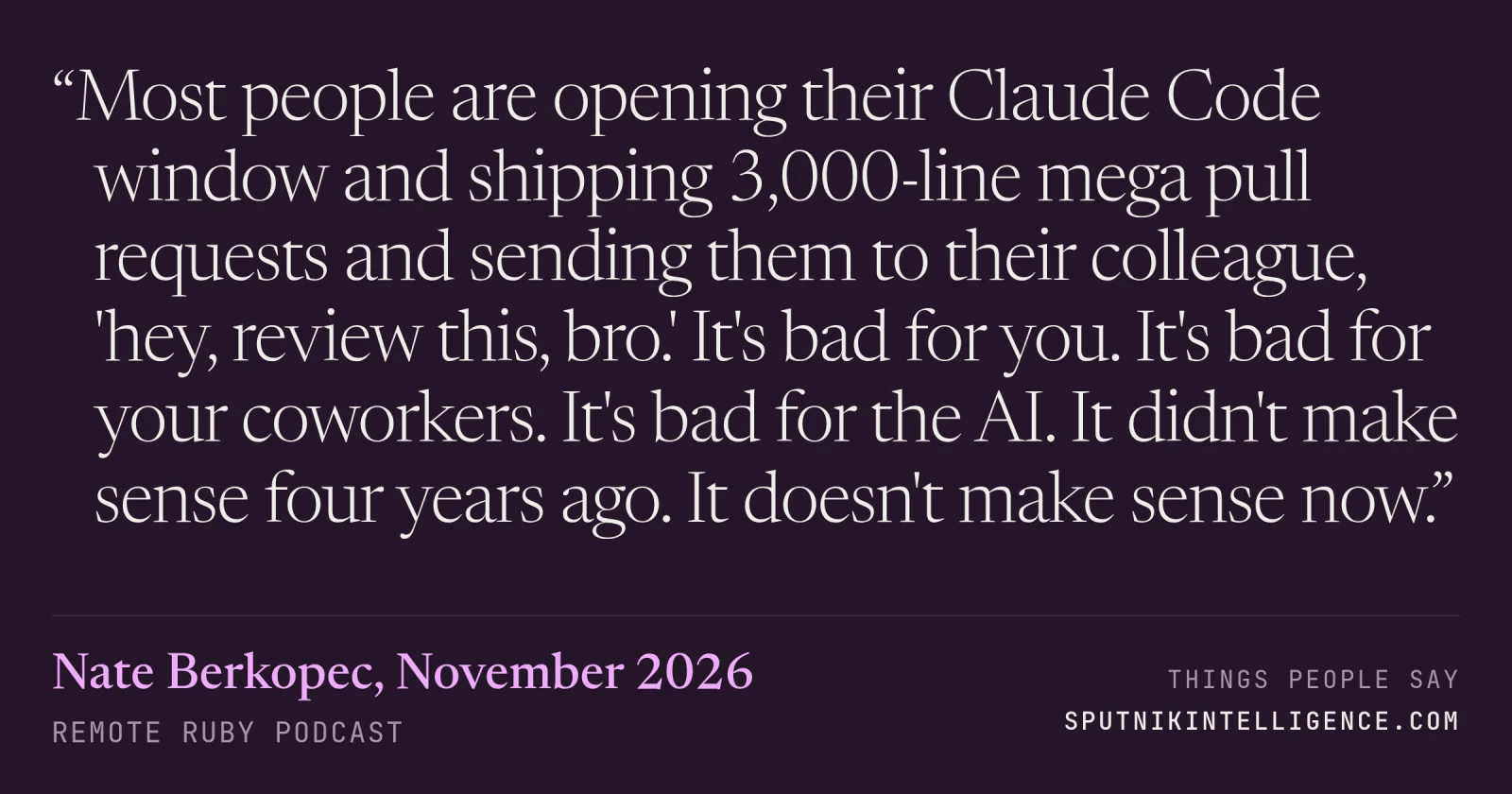
“Most people are opening their Claude Code window and shipping 3,000-line mega pull requests and sending them to their colleague, 'hey, review this, bro.' It's bad for you. It's bad for your coworkers. It's bad for the AI. It didn't make sense four years ago. It doesn't make sense now.” — Nate Berkopec, Remote Ruby

Berkopec contrasts Intercom's practice of auto-merging tiny pull requests with what he sees at most companies using coding agents. His argument is that many small PRs are how you manage the higher change velocity.

Remote Ruby · 2026-11-06 Permalink → Listen →
Remote Ruby Around 35:48 into the episode
Nate Berkopec

…so funny is like, we're still here. We're still on the remote Ruby podcast. And like, I want to hang out with you guys. Like, I don't want to hang out with, I don't know, whoever writes Rust or Python or whatever. I don't know those guys. I don't like them. I want to hang out with Ruby people.

Speaker 2

…for you? Like, what is exciting now? What do you see yourself spending time on? And what do you enjoy too? Because that I think has changed a lot where the highs and lows are not the same anymore because you're like, oh, cool, I exploited something. We're like, I didn't really do the exploit. Yeah.

Nate Berkopec

Yeah. Yeah. I think maybe this gets to why I was able to feel this in January. And only now other people are sort of waking up to what's going on. Is back in January and March, if you wanted like a role model or like to say, well, who is actually doing this now today in a way that I can see and like copy or like, who's actually doing this? Your only option was like Steve Yeggy doing Gastown. That dude's crazy. Gastown was legitimately a fever dream. It made no sense. It never made anything useful. So if your only model back then is a literal crazy person, I could see why you'd be like, well, this is dumb. The thing is, now in October 30th of 2026, there are a lot of role models that you can go look at who are doing really cool things with AI who were legit before AI, you know, and like we're shipping cool stuff before AI and are shipping more cool stuff now. So let's run through some of the examples of people you should go look for for inspiration. And, you know, one of these hopefully clicks with you. Okay. Jeff Dickey, easy. So he's merging 60 PRs a day to all of…

Speaker 2

I feel that a lot. Dude, the other day, what was I doing? Testing something on the latest Ubuntu LTS Resolute. And it was like, oh, yeah, we can't do this, it turns out, because the Rust core utils have changed and they don't support this thing that the old version did. And I was like, well, that…

Nate Berkopec

lot of people are in the nihilism phase of like the grief cycle here where because what their workflow is is basically keeping one to three clawed code windows open and switching between them. And what happens is like they do what you just did. Like they're like, wow, I found a real bug in CH own…

Speaker 2

I love that. I have thoughts on that or questions about like, what is the goal with the automation? Because I could have it go like, go find any kind of bugs or regressions on Ubuntu, which might be quite a bit of a distraction from building my product. But the other thing I wanted to point out was…
Speaker names come from our own diarization. The position is estimated from where the line sits in the episode.
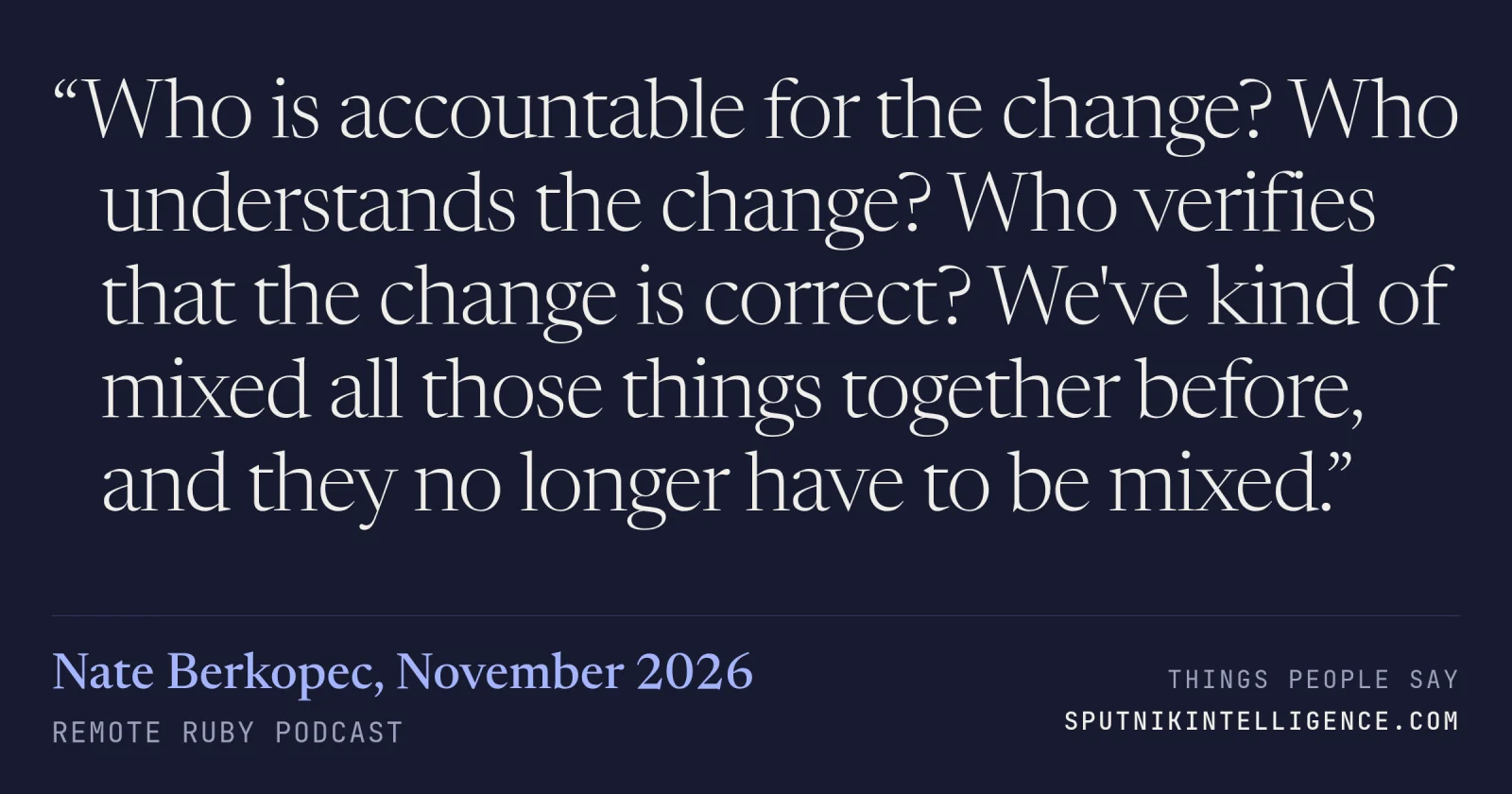
“Who is accountable for the change? Who understands the change? Who verifies that the change is correct? We've kind of mixed all those things together before, and they no longer have to be mixed.” — Nate Berkopec, Remote Ruby

Asked why he tells coding agents never to write unit tests or comments, Berkopec says people still judge AI work through the lens of understanding every line, when accountability, understanding and verification can now be separated.

Remote Ruby · 2026-11-06 Permalink → Listen →
Remote Ruby Around 41:36 into the episode
Nate Berkopec

…just like changing your focus and the bigger picture of it and everything, Monal, one of your bullet points here is why you tell your agents to never write unit tests and comments. Yeah. Why is that? And how do you keep things on the rails if you're telling it explicitly to not do that? Yeah. So

Speaker 1

I think this is a mindset shift that has to happen

Nate Berkopec

as you are moving away from human workflows to AI workflows is that we talked about at the beginning of the call the difference between understanding and verification. So this is where I think a lot of people are getting caught technically is that they are still trying to look through this lens of understanding. I hear a lot of stuff like, well, how do you ship changes if you don't understand them? Oh, you can't do that because you don't understand what's being shipped. So these concepts are all independent of each other. Who is accountable for the change? Who understands the change? Who verifies that the change is correct? And we've kind of mixed all those things together before, and they no longer have to be mixed. So think about somebody, a nuclear engineer who designs a nuclear power plant. Do they understand every single art in that nuclear power plant? No. There's like parts of the turbine that they don't understand how they work, but they understand this turbine part has…

Speaker 2

That's really interesting. Do you have an example of like how you would, I don't know, some random problem that you would that comes to mind that you show as an example?

Nate Berkopec

Puma. Yeah, Puma. So Puma has traditionally had not a very integration-focused test suite. It's like a lot of unit tests and stuff like that. What I found was actually somebody else's HTTP 1.1 spec conformance suite. And turns out, Puma doesn't do a very good job of doing what the RFCs and HTTP…

Speaker 2

Sweet. Yeah. Well, I know we're at the top of the hour and you got to run, but this has been super fun. We might have to do a part two because we had, I don't know, six or seven other bullets we wanted to cover.

Speaker names come from our own diarization. The position is estimated from where the line sits in the episode.

Collections They Appear In