 Nate Berkopec
On Remote Ruby
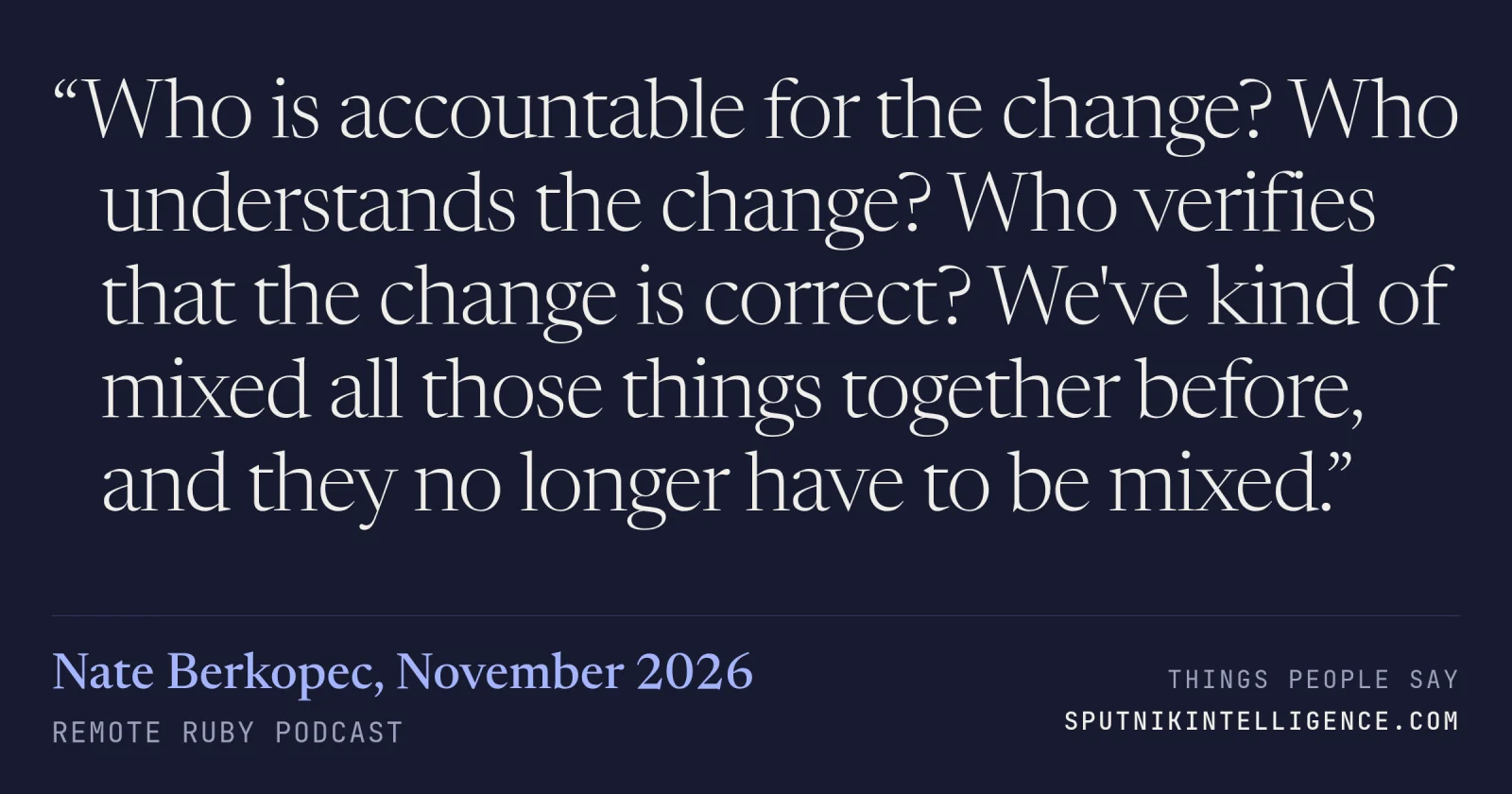
“Who is accountable for the change? Who understands the change? Who verifies that the change is correct? We've kind of mixed all those things together before, and they no longer have to be mixed.”
Remote Ruby · Hands-On Engineering Podcasts · November 2026
Context
Asked why he tells coding agents never to write unit tests or comments, Berkopec says people still judge AI work through the lens of understanding every line, when accountability, understanding and verification can now be separated.
Transcript
…just like changing your focus and the bigger picture of it and everything, Monal, one of your bullet points here is why you tell your agents to never write unit tests and comments. Yeah. Why is that? And how do you keep things on the rails if you're telling it explicitly to not do that? Yeah. So
I think this is a mindset shift that has to happen
as you are moving away from human workflows to AI workflows is that we talked about at the beginning of the call the difference between understanding and verification. So this is where I think a lot of people are getting caught technically is that they are still trying to look through this lens of understanding. I hear a lot of stuff like, well, how do you ship changes if you don't understand them? Oh, you can't do that because you don't understand what's being shipped. So these concepts are all independent of each other. Who is accountable for the change? Who understands the change? Who verifies that the change is correct? And we've kind of mixed all those things together before, and they no longer have to be mixed. So think about somebody, a nuclear engineer who designs a nuclear power plant. Do they understand every single art in that nuclear power plant? No. There's like parts of the turbine that they don't understand how they work, but they understand this turbine part has…
That's really interesting. Do you have an example of like how you would, I don't know, some random problem that you would that comes to mind that you show as an example?
Puma. Yeah, Puma. So Puma has traditionally had not a very integration-focused test suite. It's like a lot of unit tests and stuff like that. What I found was actually somebody else's HTTP 1.1 spec conformance suite. And turns out, Puma doesn't do a very good job of doing what the RFCs and HTTP…
Sweet. Yeah. Well, I know we're at the top of the hour and you got to run, but this has been super fun. We might have to do a part two because we had, I don't know, six or seven other bullets we wanted to cover.
More from Remote Ruby