Where to Find Them
Eric Ries
writes
Take Command: A Leadership Podcast
,
writes
Beyond The Prompt - How to use AI in your company
,
writes
Coaching for Leaders
,
writes
Your Undivided Attention
,
writes
The How of Business - How to start, run, grow and exit a small business.
and
writes
Unsupervised Learning with Jacob Effron
.
They have also been a guest on
The Full Ratchet (TFR): Venture Capital and Startup Investing Demystified
(4 times) ,
Masters of Scale
(3 times) ,
TBPN
(2 times) ,
Lenny's Podcast: Product | Career | Growth
(2 times) ,
Tech Lead Journal
,
HBR IdeaCast
,
Remarkable People
,
The Engineering Leadership Podcast
,
GeekWire
,
Software Engineering Daily
,
Lenny's Newsletter
,
Summation with Auren Hoffman
,
Solar Maverick Podcast
,
Capital Allocators – Inside the Institutional Investment Industry
,
Design Better
,
Digital Disruption with Geoff Nielson
,
Founder's Story
,
The SaaS Podcast - Real Lessons on Growing Profitable SaaS
,
Product Growth
,
Inside the Strategy Room
,
The Growth Podcast
,
Radical Candor: Communication at Work
,
The Product Podcast
,
The Agile Brand with Greg Kihlström®: Expert Mode Marketing Technology, AI, & CX
,
The Balancing Act with Andrew Temte, PhD, CFA
,
The Learning Leader Show With Ryan Hawk
,
Rising Tide Partners
,
Finding Peak w/ Ryan Hanley
,
Do Good To Lead Well with Craig Dowden
,
The Brainy Business | Understanding the Psychology of Why People Buy | Behavioral Economics
,
Design Better
,
The Stack Overflow Podcast
,
Y Combinator Startup Podcast
,
NEW ECONOMIES
,
a16z Podcast
,
The Aboard Podcast
,
The Twenty Minute VC (20VC): Venture Capital | Startup Funding | The Pitch
,
Decoder with Nilay Patel
,
NN/G UX Podcast
,
NEW ECONOMIES
,
Acquired
,
The Startup Ideas Podcast
,
FranklinCovey On Leadership
,
Startups Decoded
,
Hello Monday with Jessi Hempel
,
Lean Blog Interviews: Real-World Lean Leadership Conversations in Healthcare and Beyond
,
Startups For the Rest of Us
,
Think Fast Talk Smart: Communication Techniques
and
The Heart of Healthcare | A Digital Health Podcast
.
Recently:
“The “best practices” corrupting business, with Eric Ries and Krista Tippett”
on Masters of Scale (November 2026);
“329. Resisting “financial gravity”: How purpose-driven companies endure”
on Inside the Strategy Room (November 2026);
“Eric Ries”
on NEW ECONOMIES (October 2026);
“Eric Ries”
on NEW ECONOMIES (October 2026);
“Eric Ries: Lean Startup author on why good companies go bad, and why good design is critical to success”
on Design Better (July 2026);
“Eric Ries: Lean Startup author on why good companies go bad, and why good design is critical to success”
on Design Better (July 2026).
What They Said
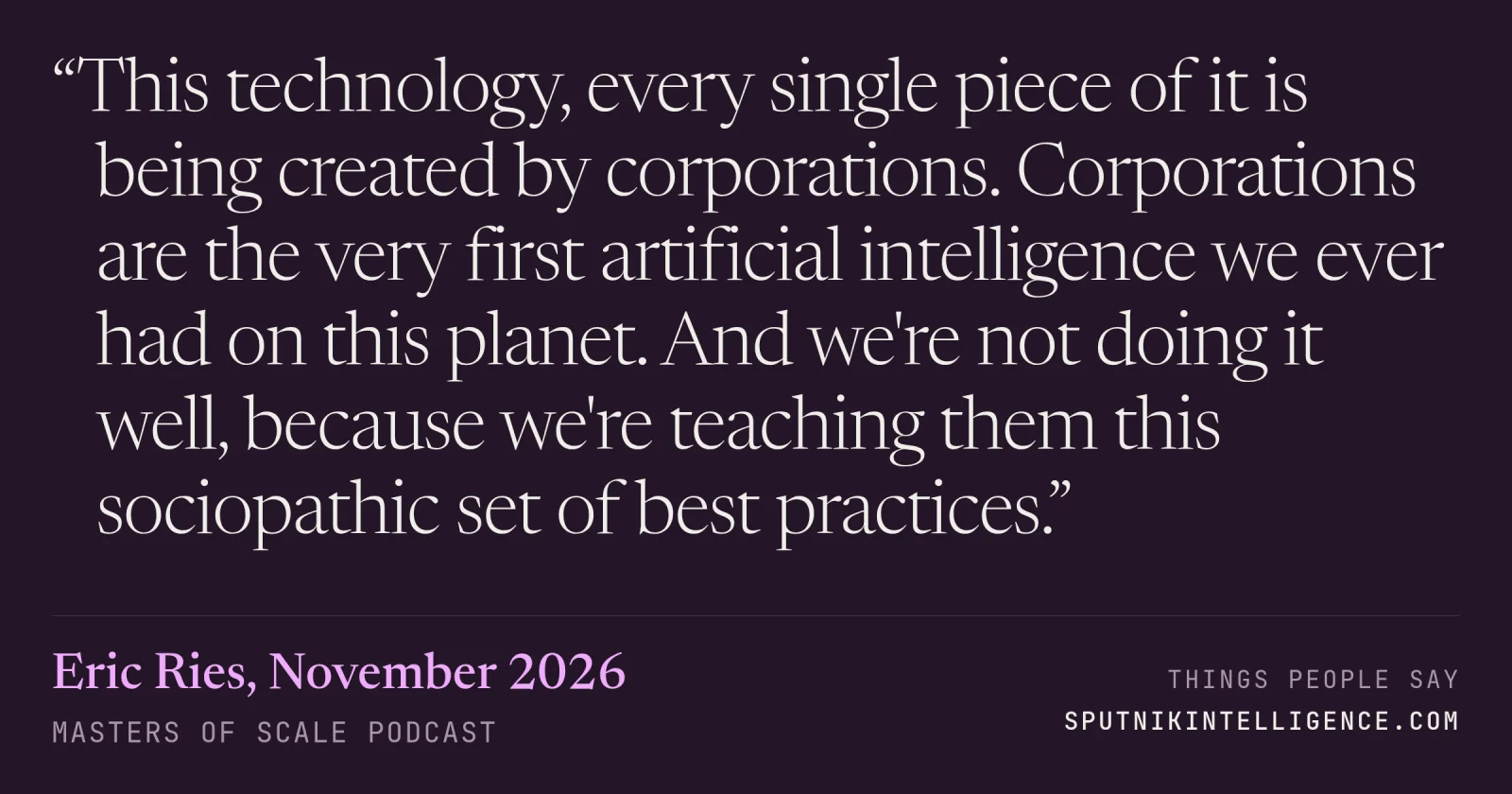
Krista Tippett asked how Ries's ideas apply to AI. He had just said AI risk is prevented by governing the technology, and asked who governs the governors. He frames AI safety as a corporate governance problem.
Masters of Scale · 2026-11-14
Permalink →
Listen →
Masters of Scale
Around 19:24 into the episode
Speaker 2
That's a true story, I see. I
Krista Tippett
…has become like a razor blade in the hands of a three-year-old. And we can't actually allow the technology of our age to become like a razor blade in the hands of a three-year-old. Also, because we're dealing with agents who can act, are kind of acting like toddlers or delinquent adolescents.
Speaker 2
I would swap them for toddlers if I could get them. You know, that could be an upgrade. Oh, my God.
Krista Tippett
I mean, yeah, just let's talk a little bit about that notion and how you're specifically looking at this astonishing development of our lifetime in business.
Speaker 2
Yeah, I think the urgency is off the charts. And the way you can tell how people are going to feel about AI, people wonder, like, why is there this massive backlash to AI? All you have to do is ask people if they think the social media era went well. And when I feel like that was a big success, all…
Krista Tippett
creations. So you make a case in the book. And I say, you know, you start talking about governance, governance, how important it is. And, you know, your eyes close. My eyes close. I'm sorry. It is. You really make a case for it being so important in doing well to not separate governance from…
Speaker names come from our own diarization. The position is estimated from where the line sits in the episode.
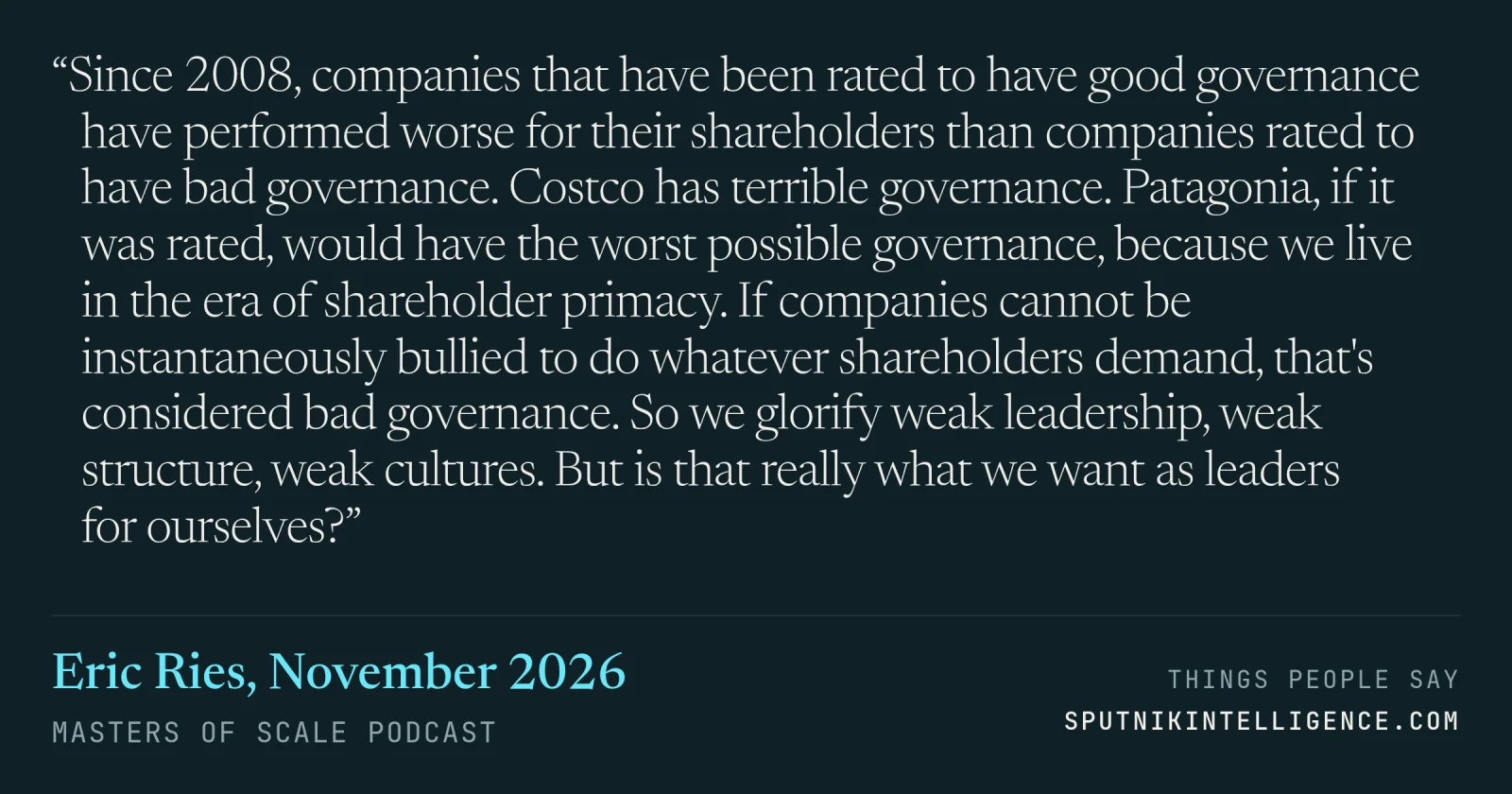
Eric Ries, on stage with Krista Tippett to discuss his book Incorruptible, argues that conventional business best practices are errors. Citing a chart in the book, he says standard governance ratings point the wrong way.
Masters of Scale · 2026-11-14
Permalink →
Listen →
Masters of Scale
Around 13:16 into the episode
Speaker 2
these there's these exceptional organizations that seem to be immune to financial gravity so how can there be exceptions to a rule that's inevitable obviously it's not inevitable there must be conditions under which this happens and doesn't happen anymore so
Krista Tippett
you're right they violate these these outliers which are multitudinous yeah violate practically every conventional business best practice we've been taught and then period that i in my ignorance used to teach
Speaker 2
i i was told they were the best practices best is right in the name so how could they not be the best i of course i taught them that's what they're the best and you one of the hardest things people have to grapple with with this book is like you have to be open-minded to the possibility that you've been taught an error nobody wants to hear that i know i'm sorry but we actually have tremendous evidence there's a whole chart in the book it's just called best practices destroy shareholder value and it's just practice practice and it's not my opinion man these are like there's academic research about these things so for example just to give you one idea to to take home with you since 2008 which is not an inconsiderable data set now companies that have been rated to have good governance have performed worse for their shareholders than companies rated to have bad governance costco has terrible governance patagonia if it was rated would have the worst possible governance because we live in the era of shareholder primacy if companies cannot be instantaneously bullied to do whatever shareholders demand that's considered bad governance so we glorify weak leadership weak structure weak cultures but is that really what we want as leaders for ourselves no
Krista Tippett
and you also say that there's so many objections that get made right and it really is like it's gravity it's financial gravity yeah yeah exactly it's it's inevitable and you say harder is easier yeah um has anyone stopped to ask why business is like it's so difficult right why is everything so…
Speaker 2
yeah this i was really surprised how many stories in the book come down to a a leader who's willing to say like someone comes to you and says look i get that you believe in design or treating people right or not poisoning our customers or whatever but that's so much harder to do it would just be so…
Krista Tippett
with an ethos with an ethos with which visionaries would recognize it or be proud of it i think is the story you tell well yeah
Speaker names come from our own diarization. The position is estimated from where the line sits in the episode.
Collections They Appear In