DV

David Vélez

Things David Says on Podcasts

Where to Find Them

David Vélez has been a guest on Equity (2 times) , Invest Like the Best (Patrick O'Shaughnessy) (2 times) , View From The Top and Crucible Moments .

Recently: “David Vélez - Building Nubank and the Future of Global Banking - [Invest Like the Best, EP.495]” on Invest Like the Best (Patrick O'Shaughnessy) (October 2026); “Nubank ft. David Vélez - An Outsider Upends the Brazilian Banking System” on Crucible Moments (January 2025); “The tourist VCs in LatAm have gone home” on Equity (March 2024); “Nubank's CEO explains what the US could learn from LatAm fintech” on Equity (June 2023); “S5E6: David Vélez, MBA '12: "Position Yourself in the Scarcity, Not in The Oversupply."” on View From The Top (May 2022); “David Vélez - Building the Branchless Bank - [Founder’s Field Guide, EP. 41]” on Invest Like the Best (Patrick O'Shaughnessy) (July 2021).

What They Said

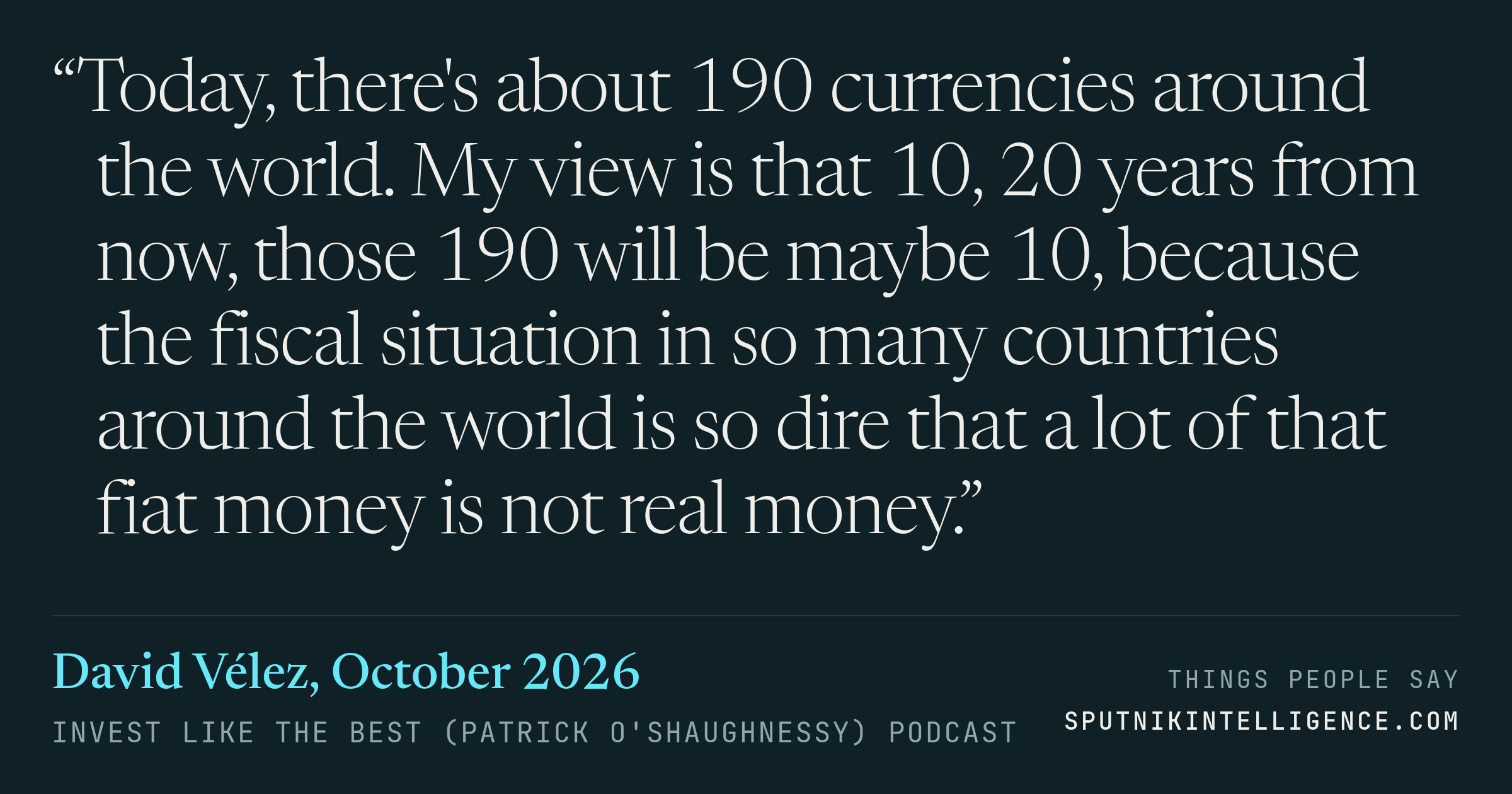
“Today, there's about 190 currencies around the world. My view is that 10, 20 years from now, those 190 will be maybe 10, because the fiscal situation in so many countries around the world is so dire that a lot of that fiat money is not real money.” — David Vélez, Invest Like the Best (Patrick O'Shaughnessy)

Asked which outside changes to the global financial system he watches most, Vélez names the end of cash, open banking, and crypto with stablecoins. He expects billions of people to bank in an offshore system of dollar stablecoins and Bitcoin alongside their local one.

Invest Like the Best (Patrick O'Shaughnessy) · 2026-10-13 Permalink → Listen →
Invest Like the Best (Patrick O'Shaughnessy) Around 18:08 into the episode
David Vélez

…can now be automatized and be done by model versus a human. That's what AI is also enabling. So it kind of let us do what we were already doing at a much more significant scale. But the culture itself already existed since we saw this as a way to differentiate ourselves since the very beginning.

Patrick O'Shaughnessy

How do you think the global financial system will change the most or needs to change the most in the next five years, totally away from your business? Like what are the exogenous changes that you're most carefully watching that you think matter?

David Vélez

…of the fiat system in your country with a global offshore system. Your lives go in between without you even realizing this. For a lot of countries around the world, it's really important. You've seen with the usage of access to Bitcoin, for example, stablecoins, increasingly they want to bank in the offshore system. They don't trust their banking system. They don't trust their fiat currency. Today, there's about 190 currencies around the world. My view is that 10, 20 years from now, those 190 will be maybe 10, because the fiscal situation in so many countries around the world is so dire that a lot of that fiat money is not real money. This is basically crypto tokens. So increasingly, billions of people are going to be banking on the offshore world, US stablecoin, but also Bitcoin and other type of assets. You see these two parallel systems interrelating with each other across the world.

Patrick O'Shaughnessy

If you had to think about the US dollar and its importance, if it goes from 190 to 10 or something, do you think the US dollar is the reserve currency 10 years from now? Is it one of a few? What do you think its role will be in the world?

David Vélez

There are two sides of that argument. You can make the case U.S. stablecoins ultimately will be the big savior or one of the biggest saviors of the US dollar because it democratizes access to the US dollar. And while the fiscal situation in the US is not great and it's deteriorating fast, it's…

Patrick O'Shaughnessy

What's the most surprising thing, do you think, about the move away from cash? What would I not appreciate about the implications of that or how long it would take? Like what's surprising about going cashless?
Speaker names from our own diarization · position estimated from where the line sits in the episode
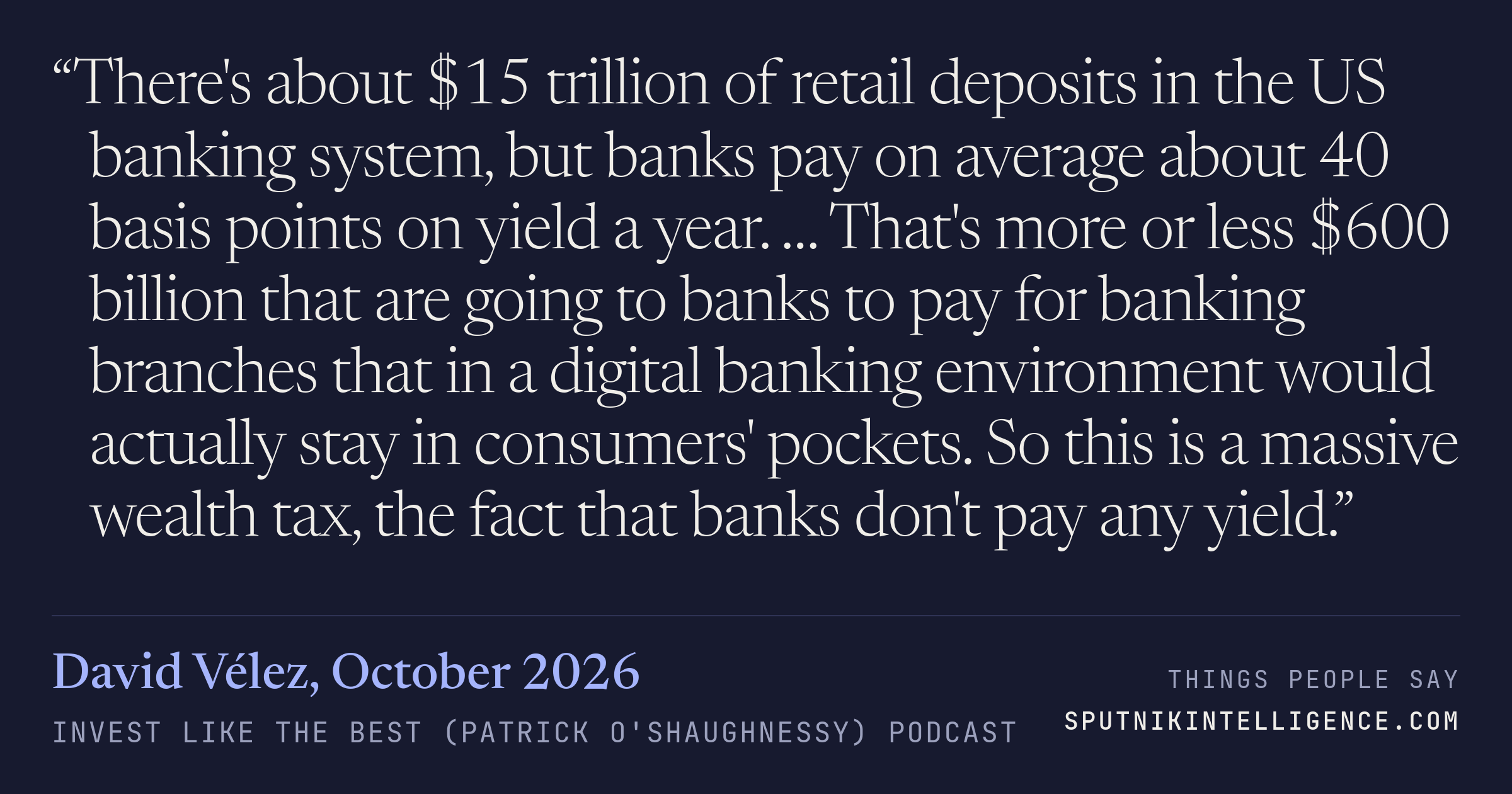
“There's about $15 trillion of retail deposits in the US banking system, but banks pay on average about 40 basis points on yield a year. … That's more or less $600 billion that are going to banks to pay for banking branches that in a digital banking environment would actually stay in consumers' pockets. So this is a massive wealth tax, the fact that banks don't pay any yield.” — David Vélez, Invest Like the Best (Patrick O'Shaughnessy)

The Nubank founder sorts what's wrong with consumer banking into access, cost and intelligence. This is his US example of hidden cost. He adds that higher-income customers do get paid yield, so the lower your income, the more of this "tax" you pay.

Invest Like the Best (Patrick O'Shaughnessy) · 2026-10-13 Permalink → Listen →
Invest Like the Best (Patrick O'Shaughnessy) Around 07:46 into the episode
David Vélez

…to increase your level of ambition. And for somebody like us, especially when we look at how early it is in the transformation, for us is why don't we go to 100 countries and try to accelerate this transformation by New Bank being one of the leading digital financial services firms in the world.

Patrick O'Shaughnessy

…like yours doing for the customer in three or five years because technology has made things possible that weren't before? Just like mobile made a lot of new things possible. We've got a much bigger wave now. Like, have you really dreamed about what could be possible? What are some of those ideas?

David Vélez

…a high-income consumer. But when you look at the cost of that banking system, it's pretty significant in ways that are not readily apparent. So, for example, there's about $15 trillion of retail deposits in the US banking system, but banks pay on average about 40 basis points on yield a year. In a world where your interest rates are 4.5%, 5%, you look at the calculation of those 15 trillion, that's more or less $600 billion that are going to banks to pay for banking branches that in a digital banking environment would actually stay in consumers' pockets. So this is a massive wealth tax, the fact that banks don't pay any yield. If you're high income, you do. The lower you income, the less you get paid. That's a huge tax and that's a huge cost. And then you look at remittances, for example, in the US, $100 billion go out of the US. People pay 5% to 10% per transaction. That will go to zero. Remittances, moving money is you're moving bits. That will trend towards zero in a more competitive environment. Monthly account…

Patrick O'Shaughnessy

Flesh that last piece out a little bit more. Wealthfront used to have this idea of self-driving money, which comes to mind. Like, okay, I've got some money. Either I don't have it in the banking system, which is the worst. So I come into the banking system, I'm earning 40 basis points instead of…

David Vélez

The first obvious rearrangement is those 600 billion that banks are keeping in their balance sheet to pay for banking branches, get rearranged, get forwarded to all the banking consumers because suddenly they realize, what am I doing with my money leaving it at zero? Especially when you think about…

Patrick O'Shaughnessy

One of the questions that I think lots of investors and founders are wrestling with is what will be the best competitive advantages or moats in this new AI era when the cost to build new stuff digitally is much, much lower. If you had to imagine it like you're some new founder, I strip everything…

Speaker names from our own diarization · position estimated from where the line sits in the episode

Collections They Appear In