Lenny asked how to tell your team about a decision you disagree with. Sherif says he lays out the pros and cons of both options before saying which was chosen, and in reviews he likes to ask "why would we not do this?"
Lenny's Podcast: Product | Career | Growth · 2026-11-22
Permalink →
Listen →
Lenny's Podcast: Product | Career | Growth
Around 1:02:12 into the episode
Sherif Mansour
…want you to decide, which by the way, they do a lot more than you'd imagine. Like they'd be like, I disagree with this, but I want you to, I want you to own that decision. But I will back you if I disagree and I will back you and move along with it. Transparency is key to foster that relationship.
Lenny Rachitsky
So, but what do you do when you're communicating it to your team and you disagree? Anything there? Is it stand behind it always?
Sherif Mansour
No, I'll present both arguments. I will state why I believe one argument is more superior than another, and I'll equally argue for the opposite. There was a recent example where, you know, we're branding a particular thing and whatever. And I think it was like the best of the worst decisions, you know, best of the worst options we can make. And I'll say, I think here are the pros, here are the cons. And if you argue for the opposite, I think here are the pros and here are the cons. We have decided to make this decision. I'll try not to call the individual out. And they're both legitimate trade-offs. And we're moving ahead with this one. And you need to speak the room of what the other opposite argument that everyone's thinking and represent that appropriately. The best VMs I find can counter, like argue against themselves and present you really good reasons why they shouldn't do the thing. The really blind ones will be like, oh yeah, my thing's the best. We should…
Lenny Rachitsky
That is great advice. Something that I'll mention briefly, when someone with power shares an opinion, a lot of times people take it as that is what we need to do. And Dharmesh Shah has this really great framework he calls flash tags. I don't know if you know this, where he basically says, okay…
Sherif Mansour
Yeah, and I'll say those are like our founders do that as well quite a bit. They'll say strong opinion, not my decision, blah, blah, blah. I will tell, but often you'll get people just in the, in the, in a discussion, they won't pre, you know, hashtag their discussion as they talk. And so I'll say…
Lenny Rachitsky
I feel like we could talk for hours of all the tips and tricks and tactics you've learned. This could go on forever. I'm going to end it here so that we have time for another episode someday to go deeper. But before we get to a very exciting lightning round, is there anything else that you wanted…
Speaker names come from our own diarization. The position is estimated from where the line sits in the episode.
Sherif was describing Atlassian's work-from-anywhere policy and open-by-default culture. He says the company's data scientists are testing whether remote teams get more out of AI. Lenny's follow-up: remote teams write more down, which gives the AI more context to work with.
Lenny's Podcast: Product | Career | Growth · 2026-11-22
Permalink →
Listen →
Lenny's Podcast: Product | Career | Growth
Around 1:16:27 into the episode
Sherif Mansour
…And so having an open by default approach to things is actually better in the long run for you as a company because by definition it means there's more context that the AI has access to and the humans have access to. So the openness is unbelievable here, but it's pretty crazy, but people love it.
Lenny Rachitsky
…and tell you what you need to know. It changes that. Like in theory, you could like, it might expose things that maybe people shouldn't have seen much more easily and quickly. On the other hand, it gives you all the context as you described to make better decisions. I have this theory, Lenny.
Sherif Mansour
So we have, we have a team anywhere policy, so you can work anywhere you like. We have a legal entity. So some people choose to work remote a lot. Some people don't. And so just as an example, you know, when, um, I have part of my team is in the West coast of the USA. They, a lot of them like an in-office culture. And for reasons, and some people in the APAC region love distributed culture. I have a theory we're trying to prove out right now, a hypothesis, which is those that are remote are more likely to get more outcomes out of AI than those that are co-located. And so we've just got a bunch of data scientists trying to prove that out right now. So that'll be a fascinating theory.
Lenny Rachitsky
And the thing here is that you just tend to write more and share more digitally when you're remote.
Sherif Mansour
And consumed, yeah. Yeah, when you post it, you just whiteboard more or whatever. And they're both good approaches and you need both. But it's, again, maybe another counterpoint of going back to in-office culture, maybe.
Lenny Rachitsky
Going back to this report that I'm putting out, actually, remote work has plateaued. Toad, there's no, it's kind of stalled at 10, 15, 20% across industries. So that'll be interesting to watch if that grows again with AI. Anyway, I keep asking you questions, but we should wrap up. Sharif, this was…
Speaker names come from our own diarization. The position is estimated from where the line sits in the episode.
Sherif is describing the "artist" PM, one of three PM types he sees. His argument is that once anyone can build software cheaply, the experience becomes one of the few things that sets a product apart, and he doubts chat will be the last interface.
Lenny's Podcast: Product | Career | Growth · 2026-11-22
Permalink →
Listen →
Lenny's Podcast: Product | Career | Growth
Around 33:41 into the episode
Sherif Mansour
…about it, but like of juniors are more likely to adopt new tools than the seniors, both internally and with customers, et cetera. On the flip side, the seniors are getting more quality and better productivity out of the ones they're using, but they're less likely to try different ways of working.
Lenny Rachitsky
…So going back to the artist PM, say a little bit more what that looks like, because people listening to this are going to be wondering, am I that? How do I become that? Talk more about, and as one, as you self-describe yourself as, what does that look like? What are you great at as an artist PM?
Sherif Mansour
…or a topic and someone sometimes feels there to pick up the whiteboard marker and draw. That's a pretty good signal. They're like, are we talking about this? Are we talking about that? And so often tend to do that. But I think in the world where more vendors and more software is cheaper to build, more people will have the same sets of features. Experience matters more than ever before. And I'm not a believer that everyone's going to chat to an agent and the agent interface is the final interface. I think there'll be many. And so I think experience still matters a lot. So I think that in a world where just generally speaking, more people can build more stuff, cheaper, faster, easier, experience matters more because that becomes one of your possible differentiators. And so those artists tend to kind of be a better asset, not a better, a good asset in that world. And so you're trying to compliment your workforce to make sure you've got a mix of these skills.
Lenny Rachitsky
I imagine it's hard to actually find that combination of a new entrant into PM and very good at this because my suspicion is you need to do this for a while to build that gut feeling and the artist experience. True or not true?
Sherif Mansour
Someone just sent me, we asked all our APMs from last cohort, the new cohort coming up to record a loom of a take-home exercise. And I watched a few of them a week before last actually. And it was fascinating again, to see how, again, they don't have domain experience, but we gave them an exercise…
Lenny Rachitsky
Yeah. So the implication here is it's not like you train to become an artist PM archetype. It's mostly that is how you are as a person. And then you build enough experience to actually be good at it. Like, I know, I'm sure. Like, tell me if you disagree, but it's probably like, this is you. And…
Speaker names come from our own diarization. The position is estimated from where the line sits in the episode.
Lenny asked what makes a great PM. Sherif says the job is filling context gaps for humans and agents, and admits the advice surprises people coming from someone at Atlassian, which makes Jira. A prioritized card is only a stand-in for context the rest of the team may not have.
Lenny's Podcast: Product | Career | Growth · 2026-11-22
Permalink →
Listen →
Lenny's Podcast: Product | Career | Growth
Around 05:50 into the episode
Sherif Mansour
It's so awesome to be here. Thank you for having me. Long time listener, first time caller. It feels surreal, but good to be here.
Lenny Rachitsky
…of time thinking about what makes a great product manager, how to develop great product managers, how to hire product managers. You spend a lot of time on the craft and the skill of being a product manager. Let me ask just this big question and see where it goes. What makes a great product manager?
Sherif Mansour
…going to run into this. So having a job of building a shared brain as a group on those three contexts becomes key because if you can empower everyone, With that context, they can move faster. I always say to PMs, your job is to stay away from the Jira backlog. And they're like, wait, what? You work at Atlassian. You can't say that. And I'm like, no, no, hang on a second. Hit me out for a sec. Run away from your backlog. Because why is it that you think some card is more important than another card? There's some context that you have that the rest of your team doesn't. So how can you power your product engineers, your feature leads, your designers, et cetera, with that context so that they can make those decisions themselves? Now, granted, you may never work yourself out of a job, but you're always filling context gaps. There might be a vision gap this year. Next quarter might be a customer gap, might be a landscape gap. Like you're always trying to fill…
Lenny Rachitsky
So a big implication of this advice, because I don't think many people would think this is what makes a great PM. This is a really interesting and unique take, this idea of just providing context for the team versus, you even said this, like your job as CPM is not to make the decisions. It's to…
Sherif Mansour
Yeah, I remember early on in my career, I remember sitting down with my manager saying, this is insane. I have so many decisions I need to make. The team's blocked on me. I need to move in this direction, in that direction, in that direction. And she looks at me after me venting for like 10 minutes…
Lenny Rachitsky
This episode is brought to you by this season's presenting sponsor, WorkOS.
Speaker names come from our own diarization. The position is estimated from where the line sits in the episode.
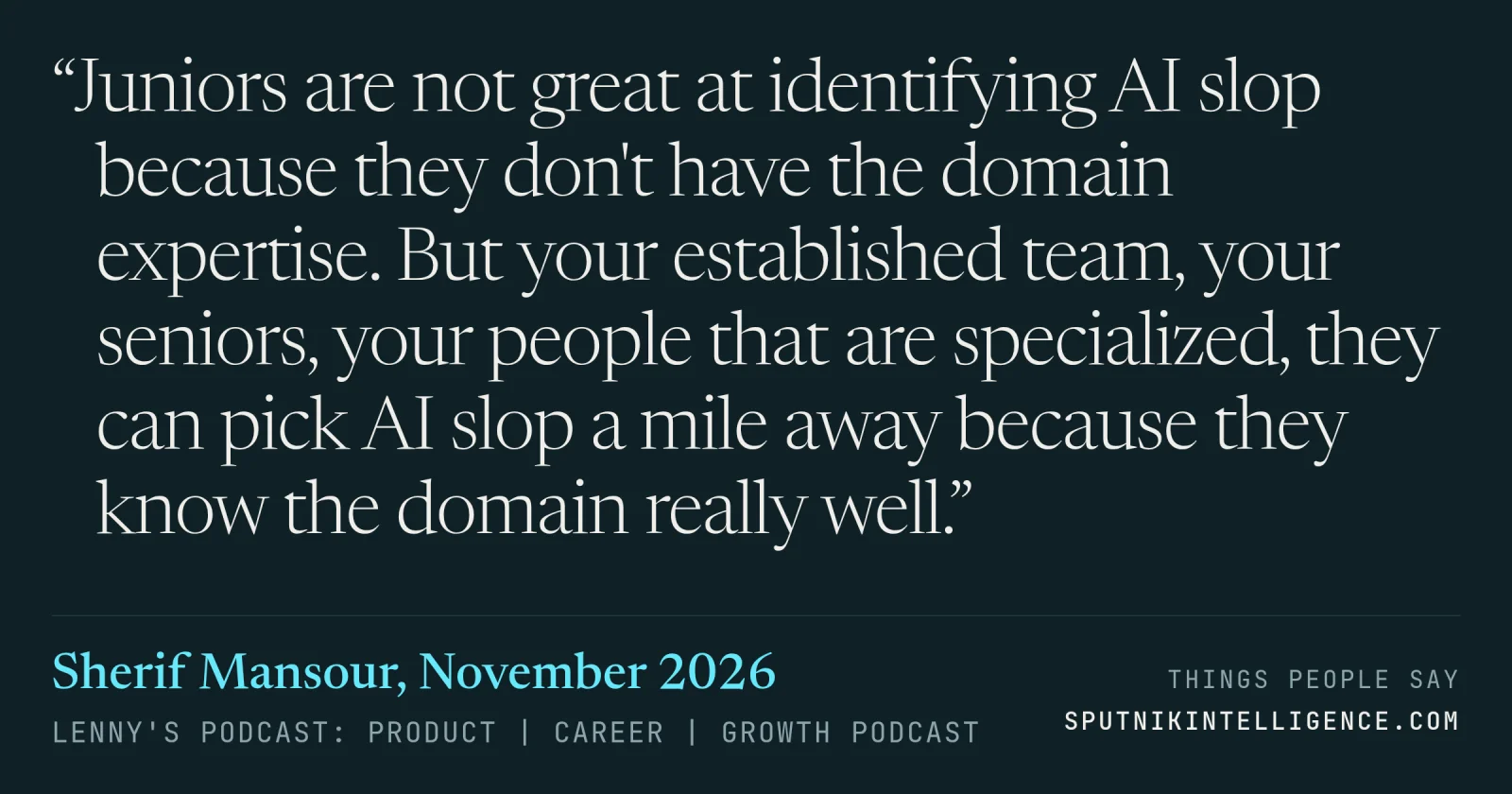
Sherif is pushing back on the idea that companies no longer need to hire juniors. At Atlassian's AI builder weeks, he says, juniors show off tools and demos while seniors catch the slop and quality problems. He wants teams that combine the two.
Lenny's Podcast: Product | Career | Growth · 2026-11-22
Permalink →
Listen →
Lenny's Podcast: Product | Career | Growth
Around 28:30 into the episode
Lenny Rachitsky
…we're on this topic of AI, you hire a lot of PMs, you interview a lot of PMs. I love asking this question. What's kind of trending up in what you are looking for when you are hiring PMs? What are kind of emerging newer skills, habits, traits, and what's trending down? What's less important now?
Sherif Mansour
Trending up in certainly larger organizations, I would say, again, to be more nuanced in the topic here, is... PMs that I'd say that are certainly more of the artist type and why that's the case is because taste has become more important than ever before when everyone has access to the same intelligence. I think that's been covered heavily in your podcast, but I think it's certainly people are more leaning towards experience-led PMs. I think that's certainly trending up. The other big thing that's trending up obviously is, you know, if anyone is in an established workforce, as in they have teams that already exist, right? You're asking yourself, how can I reinvent how each member of my team does their job in the world of AI? The problem you have is probably cultural change. If you define culture as how work gets done. And so you're looking at one thing I often do with the interviews and the interview process is you're looking at what new culture would this person bring to the team? And that means how can they transform how…
Lenny Rachitsky
This season's supporting sponsor is DX.
Lenny Rachitsky
Now that everybody at your company is finally using AI, the question that engineering leaders face is no longer are we using AI, but is it paying off? With DX, you can measure and benchmark the impact of AI adoption across your full product lifecycle. DX shows you where AI is helping developers and…
Lenny Rachitsky
Visit getdx.com slash lenny to get a demo of DX.
Speaker names come from our own diarization. The position is estimated from where the line sits in the episode.
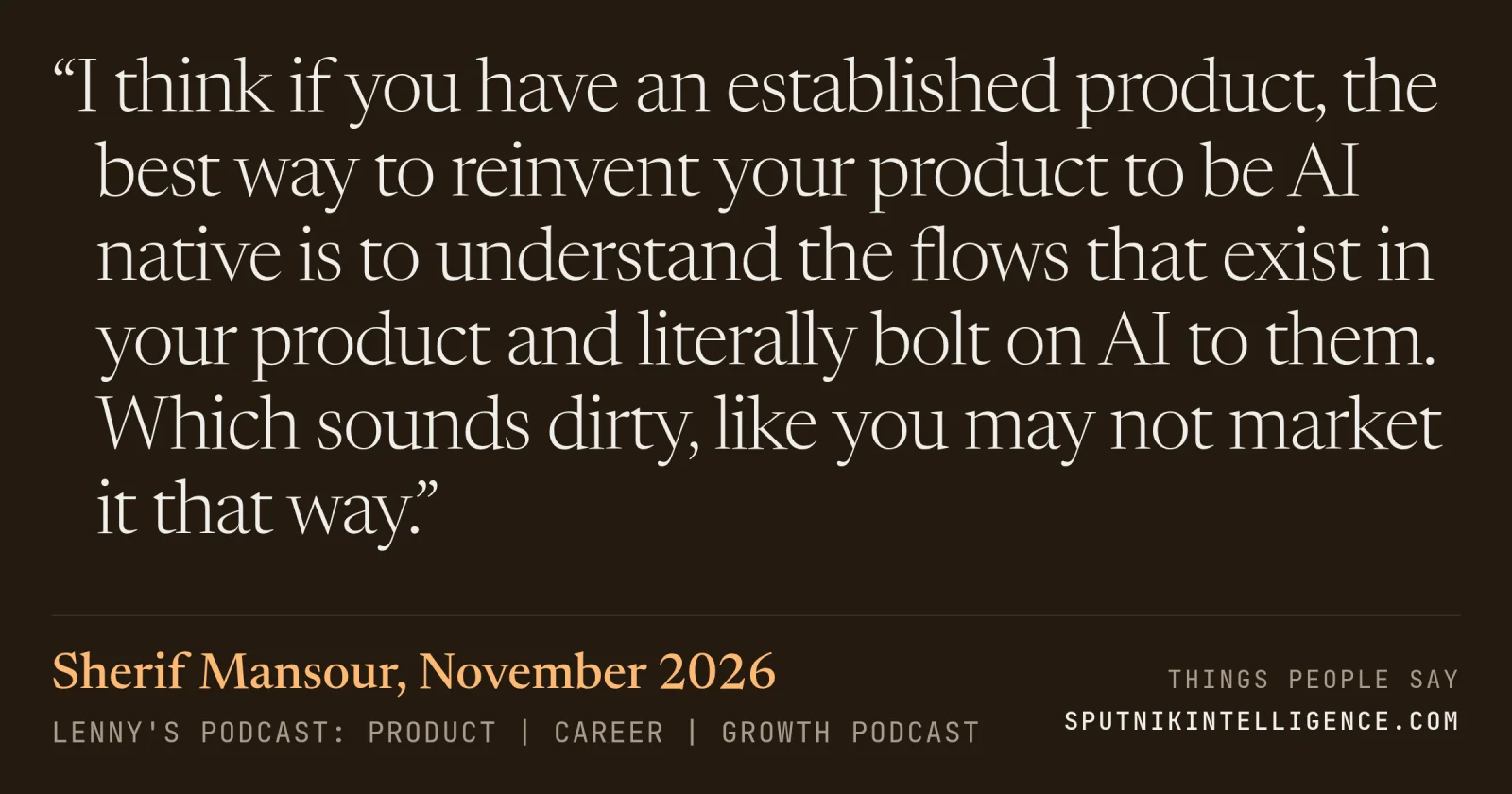
Lenny raised the common warning against "bolting AI onto" existing products. Sherif argues that for products with millions of users, adding agents to the workflows people already use beats a from-scratch rewrite, because the real job is moving customers from AI novice to AI native.
Lenny's Podcast: Product | Career | Growth · 2026-11-22
Permalink →
Listen →
Lenny's Podcast: Product | Career | Growth
Around 49:14 into the episode
Sherif Mansour
Yeah, Confluence whiteboards. It's huge. Yeah, customers can embed whiteboards in Confluence and they add agents to them and they collaborate, real-time collaboration and add sticky notes, turn them to Jira tickets, all that kind of stuff.
Lenny Rachitsky
…Didn't intend it to be as marketing, but it's a good example, I think. Yeah. Okay, cool. There's another counter narrative that you have, which is around AI and this kind of concern people have with just bolting AI onto stuff. And your feeling is that's actually good in many cases. Talk about that.
Sherif Mansour
This is where the catchy headlines, Lenny. It is very catchy to say, don't bolt AI into your product. You should reimagine the workflow. I certainly believe that. However, the nuance is, I think if you have an established product, you have something ready today, the best way to reinvent your product to be AI native is to understand the flows that exist in your product and literally bolt on AI to them. Which sounds dirty, like you may not market it that way, but actually, just think about it for a sec. You got a product, the product has millions of users. What I see some people doing, and I talk to a few startups or a few product companies, they're like, we're going to rewrite our product from scratch. I'm like, yeah, I think you can do that. But isn't the better way to actually work out is how to evolve, not like totally transform. So the example I'll have to give is the Rover Agents one I just told you about is a good one, which is customers have already modeled billions of business workflows in Jira. Just as an example…
Lenny Rachitsky
I love all these takes. Before we started recording this, I asked you what's a goal you have for this conversation. And you talked about how we need more nuance in the conversation of building product. There's all these hot takes, these viral clips that go out and people are like, oh, that's how I…
Sherif Mansour
You know, the classic thing in product, I think especially is like every advice you've probably got on how to do product, someone probably has a counter, totally opposite advice that works just as good. And again, you as a product team or a PM or a product leader, you're trying to understand the…
Lenny Rachitsky
Yeah, it's tough. I'm in a tough spot sometimes where people share an opinion and many people are like, that is wrong. Why did you not push back on that? I find the best thing I can do that scales is have different perspectives here and not try to get everyone in line. This is the way to do it. And…
Speaker names come from our own diarization. The position is estimated from where the line sits in the episode.
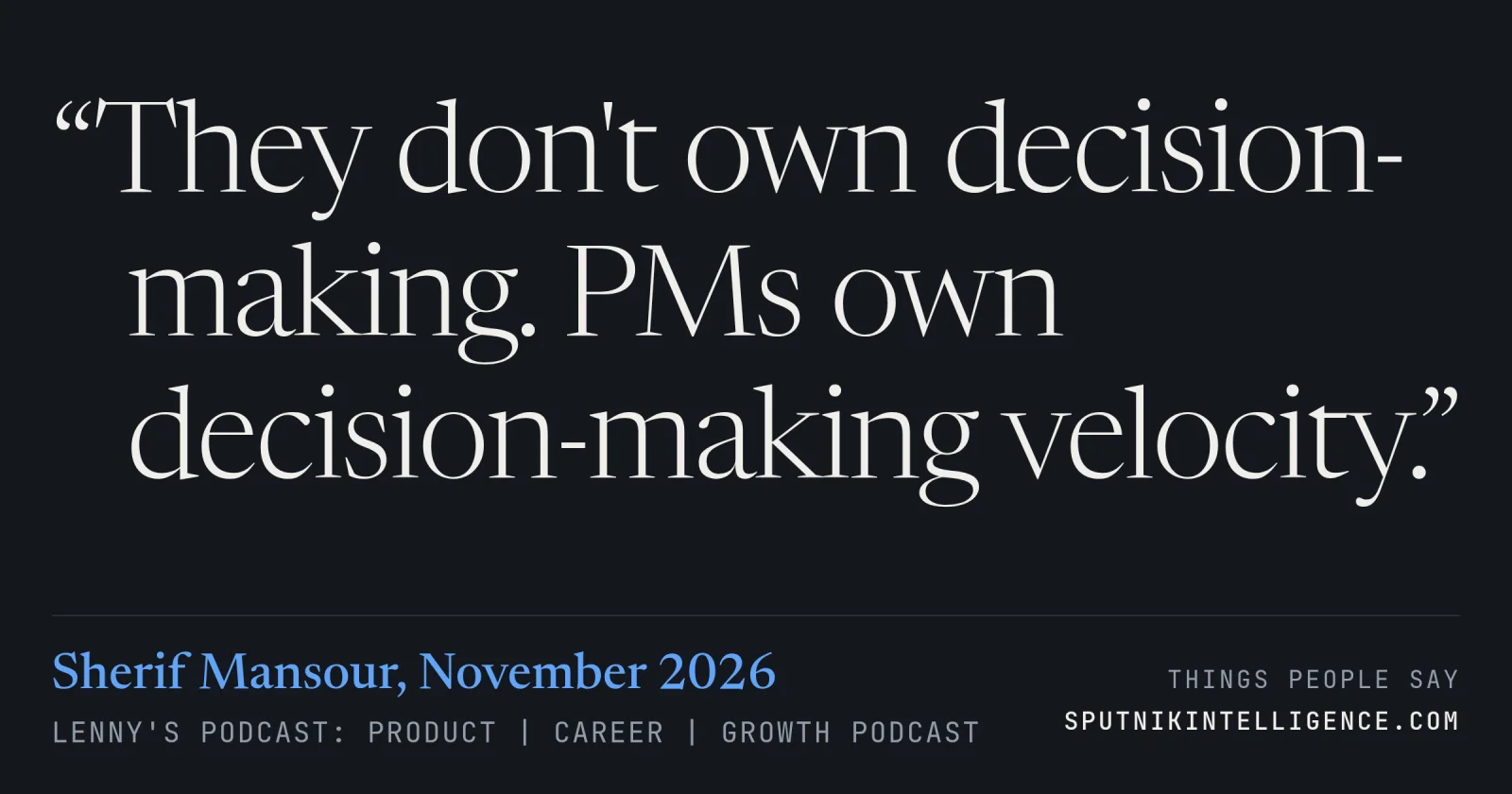
Lenny asked what PMs should actually be doing with AI. Sherif goes back to his core claim: the PM's job is closing context gaps so the team can decide faster, and AI only helps where it fills one of those gaps.
Lenny's Podcast: Product | Career | Growth · 2026-11-22
Permalink →
Listen →
Lenny's Podcast: Product | Career | Growth
Around 25:55 into the episode
Sherif Mansour
…equally getting bigger so if they're equally getting bigger you know then They're not compressing, if that makes sense. The specializations are still needed to improve the quality and taste that's coming out of each of those things. Yeah, that's just often missed as well, I think, that whole topic.
Lenny Rachitsky
…ladders and calibration and what a successful PM looks like. So this is something you spent a lot of time on. What do you think a PM should be doing in terms of AI infusing their job? Prototyping, I imagine. Should they be shipping code? What do you think is the right answer for PMs these days?
Sherif Mansour
I'll tie it back up to the top, Lenny, which is their job is to make sure the team, they don't own decision-making, PMs own decision-making velocity. And so they're thinking of how can I help the team move faster? Second question is, oh, can AI help me in any of those? I think that's the right mindset. So it's like, if I realize that, okay, customer empathy and customer awareness is a huge problem, a context gap my team has, and I just feel like they're not making the right micro decisions because they don't understand this persona over that persona, et cetera, then you'll probably be thinking about how can I involve them in the process, but also how can I use AI in the process to accelerate and filling that context gap? Um, I, I think I would, I would go back to the top and just answer that question of like, look at your team today. There's some…
Lenny Rachitsky
I love that answer. Very unlikely it will be the bottleneck for decision making and shipping code to production. Most likely that is the last thing that you need to speed up because that is so easy now. Unless, as you said, if it's like a startup or just like a new team or it's just a PM, for…
Lenny Rachitsky
Amazing. So while we're on this topic of AI, you hire a lot of PMs, you interview a lot of PMs. I love asking this question. What's kind of trending up in what you are looking for when you are hiring PMs? What are kind of emerging newer skills, habits, traits, and what's trending down? What's less…
Speaker names come from our own diarization. The position is estimated from where the line sits in the episode.
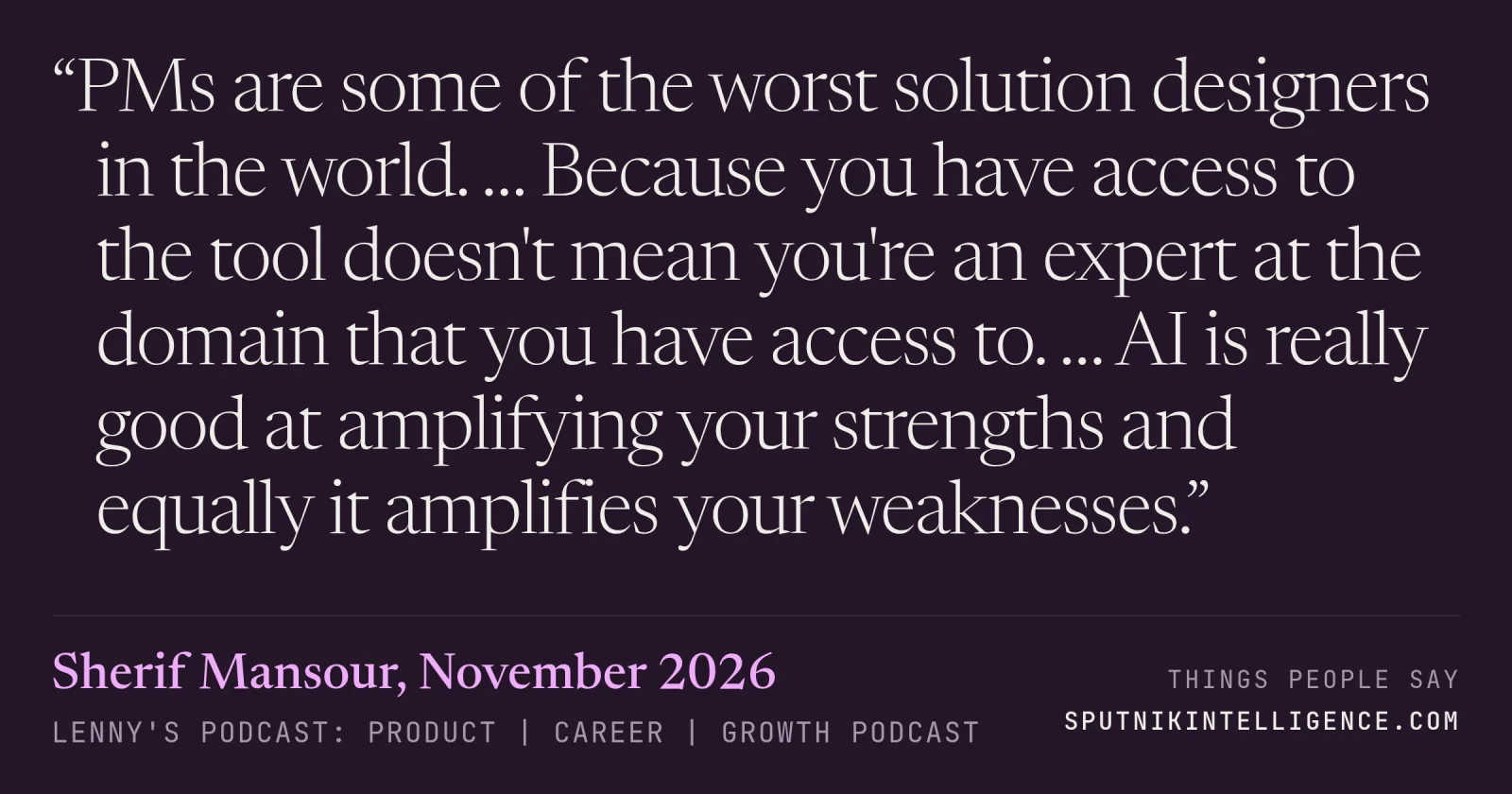
Lenny noted the AI-era assumption that PMs would start shipping code themselves. Sherif compares it to the mockup-tool era, when everyone could make a mockup but specialists still did the quality work. AI widens what everyone can touch without making the specialties overlap.
Lenny's Podcast: Product | Career | Growth · 2026-11-22
Permalink →
Listen →
Lenny's Podcast: Product | Career | Growth
Around 24:37 into the episode
Sherif Mansour
Yes, this is exactly right.
Lenny Rachitsky
…the things PMs are great at. Also, what is great? Is this ready? Is this good? Is this what we want? Is this going to hit our goals? So it's like, now that we think about it, I see this makes all the sense. Here's why we need more PMs. It's so interesting that we thought the opposite would happen.
Sherif Mansour
…through that era at Atlassian. I learned that one, yeah, everyone can create a prototype or a mockup. But yeah, actually, PMs are some of the worst solution designers in the world. Like, as in, you realize like, because you have access to the tool, doesn't mean you're an expert at the domain that you have access to, right? So like, now some PMs, more of the artist ones, ended up doing just So AI is really good at amplifying your strengths and equally it amplifies your weaknesses. So we learned there in that world that specialists, specialists is still important and specialization is still important. Like you can only get the AI to do something as good as your knowledge of the specialization is, if that makes sense. Because you've got to learn how to prompt it. We started with a mock -up era and now we're seeing it again with the prototypes era and everyone congenital…
Lenny Rachitsky
I love this. Okay. So again, this is a fun spectrum. On one end of the spectrum of what a PM should be doing. On one end, you are now an engineer. You're shipping production. This is part of your job now. The other end is don't even touch AI at all. Just do what you used to do. You actually spent a…
Sherif Mansour
I'll tie it back up to the top, Lenny, which is their job is to make sure the team, they don't own decision-making, PMs own decision-making velocity. And so they're thinking of how can I help the team move faster? Second question is, oh, can AI help me in any of those? I think that's the right…
Lenny Rachitsky
I love that answer. Very unlikely it will be the bottleneck for decision making and shipping code to production. Most likely that is the last thing that you need to speed up because that is so easy now. Unless, as you said, if it's like a startup or just like a new team or it's just a PM, for…
Speaker names come from our own diarization. The position is estimated from where the line sits in the episode.
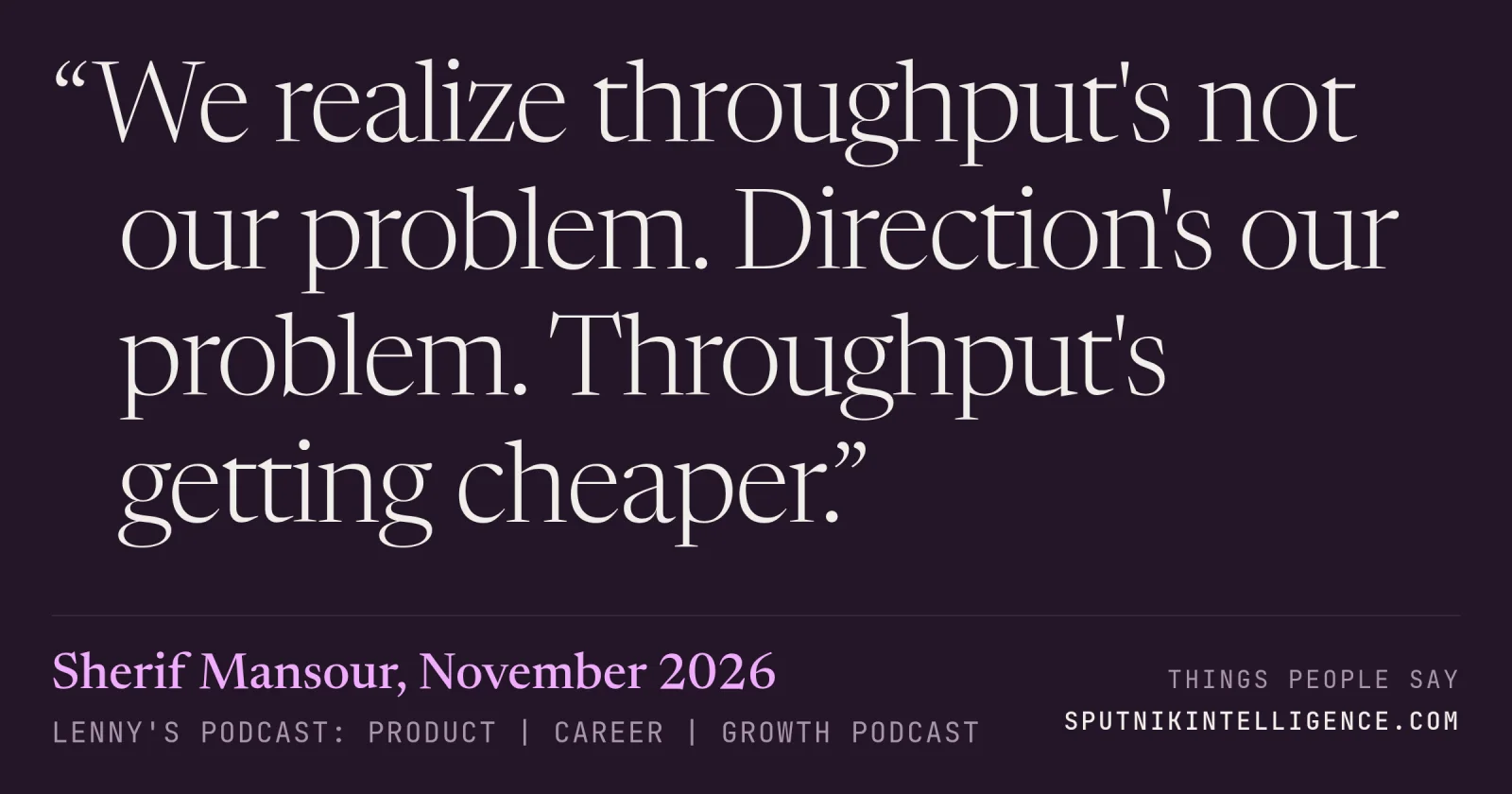
Sherif describes an Atlassian experiment that moved product managers and designers into squads where everyone was an "AI builder." About a month in, everyone had drifted back to their old jobs, and this was one PM's conclusion. He uses it to explain why PM hiring is going up, not down.
Lenny's Podcast: Product | Career | Growth · 2026-11-22
Permalink →
Listen →
Lenny's Podcast: Product | Career | Growth
Around 22:01 into the episode
Sherif Mansour
…a lot of our pricing and packaging work across AI and all that kind of stuff. And she's so good at it. Uh, and we just, she keeps finding more work across the business that lines up with that. So she's, you know, chasing that kind of work because she knows she does such a good job of that stuff.
Lenny Rachitsky
…them? Get rid of them. Surprisingly, it's the role that seems to be most thriving right now. And I actually had a post about this that I predicted this. I feel really good about this. So let me ask you this. Why do you think this is the case? Why do you think PMs are doing so well in the AI era?
Sherif Mansour
…we've moved so fast. We've moved faster than ever before. Early days, it was just amazing. Yeah, everyone's going to be an hour builder. I'm like, wow, really? Is that where it's going to hit? After about a month, he comes back and he's like, everyone's gone back to doing their traditional jobs. I'm like, sorry, what do you mean by that? He's like, It sounds so obvious in hindsight. It's like, we realize throughput's not our problem. Direction's our problem. Throughput's getting cheaper. So, you know, I wrote this blog post internally that was, you know, direct the ship, don't roll it. And it was a lot of PMs coming to us saying, should I be coding? Do I need to code? And, you know, quite a few of our PMs have committed code in some capacity or whatever. But it's very obvious in a world where you have, again, the nuance here is if you're a startup and everyone's moving really…
Lenny Rachitsky
That is an awesome answer. And that makes, like, I imagine so many people hearing this are just nodding along.
Sherif Mansour
Yes, this is exactly right.
Lenny Rachitsky
In spite of what we keep hearing, just PM should be shipping code, PM should be building. There's a few directions I want to go here. I guess just like the trend kind of to double down what you're saying, what AI is enabling is anyone can build, which is creating a ton of chaos and a lot of…
Speaker names come from our own diarization. The position is estimated from where the line sits in the episode.