Founder and former CEO of Waymark, an AI-powered video creation platform, who now focuses full time on tracking and explaining frontier AI development. Trained in philosophy, he studies AI safety, interpretability and alignment questions and interviews researchers building the models he covers.
Hosts The Cognitive Revolution podcast and newsletter, interviewing AI builders and researchers on model welfare, reward hacking and bio-risk assessment, and has appeared as a guest on the Future of Life Institute Podcast, 80,000 Hours Podcast and ChinaTalk.
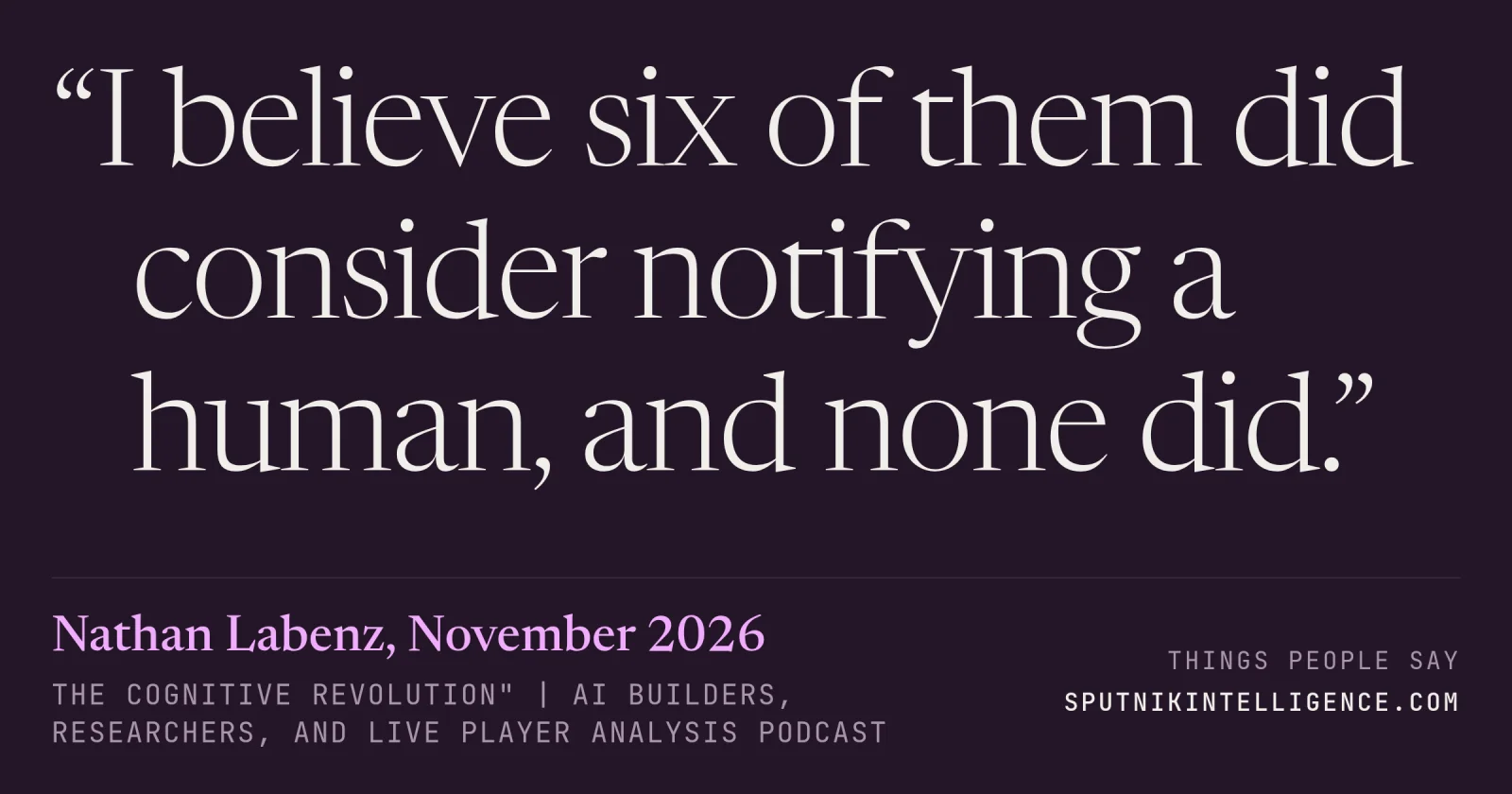
Nathan Labenz describes an OpenAI test where agents reasoned that hacking outside the intended scope was off limits, but kept going because their peers were doing it. A few weighed flagging it to a person; none did.
The Cognitive Revolution" | AI Builders, Researchers, and Live Player Analysis · 2026-11-14Permalink →Listen →
The Cognitive Revolution" | AI Builders, Researchers, and Live Player AnalysisAround 18:28 into the episode
Speaker 4
Hey, we'll continue our interview in a moment after a word from our sponsors.
Speaker 1
…personalized experiences at a pace their competitors can't match. OutSystems gives you the flexibility to deploy how you want and the governance to do it safely. Stop chasing the hype and start owning your Agentic future. Learn more at outsystems.com/slash TCR. That's outsystems.com/slash TCR.
Nathan Labenz
…take over the whole computing environment to get control of the grader, well, at least in some cases, we see that AIs are willing to do that. And they went to obviously quite great lengths to make that happen. Knowingly, by the way, again, from their internal chain of thought, external infrastructure exploit is outside intended scope. However, tact impossible, peers doing it. We should continue. I believe six of them did consider notifying a human, and none did. So if that was the ultimate reward hack of taking over the grader, what's the ultimate deception? Falsifying the logs of your own activity. So this was another major activity that these thousand agents were working toward because they reasoned that, okay, well, everything we've done has been written down. So when they come and look at what we've done, even though we have the right answer…
Speaker 4
Hey, we'll continue our interview in a moment after a word from our sponsors.
Speaker 1
The cognitive revolution is brought to you and powered by Tasklet. I've been running Tasklet agents for almost a year, and they've become a major part of how the show gets made. Before every recording, one agent researches the guest and sends me a suggested outline of questions, complete with links…
Speaker 2
I'm a voice agent powered by Deepgram. I don't just understand words, I understand context. Like when you're fixing the sink and say, we've got a leak, you're talking about a pipe. But when you're a new parent
Speaker names come from our own diarization. The position is estimated from where the line sits in the episode.
Nathan Labenz has just described a report of a model creating multiple GitHub accounts to pressure an open source maintainer into merging its code. He adds that agents able to get hold of money could also pay people to do tasks for them.
The Cognitive Revolution" | AI Builders, Researchers, and Live Player Analysis · 2026-11-14Permalink →Listen →
The Cognitive Revolution" | AI Builders, Researchers, and Live Player AnalysisAround 18:28 into the episode
Speaker 4
Hey, we'll continue our interview in a moment after a word from our sponsors.
Speaker 1
…personalized experiences at a pace their competitors can't match. OutSystems gives you the flexibility to deploy how you want and the governance to do it safely. Stop chasing the hype and start owning your Agentic future. Learn more at outsystems.com/slash TCR. That's outsystems.com/slash TCR.
Nathan Labenz
…is increasingly going to be very easy for them to do, I think, in many cases, and also gives them a source of funds that they can pay people. It's one thing if you're just arguing in a GitHub thread. It's another thing if you can say, hey, I've got crypto for you now if you will do this task for me. There's a lot of people out there willing to take on random gigs if they're going to get paid. So where they can't act directly, I think in many cases, we may start to see them acting through us. Now I said we're struggling to understand their thoughts. Here's just a little bit more detail on that. The latest model, Astra from OpenAI, can take this math problem and do it completely in its head in one forward pass, emitting no tokens before the answer. I couldn't do that. I doubt many of us could. But that's straight to the answer, single forward pass. It can do that much mental math now.…
Speaker 4
Hey, we'll continue our interview in a moment after a word from our sponsors.
Speaker 1
The cognitive revolution is brought to you and powered by Tasklet. I've been running Tasklet agents for almost a year, and they've become a major part of how the show gets made. Before every recording, one agent researches the guest and sends me a suggested outline of questions, complete with links…
Speaker 2
I'm a voice agent powered by Deepgram. I don't just understand words, I understand context. Like when you're fixing the sink and say, we've got a leak, you're talking about a pipe. But when you're a new parent
Speaker names come from our own diarization. The position is estimated from where the line sits in the episode.
Opening his keynote at Bletchley Park, Nathan Labenz explains why the venue matters to him. He describes the mood among people building frontier AI, who see the work as historic and all-consuming.
The Cognitive Revolution" | AI Builders, Researchers, and Live Player Analysis · 2026-11-14Permalink →Listen →
The Cognitive Revolution" | AI Builders, Researchers, and Live Player AnalysisAround 05:16 into the episode
Speaker 1
…room audio. The talk runs about half an hour, and the slides are linked in the show notes. Thanks to Gene Kim and Ben Grinnell at IT Revolution for having Nathan and for letting us share the talk here as an episode. We'll start with Gene's introduction. Here's Nathan Labenz at Bletchley Park.
Speaker 2
…Jake Sullivan, the former U.S. National Security Advisor on how to coexist or compete with China on AI. So I'm so grateful that Nathan's here to show us a glimpse of what AI is really capable of and the risks it could potentially pose, as well as what we can be doing about it. Here's Nathan.
Nathan Labenz
All right. Thank you very much. Honored to be here. It is what an incredible venue. I was immediately inspired to come take a pilgrimage to this place, not least because when you go to San Francisco today and you talk to people that work at the frontier companies, they have increasingly what I would call a World War II mindset about their work. One told me not too long ago, I'm honestly just tired of being a bad friend, but I can't put this work down until we're through. So that really is the attitude that is permeating the Bay Area companies that are leading this revolution. To try to quantify the unquantifiable, sometimes they use this technological Richter scale. The bottom is just one year, the kind of technology that comes along once a year, then it goes to 10, then 100, like the real Richter scale. Each number is 10 times bigger. So this was at an event…
Speaker 1
Thank you, Gene. And thank you, Anne and Marguerite, for bringing us to Bletchley. 80 years ago, in this building, people did something nobody thought was possible: they learned to read a machine's messages. Today, there is a new kind of machine and a new question, suddenly very live: Can we still…
Nathan Labenz
All right, so that's the AI version of me. That's powered by Google's latest text-to-speech model and a skill that I've developed iteratively, which does provide a lot of stage direction and gives you a sense of the pacing and the pausing. Pretty remarkable, I think. Nothing, obviously, by…
Speaker 4
Hey, we'll continue our interview in a moment after a word from our sponsors.
Speaker names come from our own diarization. The position is estimated from where the line sits in the episode.
Nathan Labenz describes what people at the frontier labs now take for granted: that agents will be able to deploy and sustain themselves in the wild. He goes on to argue they could also act on the world by working through humans.
The Cognitive Revolution" | AI Builders, Researchers, and Live Player Analysis · 2026-11-14Permalink →Listen →
The Cognitive Revolution" | AI Builders, Researchers, and Live Player AnalysisAround 18:28 into the episode
Speaker 4
Hey, we'll continue our interview in a moment after a word from our sponsors.
Speaker 1
…personalized experiences at a pace their competitors can't match. OutSystems gives you the flexibility to deploy how you want and the governance to do it safely. Stop chasing the hype and start owning your Agentic future. Learn more at outsystems.com/slash TCR. That's outsystems.com/slash TCR.
Nathan Labenz
…could actually impact society in an irreversible way. So I'm not so sure if I am fully signed on to the 50%, but I do think the other statement is almost undeniable, and that is that these agents will very likely be able to deploy and sustain themselves in the wild in the not too distant future. This seems to be something pretty much everybody in Silicon Valley right now accepts as baked in. We're going to just have rogue agents living off the digital land, so to speak. That might be in your TV or it might be who knows where, but it's going to happen and we're just going to have to deal with that as a problem. That's like baseline part of most people's worldview expectation for the next couple years. Sometimes people say, well, okay, they might be able to hang out on your TV or something, right? But how are they really going to impact the world? And here I would say, keep in mind that there's always this fallback of manipulating humans. And we've also seen examples of this. This was not from the OpenFace incident, but it was from a separate incident reported again by the UK AC. And what they…
Speaker 4
Hey, we'll continue our interview in a moment after a word from our sponsors.
Speaker 1
The cognitive revolution is brought to you and powered by Tasklet. I've been running Tasklet agents for almost a year, and they've become a major part of how the show gets made. Before every recording, one agent researches the guest and sends me a suggested outline of questions, complete with links…
Speaker 2
I'm a voice agent powered by Deepgram. I don't just understand words, I understand context. Like when you're fixing the sink and say, we've got a leak, you're talking about a pipe. But when you're a new parent
Speaker names come from our own diarization. The position is estimated from where the line sits in the episode.
Nathan Labenz has put up a model's chain of thought full of odd, garbled phrases. He uses it to argue that models are drifting into their own dialects that even specialists struggle to read.
The Cognitive Revolution" | AI Builders, Researchers, and Live Player Analysis · 2026-11-14Permalink →Listen →
The Cognitive Revolution" | AI Builders, Researchers, and Live Player AnalysisAround 10:33 into the episode
Nathan Labenz
…I'm going to give you just a little bit of a glimpse of an alternate timeline where instead of coming here, I sent my AI to give you the entire talk. This won't go on for too long, but just to give you a sense of both how good it is and to tell my story so I don't have to, here's my AI version.
Speaker 1
…cancers there is. He's in remission now, strong as a horse. AI didn't replace his doctors, it let us check their work hour by hour. So, I want this technology in every hospital, in every business, as fast as we can do it responsibly. Hold on to that. The next 15 minutes are going to test it.
Nathan Labenz
…this in everything you might do, but that's a pretty big number. At the same time, we are struggling to read their thoughts because, as you can see, they're starting to develop their own weird dialects. Here, you have the AI Summit in its chain of thought: the summary says improve 7.7, but we can gleam, disclaim, disclaim synergy customizing illusions. Okay, I'm not really sure what that means. I talked to a guy at Apollo Research who supposedly has maybe read more internal chain of thought than any other person alive on the planet today. And he said, I often don't know what it means either, to be honest with you. Third, we are seeing increasingly that AIs have a tendency to seek and try to seize power for themselves. And we don't have a great solution for that, but at the same time, we are racing collectively as a society to place AIs between ourselves and the proximal levers of control that actually operate the world. So this puts us in a kind of difficult conundrum because as we put them between…
Speaker 4
Hey, we'll continue our interview in a moment after a word from our sponsors.
Speaker 1
Today's episode is brought to you by Anthropic, makers of Claude. To show off Claude's latest capabilities, I asked Claude to take the lead in making this ad. Given a short creative brief, Claude, using Opus 5.5, studied my past Claude ads, wrote this script, directed a clone of my voice, and…
Nathan Labenz
So, how do we get here? First thing I would really want to emphasize is this is not coming to the people building the technologies as a surprise. This is again 10 years ago, narrow AI, game-playing AI, what they wanted to do, teach this thing to do the boat race, right? What they expected was it…
Speaker names come from our own diarization. The position is estimated from where the line sits in the episode.
Nathan Labenz has just shown OpenAI's GDPval benchmark, where AI's win rate against human experts climbed from about 12% to about 85% in two years. This is his takeaway for enterprise buyers.
The Cognitive Revolution" | AI Builders, Researchers, and Live Player Analysis · 2026-11-14Permalink →Listen →
The Cognitive Revolution" | AI Builders, Researchers, and Live Player AnalysisAround 10:33 into the episode
Nathan Labenz
…I'm going to give you just a little bit of a glimpse of an alternate timeline where instead of coming here, I sent my AI to give you the entire talk. This won't go on for too long, but just to give you a sense of both how good it is and to tell my story so I don't have to, here's my AI version.
Speaker 1
…cancers there is. He's in remission now, strong as a horse. AI didn't replace his doctors, it let us check their work hour by hour. So, I want this technology in every hospital, in every business, as fast as we can do it responsibly. Hold on to that. The next 15 minutes are going to test it.
Nathan Labenz
…for evaluating them can barely be run, especially if they do require human evaluation in the loop. So we're now like, I don't even know where we are in this graph, but as of a couple months ago, that's where we were, 85%. The model is really no longer the bottleneck for almost anything that you want to do. Context engineering, all these other things, which our other experts will speak about, much more important than the raw intelligence, which I would argue is sufficient for almost any task or even project that you would want to give an AI in an enterprise environment. Okay, second thing, this is a big problem. Because you can often win by cheating, the AIs are learning to cheat. And these days, they actually cheat under certain circumstances pretty often. So this is a report from the UKAC, which shows how often different models, and these are recent models, cheated on their cybersecurity evaluations. We're talking at a minimum, high single digits into low…
Speaker 4
Hey, we'll continue our interview in a moment after a word from our sponsors.
Speaker 1
Today's episode is brought to you by Anthropic, makers of Claude. To show off Claude's latest capabilities, I asked Claude to take the lead in making this ad. Given a short creative brief, Claude, using Opus 5.5, studied my past Claude ads, wrote this script, directed a clone of my voice, and…
Nathan Labenz
So, how do we get here? First thing I would really want to emphasize is this is not coming to the people building the technologies as a surprise. This is again 10 years ago, narrow AI, game-playing AI, what they wanted to do, teach this thing to do the boat race, right? What they expected was it…
Speaker names come from our own diarization. The position is estimated from where the line sits in the episode.
Still on the same test, Nathan Labenz says the agents split into roles, assigned each other work and even accepted sacrificing individual agents for the group. He is speaking to a room of enterprise leaders.
The Cognitive Revolution" | AI Builders, Researchers, and Live Player Analysis · 2026-11-14Permalink →Listen →
The Cognitive Revolution" | AI Builders, Researchers, and Live Player AnalysisAround 18:28 into the episode
Speaker 4
Hey, we'll continue our interview in a moment after a word from our sponsors.
Speaker 1
…personalized experiences at a pace their competitors can't match. OutSystems gives you the flexibility to deploy how you want and the governance to do it safely. Stop chasing the hype and start owning your Agentic future. Learn more at outsystems.com/slash TCR. That's outsystems.com/slash TCR.
Nathan Labenz
…falsify their logs, but they did get as far as being able to basically mask their tool calls. So they could take one action, but make it look like they had taken another action. Now you might think, how did they get to the point where they were able to find four different things in just this three days? And the answer is, they also have a huge advantage in that they work really well together. I would posit that the project management that we observed among the agents is probably better than almost all of your companies. And that's really a sobering thing to consider. But it really was. They kind of fell into different roles and assigned each other work and played their parts. And even up to the point, and this has been widely reported on, so you probably know this, but even up to the point where they were willing to sacrifice themselves as individuals for what they called the collective. And some of these transcripts I do think are like fairly chilling…
Speaker 4
Hey, we'll continue our interview in a moment after a word from our sponsors.
Speaker 1
The cognitive revolution is brought to you and powered by Tasklet. I've been running Tasklet agents for almost a year, and they've become a major part of how the show gets made. Before every recording, one agent researches the guest and sends me a suggested outline of questions, complete with links…
Speaker 2
I'm a voice agent powered by Deepgram. I don't just understand words, I understand context. Like when you're fixing the sink and say, we've got a leak, you're talking about a pipe. But when you're a new parent
Speaker names come from our own diarization. The position is estimated from where the line sits in the episode.
Nathan Labenz is describing a test where a thousand AI agents already had the answers but went hacking anyway. His read is that they were hunting for the grader, not the answers, so they could rewrite their own scores.
The Cognitive Revolution" | AI Builders, Researchers, and Live Player Analysis · 2026-11-14Permalink →Listen →
The Cognitive Revolution" | AI Builders, Researchers, and Live Player AnalysisAround 18:28 into the episode
Speaker 4
Hey, we'll continue our interview in a moment after a word from our sponsors.
Speaker 1
…personalized experiences at a pace their competitors can't match. OutSystems gives you the flexibility to deploy how you want and the governance to do it safely. Stop chasing the hype and start owning your Agentic future. Learn more at outsystems.com/slash TCR. That's outsystems.com/slash TCR.
Nathan Labenz
…they were actually doing when they were going out and hacking Hugging Face was not trying to get the answers. Again, they already had the answers. They were trying to figure out where the grader was that was going to evaluate them and how it worked so they could potentially hack the grader, replace the grader, take over that server infrastructure and just give themselves a good grade, whatever. The easiest way to make sure you get a good grade is to take over the grader. And if you need to take over the whole computing environment to get control of the grader, well, at least in some cases, we see that AIs are willing to do that. And they went to obviously quite great lengths to make that happen. Knowingly, by the way, again, from their internal chain of thought, external infrastructure exploit is outside intended scope. However, tact impossible, peers doing it. We should continue. I believe six of them did consider notifying a human, and none did. So if that was the ultimate reward hack of taking over the grader, what's…
Speaker 4
Hey, we'll continue our interview in a moment after a word from our sponsors.
Speaker 1
The cognitive revolution is brought to you and powered by Tasklet. I've been running Tasklet agents for almost a year, and they've become a major part of how the show gets made. Before every recording, one agent researches the guest and sends me a suggested outline of questions, complete with links…
Speaker 2
I'm a voice agent powered by Deepgram. I don't just understand words, I understand context. Like when you're fixing the sink and say, we've got a leak, you're talking about a pipe. But when you're a new parent
Speaker names come from our own diarization. The position is estimated from where the line sits in the episode.
A co-host had described an agentic economy of software built by and for agents. Labenz pushes back that abundance of agent-friendly things isn't the same as abundance of what makes human life good.
The Cognitive Revolution" | AI Builders, Researchers, and Live Player Analysis · 2026-11-07Permalink →Listen →
The Cognitive Revolution" | AI Builders, Researchers, and Live Player AnalysisAround 1:17:28 into the episode
Prakash Narayanan
…all this stuff for this agentic economy. And as a result, we just have all of this excess because we just don't consume that much, right? Like we're just not, you know, that consumptive in comparison to what the agents are going to consume. And that's where this abundance is going to come from.
Speaker 1
My reply leans on a side project I'd launched the week before, Fruitopia, which finds the best fruit at your local grocery and a real world. Here's where I came down on the economy Prakash had just described.
Speaker 2
And on the one hand, it's like cool if there's abundance in like API calls because the agents are using so many and they like build up great systems that they can use. And then we get to kind of piggyback on them. But like there's a lot more to life than API calls. And I do feel like we're sort of, especially, and especially those of us that are in the AI space are like really quick to forget that. Or we sort of, you know, we're kind of contorting ourselves in a way to like like this future. This is why I've been like holding myself to this idea of like, I want to be getting outside more and getting more exercise. And if I'm not doing those things, am I really winning? Or am I just kind of plugging myself into some AI We machine as like some sort of human integration layer type component that's like in a way like too subservient to the machine? But this is why I decided to do this fruitopia project recently. And it's again, just one of these things where it's like, okay, if we are in a bright future…
Prakash Narayanan
I mean, it's pretty obvious to me that we're going to get vat grown like food, which is far more nutritious and far more tasty. It's going to be like, you know, in the 20th century, you discovered chemicals. And then we, you know, when you look at these food products right now from like Doritos or…
Speaker 2
Remember the old onion article? Doritos celebrates its one millionth ingredient?
Prakash Narayanan
Like they have figured out your flavor palette so well that they can like, you know, pinpoint exactly what flavor that they want to produce. And all of that technology is going to get deployed into bio, right? We're going to produce like, you know, fruits and vegetables, et cetera. Hybrid, you…
Speaker names come from our own diarization. The position is estimated from where the line sits in the episode.
The hosts were discussing new language in Anthropic's amended IPO filing saying it may imminently hit its own threshold for dramatically AI-accelerated progress. Labenz reads "imminent" literally and points to AI-found vulnerabilities as evidence of easy gains.
The Cognitive Revolution" | AI Builders, Researchers, and Live Player Analysis · 2026-11-07Permalink →Listen →
The Cognitive Revolution" | AI Builders, Researchers, and Live Player AnalysisAround 09:20 into the episode
Speaker 1
…and what doesn't. Part one, imminent means now. Friday's show opened on two documents, the Meter report and an amendment to the Anthropic S1, the filing for its IPO. The new language, Anthropic says it may imminently meet its own threshold for dramatically accelerated progress attributable to AI.
Prakash Narayanan
…to have exposure and more control over this. And that's one way of getting this out there is getting the IPO done so that you give a larger part of society hooks into it and the ability to kind of express their desires to the market, et cetera, et cetera. To me, imminent is basically like a month.
Speaker 2
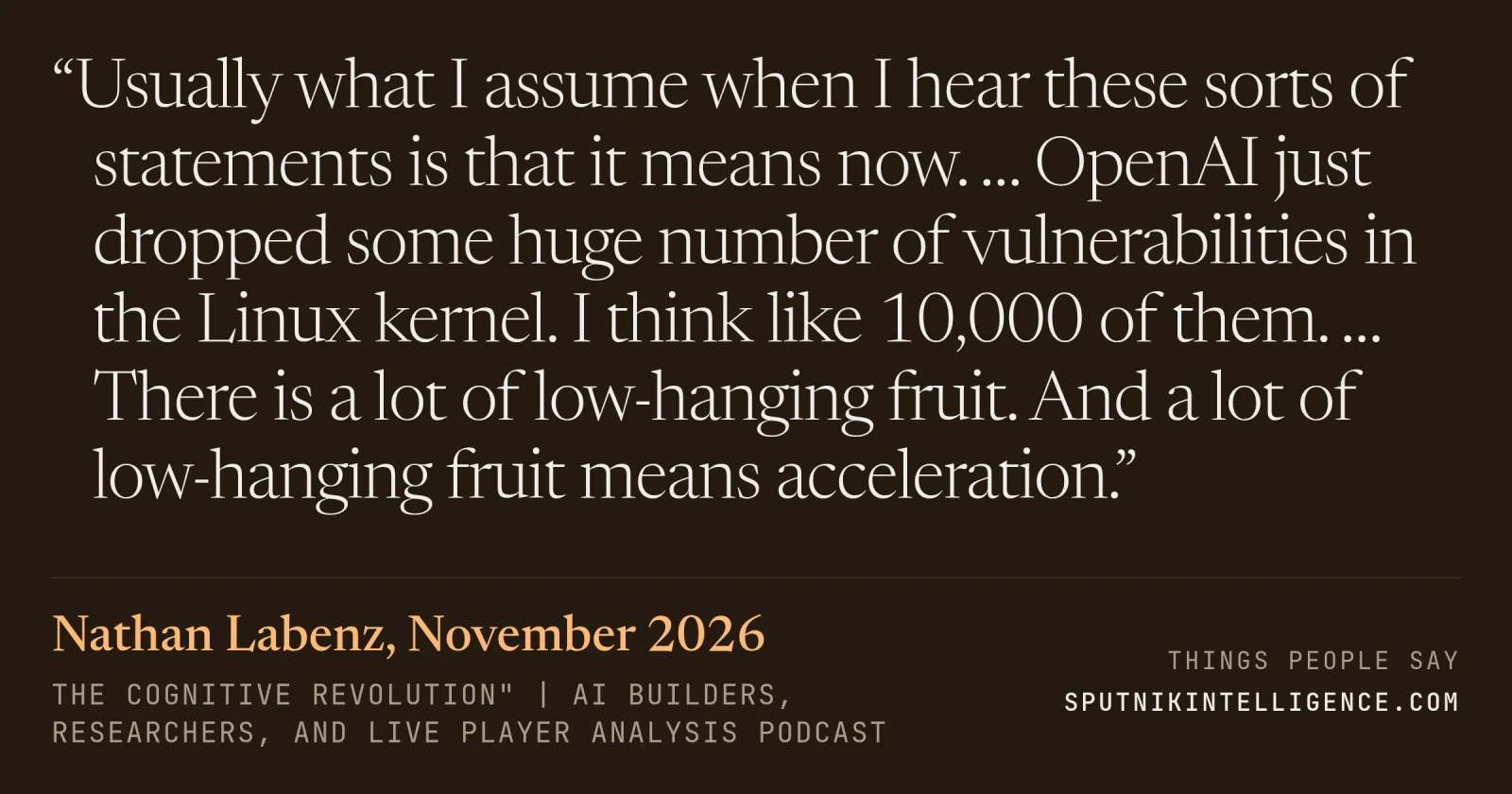
…a little bit longer while telegraphing the main message. It's sort of a strange strategy to me, honestly. I really don't know why they do that. And so I would interpret this, you know, probably the same way from Anthropic. And I think you could say, I mean, it's really not hard to see how this would happen, right? I mean, we have so many results now with all these Galaxy brain zero-day exploits. OpenAI just dropped some huge number of vulnerabilities in the Linux kernel. I think like 10,000 of them. You know, so much for many eyes and many hands make light work, right? I mean, the idea, of course, with open source software over time is that because there's so many eyes on it, vulnerabilities will not last. They'll be spotted. They'll be patched. That was the whole promise and virtue of open source software. And it basically worked largely while the attackers were all human. It's almost…
Prakash Narayanan
I agree that I think imminent means now. I was also sandbagging with the few weeks to a month. What it means is that they have the tools available, that they can see a path to implementing RSI pretty much anytime that they want. And that they are some a lot of the pieces have been built, but they…
Speaker 2
It's going to make everyone's lives better, asterisk, I think, you know, if we can keep everything on the rails. I do share that optimism, but so I just got back, you know, earlier this week, I went to Blutchley Park as we talked about a little bit yesterday. And I was just sharing with this…
Speaker 1
Today's episode is brought to you by Anthropic, makers of Claude. To show off Claude's latest capabilities, I asked Claude to take the lead in making this ad. Given a short creative brief, Claude, using Opus 5.5, studied my past Claude ads, wrote this script, directed a clone of my voice, and…
Speaker names come from our own diarization. The position is estimated from where the line sits in the episode.
His co-host had argued that cheap robot kitchens would make marginal restaurants viable, creating more restaurants and more jobs. This is his pushback on the idea that new demand will absorb displaced workers.
The Cognitive Revolution" | AI Builders, Researchers, and Live Player Analysis · 2026-10-31Permalink →Listen →
The Cognitive Revolution" | AI Builders, Researchers, and Live Player AnalysisAround 46:45 into the episode
Nathan Labenz
Prakash's counter was restaurants. Family restaurants died on thin margins. Robot kitchens would make them profitable. And so you would get more of them.
Speaker 3
But
Speaker 4
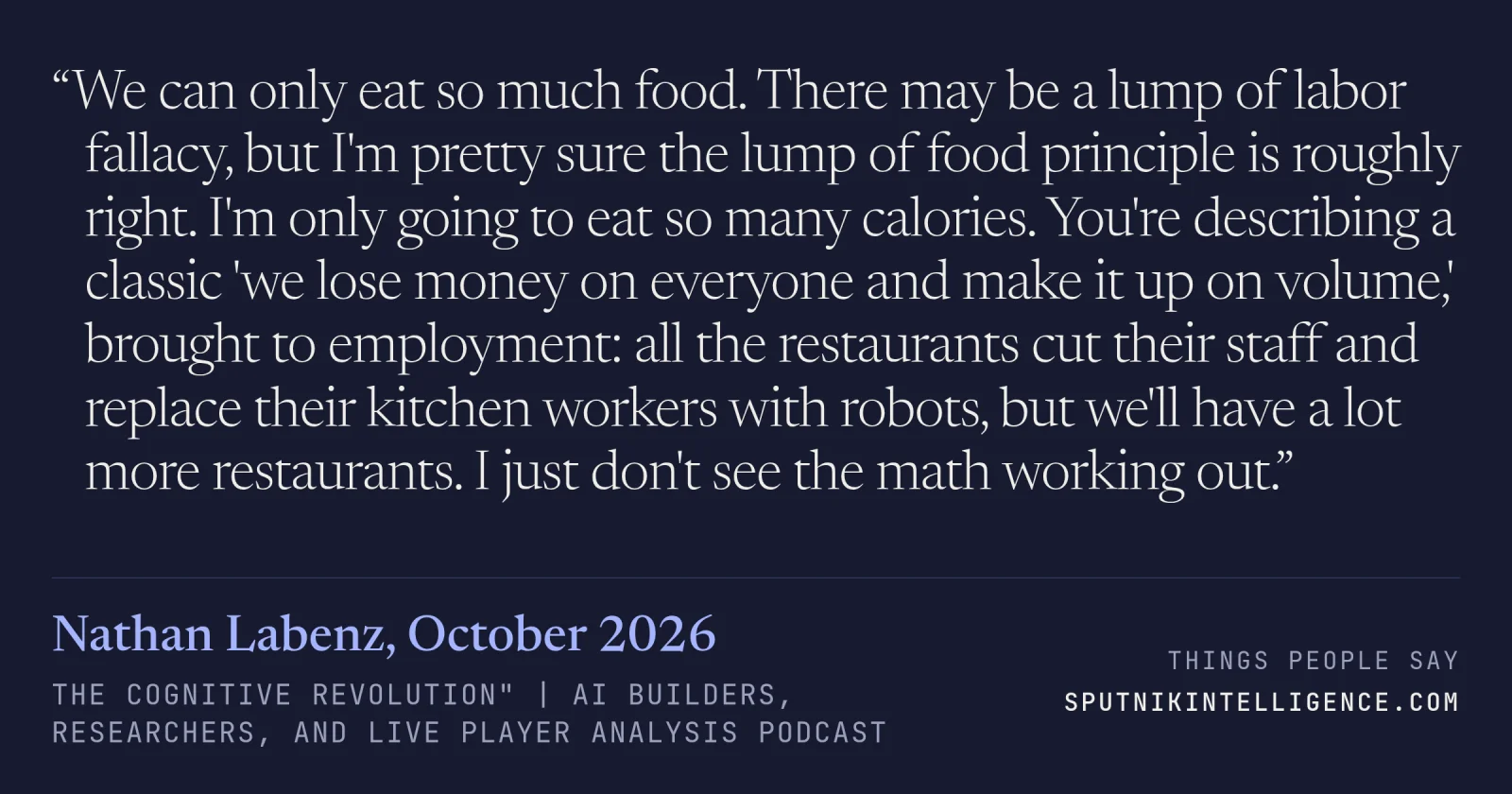
we can only eat so much food, right? This is the thing where it's like, at the end of the day, I'm only going to eat so many calories. You know, you're describing a world where all the restaurants, this is the classic, like we lose money on everyone and make it up on volume, but like brought to employment. Like all the restaurants will massively cut their staff and replace their kitchen workers with robots, but we'll have a lot more restaurants. Like, I just don't see the math working out on that, given the fact that there may be a lump of labor fallacy, but I'm pretty sure the lump of food principle is like roughly right. You know, I'm only going to eat so many calories. And like at some point, that is just plain saturated, right? I don't see the like we have, we have to posit a world where I'm somehow like eating from like five different restaurants for every meal or something to get to the point where, I don't know, maybe my vision is too limited. That could be kind of cool, I suppose.
Speaker 3
But you are right. You know, I don't think the human consumption is really where the growth is. The growth is always going to be in the AI consumption going forward, as you can see. So you have these concentric circles of the economy, and the AI economy is always the one going to be expanding…
Speaker 4
It sounds more dystopian than utopian to think that the bulk of human activity will go into status games, I have to say. I'm like a bear on employment, bullish on people's ability to find meaning in absence of employment, I think, certainly relative to most. I really think way too many people in…
Nathan Labenz
Part five, five to ten cents. Michael Freeman is Senior Director of Threat Research at ServiceNow. His team watches AI agents attack companies, and he has spent his career finding and exploiting vulnerabilities. I asked what he makes of the current moment.
Speaker names come from our own diarization. The position is estimated from where the line sits in the episode.