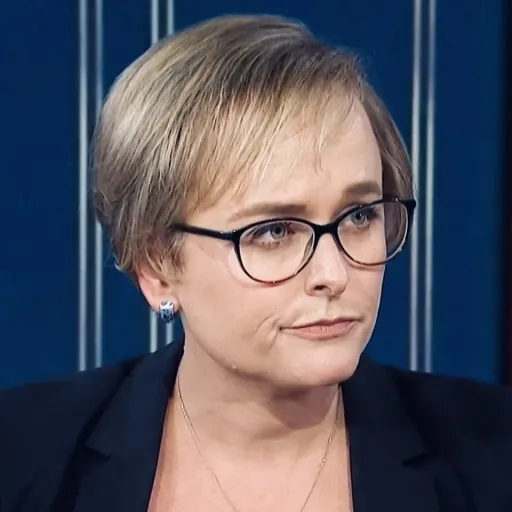
Julia Curlee

Things Julia Says on Podcasts

Lawfare Public Service Fellow, former CIA officer and NSC Director, current citizen.

Where to Find Them

Julia Curlee hosts The Lawfare Podcast: Patreon Edition , hosts The Lawfare Podcast , writes Dog Shirt Daily , hosts Rational Security , writes The Bulwark , writes HUMINT and writes The Steady State . They have also been a guest on Mission Implausible (2 times) , The Long Game with Jake Sullivan & Jon Finer (2 times) , SpyTalk , The Long Game with Jake Sullivan and Jon Finer , Frank Figliuzzi , Lincoln Square and The Steady State Sentinel . They also write for Julia Curlee on Substack.

Recently: “Lawfare Daily: The President’s Hand in Russia’s Covert Action” on The Lawfare Podcast (November 2026); “Lawfare Daily: The President’s Hand in Russia’s Covert Action” on The Lawfare Podcast: Patreon Edition (November 2026); “Lawfare Daily: The Midterms and What's Next” on The Lawfare Podcast: Patreon Edition (November 2026); “Lawfare Daily: The Midterms and What's Next” on The Lawfare Podcast (November 2026); “Lawfare Daily: Escalate to What End? Trump's Plan for the Iran War After the Midterms” on The Lawfare Podcast (October 2026); “Lawfare Daily: What We're Worried About for the Elections” on The Lawfare Podcast: Patreon Edition (October 2026).

What They Said

“If we're going to draw sort of vast conclusions about covert action, we're talking about a secret activity for which our data set is limited… when the data set I was able to use is an unclassified one put together by the CIA historian that ends in 2011. So who knows? There might be other key comparators to this.” — Julia Curlee, The Lawfare Podcast

Pressed on whether an apparent covert success might be luck, she adds a candid caveat about how little public data exists for rating covert operations.

The Lawfare Podcast · 2026-11-06 Permalink → Listen →
The Lawfare Podcast Around 30:00 into the episode
Speaker 2

…hits, you're ready to go. Switch today at shipstation.com, code audio. Why can't we get AI to production? Our competitors are all ready. How do we keep data secure? AWS AI cuts through the noise. Ready-to-use agents and the broadest set of AI tools. Stop overthinking. Start building. AWS AI is how.

Benjamin Wittes

…this, that the events that transpired correlated nearly precisely, and we'll get to a few exceptions in a moment, with Russian interests. But is there any way to know that that means the covert action was a success rather than that the covert action was a really good bit of futuristic betting?

Julia Curlee

You're humming in on a pure methodological problem that I think is inescapable for evaluating covert action, this causality question of coincidence versus like, did it actually cause that? And you were right. And I could add on top of that, if we're going to draw sort of vast conclusions about covert action, we're talking about a secret activity for which our data set is limited, including the U.S., that we're saying this is one of the most successful covert actions in history when the data set I was able to use is an unclassified one put together by the CIA historian that ends in 2011. So who knows? There might be other key comparators to this. Yeah, because we've been

Benjamin Wittes

doing so well since 2000. We have been doing

Julia Curlee

very well. So it is a very difficult question. We have from that data set drawn what seemed to be some best practices in covert action for which this operation followed, whether it is the using what's there and building upon that, whether it is the finding that for a political action such as this…

Benjamin Wittes

All right. Let's talk about some of the downsides from the Russian point of view. The Russian economy is a disaster. Partly in response to U.S. sanctions, which are partly in response to this, although the Weight of them are all about Ukraine. So, how do you understand the downside of this? And I…

Speaker names come from our own diarization. The position is estimated from where the line sits in the episode.
“Most of the successful ones are actually not that expensive. And if they are expensive, then you're probably using the wrong tool. You probably should be doing something that is overt, that uses the mass of the other institutions of the United States, like the military, to achieve an objective.” — Julia Curlee, The Lawfare Podcast

Part of the same answer on lessons for US intelligence: she says the Russian operation worked partly because it was narrow, concrete and cheap, and draws a general rule about when covert action is the right tool.

The Lawfare Podcast · 2026-11-06 Permalink → Listen →
The Lawfare Podcast Around 37:20 into the episode
Julia Curlee

and there were plenty of other counteractions that Russia took in the decade afterwards that have done severe damage to the Russian economy and its people, most principally the invasion of Ukraine.

Benjamin Wittes

…that also does covert actions. And what should we learn from this? Should we be actively measuring in lots of countries' internal affairs? Should we be running covert campaigns in Greenland? Should we be, you know, what should we be taking from this as a lesson of success for our own covert action?

Julia Curlee

…in the domestic political affairs of a democratic nation. At least traditionally, that's true. I would say that learning from this, that covert action in this case succeeded partly because it was narrow, had very specific concrete goals. Two out of three were measurable on the night of the election. It was relatively cheap. Some covert action succeeds. That is a bit more expensive, but most of the successful ones are actually not that expensive. And if they are expensive, then you're probably using the wrong tool. You probably should be doing something that is overt, that uses the mass of the other institutions of the United States, like the military, to achieve an objective. It was part of a broader policy. So the covert effort was consistent with the overt effort of the Russians to, whether it's diminishing U.S. power, getting the U.S. to turn within, dividing us from our allies, it was all consistent with that. It wasn't trying to achieve some underhanded miracle at odds with the public statement of the Russians. And that probably most importantly, it exploited…

Benjamin Wittes

And what about in a defensive sense? You end the piece with two lessons for us as a recipient nation of this Russia’s Covert Action. I want to read them and then have you flesh out both a little bit. 10 years on Russia's 2016 operation offers two lessons. First, a foreign intervention pays off most…

Julia Curlee

You know, like a lot of things as we think about how to Trump proof the presidency, I will start off with the caveat that there may be no proofing the presidency against the president, but there are probably things we could do to increase friction so that, as I discussed in this, the winner's veto…

Benjamin Wittes

We are going to leave it there, Julia Curlee. The piece is the unhidden hand. And it was published in Lawfaire several days ago on October 22nd. How Russia's greatest returns from the 2000, from 2016 came from the president it helped elect. Thank you for joining us today.

Speaker names come from our own diarization. The position is estimated from where the line sits in the episode.
“It is humility in what we can actually achieve using this tool, which is probably best used as a scalpel, not a hammer. And for the United States, I think that we are not well suited as a country to use this to interfere in other countries' political systems. We have a pretty bad track record of it sustaining good results over time.” — Julia Curlee, The Lawfare Podcast

Asked what a CIA instructor should teach recruits from the 2016 Russian influence operation, the former practitioner says covert action works best narrow and cheap, and that the US record at it is poor.

The Lawfare Podcast · 2026-11-06 Permalink → Listen →
The Lawfare Podcast Around 37:20 into the episode
Julia Curlee

and there were plenty of other counteractions that Russia took in the decade afterwards that have done severe damage to the Russian economy and its people, most principally the invasion of Ukraine.

Benjamin Wittes

…that also does covert actions. And what should we learn from this? Should we be actively measuring in lots of countries' internal affairs? Should we be running covert campaigns in Greenland? Should we be, you know, what should we be taking from this as a lesson of success for our own covert action?

Julia Curlee

…War, where you have Gustav Rakados, one of the key minds behind this, being asked about the, you know, to toast the success of the operation. And he says, we'll see because he has seen these before, and he knows that over time, the success can fade and that the blowback can be real. And in the movie, they talk about the rise. Of al-Qaeda, which one can argue about that direct causality. But it is humility in what we can actually achieve using this tool, which is probably best used as a scalpel, not a hammer. And for the United States, I think that we are not well suited as a country to use this to interfere in other countries' political systems. We have a pretty bad track record of it sustaining good results over time. I think at the beginning of the Cold War, it was quite successful in Italy once or twice. But you could make a sound argument if looking at the U.S. interventions in Iran that interfering in Iran domestic processes helped lay the groundwork for the rise of the IRGC and the Iranian revolutionary regime. Obviously, many other things were happening at the time, but Iranians remember viscerally our…

Benjamin Wittes

And what about in a defensive sense? You end the piece with two lessons for us as a recipient nation of this Russia’s Covert Action. I want to read them and then have you flesh out both a little bit. 10 years on Russia's 2016 operation offers two lessons. First, a foreign intervention pays off most…

Julia Curlee

You know, like a lot of things as we think about how to Trump proof the presidency, I will start off with the caveat that there may be no proofing the presidency against the president, but there are probably things we could do to increase friction so that, as I discussed in this, the winner's veto…

Benjamin Wittes

We are going to leave it there, Julia Curlee. The piece is the unhidden hand. And it was published in Lawfaire several days ago on October 22nd. How Russia's greatest returns from the 2000, from 2016 came from the president it helped elect. Thank you for joining us today.

Speaker names come from our own diarization. The position is estimated from where the line sits in the episode.

Collections They Appear In