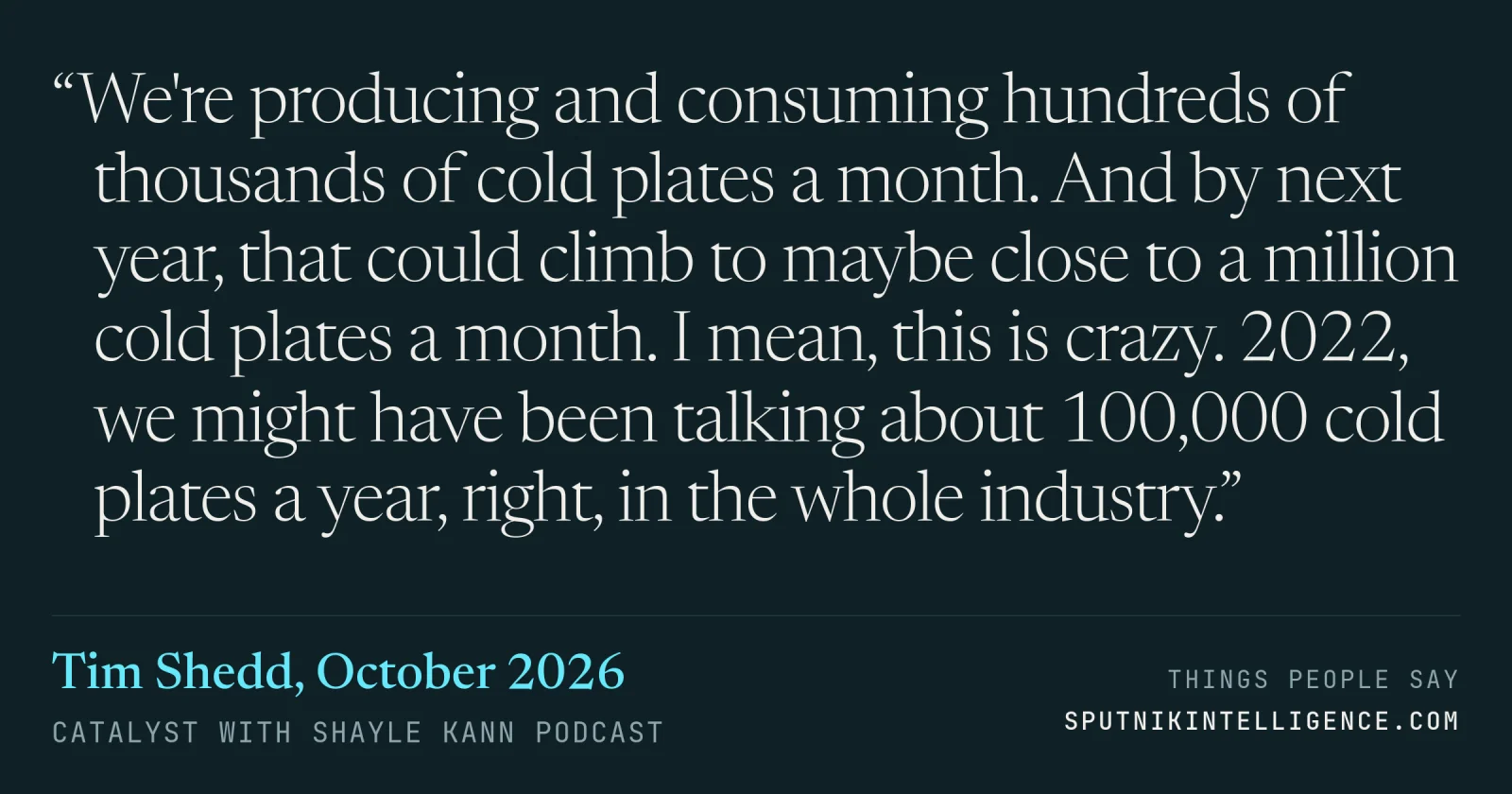
Shedd is explaining the different ways of cooling data center chips with liquid. A cold plate is the finned copper block that sits on a chip and carries coolant across it. He says the industry has settled on the simplest version of this because it is the only one whose supply chain can keep up with demand.
…out how to seal those things so they don't, you know, they don't leak easily. They can be shipped across the oceans and not burst or have any other problems. There's a lot, a lot of engineering has gone into the cold plates in a pretty short time to make them reliable and high performance. Can
…a little bit on there's different architectures within liquid cooling and you hear these different terms? Just give me like the sense of direct-to-chip cooling, immersion cooling people talk about two-phase. Like what, how should I think about categorizing the different ways to do liquid cooling?
Direct-to-chip means bringing the coolant to the chip. That's why it's direct-to-chip. And that can be either single-phase or two-phase. So the dominant form today is single-phase direct-to-chip cooling using water with 25% propylene glycol mixed in. So it's basically, crudely speaking, it's basically the antifreeze that you pour into your car diluted to 25%. When you go buy it at the auto parts store, it's often 50% mixed, pre-mixed. The really important detail that you don't even think about when you go pick up a bottle of antifreeze is that that gallon jug that you have has a very small percentage, about 1% to 2% maybe, of a proprietary chemical mix called an inhibitor or inhibitor package that prevents corrosion. So your car has aluminum and brass and all sorts of other materials in it and lasts for years without corroding and falling apart. That's actually phenomenal. That's amazing. So our partners at, you know, like Valvoline and Dow and RicoChem, they've done an amazing job developing these coolants that are very long lasting and allow us to use many…
For data centers, connecting to the grid quickly means two things: building distributed energy and having a plan for demand flexibility. Grid Beyond helps with both. Grid Beyond Sturms and VPP platform unlocks the potential of distributed assets and dispatches flexibility into the right market at…
When you harness the power of millions of DERs in a VPP and put artificial intelligence behind the dispatch, the outcomes exceed conventional generation. Energy Hub's Derms platform has been trained on years of real dispatch data from over 2.6 million DERs, so utilities can plan with confidence.…
Okay, so now explain the relationship between the cooling architecture and water consumption at the data center level.