IZ

Ioannis Zempekakis

Things Ioannis Says on Podcasts

Where to Find Them

Ioannis Zempekakis has been a guest on MLOps.community .

Recently: “Cut One AI Cost and Two More Grow Back” on MLOps.community (November 2026).

What They Said

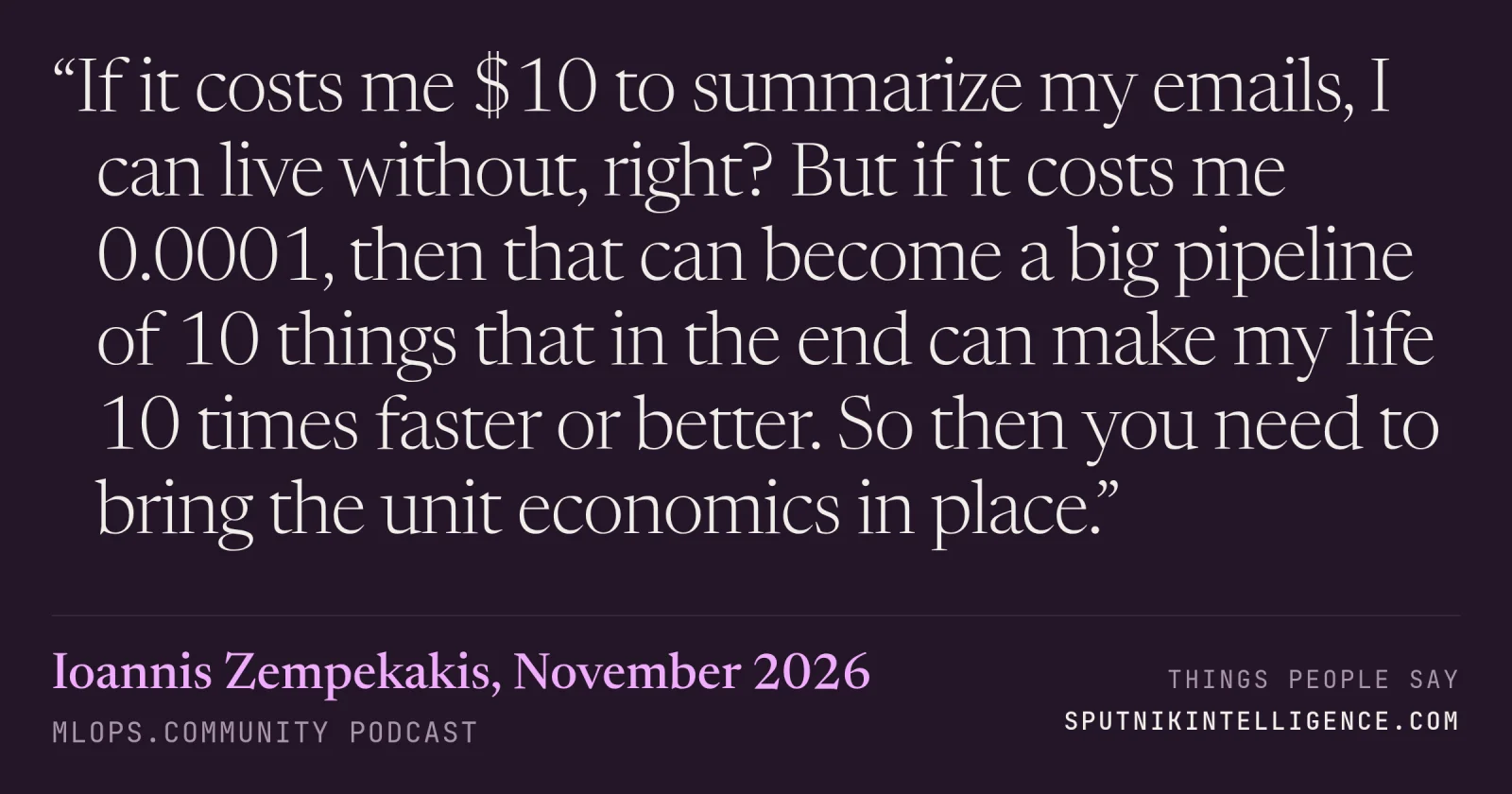
“If it costs me $10 to summarize my emails, I can live without, right? But if it costs me 0.0001, then that can become a big pipeline of 10 things that in the end can make my life 10 times faster or better. So then you need to bring the unit economics in place.” — Ioannis Zempekakis, MLOps.community

He argues that many AI applications only become viable once per-use cost falls. This follows his point that current AI usage is still highly subsidized by providers and that the subsidies will not last.

MLOps.community · 2026-11-05 Permalink → Listen →
MLOps.community Around 04:41 into the episode
Ioannis Zempekakis

…the agent as less instruction as it requires because then you are not overcrowded with lots of context and it works better even. So we went into that path and we went into that path first with cloud and open AI and then we find out very quickly that the costs are growing exponential day every day.

Demetrios Brinkmann

And this is according to you with the subsidies. So you're expecting that eventually the subsidies will run out and it's going to get even more expensive. Exactly. You recognize that's not feasible.

Ioannis Zempekakis

Yes, that is not feasible because lots of applications during this transformation are actually becoming viable. In the end it's a unit economy, right? So if it costs me $10 to summarize my emails, I can live without, right? But if it costs me 0.0001, then that can become a big pipeline of 10 things that in the end it can make my life 10 times faster or better. So then you need to bring the unit economics in place. How are

Demetrios Brinkmann

you deciding what use cases are worth doing and which ones aren't? Is that where the hard work comes in? Is that why it's so hard?

Ioannis Zempekakis

Yes, it's very hard.

Demetrios Brinkmann

Because at the end of the day, you can't have a judge looking at every use case and saying this one is worthy, this one is not.
Speaker names come from our own diarization. The position is estimated from where the line sits in the episode.
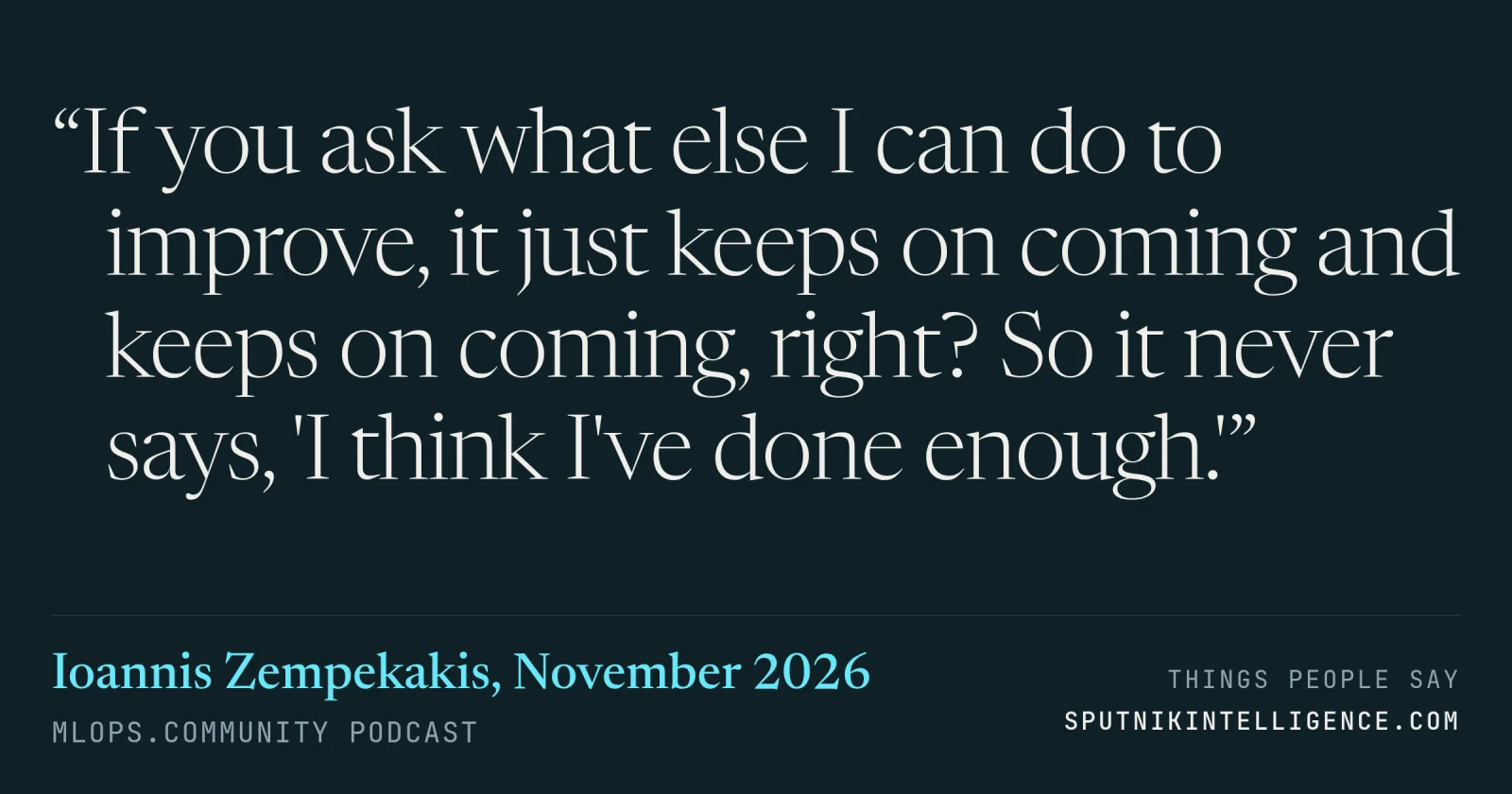
“If you ask what else I can do to improve, it just keeps on coming and keeps on coming, right? So it never says, 'I think I've done enough.'” — Ioannis Zempekakis, MLOps.community

Asked how he hires AI engineers, he says candidates must be able to smell the over-engineered code that AI models produce. This is his explanation of why: a model asked for improvements never decides to stop.

MLOps.community · 2026-11-05 Permalink → Listen →
MLOps.community Around 32:33 into the episode
Ioannis Zempekakis

One, two, go. Three.

Demetrios Brinkmann

Let's fucking go.

Ioannis Zempekakis

Yeah.

Demetrios Brinkmann

Sorry. No. Did I go too hard on the okay? So you've got the traditional whiteboard interviews. Yes,

Ioannis Zempekakis

that needs to happen, especially now because coding itself doesn't say anything. You need to understand if you understand how to build things that they scale, things that they can, you know, they are not over-engineering. Now, over-engineering is quite simple because you just ask. But then…

Demetrios Brinkmann

It's smelling the overengineered code that Fabo tries to give you.

Speaker names come from our own diarization. The position is estimated from where the line sits in the episode.

Collections They Appear In