Robert Leshner

Things Robert Says on Podcasts

CEO and co-founder of Superstate, an asset management firm that builds infrastructure for investment funds, and an investor at Robot Ventures. Founded Compound Labs in 2017, which built one of the first DeFi applications. Holds an economics degree from the University of Pennsylvania and is a CFA charterholder. Appears on Unchained and as a guest on the CoinDesk Podcast Network, Wealthion, Tokenized and Forward Guidance.

Where to Find Them

Robert Leshner hosts Unchained . They have also been a guest on CoinDesk Podcast Network (2 times) , Wealthion - Be Financially Resilient , Tokenized and Forward Guidance .

Recently: “The Chopping Block: The Midterm Mega Tsunami, a16z Goes Frontier, the CFTC Clears Equity Perps, and the Fight Over Abliterated AI Models” on Unchained (November 2026); “The Chopping Block: The Binance Hack, Circle's Fast Freeze, YC's Crypto Wishlist, and ICE Bringing Hyperliquid Perps Onshore” on Unchained (October 2026); “The Chopping Block: Black October, Banks Blocking AI Agents, Hyperliquid's Blockchain-Not-Bitcoin Moment, and the Visa-Fireblocks Rumor” on Unchained (October 2026); “The Chopping Block: The Ledger Hardware Implant, a Listening Device at OpenAI, Papertrade's 1000x House, and the Death of Technical Moats” on Unchained (October 2026); “The Chopping Block: Bitget's 387 Million Dollar Hack, Kalshi's Cooked Perps Volume, and Agentic Bank Runs” on Unchained (October 2026); “The Chopping Block: CLARITY Dies on the Senate Floor, Hunter Biden's LAPTOP Rug, & the AI Pause Pact” on Unchained (September 2026).

What They Said

“How is that a risk? That sounds so positive for the business.” — Robert Leshner, Unchained

A co-host had just said Anthropic's updated IPO filing added recursive self-improvement, AI models improving the next generation of models, as a new risk factor. This was Leshner's reaction; another host answered that the risk is getting regulated.

Unchained · 2026-11-06 Permalink → Listen →
Unchained Around 41:04 into the episode
Tom Schmidt

…I know, I think, you know, like Tarun, there's a, our forefathers, you know, wrote into the constitution a very clear distinction between a future and a swap. And we have to respect what the, no, I'm just, I'm just fucking, I'm playing with you. No, I have no idea what the opposition could be.

Haseeb Qureshi

…they added some new risk factors, including RSI. RSI, meaning recursive self-improvement, means the ability for an AI Models to improve a future generation of the AI Models and potentially causing some accelerating loop of self-improvement that results in, quote, dramatically accelerating progress.

Robert Leshner

How is that a risk? That sounds so positive for the business.

Haseeb Qureshi

Well, it is a risk of risk of

Tarun Chitra

getting regulated or whatever, right?

Haseeb Qureshi

Well, we all have risk of getting regulated now. Yes, that's right. I mean, you know, with this blue wave, it's interesting to me that like you see in the Anthropic perps, Anthropic's clearly up over the last 24 hours. Surprising because so many of the states that ended up flipping were like the…

Speaker names come from our own diarization. The position is estimated from where the line sits in the episode.
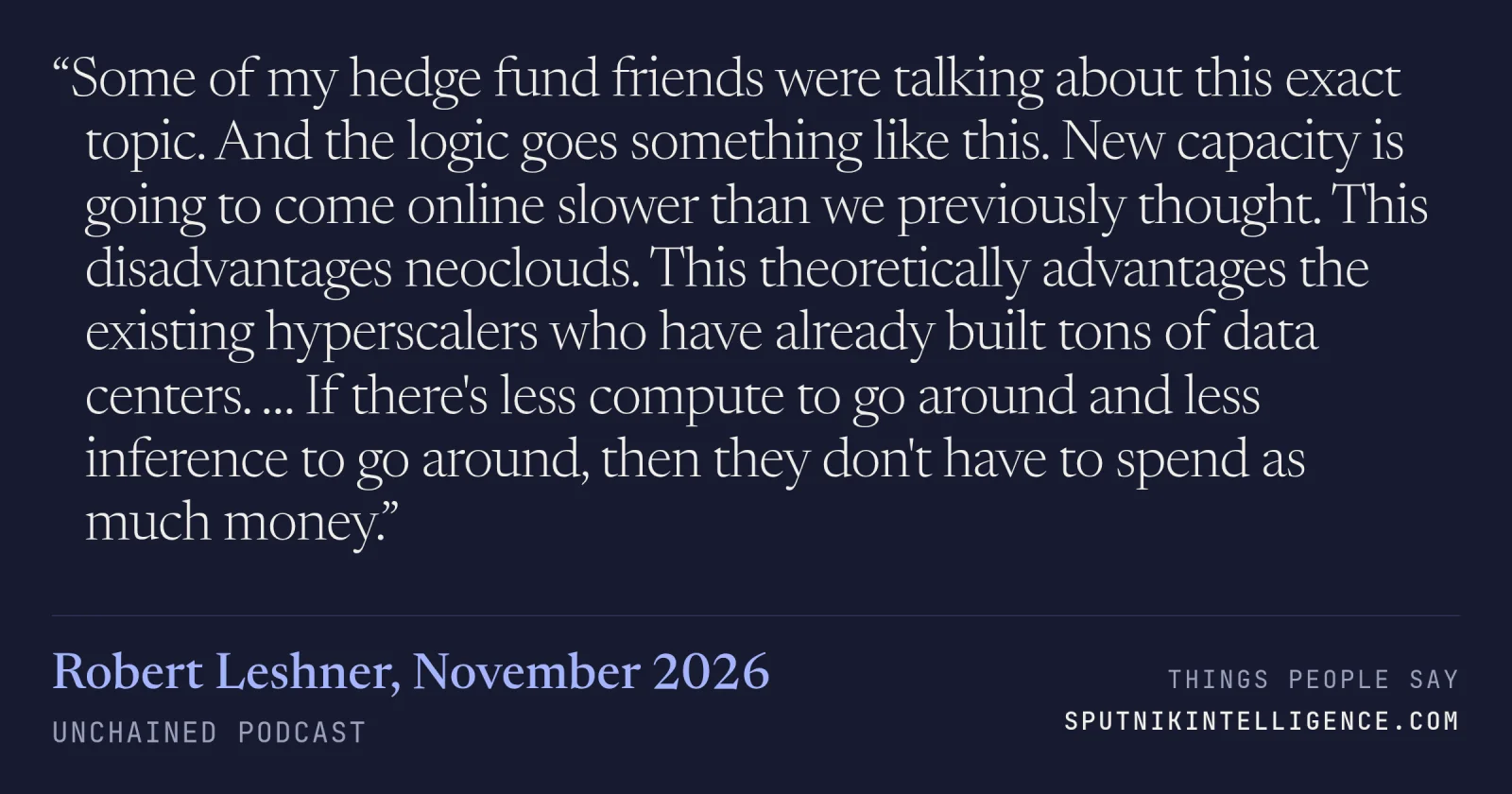
“Some of my hedge fund friends were talking about this exact topic. And the logic goes something like this. New capacity is going to come online slower than we previously thought. This disadvantages neoclouds. This theoretically advantages the existing hyperscalers who have already built tons of data centers. … If there's less compute to go around and less inference to go around, then they don't have to spend as much money.” — Robert Leshner, Unchained

A co-host noted that Anthropic-linked markets rose after the midterms even though several data-center states flipped. Leshner explains why some hedge funds think slower data-center buildout helps the companies that already have compute.

Unchained · 2026-11-06 Permalink → Listen →
Unchained Around 42:10 into the episode
Tarun Chitra

getting regulated or whatever, right?

Haseeb Qureshi

…now. Yes, that's right. I mean, you know, with this blue wave, it's interesting to me that like you see in the Anthropic perps, Anthropic's clearly up over the last 24 hours. Surprising because so many of the states that ended up flipping were like the data center states and they went blue.

Robert Leshner

This is actually why. So some of my hedge fund friends were talking about this exact topic. And the logic that they were using goes something like this. New capacity is going to come online slower than we previously thought, right? This disadvantages neoclouds. This theoretically advantages the existing hyperscalers who have already built tons of data centers, whether they fully retrofit that for new AI use cases or not. In some ways, it directly benefits the competitive dynamic of the frontier companies in the aggregate. Because if there's less compute to go around and less inference to go around, then they don't have to spend as much money. Their commitments are lower. If it affects everybody equally, it's a good thing. It's almost like the pacing that they were asking for, but in a fair, more uniformly distributed way. And so theoretically, it like reduces their like CapEx burden and it allows them to like continue delivering their models, but without having to spend the bajillion dollars that they've committed.

Haseeb Qureshi

Right. But a lot of their spending commitments are locked in, but it means largely they can't. But if they're if that

Robert Leshner

compute's not delivered to them, they don't have to spend for it.

Tom Schmidt

Yeah, I think, I think Robert's point is more that like, you know, competitors, you know, are now sort of suffocated off from new compute. It's like they bought all the chickens and so you can't start a new restaurant. And even if the chickens don't ever end up happening, you're still not going to…

Speaker names come from our own diarization. The position is estimated from where the line sits in the episode.
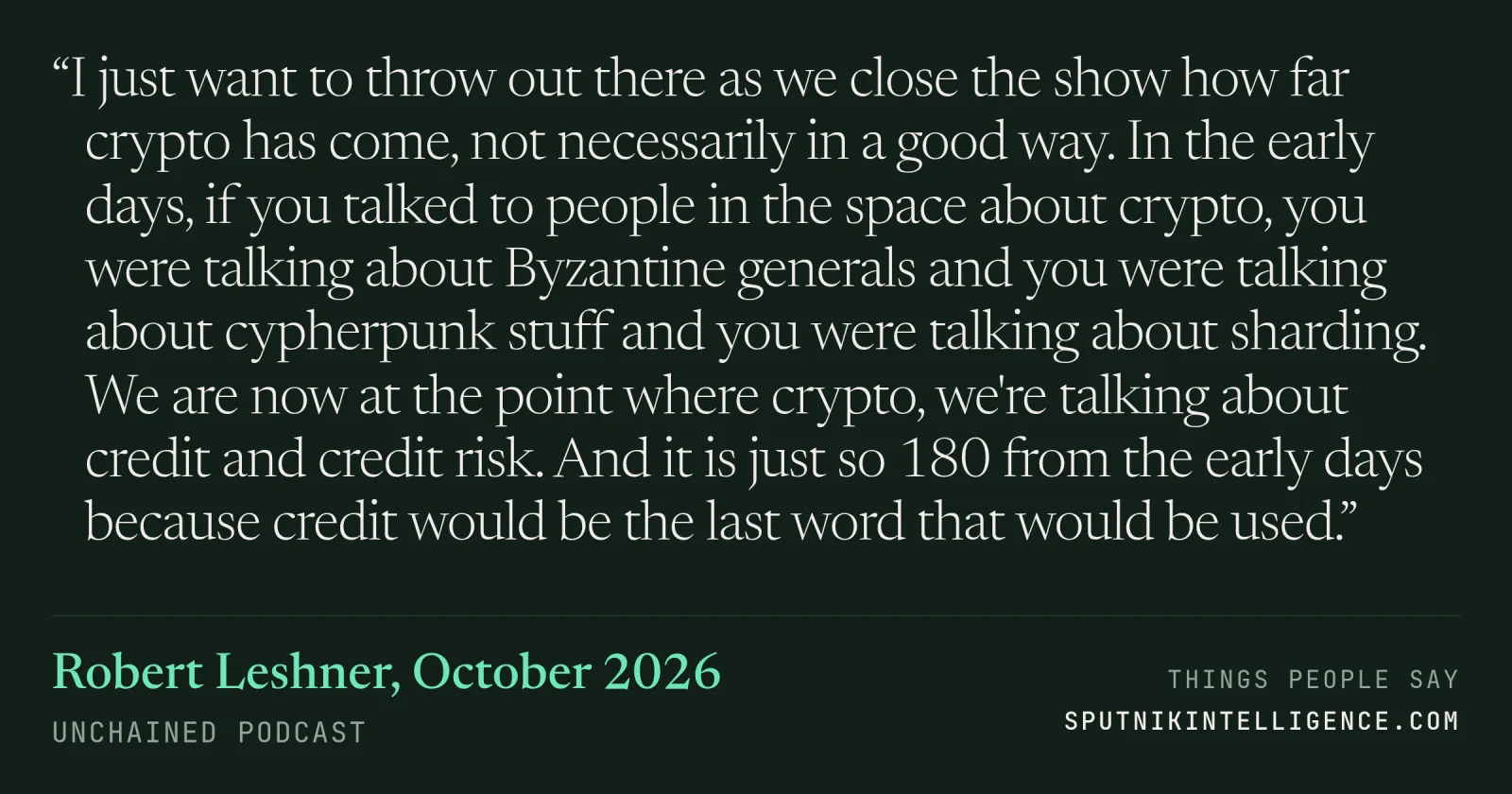
“I just want to throw out there as we close the show how far crypto has come, not necessarily in a good way. In the early days, if you talked to people in the space about crypto, you were talking about Byzantine generals and you were talking about cypherpunk stuff and you were talking about sharding. We are now at the point where crypto, we're talking about credit and credit risk. And it is just so 180 from the early days because credit would be the last word that would be used.” — Robert Leshner, Unchained

Closing the show after a discussion of counterparty risk and clearinghouses, he contrasts crypto's early cypherpunk themes with its current focus on credit risk.

Unchained · 2026-10-31 Permalink → Listen →
Unchained Around 50:23 into the episode
Robert Leshner

…the best of both worlds instead of a halfway solution. And I think that's when it becomes an institutional product. Right now, totally retail. Retail doesn't care about credit risk. Right. Retail doesn't care about their money being on the exchange and like separation and all these other things.

Rob Hadick

…it was just like not the mindset of people necessarily in the space in the same way. But it was the most important thing at the big traditional hedge funds around like, what is my counterparty risk? What is my credit risk? And we learned it the hard way in FTX, obviously, and we're solving that.

Robert Leshner

Totally. I just want to throw out there as we close the show how far crypto has come, not necessarily in a good way. That in the early days, if you talk to people in the zone about crypto, you were talking about Byzantine generals and you were talking about cypherpunk stuff and you were talking about sharding and you were talking about all these things. We are now at the point where crypto, we're talking about credit and credit risk. And it is just so 180 from the early days because credit would be the last word that would be used.

Rob Hadick

Yeah, well, and I think credit counterparty risk, definitely. So maybe it is a good place.

Nemil Dalal

I think just for comparison, like the internet, the same thing. We talked about TCP IP. And then you have like all these things like e-commerce and social networks and things like that. And that is the arc to me of any industry. And this is an awesome thing. And lastly, I have tons of friends that…

Rob Hadick

Yeah, I think there's no doubt about that. I continue to think it's as exciting as a time to be, you know, building and investing in this space. And I know that's why we're all here. And it sounds like Namil, you guys at Y Combinator are as excited as you've ever been. And so probably a good place…

Speaker names come from our own diarization. The position is estimated from where the line sits in the episode.
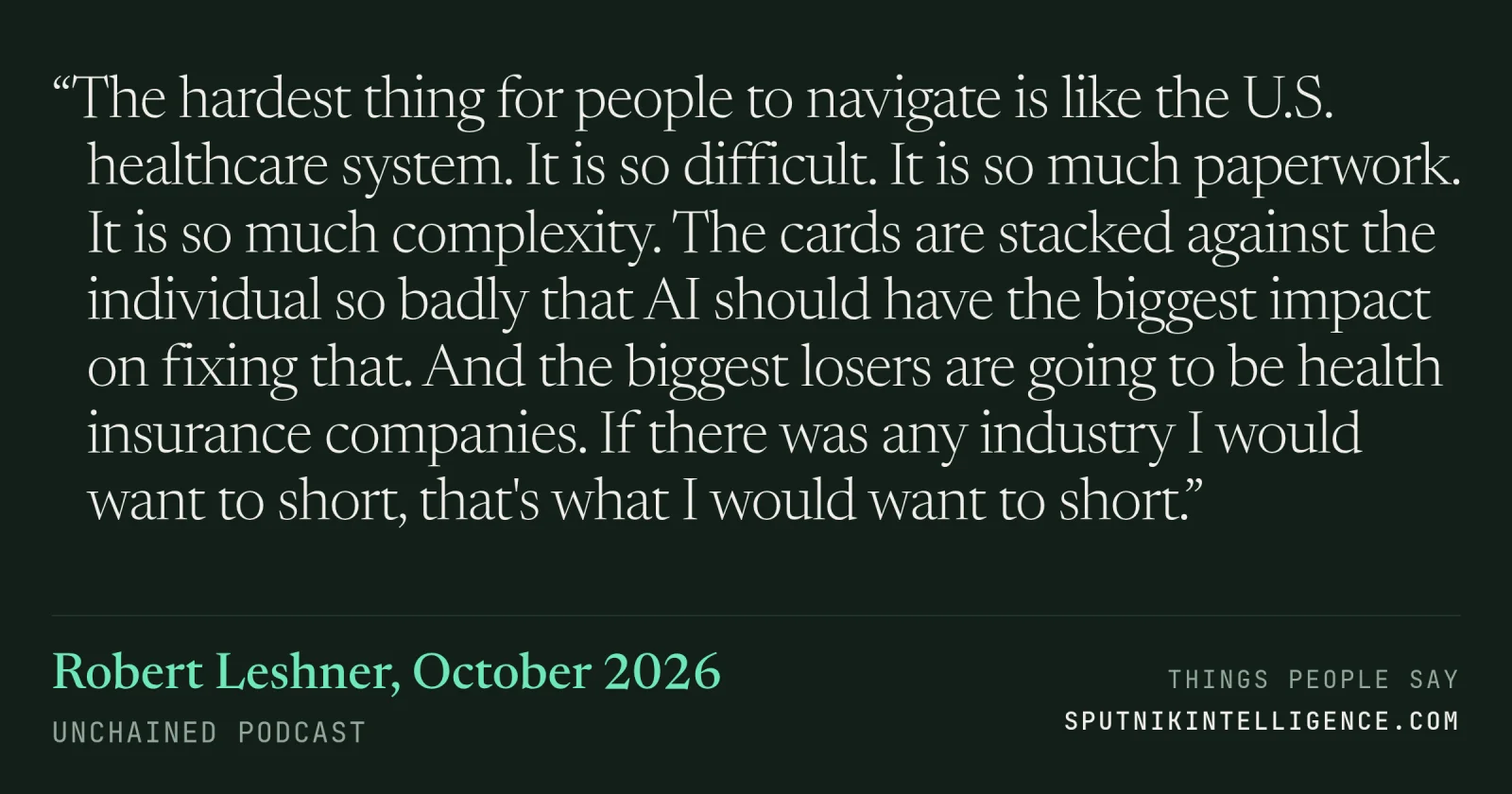
“The hardest thing for people to navigate is like the U.S. healthcare system. It is so difficult. It is so much paperwork. It is so much complexity. The cards are stacked against the individual so badly that AI should have the biggest impact on fixing that. And the biggest losers are going to be health insurance companies. If there was any industry I would want to short, that's what I would want to short.” — Robert Leshner, Unchained

The hosts were discussing banks blocking AI agents from customer accounts. Leshner says agents will matter most where systems are nearly impossible for people to navigate on their own, after a co-host described using one to get years of overpaid copays refunded.

Unchained · 2026-10-24 Permalink → Listen →
Unchained Around 27:25 into the episode
Robert Leshner

Totally. Yeah, I think the banks will generally be fine. Tarun has talked about the example of him getting his health insurance fixed. Like I feel like, you know, or

Tarun Chitra

getting paid back copay as I overpaid for five years. Correct.

Robert Leshner

Correct. If you look at where AI Agents, the end user the most, it's on things that are basically impossible to navigate as a human. Yeah. Right. Yeah. I think the hardest systems for people, regular people, everyone, smart people, dumb people, whatever, like all people, the hardest thing for people to navigate is like the U.S. healthcare system. It is so difficult. It is so much paperwork. It is so much complexity. The cards are stacked against the individual so badly that AI should have the biggest impact on fixing that. And the biggest losers are going to be health insurance companies. If there was any industry I would want to short, that's what I would want to short.

Rob Hadick

All right. Maybe move on to a new topic. So speaking of shorting. Speaking of shorting, let's short this topic. Let's move on to Joe Wisenthal and Hyperliquid's US path. So this was actually, I thought was really interesting to me. So Joe Wisenthal and Tracy Alloway did an Odd Lots newsletter and…

Tom Schmidt

Well, I think it's funny that like hyperliquid is the thing that he cites, which I'm like, this is not TradFi in any way, right? He's not talking about like, well, you know, he did profess, I guess, some awareness of stablecoins and I think some understanding of why stablecoins are good. But…

Tarun Chitra

Well, it's also like, is he realizing, isn't he realizing this a little late? I feel like this has been, it's like Bloomberg, other people at Bloomberg have been talking about this and writing about this for like nine months. It's like, I don't, I found that a little bit funny because it's like…

Speaker names come from our own diarization. The position is estimated from where the line sits in the episode.

Collections They Appear In