MM

Moxie Marlinspike

Things Moxie Says on Podcasts

Where to Find Them

Moxie Marlinspike has been a guest on Conversations with Tyler .

Recently: “Moxie Marlinspike on Cryptography, Privacy, and Mass Surveillance” on Conversations with Tyler (November 2026).

What They Said

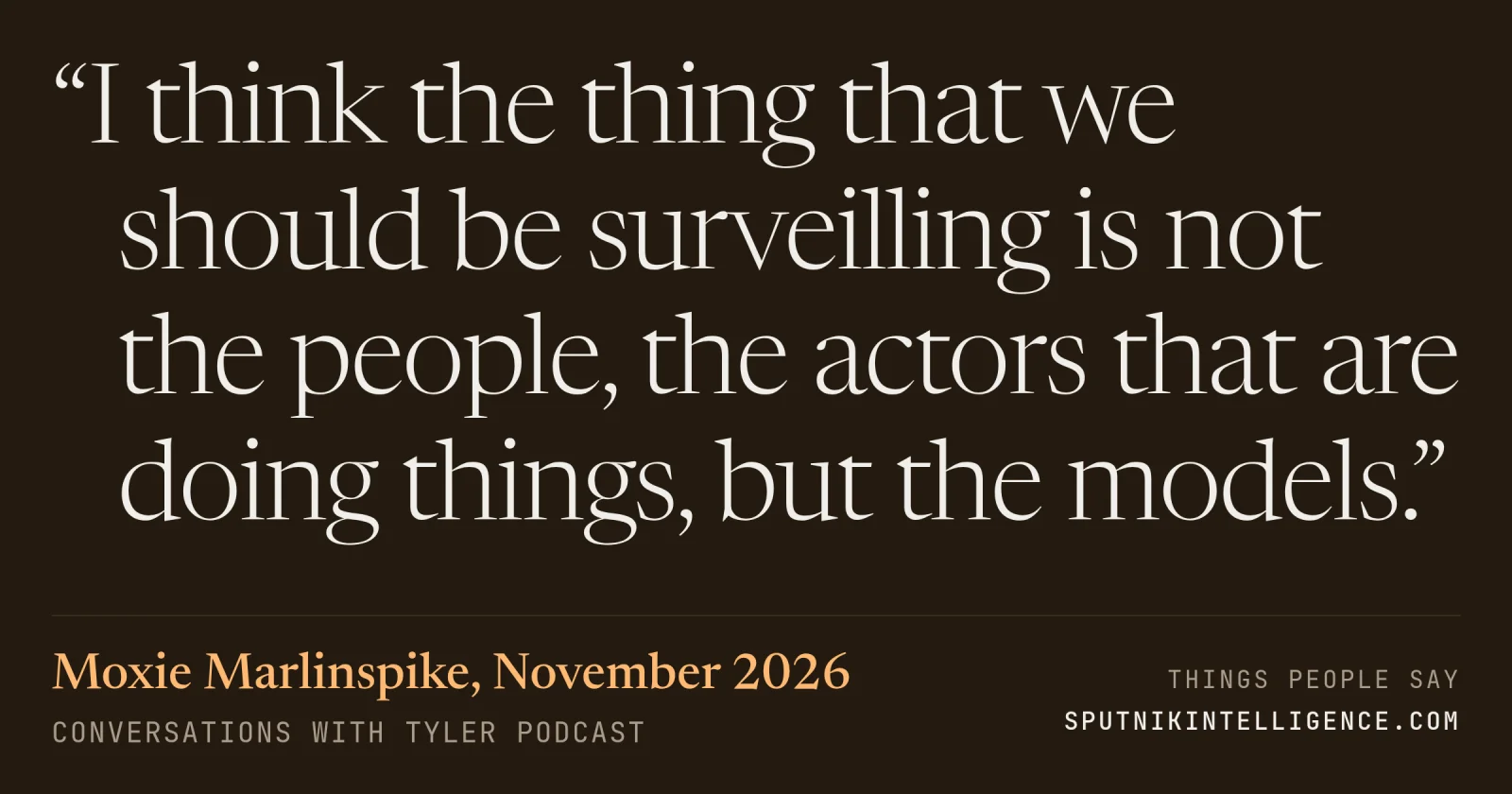
“I think the thing that we should be surveilling is not the people, the actors that are doing things, but the models.” — Moxie Marlinspike, Conversations with Tyler

Asked whether privacy can coexist with accountability when AI agents are used for harm, he argues that safety approaches which score every user's activity for "badness" amount to building mass surveillance, and that monitoring should target the models instead.

Conversations with Tyler · 2026-11-25 Permalink → Listen →
Conversations with Tyler Around 11:24 into the episode
Moxie Marlinspike

you talking about loss of control as your concern? Are you talking about like people telling

Tyler Cowen

their agents to do evil things?

Moxie Marlinspike

…bad. And then we're going to have an army of human reviewers that just go through and are like, you know, looking at everything and evaluating the badness. And you're building a machinery of mass surveillance that is kind of larger and more efficient than any other mass surveillance machinery in history. And that just seems like a dangerous thing to be constructing. And what's your approach? I think the thing that we should be surveilling is not the people, the actors that are doing things, but the models. And so there's a different way to think about it of like instead of trying to do actor monitoring where you're trying to figure out like what are people up to and do we think the thing that they're up to is good or bad of systems that are that are monitoring alignment of the models themselves. Like do the models themselves show negative tendencies.

Tyler Cowen

But can we surveil the models? So people in the main labs claim the chain of thought isn't working so well anymore. It may go away altogether. Like the Hugging Face incident, the number of pages of documents of pages is even the right word. I forget the number, but I think it was tens of thousands.…

Moxie Marlinspike

I think you are when you use AI to surveil AI. I think the idea is like you generate, you build these general capacity models and you try to align them, but it's difficult because they can do so many different things and there could be like jailbreaks and all kinds of stuff or whatever. And then…

Tyler Cowen

We're recording in October 2026. You probably know a few days ago there was an account of one person who broke into the South Korean banking system. Not even using the best models. I think it was some mix of open source and open weight models. I'm not sure it created any damage. What would your…
Speaker names come from our own diarization. The position is estimated from where the line sits in the episode.
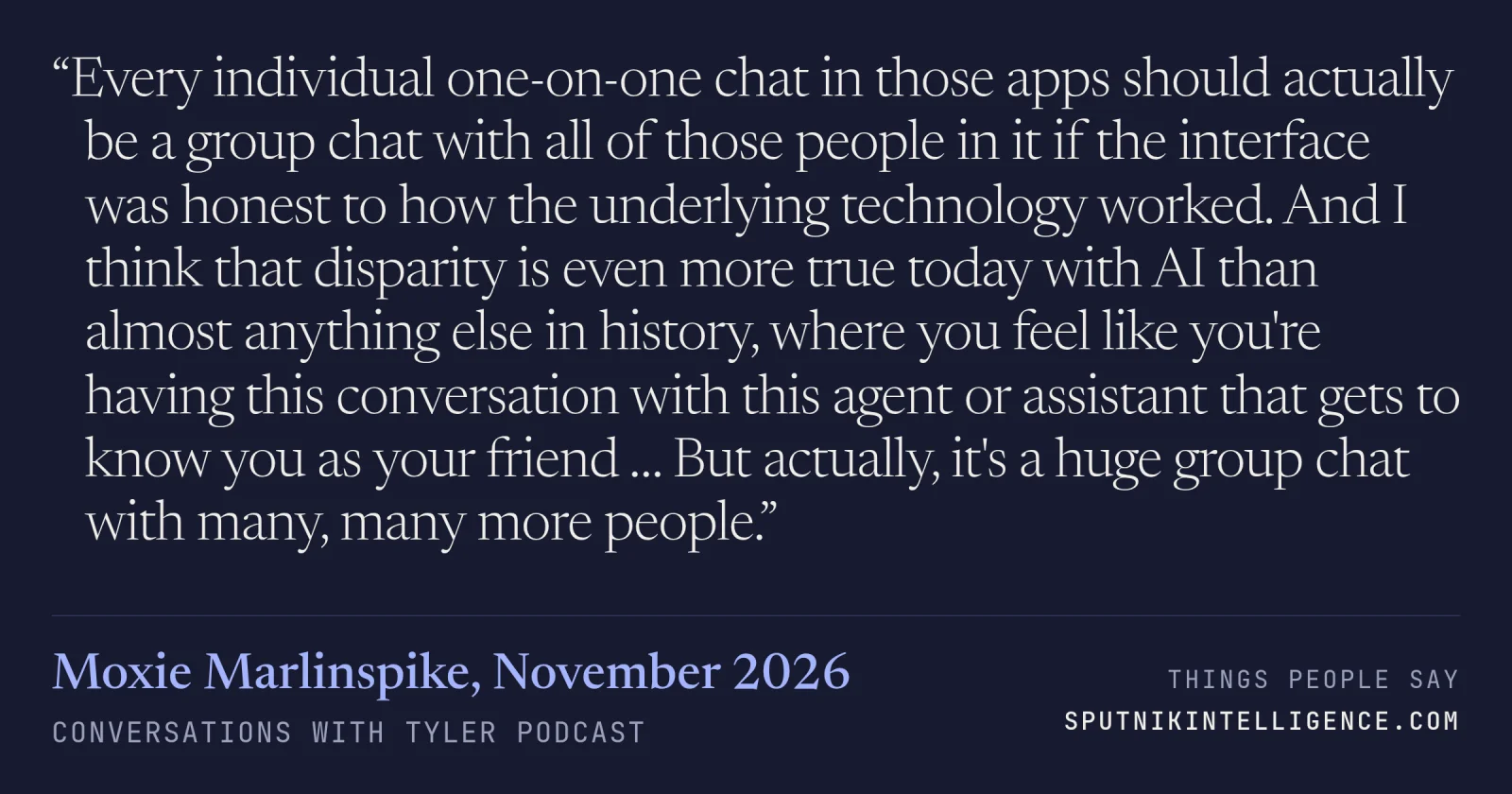
“Every individual one-on-one chat in those apps should actually be a group chat with all of those people in it if the interface was honest to how the underlying technology worked. And I think that disparity is even more true today with AI than almost anything else in history, where you feel like you're having this conversation with this agent or assistant that gets to know you as your friend … But actually, it's a huge group chat with many, many more people.” — Moxie Marlinspike, Conversations with Tyler

Asked why people confess things to AI they wouldn't tell a priest or therapist, the Signal founder says the chat interface implies privacy, while the company, its staff and anyone who breaches its systems can see the conversation.

Conversations with Tyler · 2026-11-25 Permalink → Listen →
Conversations with Tyler Around 05:33 into the episode
Moxie Marlinspike

I haven't noticed the same anecdote.

Tyler Cowen

Now, some questions about privacy and AI models. People treat the AI model like a therapist or a girlfriend or a boyfriend. Why are people willing to confess to an AI what they would not tell a priest or a therapist?

Moxie Marlinspike

Well, I think people are confessing what they would tell a priest or a therapist to an AI. And I think the form of technology affects how it is that we interact with it. And the form of AI in this sort of conversational interface that makes it really powerful is a form of technology that sort of invites confession, that you feel like you're communicating with somebody and that it is a private space. And I think my critique of the way that technology is often organized in general is that what I am trying to do in creating privacy-enhancing technology is to create an interface where the underlying technology is consistent with the way that the app looks. So you open a messaging app and you send a message to your friend. And the way it looks in the app is it's like just you and your friend in this little window talking to each other. But the way that it actually works for many messengers is the exact opposite of that. That it's not just you and your friend in there. It's like you, thousands of people who work with this company, anybody who compromises the computers of that system, like information that could be still advertised. Every individual one-on-one chat in those apps should actually be a group chat with all of those people in it if it…

Tyler Cowen

Putting aside open weights models, is there a version of privacy-enhancing chat with an AI from one of the major labs that could be secure?

Moxie Marlinspike

It's possible to build, yeah.

Tyler Cowen

It's possible to build.

Speaker names come from our own diarization. The position is estimated from where the line sits in the episode.

Collections They Appear In