AV

Amir Vardi

Things Amir Says on Podcasts

Where to Find Them

Amir Vardi has been a guest on UBS On-Air: Market Moves .

Recently: “Credit Snapshot quarterly update with UBS Asset Management” on UBS On-Air: Market Moves (November 2026).

What They Said

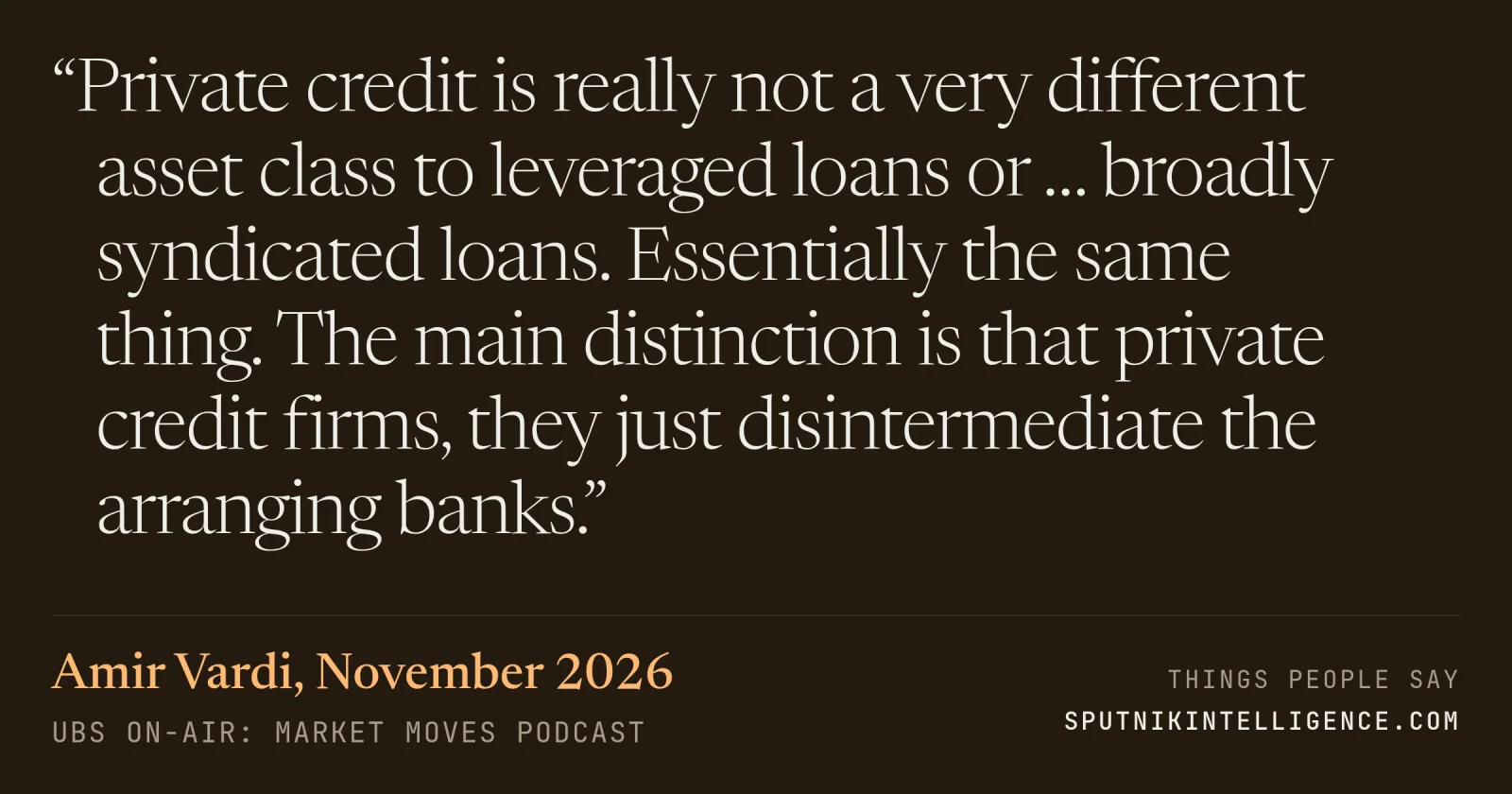
“Private credit is really not a very different asset class to leveraged loans or … broadly syndicated loans. Essentially the same thing. The main distinction is that private credit firms, they just disintermediate the arranging banks.” — Amir Vardi, UBS On-Air: Market Moves

The guest sets up how private credit and the broadly syndicated loan market relate, before explaining what this year's private credit headlines, including worries about AI disrupting software borrowers, mean for CLOs.

UBS On-Air: Market Moves · 2026-11-03 Permalink → Listen →
UBS On-Air: Market Moves Around 12:01 into the episode
Speaker 1

…levels is attractive. What would help, and hopefully we get this, is net new loan supply, which would increase those spreads as opposed to decrease them. And then the other thing that would help is slower new issue CLO creation. So basically less demand because of less creation of new deals.

Eileen Liu

…CLOs, but I would like to just take a minute to talk about private credit because it continues to be in the news. And there are private credit CLOs. Well, our discussion today was focused on BSL CLOs. How do you think recent trends in private credit and market sentiment affect CLOs more broadly?

Speaker 1

Yes, and actually this question kind of ties into that last question. I was just talking about spreads. But let me just take a step back first because I think to frame the two markets is maybe helpful to what I'm about to get to. So private credit is really not a very different asset class to leverage loans or what you just called ESL, broadly syndicated loans. Essentially the same thing. The main distinction is that private credit firms, they just disintermediate the arranging banks. So in the old days, instead of calling it private credit direct lending, we used to call it middle market lending because the size of those loans were smaller. And the smaller loans were essentially outside of the scope of what traditional banking players would care about. And so there became these smaller direct lenders that came to lend to those unbanked companies. But now with the last 10…

Eileen Liu

Great. Thank you for that, Amir.

Speaker 1

As a firm providing wealth management services to clients, UBS Financial Services Inc. offers investment advisory services in its capacity as an SEC registered investment advisor and brokerage services in its capacity as an SEC registered broker dealer. Investment advisory services and brokerage…

Speaker 3

UBS 2026, all rights reserved. The key symbol and UBS Asset among the registered and unregistered trademarks of UBS. UBS Financial Services Inc. is a subsidiary of UBS Group AG, member FINRA SIPC.
Speaker names come from our own diarization. The position is estimated from where the line sits in the episode.
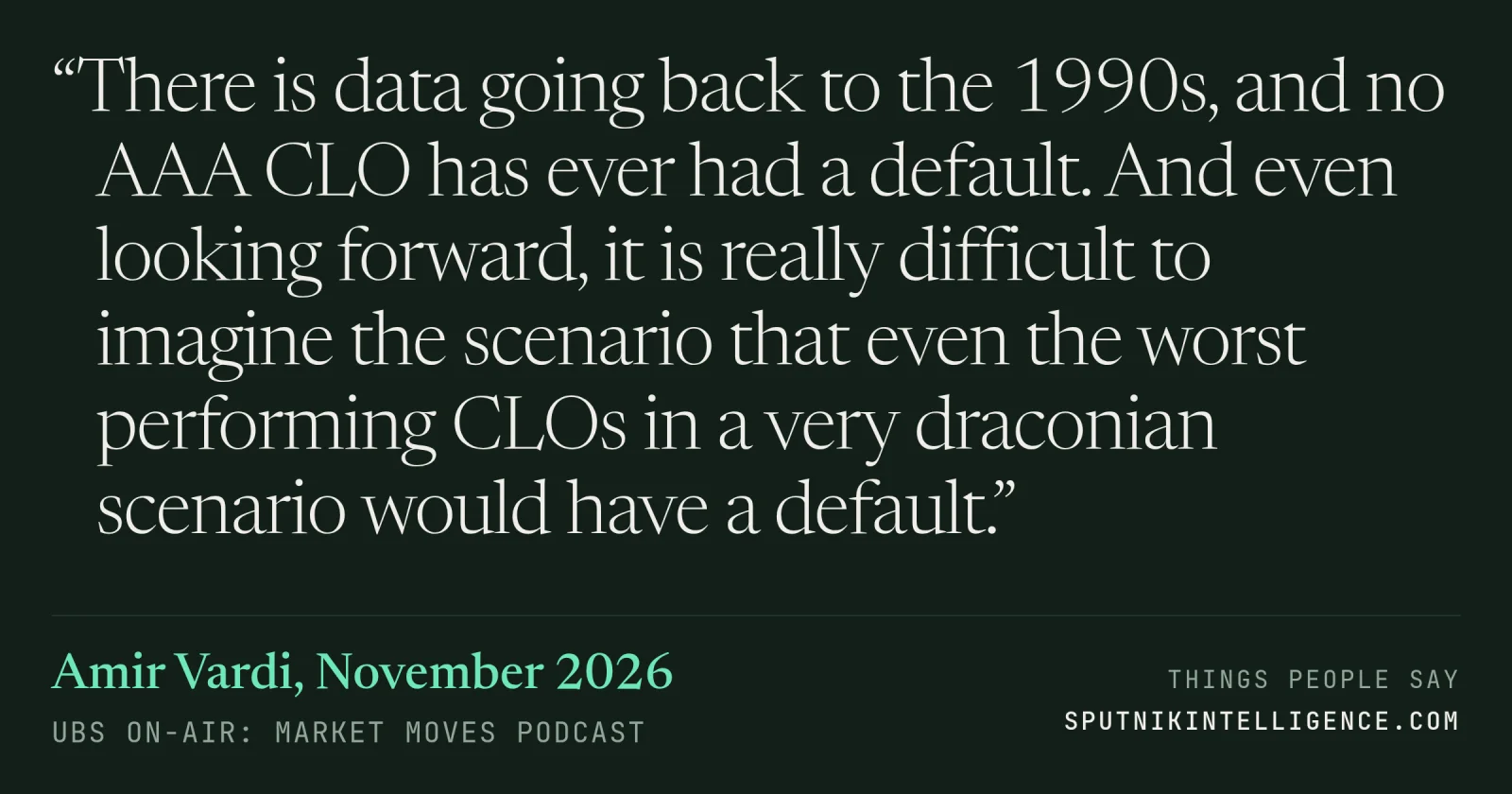
“There is data going back to the 1990s, and no AAA CLO has ever had a default. And even looking forward, it is really difficult to imagine the scenario that even the worst performing CLOs in a very draconian scenario would have a default.” — Amir Vardi, UBS On-Air: Market Moves

Asked why AAA-rated CLO funds are drawing so much money, the guest gives the safety record as one reason, contrasting it with the mortgage-backed CDOs that drove the 2008 crisis.

UBS On-Air: Market Moves · 2026-11-03 Permalink → Listen →
UBS On-Air: Market Moves Around 06:00 into the episode
Speaker 1

…CLO can trade the portfolio. They'll replace loans that get repaid. They're essentially actively managed five years. After five years, the CLO begins to amortize. So loans are repaid by the company. They're sold. And so overall, the expected life is around seven to eight years for one single CLO.

Eileen Liu

…and asset-based ETFs investing in CLO debt, really from AAA down to double B's. And CLO, U.S. CLO AUM, crossed $50 billion mid-year of this year, and it's seen about $17.5 billion to $18 billion of inflows through the third quarter. Why do you think we've seen such high demand for CLO ETFs of late?

Speaker 1

…low-risk options. Just as an example, the investment-grade corporate market, which is massive, the overall spread on investment-grade corporates is 85 basis points today. And by the way, about half of the investment-grade market is triple B rated, and almost none of it, less than 1%, is AAA rated. So getting 120 basis points of spread on CLO AAA. To me, that seems very attractive. Number two, there is data going back to the 1990s, and no AAA CLO has ever had a default. And even looking forward, it is really difficult to imagine the scenario that even the worst performing CLOs in a very draconian scenario would have a default. So it took some time for the market to appreciate that. Even today, there's folks that get confused with comparing CLOs to things like ABS CDOs, CDO squared, synthetic CDOs. These are all the things that essentially brought us into the GFC in 2008. Those CDOs had highly correlated assets inside of them. What people kind of got confused, thousands of line items, mortgages specifically. But these…

Eileen Liu

Thanks, Premier. I do wonder if we gave you more time, how many more reasons you'd have because I do think there's quite a number of reasons, but those three are more. At least three more, but let's not go there. Okay. I'll keep this moving. So AAAs, you know, a lot of interest in AAAs. What about…

Speaker 1

Yes, has not performed well. That would be an understatement. CELO equity has not had a good total return the last couple of years. I find it fascinating, and so I'll try to explain what's happening there. In some ways, it has been a victim of its own success. So historically, CELO equity has…

Eileen Liu

Thank you. That's very helpful to hear. So, you know, this discussion really isn't so much focused on loan supply and demand, broadly syndicated, loan supply and demand. I know have really related CLOs, but I would like to just take a minute to talk about private credit because it continues to be…

Speaker names come from our own diarization. The position is estimated from where the line sits in the episode.

Collections They Appear In