RA

Rama Afullo

Things Rama Says on Podcasts

Where to Find Them

Rama Afullo has been a guest on This Week in Startups and The Space Madness Podcast .

Recently: “Running Google’s Gemma on Satlyt’s orbital AI (w/ CEO Rama Afullo)” on This Week in Startups (November 2026); “Space Madness Podcast Episode 56: Virtual AI Data Centers in Space” on The Space Madness Podcast (June 2026).

What They Said

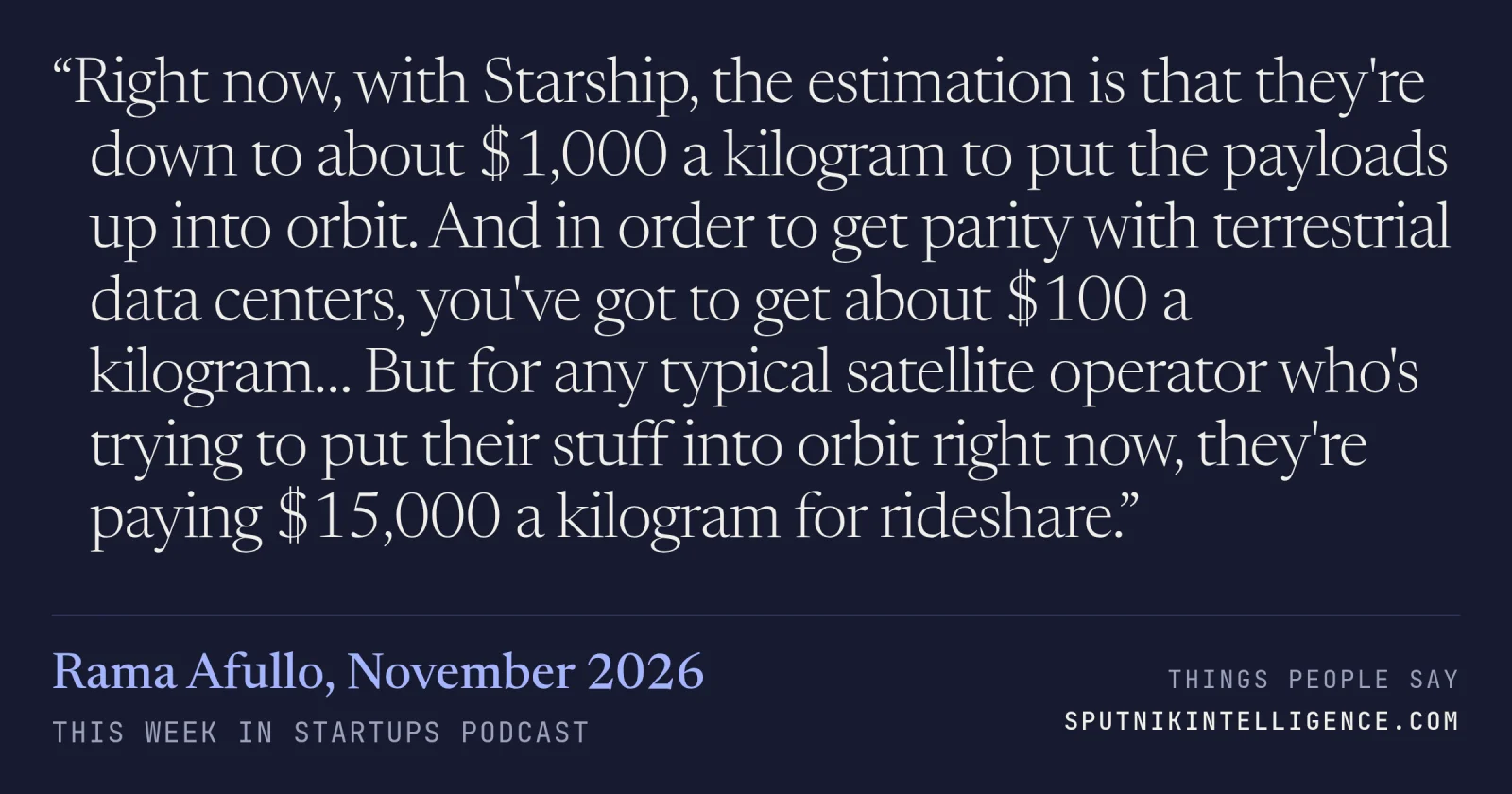
“Right now, with Starship, the estimation is that they're down to about $1,000 a kilogram to put the payloads up into orbit. And in order to get parity with terrestrial data centers, you've got to get about $100 a kilogram… But for any typical satellite operator who's trying to put their stuff into orbit right now, they're paying $15,000 a kilogram for rideshare.” — Rama Afullo, This Week in Startups

Asked when orbital compute becomes cost-effective compared with ground data centers, Rama Afullo gives his launch-cost figures for the break-even point and says larger rockets have to work first.

This Week in Startups · 2026-11-12 Permalink → Listen →
This Week in Startups Around 15:01 into the episode
Rama Afullo

…data about what was going to happen in LA a lot quicker than the typical human typical sort of lay person was, right? And a few of them changed their policies just before those fires hit, right? So, you can, it's a little bit dark, right? But so, you can have some control in that respect as well.

Speaker 3

…not just technically viable. I think we all believe you'll be able to do it. Elon, Google is working on it. Everybody's kind of working on this vision at the same time, Star Cloud, a bunch of folks. When does it actually become cost-effective? Is there a curve that you guys are watching for this?

Rama Afullo

I think for us, for satellites, it's really cost-effective because we don't build our own hardware. Sure. Right? So, we've got that advantage. But if I think about the macro scale and the rest of the environment, there's a few things. You are correct, right? So, right now, I guess with Starship, the estimation is that they're down to about $1,000 a kilogram, right? To put the pillows up into orbit. And in order to get parity with terrestrial data centers, you've got to get about $100 a kilogram. So you're right about on the money there, right? But for the typical, for any sort of typical satellite operator who's trying to put their stuff into orbit right now, they're paying $15,000 a kilogram for Rideshare, right? So we are taking the best base case, but eventually we need to bring everyone along for the ride. Now, in order to do that, there's a few different things that have to happen. You need to have significant efficiency in terms of your launch capacity. So Starship needs to work. Blue Origins New Glenn needs to work. Anyone who's building a massive vehicle to transport more satellites into orbit, like those folks who can put up much larger…

Speaker 3

need to figure out how to catch it right now. So I think Elon's doing Starship 15 in the next week or two. And if he catches it, then we're off to the races.

Rama Afullo

Yeah, with the chopsticks, right? Yeah.

Speaker 3

Chopsticks. Pretty easy to do. It's like catching a fly with chopsticks. It's possible. I may need to be a kung fu master to do it right now, but I think he kind of is best described as one. All right. So let's take a look at the demo you have of how this might work. I think people are interested…
Speaker names come from our own diarization. The position is estimated from where the line sits in the episode.
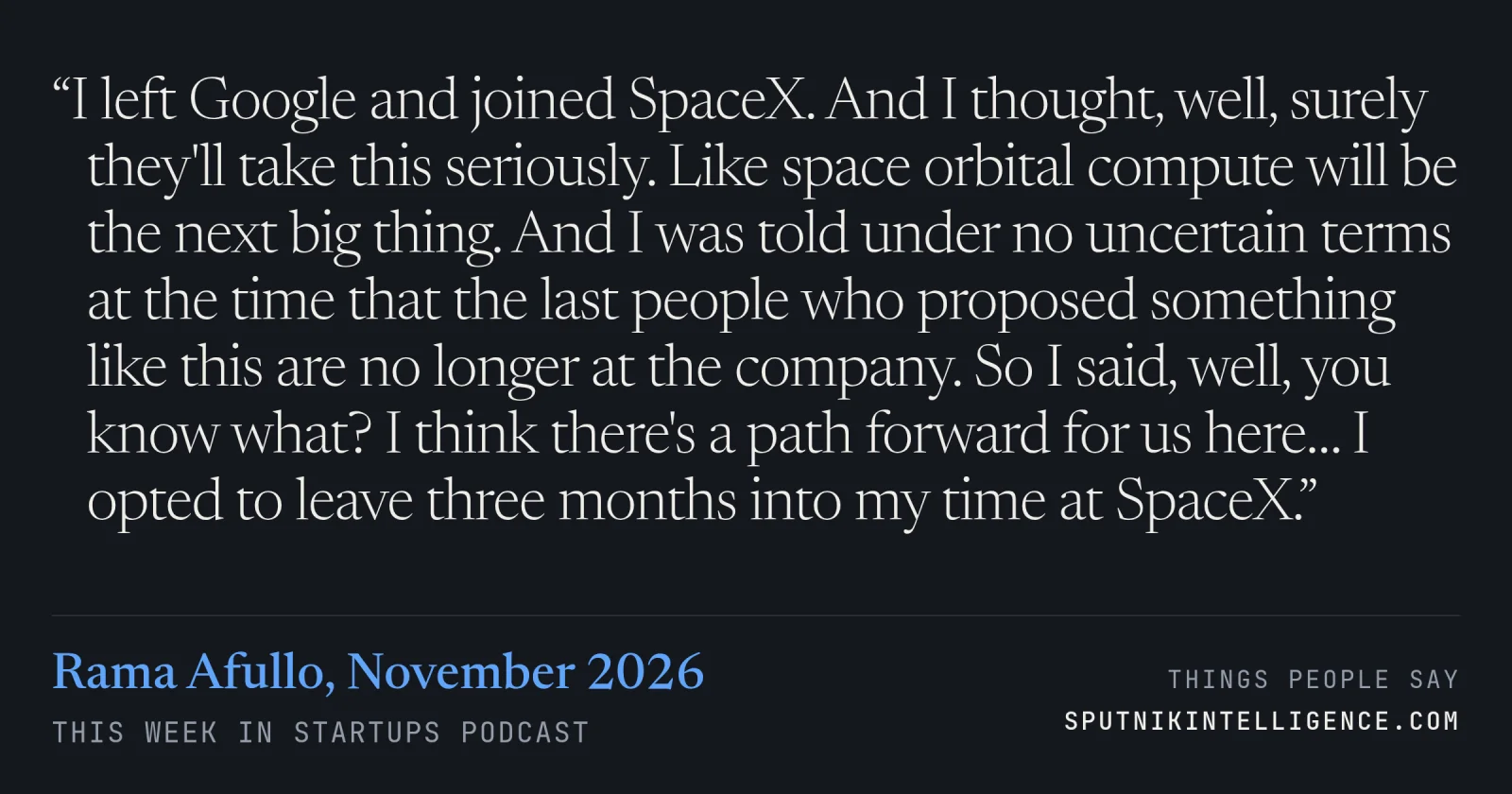
“I left Google and joined SpaceX. And I thought, well, surely they'll take this seriously. Like space orbital compute will be the next big thing. And I was told under no uncertain terms at the time that the last people who proposed something like this are no longer at the company. So I said, well, you know what? I think there's a path forward for us here… I opted to leave three months into my time at SpaceX.” — Rama Afullo, This Week in Startups

Jason Calacanis asked for Satlyt's origin story. Rama Afullo says he first pitched orbital data centers at Google, then at SpaceX, where he worked on Starlink. It lands the same week SpaceX announced huge AI data center plans of its own.

This Week in Startups · 2026-11-12 Permalink → Listen →
This Week in Startups Around 04:34 into the episode
Rama Afullo

…electrical engineering. And a lot of the work that he did, his PhD was focused on SATCOM and microwave and satellite technology. Right. And my mom's a computer scientist. Right. And so she was very much like, she's actually the person who told me how to copy paste. And that changed my life. Right.

Speaker 3

Copy-paste, very underrated quick keys. Oh, you're talking about saving an hour a day. It compounds pretty nicely.

Rama Afullo

…through that, I worked at Tesla, then I worked at Google. And when I was at Google, I was really pitching for Google to push on orbital compute and orbital data centers. And this is just at the beginning of the AI boom. So, of course, their priorities were specifically terrestrially. How do we make sure that our LLMs are as powerful as what ChatGPT is doing? Right. So I understood that. And I left Google and joined SpaceX. And I thought, well, surely they'll take this seriously. Like space orbital compute will be the next big thing. And I was told under no uncertain terms at the time that the last people who proposed something like this are no longer at the company. So I said, well, you know what? I think there's a path forward for us here. And I'm going to either stay here and become part of the furniture or leave SpaceX. I was a product manager at Starlink, leave and go and do this on my own. So I opted to leave three months into my time at SpaceX. And I started this just over two years ago and happy to deeply from there.

Speaker 3

Yeah. And so for people who don't know the why, why would we want compute in space? I think most people listening here are going to understand it, but you started this before the why existed. So I'm wondering what your why was, because there's a recent why, which has to do with, you know, a lot of…

Rama Afullo

Sure. So I've always felt like I know a secret within a secret. So the first secret is that we should put space, we should put compute in space for a number of reasons, right? One of them, like you said, is societal. Like folks don't actually want data centers in their backyards. Like that's an…

Speaker 3

solved, right, by getting closer to the Earth. But if I translate what you're saying here to a layperson, you still need to make some decisions up in space as to what to do. So that even if it was just Starlink and Hughes satellite and all the other side of products, they still need to process…

Speaker names come from our own diarization. The position is estimated from where the line sits in the episode.

Collections They Appear In