Asked at the close whether science can save wine grapes, José says no single fix will win; regions will take different routes.
Wine Blast with Susie and Peter · 2026-11-22
Permalink →
Listen →
Wine Blast with Susie and Peter
Around 38:50 into the episode
José Vouillamoz
…only purpose is to drink alcohol made from some kind of grape varieties and probably taste rather good, then fine. But if you want to keep the complexity and this sense of place that we all like in wine, we should keep the traditional grape variety. And there are many question marks to keep them.
Susie Barrie
So how do you see the future of wine grapes? What's your instinct about how all this is going to play out? You know, can science save us?
José Vouillamoz
Well, science cannot save us every time, especially with climate change. We'll have to find our own solutions. I think that in this book, I'm giving many different approaches, and not one single of them will be the solution. I think a combination of everything that is dealt with in the book will be the future. In some regions, we'll have hybrids. In other regions, we'll have indigenous grape varieties brought back to life. Other regions will have GMOs to keep Pinot Chardonnay. I think it will be a combination of everything that is suggested in the book in the future.
Susie Barrie
Jose, thank you so much.
José Vouillamoz
Thank you, my pleasure.
Peter Richards
Rarely has continuity been so intriguing.
Speaker names come from our own diarization. The position is estimated from where the line sits in the episode.
Asked what options exist besides importing grapes from hotter regions, José argues for reviving forgotten local varieties that already survived big climate swings.
Wine Blast with Susie and Peter · 2026-11-22
Permalink →
Listen →
Wine Blast with Susie and Peter
Around 15:37 into the episode
José Vouillamoz
…900 years old and it's officially the oldest grape variety in the world so far. So it's been around since a long time and I hope it will be in the future because it had a huge influence on Western Europe viticulture. It gave birth to more than 50 grape varieties and some of them are very important.
Susie Barrie
So instead of the thought of moving to just another variety, what else, what other options are there in terms of changing grape varieties?
José Vouillamoz
What I like most is to make good use of the heritage grape varieties that we have in each traditional historical wine regions. Why? Because these varieties may be obscure varieties under the radar. But they've gone through a lot of different climates. We had a warm period during the Middle Ages, the optimal warm period. Then we had the Little Ice Age during which they kind of almost disappeared. Those that have survived have already undergone that kind of differences in climates. And for me, they are the best ones to cope with the future climate change. So
Susie Barrie
they're the sort of the indigenous varieties that have kind of been forgotten.
José Vouillamoz
Yeah, yeah. That's the one I like to favor. And these are forgotten from the past, but maybe the flagship varieties of the future.
Susie Barrie
And can you name any that we may not have heard of in particular regions?
Speaker names come from our own diarization. The position is estimated from where the line sits in the episode.
Asked whether this year's vintage illustrates his point about warming, José gives harvest dates from Burgundy and his home in Switzerland.
Wine Blast with Susie and Peter · 2026-11-22
Permalink →
Listen →
Wine Blast with Susie and Peter
Around 08:48 into the episode
José Vouillamoz
…more quickly. When the ratio is reached, the aromas and flavors are not ready yet. So if you harvest at that date, you have a dull wine without flavors. If you wait until the aromas come up, then the balance is lost. It's either too acidic or too sweet, and the wine would be heavy, jammy.
Susie Barrie
And presumably vintages like 2026 are a good illustration of this.
José Vouillamoz
Of course, because 2026 broke many records of the earliest harvest dates in many places in Europe, especially in Burgundy. They never had such an early harvest as this year. I think they started mid-August in some areas. In Switzerland where I live, they started August 11, while the regular period even for the early ripening varieties was September. So we are almost one month earlier than what I have experienced as a child. It's going very fast.
Susie Barrie
I mean, do you think that the time is approaching where Burgundy needs to decide if Chardonnay and Pinot Noir are still appropriate grape varieties for the region?
José Vouillamoz
Of course, we can already observe that. If you had some 2023 or even 2022 red burgundy, they are too ripe to my taste. And for me, most of them have lost the elegance and the balance that they used to have. And 2026, I haven't tasted any, but will be even more powerful than what it used to be. So…
Susie Barrie
So you truly believe we will never have wines like older Bordeaux in our cellars ever again?
Speaker names come from our own diarization. The position is estimated from where the line sits in the episode.
Discussing whether warming regions should swap in grapes from hotter places, José describes Burgundy's possible future with Piedmont's Nebbiolo, and says why he hopes it never happens.
Wine Blast with Susie and Peter · 2026-11-22
Permalink →
Listen →
Wine Blast with Susie and Peter
Around 11:13 into the episode
José Vouillamoz
…and 12.5 in alcohol. The 2022 same magazine, Wine Advocate, was described as fruity, round, powerful, mellow, almost ready to drink at 14.2 of alcohol. So, same place, same wine, same family, two different wines. And I cannot think of any future vintage that would be similar to 1982 or 1961.
Susie Barrie
…climate change, in the book, you propose two main solutions when it comes to grape varieties: either all change or the continuity model, which is basically adapting within a familiar varietal context. So, should we look at each of those in turn and start with the option of changing grape varieties?
José Vouillamoz
So, if you change grape varieties, you have a lot of choices. You can study grape varieties from another region to see if they are adapted to a given region. Let's take the example of Bordeaux. They've been studying 52 different varieties over the last 15 years, measuring all the parameters, each vintage. And
Susie Barrie
that's in one specific vineyard. One specific
José Vouillamoz
plot called Parcel Saint-Conte deu, Parcel, 52 grape varieties. And one of them that stood out was Torrega Nacional from Portugal. So that is used to make port wine. And the results were convincing. And since 2000, I think, 23 or 21, don't remember, they have officially authorized Torrega Nacional…
Speaker 4
I think a lot of people would agree with you.
Speaker names come from our own diarization. The position is estimated from where the line sits in the episode.
Asked about disease-resistant hybrid grapes, José says he doesn't want them in fine wine, but sees an obvious place for them in cheap volume wine, where nobody checks the grape on the label.
Wine Blast with Susie and Peter · 2026-11-22
Permalink →
Listen →
Wine Blast with Susie and Peter
Around 25:37 into the episode
José Vouillamoz
…it really matched the request and the demand of the Chinese market in terms of style. It's quite dark, quite spicy, powerful. And today it has become the most planted red variety in China, Marcelon. So the cross was made in France and has been successful in China, one of the examples of crossings.
Susie Barrie
So just moving on to hybrids then, what do you feel about those and what are the arguments in favor of using a hybrid?
José Vouillamoz
For me, again, and I would be happy to be proven wrong, hybrid wines do not have the depth and the complexity that you can find in a traditional variety. But I see many advantages with hybrids. First of all, they have already started to do that in Champagne. Champagne, they have included Voltis, which is a multi-resistant hybrid, very good resistance to powdery mildew, dynamil. They have planted it up to 5% in the vineyard, 10% in the wine. It does not really change the profile. The champagne, but it's very useful as a blending partner. I see two good reasons to plant hybrids. Again, I don't want to see hybrids at Romani Conte. But in the case of champagne, you can plant hybrids like Voltis around the villages, around the houses where people live. So you don't need almost, you don't need to spray these vineyards, maybe once or twice a year. So it's better for the human health, better for the population, and better for the image of wine. Because when you have a school with kids and you have a guy that is dressed like a cosmode going on the moon, it's not good for the image. So planting around the villages is one thing. But something that…
Peter Richards
So when it comes to changing varieties, you get the feeling that Jose favors rescuing obscure indigenous vines rather than resorting to crossings or hybrids.
Susie Barrie
Yeah, I mean, his story about Diol was great, wasn't it? And in the book, he writes that crossings only make up 3.5% of the global vineyard, and hybrids are less than 2%. So that kind of tells its own story. I mean, I think he's fine with it in certain contexts, like more high-volume wine…
Peter Richards
But, you know, I guess the challenge is awareness, isn't it? Most people only know a handful of grape varieties at best, so try to sell them even more niche ones won't be easy. He did tell us another story about a variety called Zankt Georgina, I think that's the right way of saying it, which is a…
Speaker names come from our own diarization. The position is estimated from where the line sits in the episode.
Asked whether gene-altered grapes, such as a new-generation Chardonnay, will be part of wine's future, José says he thinks gene editing will become unavoidable if classic varieties are to stay where they are.
Wine Blast with Susie and Peter · 2026-11-22
Permalink →
Listen →
Wine Blast with Susie and Peter
Around 37:14 into the episode
Susie Barrie
Do you think gene-altered wine grapes will be a part of the future of wine? Could we have a new generation Chardonnay, for example?
José Vouillamoz
I believe so. I think at some point we will have no choice. Not only for grape varieties, but also for anything we cultivate, also for human beings. Gene therapy is underway for human beings. This is I think part of the future with grapevarieties it would be so difficult to keep the traditional grapevarieties in their own place without using GMOs because that's what they are, genetically modified organisms. In terms of economics, in terms of environment, it would be much better to use altered or modified grape varieties than increasing the chemical treatments and or changing the variety. I think we'll have no choice.
Susie Barrie
And how much of a big deal is all of it, really, in your opinion? I mean, wine consumption has always changed over time, hasn't it?
José Vouillamoz
Yes, true. But wine is not only alcohol, it's culture. It's history. And I think that the famous traditional wine regions are part of the history of Western Europe. It's also the case in other parts of the world, of course. And we don't want to lose that. If the only purpose is to drink alcohol…
Susie Barrie
So how do you see the future of wine grapes? What's your instinct about how all this is going to play out? You know, can science save us?
Speaker names come from our own diarization. The position is estimated from where the line sits in the episode.
Asked about gene-edited vines, José says his worry isn't the editing itself but that editing only a few clones of a variety could wipe out the diversity within it.
Wine Blast with Susie and Peter · 2026-11-22
Permalink →
Listen →
Wine Blast with Susie and Peter
Around 33:37 into the episode
José Vouillamoz
…difficult to agree with them because it is GMO from equipment. And you can also introduce another gene if you want with this same technique. But it's quite promising because they have been able to create a Chardonnay plant that is almost completely resistant to powdery Mildew using this technique.
Susie Barrie
Is it allowed to be used? Is it legal?
José Vouillamoz
Good question. The regulation is rather vague about that. Nobody knows at the moment. Nobody knows. Be it CRISPR-Cas9 or GMOs, I don't mind. What I would mind is that it's very costly to do that on any grape variety. So you will do that on one or two clones. And if you think of Pinot that has more than 1,000 clones, all the other ones would be lost. And that is what I fear the most. I don't fear the modification. I know how they do. I know that there's almost zero risk for the human health. But the risk for me is what. We call genetic erosion, because you would lose the diversity within the grape variety. If you have a Chardonnay that is resistant to anything you don't like, everybody would want to plant it.
Susie Barrie
Now, epigenetics is fascinating too. Can you tell us what that is and how it's of interest here?
José Vouillamoz
So, I did my biology studies in the 1990s, and this word did not exist. And I did not learn it at university. It's a very recent field of science over the last 15 years, I would say. And it contradicts everything that I have learned back then, because we would always learn that the environment…
Susie Barrie
surely that suggests that any new planting material should be selected from old vines.
Speaker names come from our own diarization. The position is estimated from where the line sits in the episode.
Asked to explain epigenetics and why it matters for vines, José offers an unproven hypothesis from tasting in Bordeaux: vineyards that lived through earlier hot years may have adapted.
Wine Blast with Susie and Peter · 2026-11-22
Permalink →
Listen →
Wine Blast with Susie and Peter
Around 34:25 into the episode
José Vouillamoz
…know how they do. I know that there's almost zero risk for the human health. But the risk for me is what. We call genetic erosion, because you would lose the diversity within the grape variety. If you have a Chardonnay that is resistant to anything you don't like, everybody would want to plant it.
Susie Barrie
Now, epigenetics is fascinating too. Can you tell us what that is and how it's of interest here?
José Vouillamoz
So, I did my biology studies in the 1990s, and this word did not exist. And I did not learn it at university. It's a very recent field of science over the last 15 years, I would say. And it contradicts everything that I have learned back then, because we would always learn that the environment cannot influence the DNA. Of course, it is still true if you look at the molecules composing the DNA, the basis of life. The environment cannot influence these molecules, except if you're close to Chernobyl and you have radiations, that is possible. But the environment can influence what is around the DNA molecule. There are a lot of proteins for the structure, a lot of other components that influence the expression of the genes. You don't modify the genes, so the ATGC, you don't modify them, these molecules, but you modify what is around, what I call the decoration of the DNA. And if you modify it, you can influence the expression of a gene. The external influences can be integrated into this combination around the DNA. And if you take cuttings from this plant, you would propagate this influence. So my theory is, again, it's not proven. It's still under study. But I was thinking of Merlot in Bordeaux, vintage 2022. I was there for the…
Susie Barrie
surely that suggests that any new planting material should be selected from old vines.
José Vouillamoz
That's the reason why, yeah. Because we were speaking about old indigenous grape varieties. They have gone through different climates and they have the record, the chemical record in their chemical structure around the DNA of the past climates. Now
Susie Barrie
there's an interesting initiative, isn't there, in New Zealand to do with Sauvignon Blanc, Sauvignon Blanc 2.0, which takes this as sort of a stage further, the idea.
Speaker names come from our own diarization. The position is estimated from where the line sits in the episode.
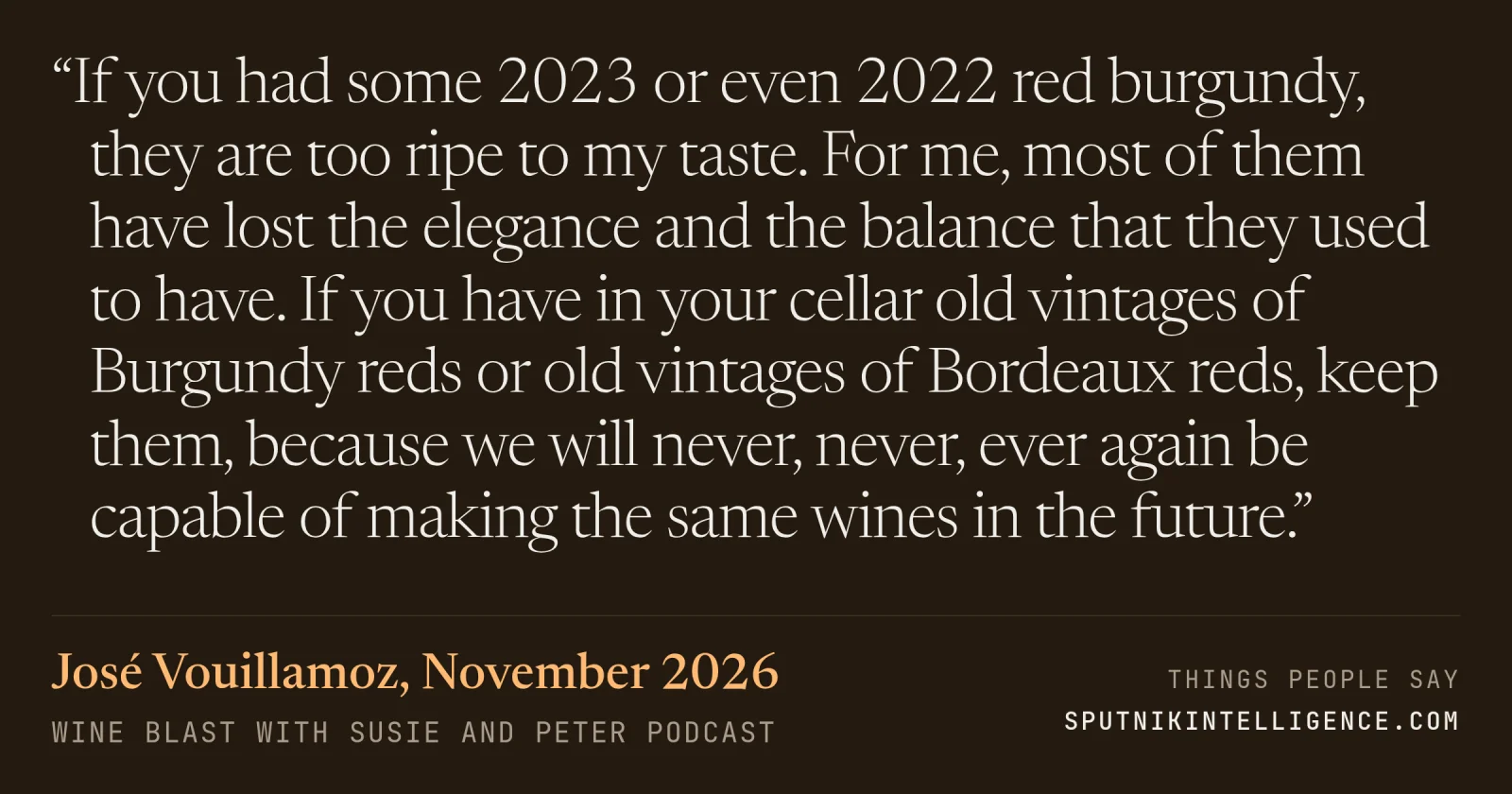
Asked whether Burgundy needs to rethink Pinot Noir and Chardonnay, José says the style of recent red Burgundy is already shifting with the heat, and advises collectors to hold on to old bottles.
Wine Blast with Susie and Peter · 2026-11-22
Permalink →
Listen →
Wine Blast with Susie and Peter
Around 09:36 into the episode
José Vouillamoz
…harvest as this year. I think they started mid-August in some areas. In Switzerland where I live, they started August 11, while the regular period even for the early ripening varieties was September. So we are almost one month earlier than what I have experienced as a child. It's going very fast.
Susie Barrie
I mean, do you think that the time is approaching where Burgundy needs to decide if Chardonnay and Pinot Noir are still appropriate grape varieties for the region?
José Vouillamoz
Of course, we can already observe that. If you had some 2023 or even 2022 red burgundy, they are too ripe to my taste. And for me, most of them have lost the elegance and the balance that they used to have. And 2026, I haven't tasted any, but will be even more powerful than what it used to be. So we are losing the proper identity of what an excellent, balanced, elegant, delicate red burgundy should be. And one thing that people must realize: if you have in your cellar old vintages of burgundy reds or old vintages of border reds, keep them, because we will never, never, ever again be capable of doing the same wines in the future. For the next 10,000 years, I would say.
Susie Barrie
So you truly believe we will never have wines like older Bordeaux in our cellars ever again?
José Vouillamoz
Yes, I do. The effect of climate change has been observed since the 1980s and it's not going to stop. At least for the next 10,000 years. In the book, I give the example of Levile Barton 1982 versus 2022. Same family, same philosophy, same wine making. The 82 was described back then by Robert…
Susie Barrie
So, in the face of climate change, in the book, you propose two main solutions when it comes to grape varieties: either all change or the continuity model, which is basically adapting within a familiar varietal context. So, should we look at each of those in turn and start with the option of…
Speaker names come from our own diarization. The position is estimated from where the line sits in the episode.
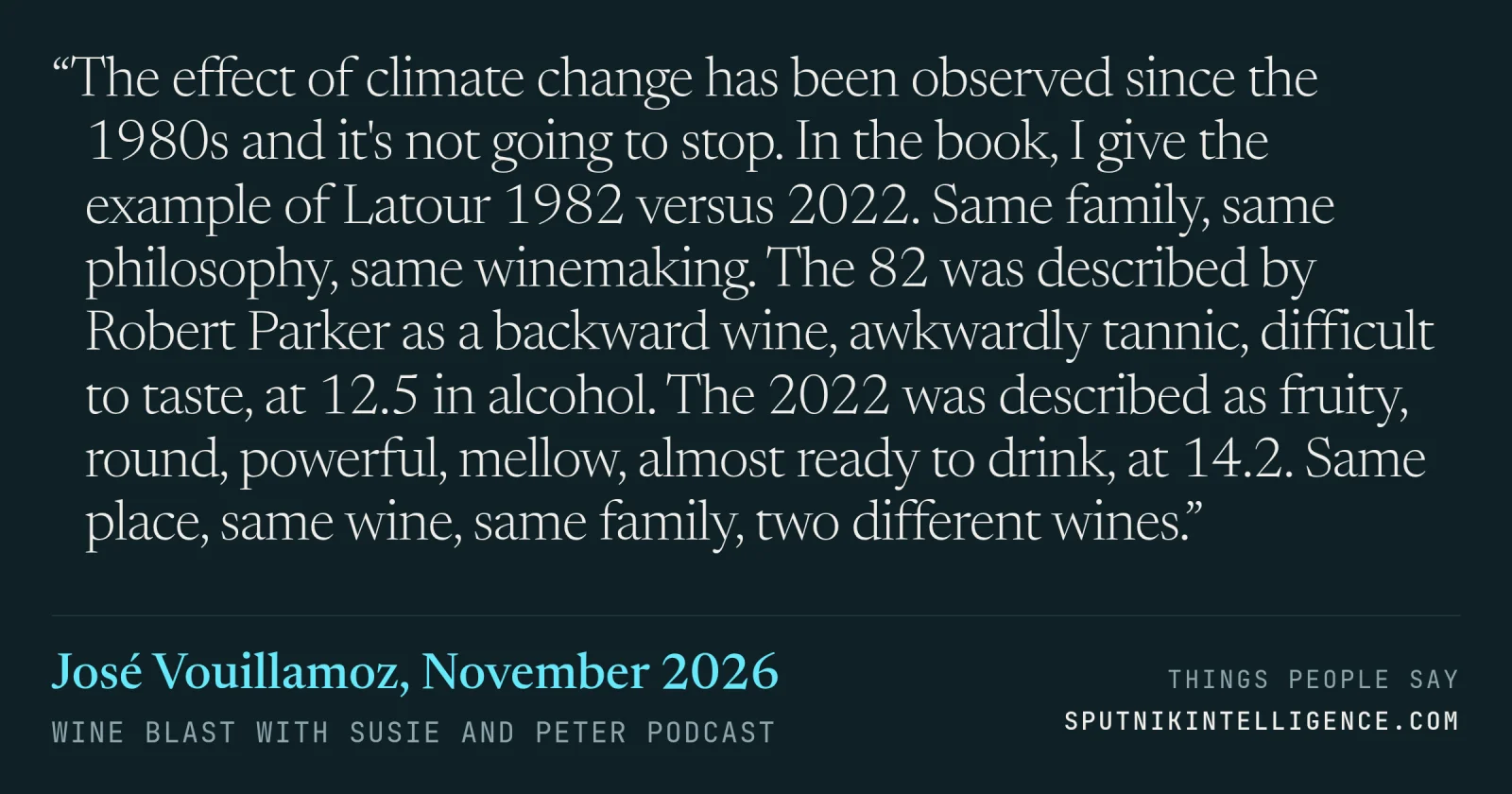
Asked whether wines like older Bordeaux will never be made again, the grape geneticist gives a side-by-side of two vintages from the same estate, 40 years apart, as evidence of how much warming has already changed the wine.
Wine Blast with Susie and Peter · 2026-11-22
Permalink →
Listen →
Wine Blast with Susie and Peter
Around 10:24 into the episode
José Vouillamoz
…red burgundy should be. And one thing that people must realize: if you have in your cellar old vintages of burgundy reds or old vintages of border reds, keep them, because we will never, never, ever again be capable of doing the same wines in the future. For the next 10,000 years, I would say.
Susie Barrie
So you truly believe we will never have wines like older Bordeaux in our cellars ever again?
José Vouillamoz
Yes, I do. The effect of climate change has been observed since the 1980s and it's not going to stop. At least for the next 10,000 years. In the book, I give the example of Levile Barton 1982 versus 2022. Same family, same philosophy, same wine making. The 82 was described back then by Robert Parker as an backward wine, awkwardly tannic, difficult to taste with a potential and 12.5 in alcohol. The 2022 same magazine, Wine Advocate, was described as fruity, round, powerful, mellow, almost ready to drink at 14.2 of alcohol. So, same place, same wine, same family, two different wines. And I cannot think of any future vintage that would be similar to 1982 or 1961.
Susie Barrie
So, in the face of climate change, in the book, you propose two main solutions when it comes to grape varieties: either all change or the continuity model, which is basically adapting within a familiar varietal context. So, should we look at each of those in turn and start with the option of…
José Vouillamoz
So, if you change grape varieties, you have a lot of choices. You can study grape varieties from another region to see if they are adapted to a given region. Let's take the example of Bordeaux. They've been studying 52 different varieties over the last 15 years, measuring all the parameters, each…
Susie Barrie
that's in one specific vineyard. One specific
Speaker names come from our own diarization. The position is estimated from where the line sits in the episode.