 José Vouillamoz
On Wine Blast with Susie and Peter
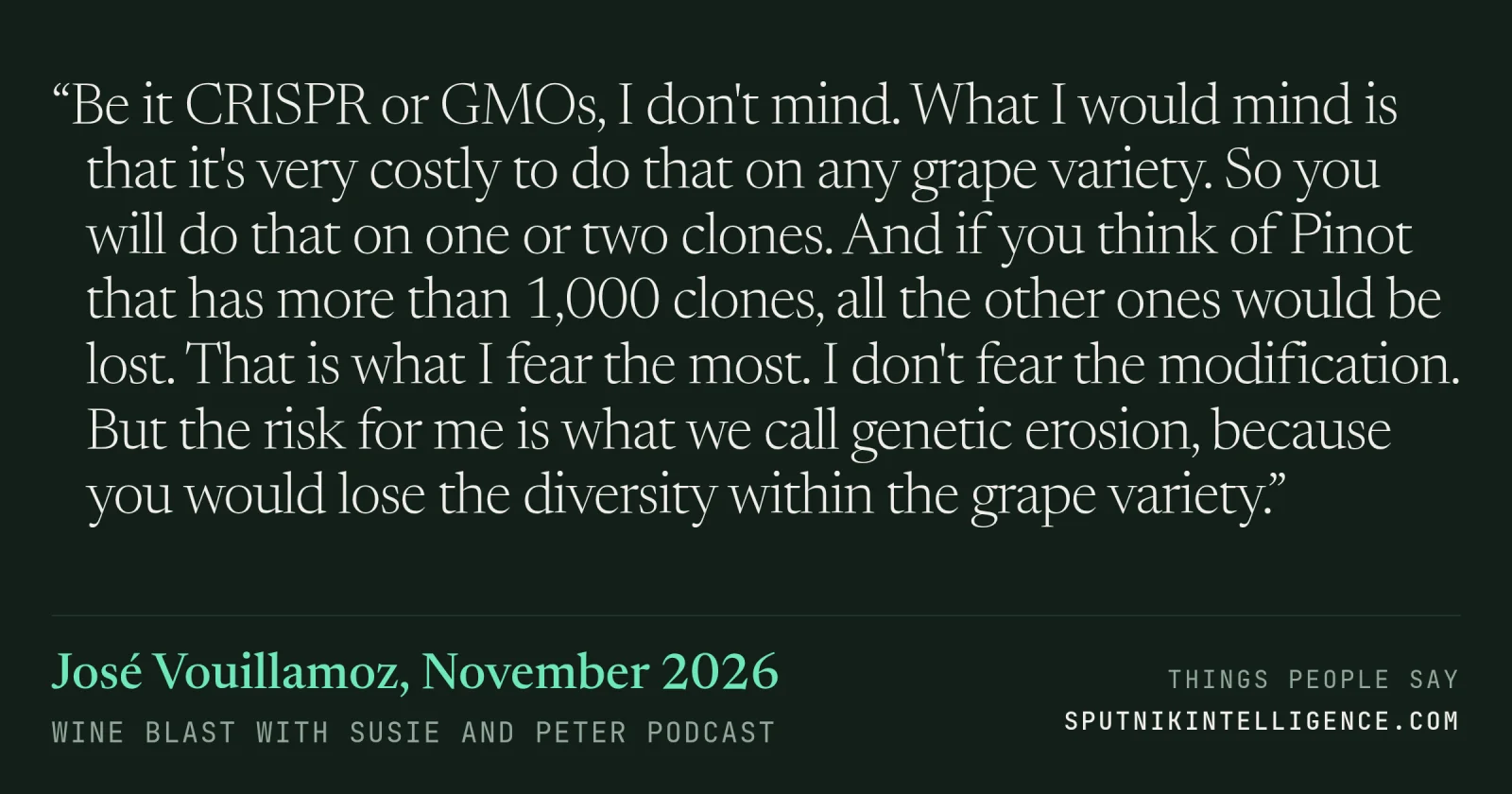
“Be it CRISPR or GMOs, I don't mind. What I would mind is that it's very costly to do that on any grape variety. So you will do that on one or two clones. And if you think of Pinot that has more than 1,000 clones, all the other ones would be lost. That is what I fear the most. I don't fear the modification. But the risk for me is what we call genetic erosion, because you would lose the diversity within the grape variety.”
Wine Blast with Susie and Peter · Food & Beverage · November 2026
Context
Asked about gene-edited vines, José says his worry isn't the editing itself but that editing only a few clones of a variety could wipe out the diversity within it.
Transcript
…difficult to agree with them because it is GMO from equipment. And you can also introduce another gene if you want with this same technique. But it's quite promising because they have been able to create a Chardonnay plant that is almost completely resistant to powdery Mildew using this technique.
Is it allowed to be used? Is it legal?
Good question. The regulation is rather vague about that. Nobody knows at the moment. Nobody knows. Be it CRISPR-Cas9 or GMOs, I don't mind. What I would mind is that it's very costly to do that on any grape variety. So you will do that on one or two clones. And if you think of Pinot that has more than 1,000 clones, all the other ones would be lost. And that is what I fear the most. I don't fear the modification. I know how they do. I know that there's almost zero risk for the human health. But the risk for me is what. We call genetic erosion, because you would lose the diversity within the grape variety. If you have a Chardonnay that is resistant to anything you don't like, everybody would want to plant it.
Now, epigenetics is fascinating too. Can you tell us what that is and how it's of interest here?
So, I did my biology studies in the 1990s, and this word did not exist. And I did not learn it at university. It's a very recent field of science over the last 15 years, I would say. And it contradicts everything that I have learned back then, because we would always learn that the environment…
surely that suggests that any new planting material should be selected from old vines.
More from Wine Blast with Susie and Peter