Seshan splits her work writing in two: writing as reporting, meaning status updates and launch plans, and writing as thinking, meaning briefs that argue for a product or a change of direction. She hands the first kind to the models and refuses to hand over the second. She adds that most people paint with too broad a brush in either direction, insisting they never use models for writing or always do.
sure, for sure. Help us know
…Adam Ward from Grocer. So she said, okay, you should ask her about writing/slash thinking. A Tara brief is iconic. Help us understand just what makes your writing, your briefs iconic, and any tips that might be helpful for people that are maybe trying to get better at writing and writing documents.
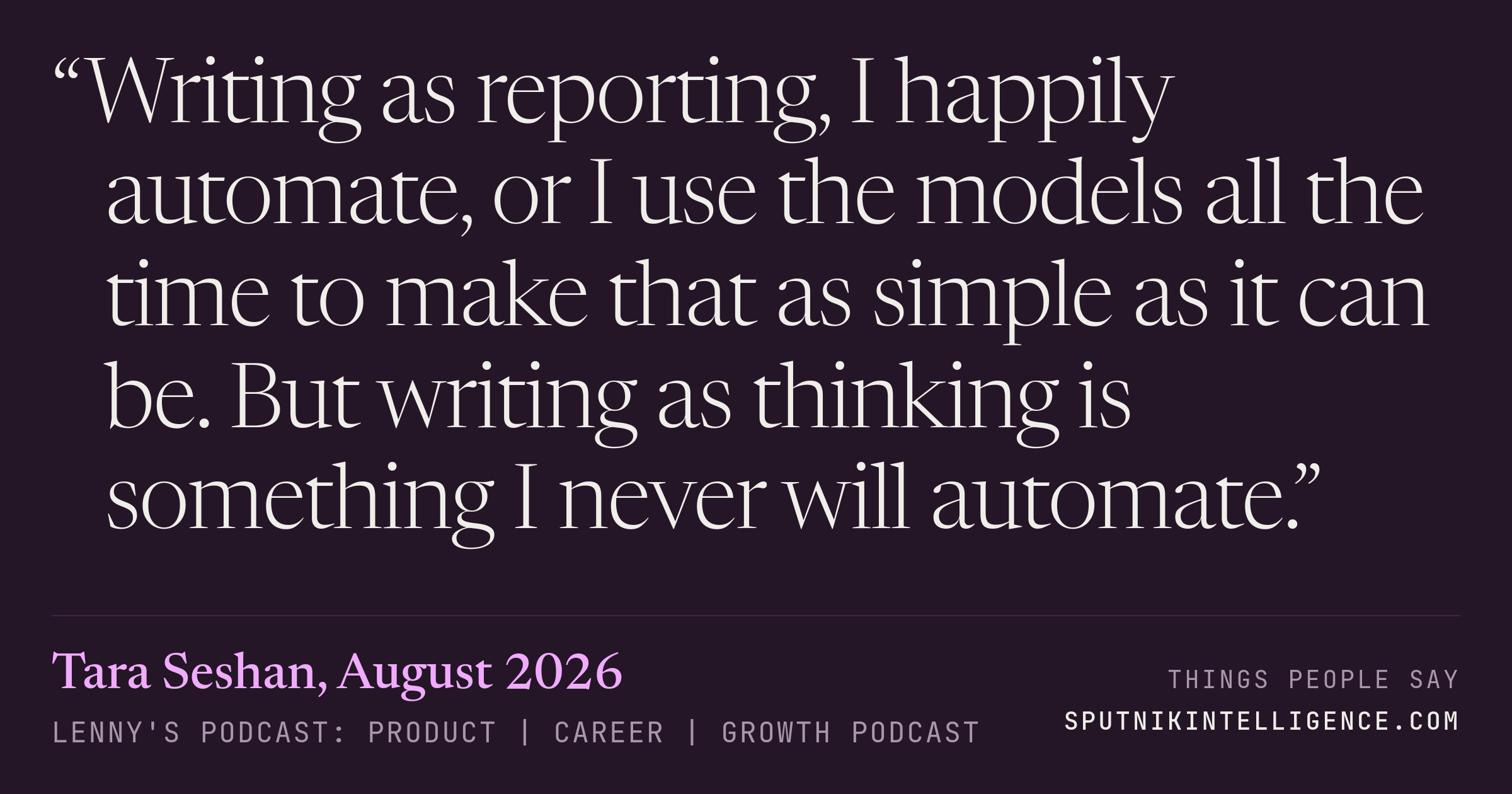
…thinking is me writing a like a brief about why we should build a certain product or why we should take a certain strategy or why, like maybe a spicy take. But writing as reporting is things like, oh, I'm summarizing the status of what our team has been up to this week and I'm sending over a report about it. Or this is our plan for this particular launch or announcement or something like that. Writing as reporting, I happily automate, or I use the models all the time to make that as simple as it can be. But writing as thinking is something I never will automate. I really strongly believe that, at least for me, the act of going through and outlining something, turning it into some level of prose, cutting it and editing it, continuing to iterate on it is one of the most important steps for me to get my ideas in line. I think most people actually will paint with a really broad brush. Like, I will never use the models for writing, or I always use the models…
That is so interesting. I really liked your tip of getting tons of feedback on a doc. Like, you know, it sounds obvious, but you can get to an iconic doc slash brief by just cheating almost and getting lots of feedback on it as you're iterating to make it stronger and stronger and stronger versus…
had a manager who told me that the right thing to always do is write a doc to 70% completion and then take it to the people that you need buy-in from and get it from 70% to 100%. And that still is like a thing that I do all the time because very few great people want to interact with like a…
How do you think about AI brain rot and starting to over rely on AI? That's just the challenge everybody's going to have. Why not use this magic to help look at something? And then we start to lose our ability to write, read long documents. Is there anything you do that you are trying to avoid that?