
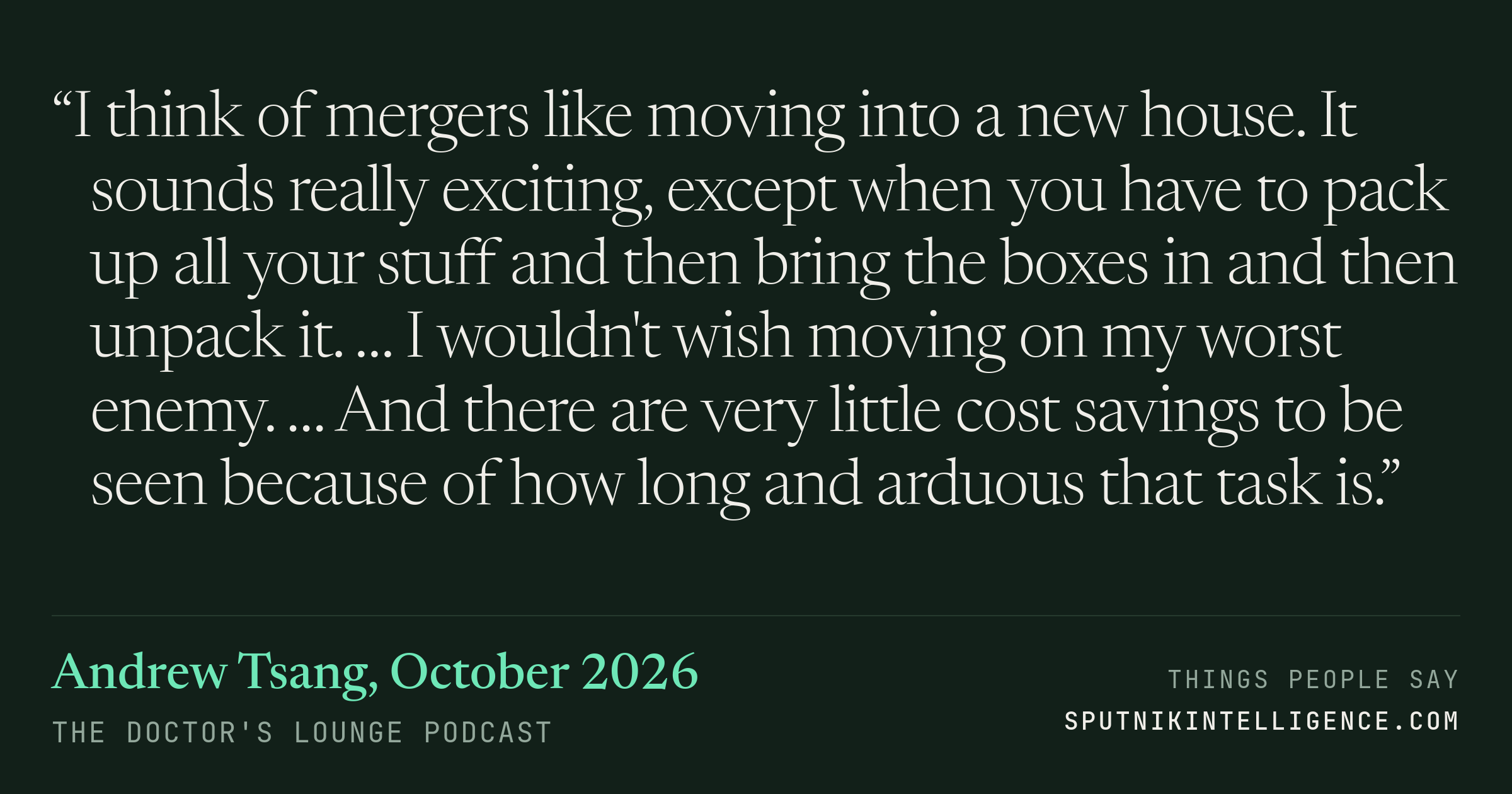
The hosts raised research showing that hospital consolidation raises prices and drags on the wider economy. Tsang, who says he has worked on many mergers, argues that most hospital executives aren't thinking about that. The promised savings rarely show up because merging systems takes years.
…our vulnerable, right? And therefore, what we can do is we can kind of uh in order to compensate for the losses we're taking there, squeeze our more able-bodied, likely able-bodied, uh employed groups, uh people with commercial insurance, a little bit more. So yeah, I I could see that um that Tate.
…less money to hire new employees, less money to give raises, less money to expand operations because their healthcare costs go up. Um does that go into does that get brought up in the the C-suite of hospitals when they're when they're exercising their market power? I'll be honest, probably not.
…I have been writing extensively about the experience of it. Like, I'll kind of break this down. I know you guys are a wonky group, but I'll simplify it too. Like, I think of mergers, like uh moving into like a new house, it sounds really exciting, except like when you have to pack up all your stuff and then like bring it in, the boxes in and then like unpack it. It's really tedious, right? Like I wouldn't wish moving on my worst enemy. Uh, that's what it feels like. So people who are considering mergers in a house system are really thinking about a couple things from my experience. A lot of it is operational, like um use, right? Like, how can we oh, take advantage of like this great system that they have here, right? Like this IT system, or maybe they have like you know, a bunch of like outpatient ambulatory centers, like how…
So you don't think for so you know, speaking from the vantage point of the insurance companies, I mean, but you you've had that perspective. You you know, just to recap what you said earlier, you don't think the MLR uh is really making these insurance companies not care about suppressing costs. Um…
Well, I'll I'll say this like it, you know, kind of like you guys were saying, like I think nobody wakes up to be a villain. So I think they think that they are trying to do their best to suppress costs. The incentive because of just simple math, right? Like 85% of a bigger pie is still more money…
So what is so what's the reform? How would you reform this? Um I mean, I I think all of us agree that there's no villains and everyone was just kind of rationally following incentives. Um again, it's a little surprising to me that okay, I mean, why why why why are insurance companies and I mean…