Sam Lessin

Things Sam Says on Podcasts

Founding partner at Slow Ventures, a venture firm investing across early- and growth-stage companies, and a columnist at The Information. Previously VP of Product at Facebook after it acquired his company Drop.io, and founder of the production-studio startup Fin. Hosts More or Less with Jessica Lessin, Dave Morin and Brit Morin, a weekly debate on Silicon Valley, AI and venture capital. Appears regularly on The Information's TITV and The Exchange, and has guested on 20VC, This Week in Startups and The Logan Bartlett Show.

Where to Find Them

Sam Lessin hosts and writes More or Less and writes The Logan Bartlett Show . They have also been a guest on The Exchange (6 times) , The Information's TITV (6 times) , TBPN (5 times) , Turpentine VC" | Venture Capital and Investing (3 times) , This Week in Startups (3 times) , The Twenty Minute VC (20VC): Venture Capital | Startup Funding | The Pitch (3 times) , RiskReversal Pod , Summation with Auren Hoffman , Closing Bell , The Learning Leader Show With Ryan Hawk , Joe Lonsdale: American Optimist , Lenny's Podcast: Product | Career | Growth and The Cognitive Revolution" | AI Builders, Researchers, and Live Player Analysis .

Recently: “We asked 3 VCs: would you invest in Elizabeth Holmes’ next startup? | E2353” on This Week in Startups (October 2026); “The Death of the Web Is Inevitable” on More or Less (October 2026); “Agentic Commerce Hits a Wall: Hilton, Amazon and the Bot Blocking Fight” on More or Less (October 2026); “Meta Muse vs Instinct vs OpenAI Dots: Do AI Agents Have Any Moat?” on More or Less (October 2026); “Meta Muse vs Instinct vs OpenAI Dots: Do AI Agents Have Any Moat?” on More or Less (October 2026); “Claude Is Doing Science, a16z Is Starting a University & the AI Bubble Keeps Growing and Still Be a Terrible Business; We'd Rather Send Our Kids to the Military Than to a16z's School” on More or Less (September 2026).

What They Said

“Unlike a human assistant, which is what you're all trying to proxy, everyone is a hairline trigger. If you screw me once, it's so easy to fire a digital assistant… If your human assistant screws up, which they do all the time, you don't instantly fire them… But if you turn into a service and say, we have a service for doing this stuff, the tolerance for mistakes goes to zero.” — Sam Lessin, More or Less

Ten years ago Lessin co-founded Finn, an assistant service with humans in the loop. He is explaining why today's AI agents will hit the same wall: a service is liable for every mistake down the chain, and errors like booking the wrong flight cost more than thin margins can absorb.

More or Less · 2026-10-16 Permalink → Listen →
More or Less Around 18:38 into the episode
Brit Morin

what Finn is for anyone who doesn't know.

Dave Morin

Lick the cookie on Finn, please. I got

Sam Lessin

…don't have the margin to pay for the mistakes. And so there's a fundamental problem with running this service. And then, unlike a human assistant, which is what you're all trying to proxy, everyone is a hairline trigger. Like, if you screw me once, it's so easy to fire a digital assistant effectively. There's no emotional bond. I didn't hire the person. It didn't take me a bunch of time. Like, if your human assistant screws up, which they do all the time, you don't instantly fire them. Like, you're like, I have to work with you. There's some stickiness. There's like this whole human. But people, if you turn into a service and say, we have a service for doing this stuff, the tolerance for mistakes goes to zero. Now, with Finn, people would constantly cancel and then be like, oh man, I really missed that and come back a month later, right? Once there was a mistake. But the…

Brit Morin

But at some level, it does feel inevitable

Jessica Lessin

too. And so the question, I think, is like, what gets us through this period? And Sam, you've written about sort of treaties and you think doing treaties at scale. Like, I do feel like it is inevitable that we're just in an intense early adopter growing pain period. That's how it feels to me. You…

Sam Lessin

I think what's inevitable is the death of the web. I think what's inevitable is like a bunch of like the simple shim like types. Yes, you will obviously use these things, right? And for a bunch of stuff, and they'll be good at a bunch of stuff, but it's the problem is going to be there's going to…

Speaker names from our own diarization · position estimated from where the line sits in the episode
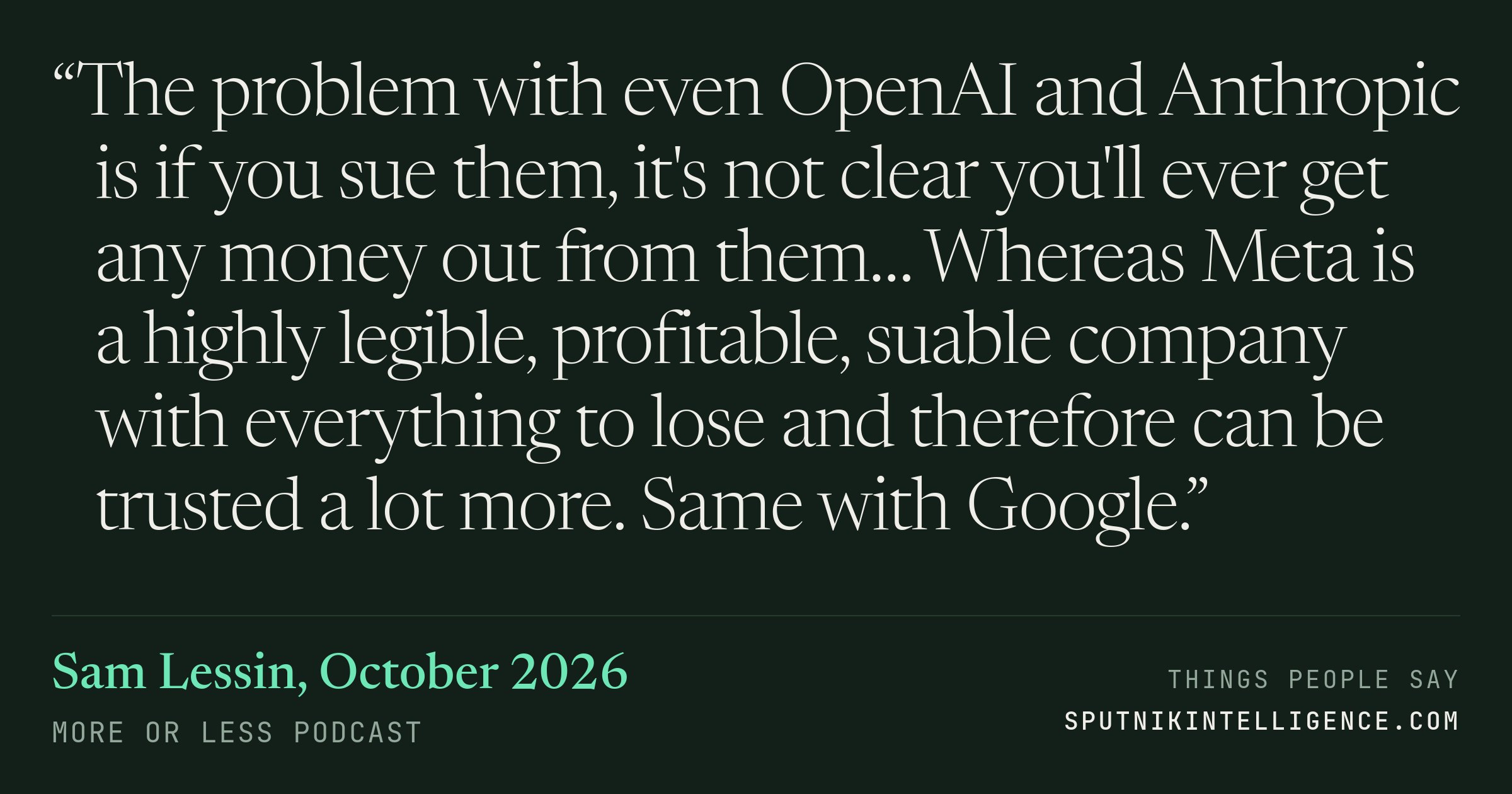
“The problem with even OpenAI and Anthropic is if you sue them, it's not clear you'll ever get any money out from them… Whereas Meta is a highly legible, profitable, suable company with everything to lose and therefore can be trusted a lot more. Same with Google.” — Sam Lessin, More or Less

The hosts are comparing how much personal data they hand to AI agents. Lessin says that, ironically, he trusts Meta's Muse the most, and credits an old lesson from his father: a real public company can be sued and has a lot to lose.

More or Less · 2026-10-16 Permalink → Listen →
More or Less Around 16:28 into the episode
Jessica Lessin

but I try to go full send. The internet won't let me. But yes,

Brit Morin

…lot of people are having this conversation right now. I'm in a lot of WhatsApp groups and everyone's like, how much information are you guys giving all your agents? And some people, a lot of people are going like full send mode. At the same time, it's very binary. A lot of people are like, no way.

Sam Lessin

Muse is the one I'm most willing to give complete information, like information to, ironically. Like I actually trust Muse the most, but I don't give any of them local access. Why? It's an old Bob lesson, my dad line, which is when I was a kid, I was scared at Disney World on a roller coaster and he said, don't worry, Sam Lessin a public company, right? And the basic point is like, it's a real company. They can be sued. It's meaningful to them. They care about the security angles. Right. So I think like the problem with even Open AI and Anthropic is if you sue them, it's not clear you'll ever get any money out from them. Again, this goes back to the whole internalizing the profits or the value and externalizing the risks, right? They might cause a national crisis, but you're never going to sue them, right? Whereas Meta is like a highly legible, profitable, suable company with everything to lose and therefore can be trusted a lot more. Same with Google. I would trust Google the same way.

Brit Morin

I know. I would trust Google first. And I'm waiting for Google to roll theirs out. I think the Gemini stuff was a step in the right direction, but they haven't fully connected the dots yet.

Sam Lessin

It's the trust. And then it's just, it's also the whole on the other side. It's like, who can just do the BD deals to keep stuff open? Because that's the other thing we're seeing is there's nothing surprising about anything going on. Turns out that once you see a ton of agentic traffic, which is…

Jessica Lessin

I just know to everyone at Meta who's going to be mad for me saying this. I'm sorry. I speak the truth. But, and this isn't a fault of theirs, but like a solid 70% of my Muse use cases that I was so excited about do not work. I cannot complete things. Like the internet is just standing in my way…

Speaker names from our own diarization · position estimated from where the line sits in the episode
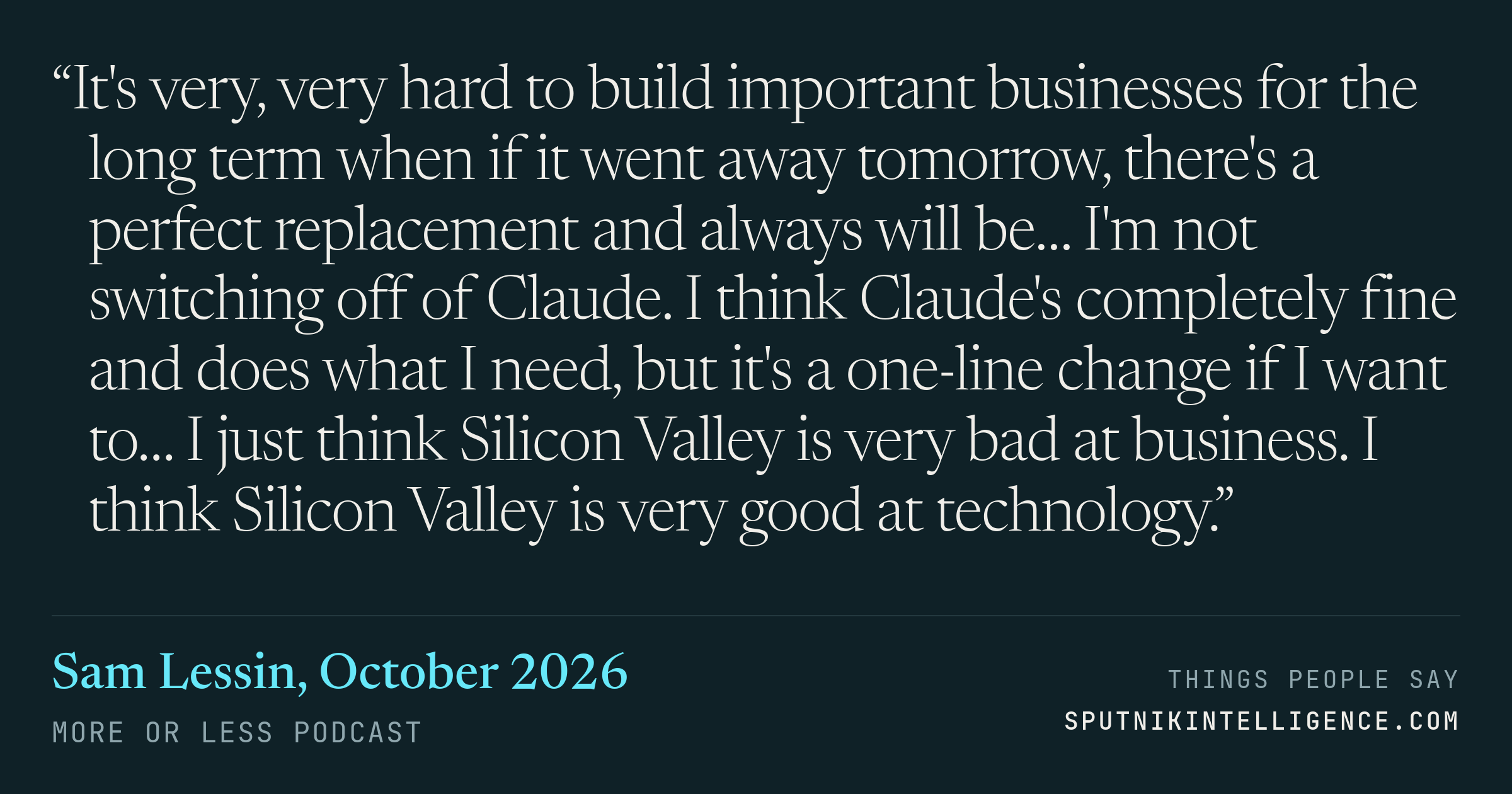
“It's very, very hard to build important businesses for the long term when if it went away tomorrow, there's a perfect replacement and always will be… I'm not switching off of Claude. I think Claude's completely fine and does what I need, but it's a one-line change if I want to… I just think Silicon Valley is very bad at business. I think Silicon Valley is very good at technology.” — Sam Lessin, More or Less

The panel was discussing reports that Meta and Microsoft had roughly halved their use of Claude in favour of their own models. Lessin, who uses Claude as infrastructure, argued that model makers have a hard time building durable businesses when switching costs are close to zero.

More or Less · 2026-10-09 Permalink → Listen →
More or Less Around 17:48 into the episode
Speaker 3

it's interesting. I use a lot of Claude, but I don't actually talk to Claude that way.

Speaker 2

You just use it as inference. Yeah,

Speaker 3

it's just, it's just infrastructure for me. And it's just excellent at what it does. I mean, I published my diagram of like how all of my infrastructure works. And like, I'm loving it. As I said on the last pod, like my thing is, though, I think that the warning sign in mind is what we've been saying all along, which is this stuff is great. Multiplying big matrices is amazing. You can do great stuff with it. But it's very, very hard to build important businesses for the long term when if it went away tomorrow, there's a perfect replacement and always will be. It's fine. And so like I'm not switching off of Claude. I think Claude's completely fine and does what I need, but it's a one-line change if I want to. And like, it doesn't matter. Silicon Valley, if you'd be silly about it for a second, I just think Silicon Valley is very bad at business. I think Silicon Valley is very good at technology. And the irony is technology has been so dominant in certain areas that like being good at technology has swamped all sense of business and strategy for a long time. So it's like you don't need to be good at business. You just do technology, but this is a little different.

Speaker 2

Well, Sam, I think that you've rightly pointed out that Silicon Valley is great at one kind of business, which is create enormous capital bubble to make number go up until the like the one emerges that can outstrip all of the business losses and become infinity. That's like the kind of easy way to…

Speaker 3

Although it's a recent phenomenon, right? Because like even as far as 10, 15 years ago, the businesses that Silicon Valley generated were like unbelievably capitalist. You know what I mean? Like it wasn't about like moving heavy dollars. Like that's kind of a recent Bitcoin style. There's a series…

Speaker 2

And those were even weirder, by the way, because they had no dilution involved in some cases. Well,

Speaker names from our own diarization · position estimated from where the line sits in the episode
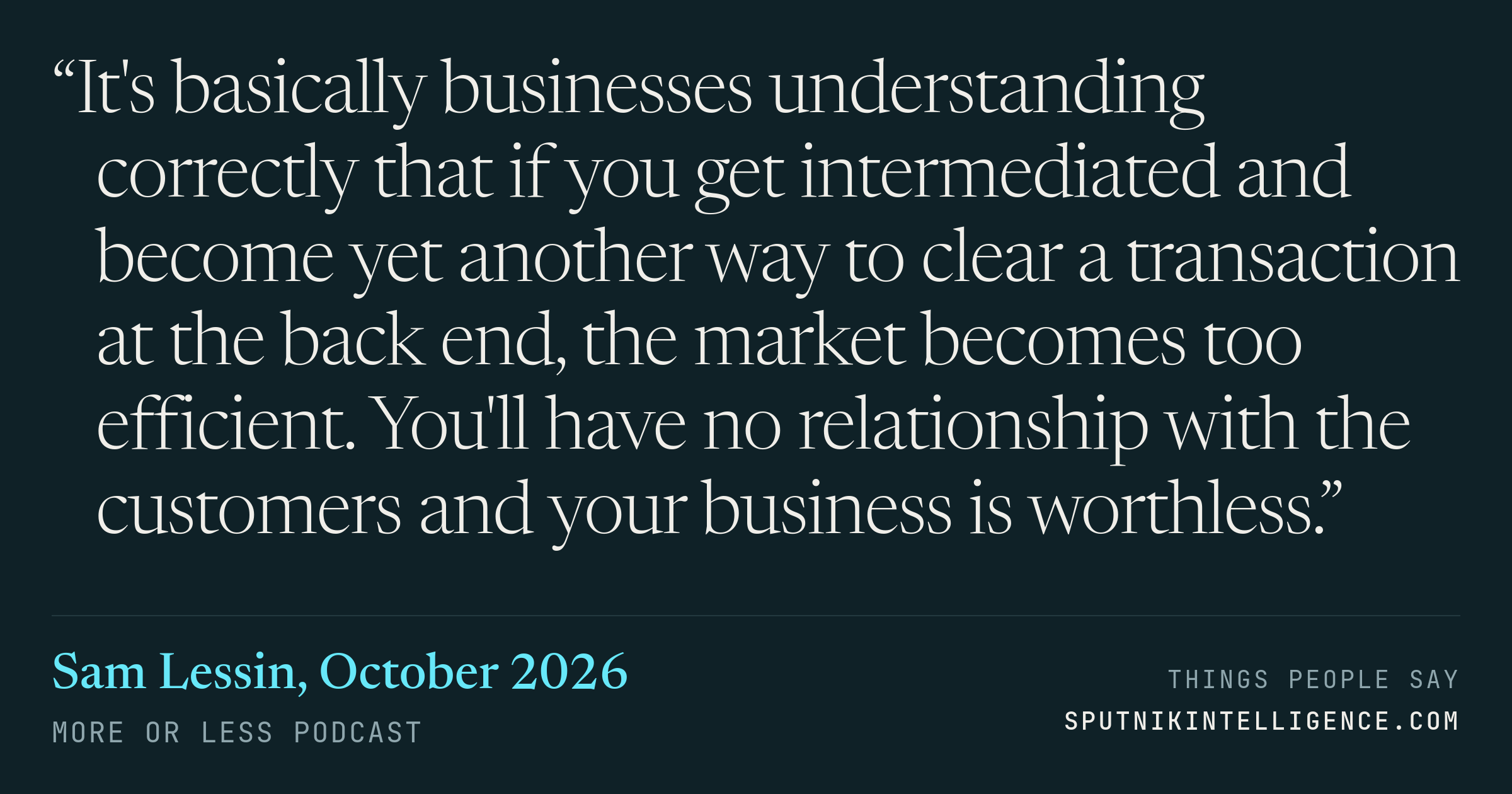
“It's basically businesses understanding correctly that if you get intermediated and become yet another way to clear a transaction at the back end, the market becomes too efficient. You'll have no relationship with the customers and your business is worthless.” — Sam Lessin, More or Less

Lessin's AI agent got stuck in loops trying to book a room on Hilton's site, which now blocks bots. He argued that the stall in agentic commerce isn't technical: businesses are blocking agents because their customer relationship is what they are protecting.

More or Less · 2026-10-09 Permalink → Listen →
More or Less Around 27:21 into the episode
Speaker 3

…as a business you're either gonna say well I literally cannot stop people from crawling me or taking my stuff that's what happened with like the textual internet and why we didn't have ai is they basically just like carmen san diego stole the entire internet to bootstrap these things right like

Speaker 1

so what you're saying sam is you're mute Agent tried to book a room for you on the Hilton site, which it used to probably do easily. And now it's getting in these loops because Hilton has done something to like block the agents. Yeah, it's

Speaker 3

Cloudflare. I mean, it's basically businesses understanding correctly that if you get intermediated and to become yet another way to clear a transaction at the back end, the market becomes too efficient. You'll have no relationship with the customers and your business is worthless.

Speaker 1

Which is what Amazon did too, right? To Muse as well.

Speaker 3

Which is correct if you have like enough power to do it. Do

Speaker 1

you think Hilton has enough power to do that?

Speaker names from our own diarization · position estimated from where the line sits in the episode

Collections They Appear In