RW

Ryan Watkins

Things Ryan Says on Podcasts

Where to Find Them

Ryan Watkins has been a guest on Unchained (6 times) and The Milk Road Show (2 times) .

Recently: “How Pearl Could Turn AI Data Centers Into a Challenger to Bitcoin” on Unchained (November 2026); “Crypto Sentiment Is Down Bad. The Reality Is Far Different, Says Ryan Watkins” on Unchained (January 2026); “How Hyperliquid Came to ‘Threaten the Very Existence’ of CEXs Like Binance - Ep. 915” on Unchained (October 2025); “Why Hyperliquid Could Flip Solana & Ethereum w/ Ryan Watkins” on The Milk Road Show (July 2025); “The Chopping Block: Robinhood’s Tokenized-Stock Gambit, Solana’s ETF Splash & the Proof-of-Stake Reality Check - Ep. 862” on Unchained (July 2025); “Pump.fun’s $1 Billion ICO Has Caused Controversy. Can It Succeed? - Ep. 847” on Unchained (June 2025).

What They Said

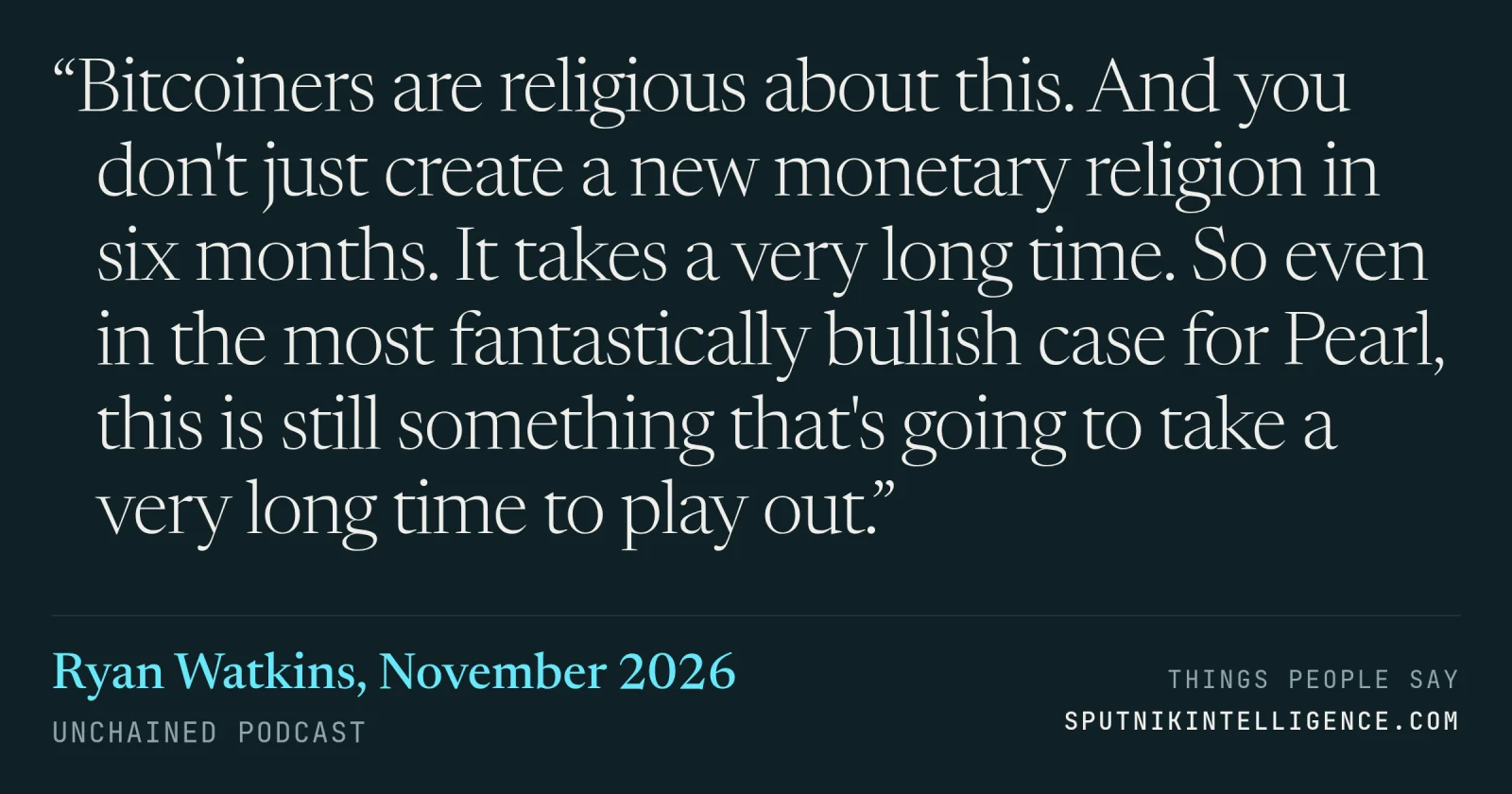
“Bitcoiners are religious about this. And you don't just create a new monetary religion in six months. It takes a very long time. So even in the most fantastically bullish case for Pearl, this is still something that's going to take a very long time to play out.” — Ryan Watkins, Unchained

Asked what Bitcoin would be worth if Pearl's hash rate ever passed it, Watkins says hash rate isn't everything: Bitcoin's 17-year record and its believers can't be copied quickly.

Unchained · 2026-11-24 Permalink → Listen →
Unchained Around 55:10 into the episode
Ryan Watkins

Like if the hash rate for Perl surpasses Bitcoin?

Laura Shin

Yeah. Yeah. Like if your thesis plays out as you, you know, as you wrote about, like the security budget problem isn't fixed, the quantum issues aren't fixed, like the hash rate of P-Day or of Pearl happens and P-Day happens, like, then what do you think the future of Bitcoin would be?

Ryan Watkins

Yeah, you know, I think one of the one of the ideas that fascinates us most about this thesis is that I don't know what happens if Perl surpasses Bitcoin in its compute energy footprint. But my guess is that Perl reprices a lot higher as that day becomes closer. Now, I also don't think that hash rate is the end-all be-all of these assets. I think what's working in Bitcoin's favor is that it has a 17-year track record of doing what it's supposed to do. And that just takes time for any competitor to build towards that. So I think it's step one, if you want to challenge Bitcoin, is beat it on a dimension that's important. In this case, it would be hash rate and like long-term security model. But then step two would be the other things, like proving out this model of the course of time, developing a strong foundation of holders and believers in the asset in the same way that there is for Bitcoin. Bitcoiners are religious about this. And you don't just create a new monetary religion in six months. It takes a very long time. So I think even in the…

Laura Shin

and but but what do you think would happen to bitcoin in that world like do you feel like it will still be one of the top cryptos or do you think that you know something something very different could happen to it

Ryan Watkins

i'm not sure but i'm really not sure i think that the closer that any of these assets whether it be pearl or zcash get to challenging bitcoin i think it lights a fire in the community to um do something about it uh so i think it's just going to be very path dependent and i think this is very…

Laura Shin

okay so we have covered kind of pretty much all the things about pearl but there are some upgrades and new features that pearl is planning to adopt so give us a look ahead at kind of some of the upcoming developments

Speaker names come from our own diarization. The position is estimated from where the line sits in the episode.
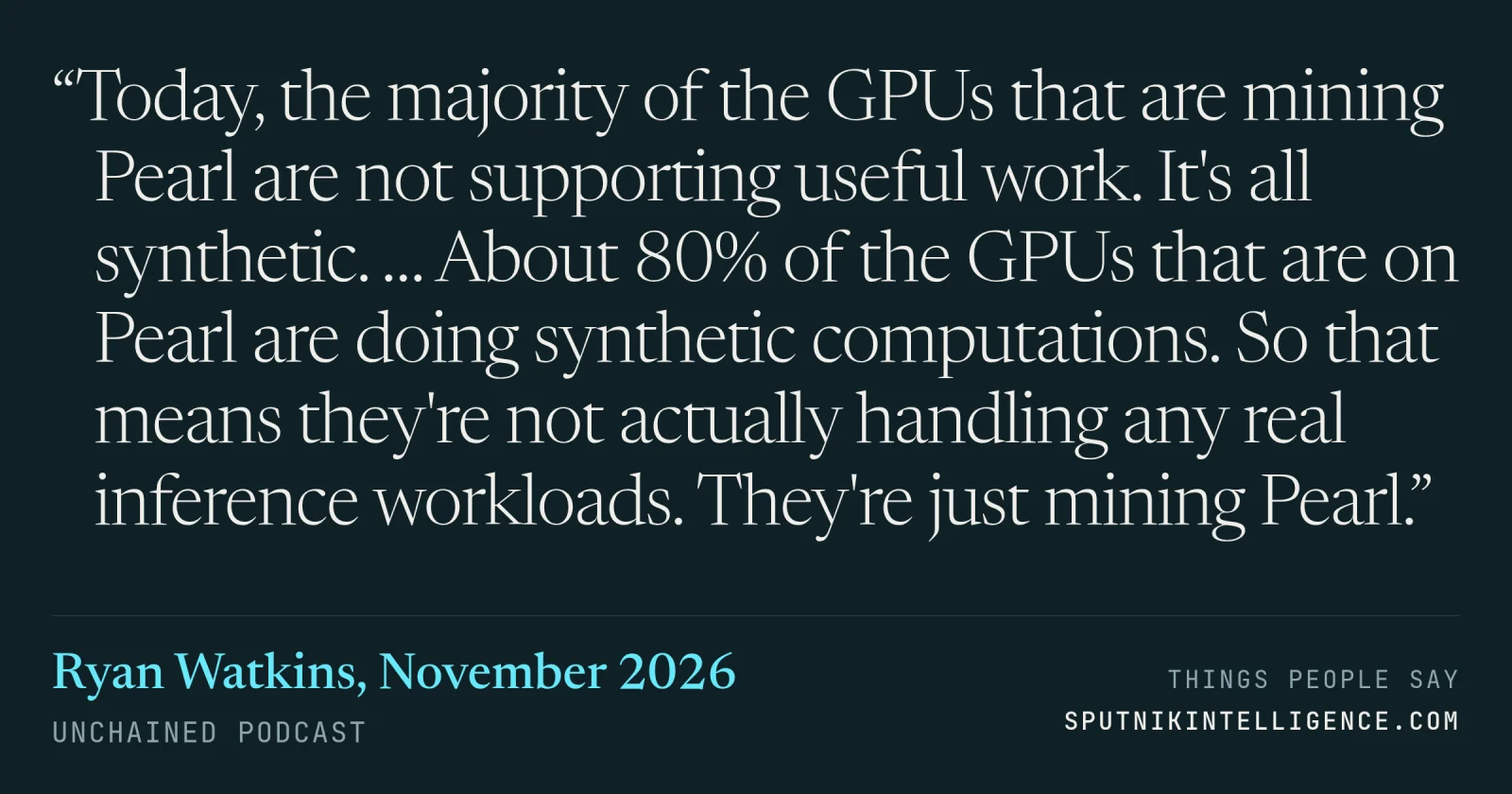
“Today, the majority of the GPUs that are mining Pearl are not supporting useful work. It's all synthetic. … About 80% of the GPUs that are on Pearl are doing synthetic computations. So that means they're not actually handling any real inference workloads. They're just mining Pearl.” — Ryan Watkins, Unchained

Pearl mining means proving matrix multiplication, the core operation of AI inference. Watkins, who backs it, concedes that most miners today do no real AI work, which is the gap a planned upgrade is meant to close.

Unchained · 2026-11-24 Permalink → Listen →
Unchained Around 15:31 into the episode
Ryan Watkins

Yeah. So basically, basic basics of how Perl works is you have a GPU, that GPU is doing matrix multiplication. And by proving that you're doing this matrix multiplication, you can mine Perl. That's basically. And explain

Laura Shin

what matrix multiplication means.

Ryan Watkins

Think about it as much as the foundational operation that underpins all of the AI compute that we're doing today. That's like maybe a simple way of putting it. And to contrast this with Bitcoin, Bitcoin, what you're doing when you mine Bitcoin is you're just doing SHA-256 over and over and over again, which is a useless hash function. Like you doing the computation provides no value for the world beyond securing the Bitcoin blockchain, which is debatable about whether or not use this is the right word. I think it's useful. Many people don't think it's useful, but the hash function itself provides no value. So the difference is that if you replace SHA-256 with matrix multiplication, well, this matrix multiplication in theory is a useful computation. This is being used to provide inference. So maybe you're querying a chatbot, maybe you're doing a coding agent, whatever it might be. In theory, like you can mine while servicing this real AI Data. Now, what is a network build that today? Today, the majority of the GPUs that are mining Perl are not supporting useful…

Laura Shin

Okay. So yeah, so one other bit, which I don't remember if you mentioned this, but you wrote that one of the Perl team's most underappreciated core competencies is GPU kernel engineering. So what is that? I guess that's another part of the AI process. So can you explain a little bit more, like what…

Ryan Watkins

you see, you can think of the kernel as like this program that tells the GPU how to do one specific operation. So in the case of Perl, the kernel is the code that tells the GPU how to do matrix multiplication efficiently. And matrix multiplication is at the heart of all AI inference. And this is…

Laura Shin

Okay. So essentially like the current trajectory or the current thought about your investment is that the AI cloud providers could be sort of like mining Perl simultaneously. And then their overhead from mining it would basically be zero. So essentially they can just accumulate Perl for no extra…

Speaker names come from our own diarization. The position is estimated from where the line sits in the episode.
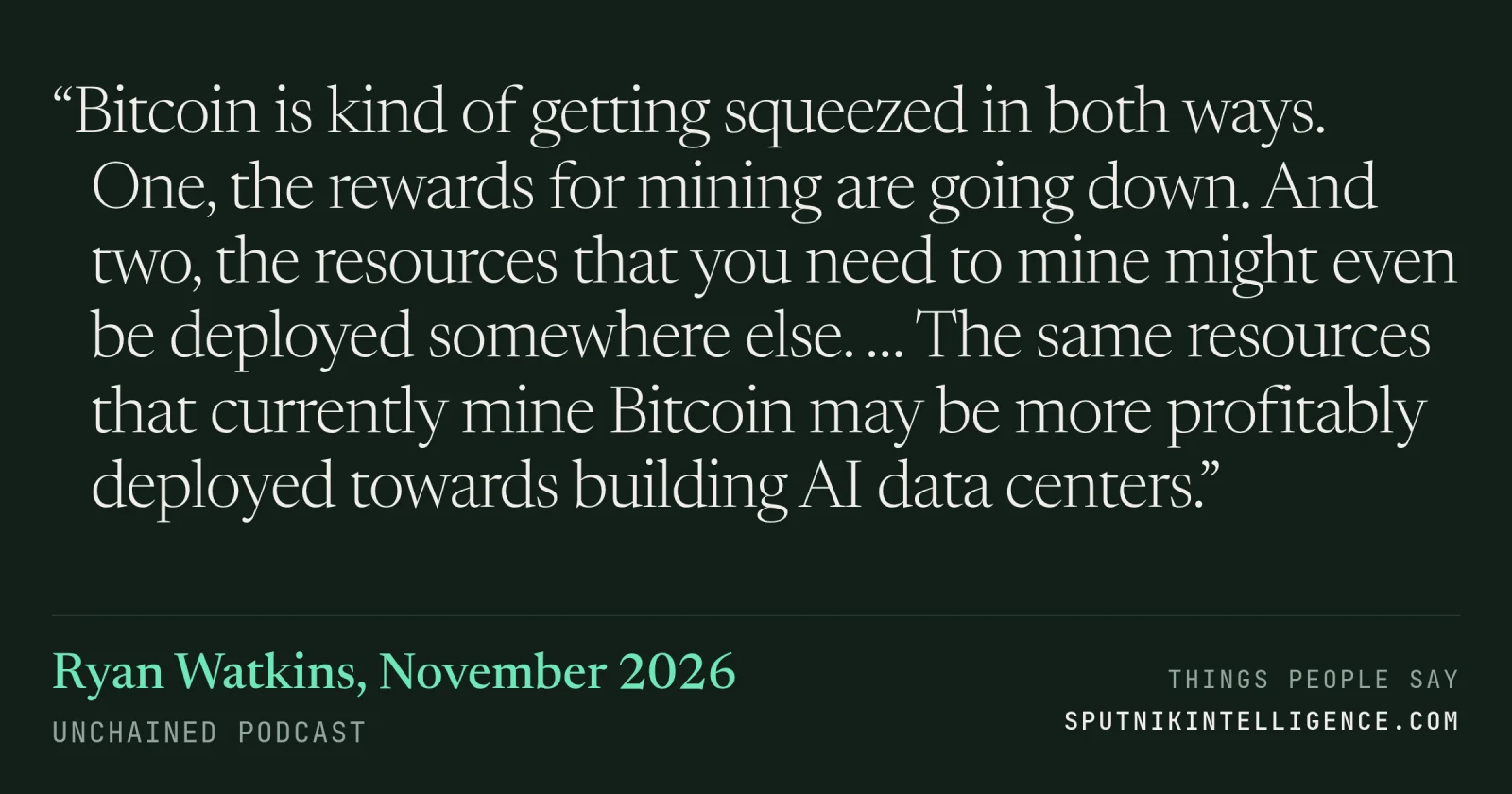
“Bitcoin is kind of getting squeezed in both ways. One, the rewards for mining are going down. And two, the resources that you need to mine might even be deployed somewhere else. … The same resources that currently mine Bitcoin may be more profitably deployed towards building AI data centers.” — Ryan Watkins, Unchained

Watkins explains why miners are being pulled toward AI. This sets up his case that AI hardware could secure a new chain.

Unchained · 2026-11-24 Permalink → Listen →
Unchained Around 06:54 into the episode
Ryan Watkins

…an answer to the long-term security budget question that Bitcoin has. And I think when I saw that, I was like, okay, you know what? It's time for me to dig in deeper. I think AI Bitcoin is this great meme, but there actually is like a fundamental piece here. And that's why I started to dig in more.

Laura Shin

All right. So you also wrote in your essay, quote, if every AI cloud could mine Perl at near zero incremental overhead, then it would be a no-brainer for all of them to adopt it. Explain. So that, I mean, that's a big statement. So explain what you meant by that.

Ryan Watkins

Yeah, yeah. Maybe let's go back to just the fundamentals of proof of work. So the reason why this exists is because if you have an open system and you want people to agree on who gets to propose the next block for Bitcoin, well, how do you do that? If you think about almost like a voting system, well, you need a way to prevent a single person or a single entity from saying that there are 10,000 votes, even though there's one person, right? So in the Driftfield world, we have identities. And if we are voting in America, it's one person, one vote. And it's really hard to basically just create replicas of yourself to go and vote. But in Bitcoin, there's no been a way of doing this for a long time. So Bitcoin said, you know, one CPU, one vote. So we're going to have this process where you do these brute force hashing. And if you do more of it, then you have like a high probability of winning the right to propose the next block. And this has been this great way that Bitcoin has addressed this problem, which is civil resistance. Now, so hash rate and maybe upstream of that, just…

Laura Shin

All right. So in a moment, we're going to talk about what Pearl is, which we're kind of dancing around but haven't really dove into. But first, we're going to take a quick word from the sponsors who make this show possible. Already have a crypto-backed loan. You could be paying more interest than…

Ryan Watkins

I think it's a good question because I think one of the biggest criticism that people have is that, oh, Pearl is a speculative asset and why do people want to hold this? And I think one push common pushback would just be that, well, you know, Bitcoin is a speculative asset and why do I want to hold…

Laura Shin

Yeah. The only thing is I don't know if I would agree with that for gold. There are people who say that gold has its own utility.

Speaker names come from our own diarization. The position is estimated from where the line sits in the episode.
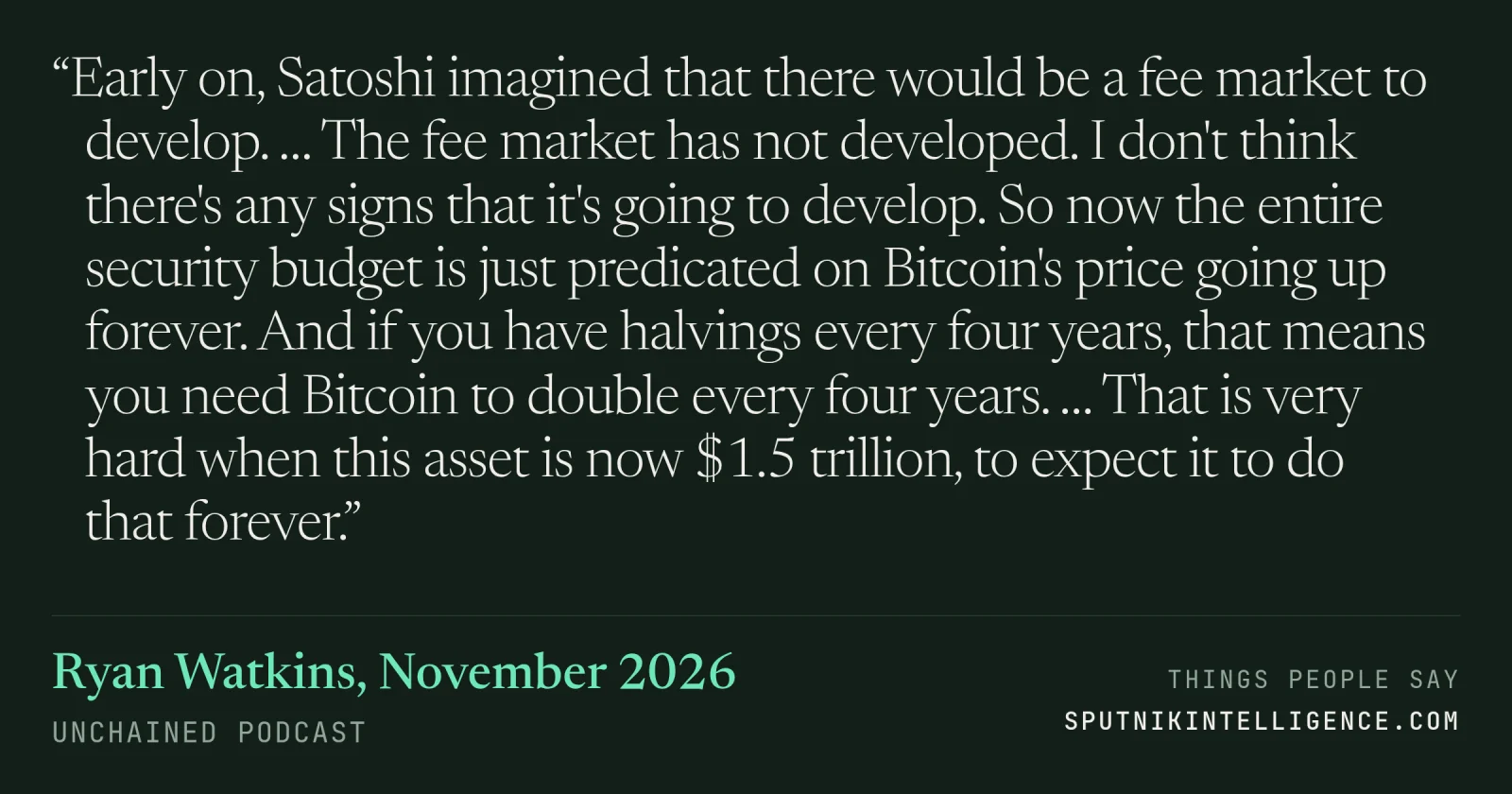
“Early on, Satoshi imagined that there would be a fee market to develop. … The fee market has not developed. I don't think there's any signs that it's going to develop. So now the entire security budget is just predicated on Bitcoin's price going up forever. And if you have halvings every four years, that means you need Bitcoin to double every four years. … That is very hard when this asset is now $1.5 trillion, to expect it to do that forever.” — Ryan Watkins, Unchained

Asked to explain his essay's claim that Bitcoin's long-term viability is being tested, he says the biggest risk is the miners' security budget, because transaction fees never became a real revenue source.

Unchained · 2026-11-24 Permalink → Listen →
Unchained Around 03:27 into the episode
Ryan Watkins

Yeah, thanks for having me on.

Laura Shin

…Pearl bit. You wrote, quote, for the first time in years, Bitcoin is being tested, not in terms of price or legitimacy, but in terms of its long-term viability as the world's preeminent digital store of value. Explain what you mean by that. Those are fighting words in certain parts of the internet.

Ryan Watkins

…It's going to be like a messy migration. I think that people have not really liked Sailors' influence, maybe the institutionalization of Bitcoin, which to me I'm fine with, but some people feel like you're sacrificing some of the cypherpunk ideals. And then while we're at it, and this has actually always been that the biggest risk to Bitcoin, in my opinion, is the long-term security budget. So early on, Satoshi imagined that there would be a fee market to develop. So people would pay to use the Bitcoin network for transactions, mind you. The original white paper is called Bitcoin, a peer-to-peer electronic cash system, not a digital store of value system. So the idea is that we'd use this as cash. Pearl Could pay to use it as cash. And long term, you use the fees to pay for the miners. Now, the fee market has not developed. I don't think there's any signs…

Laura Shin

Okay, yeah. So talk about how that led you to view Pearl as a potential contender to not only succeed, but you basically talk about it as potentially taking Bitcoin's mantle as the store of value crypto. So explain your thesis in relation to Bitcoin.

Ryan Watkins

Yes. So I think base case, you have to assume. That Bitcoin figures it out and it will continue to be the leader. I think that is the base case. Now, there is a chance that Bitcoin does not figure it out. And in that world, you want to be prepared. And I think so long as Bitcoin does not address…

Laura Shin

All right. So you also wrote in your essay, quote, if every AI cloud could mine Perl at near zero incremental overhead, then it would be a no-brainer for all of them to adopt it. Explain. So that, I mean, that's a big statement. So explain what you meant by that.

Speaker names come from our own diarization. The position is estimated from where the line sits in the episode.

Collections They Appear In