OI

Olya Irzak

Things Olya Says on Podcasts

Where to Find Them

Olya Irzak has been a guest on Catalyst with Shayle Kann .

Recently: “BTM data centers’ looming methane surge” on Catalyst with Shayle Kann (October 2026).

What They Said

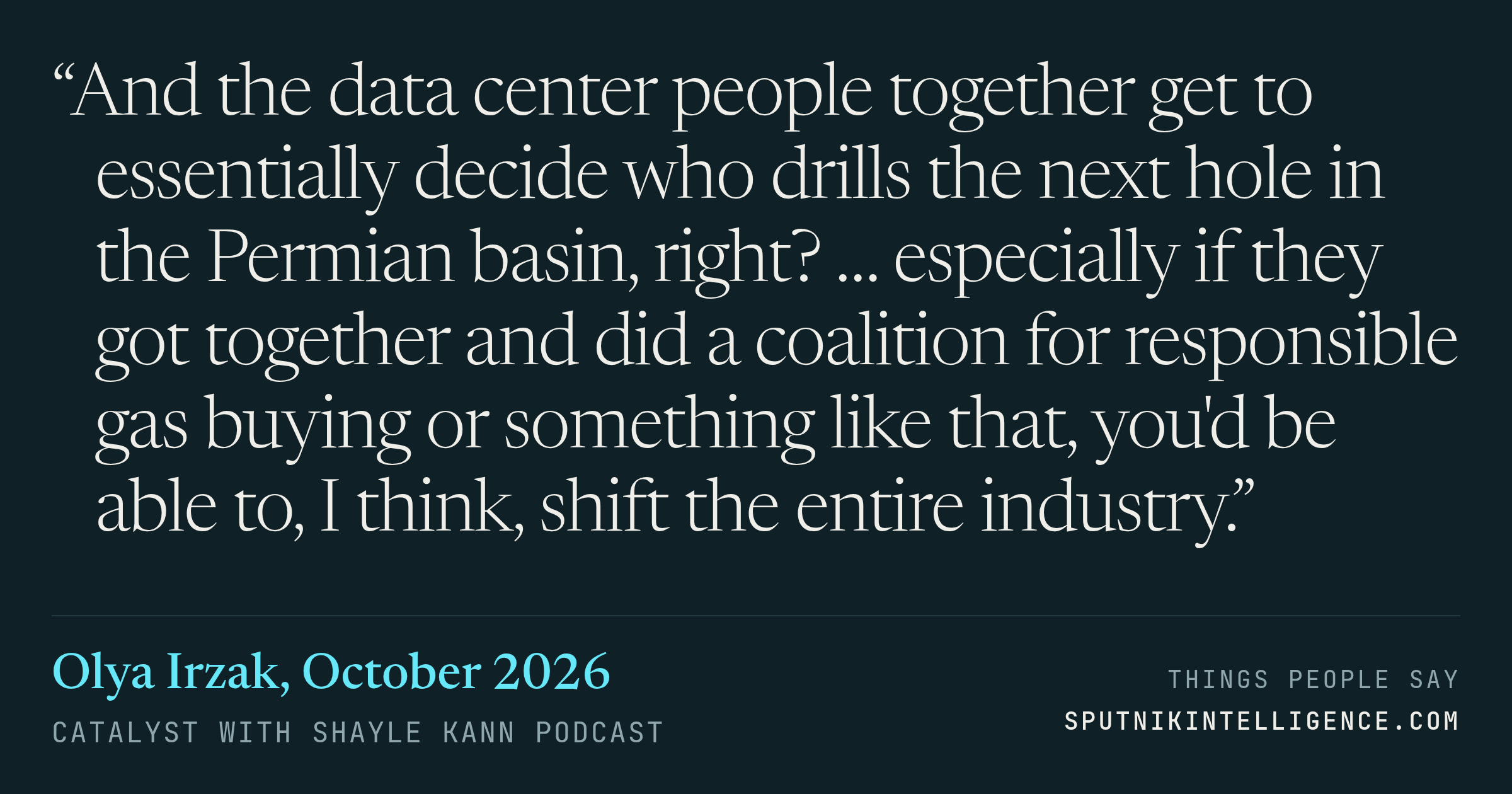
“And the data center people together get to essentially decide who drills the next hole in the Permian basin, right? … especially if they got together and did a coalition for responsible gas buying or something like that, you'd be able to, I think, shift the entire industry.” — Olya Irzak, Catalyst with Shayle Kann

On fixing upstream methane leaks: certified low-leak producers already exist and charge little extra for their gas. Irzak argues that data center buyers are now big enough to push the whole gas industry into the low-leak regime.

Catalyst with Shayle Kann · 2026-10-22 Permalink → Listen →
Catalyst with Shayle Kann Around 18:47 into the episode
Olya Irzak

…months, right? It's not like we're going to stop building the data centers afterwards. So this is like by far the biggest climate lever that I ever had a chance to pull in my career. I don't know if you had 15% of electric grid lying on the ground in your career, but I'm like... I like to think so,

Shayle Kann

…I have. Okay, so you said preventable. Let's talk about what it takes to prevent it. And I guess, you know, it makes sense to probably similarly walk through the value chain because there's different things you have to do at each step in the value chain, starting with the upstream wellhead stuff.

Olya Irzak

…for the data center companies to tip everybody into the low leak regime, right? Because we know it's possible. There's existence proofs of the good players that do this. And the good players, the folks that leak less, these aren't like small companies, right? Like BP is one of the certified ones, for example, in the Permian basin. So it's a large supply that is available at the low leak rate. And the data center people together get to essentially decide who drills the next hole in the Permian basin, right? And they can make that decision, right? Because this is such significant amounts of natural gas that, especially if they got together and did a coalition for responsible gas buying or something like that, you'd be able to, I think, shift the entire industry, not even just their direct suppliers, I mean, starting with their direct suppliers to that regime. Midstream, I think very similarly…

Shayle Kann

Is it an issue for like aeroderivative turbines or no?

Olya Irzak

I don't think so. But I could double check on those. But I don't think any turbines have this issue. I think they all have much more complete combustion. And then for reciprocating engines, you have this issue. And so first of all, just don't run them with partial loads. So I know a lot of folks…

Speaker 1

For data centers, connecting to the grid quickly means two things, building distributed energy and having a plan for demand flexibility. Grid Beyond helps with both. Grid Beyond's Derms and VPP platform unlocks the potential of distributed assets and dispatches flexibility into the right market at…
Speaker names from our own diarization · position estimated from where the line sits in the episode
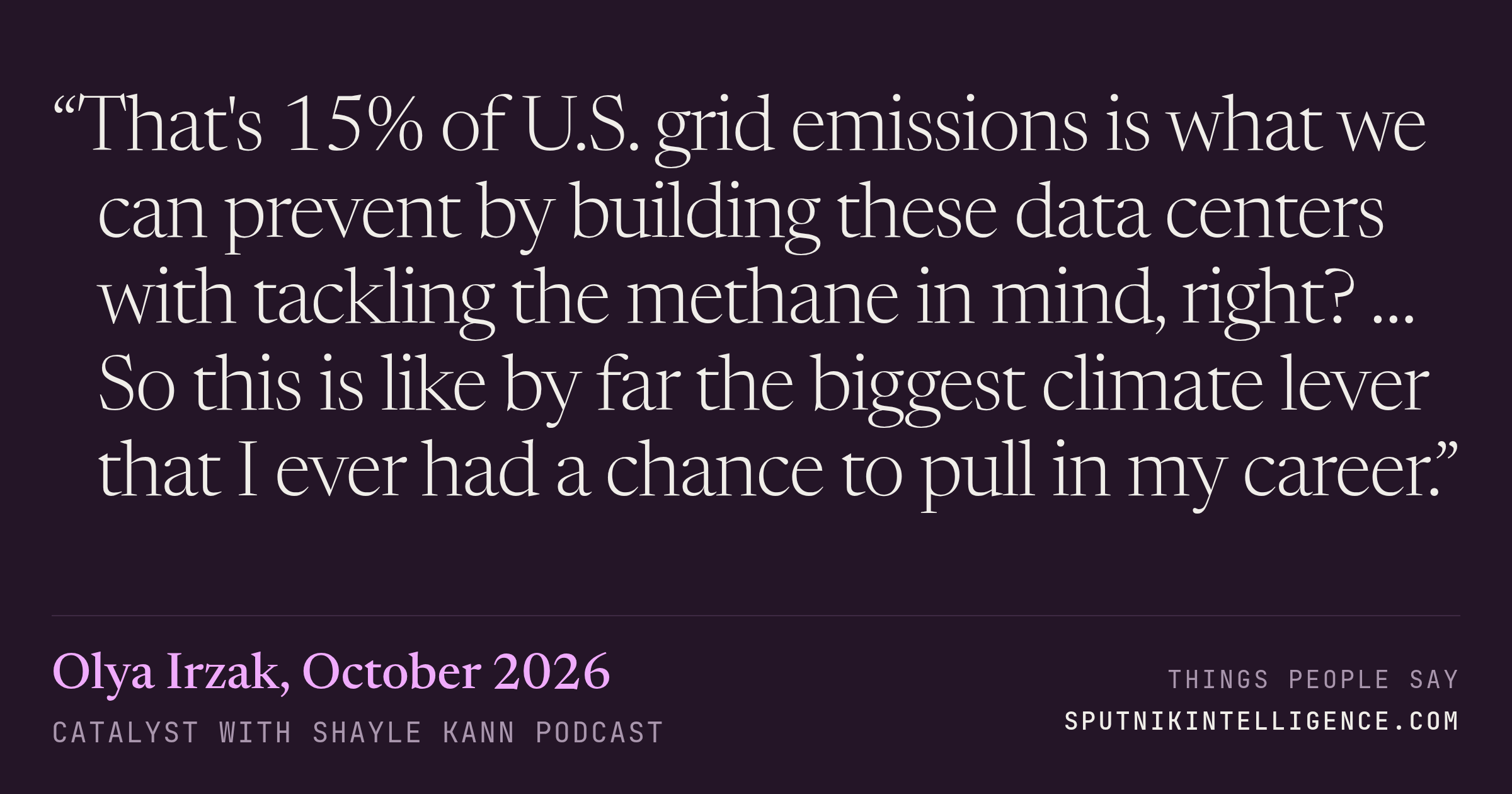
“That's 15% of U.S. grid emissions is what we can prevent by building these data centers with tackling the methane in mind, right? … So this is like by far the biggest climate lever that I ever had a chance to pull in my career.” — Olya Irzak, Catalyst with Shayle Kann

Irzak estimates that 50 gigawatts of new on-site gas generation for data centers would add about 380 megatons of CO2e, and that 40 to 50% of it comes from methane leaking upstream and slipping from engines. Shayle Kann had asked her to put that number in context.

Catalyst with Shayle Kann · 2026-10-22 Permalink → Listen →
Catalyst with Shayle Kann Around 17:29 into the episode
Olya Irzak

…being methane. So there's kind of a big question of like, are we looking at a 100-year time horizon for warming or at 20? If at 20, the methane completely dominates. If 100, then yes, then it's double. So it might be even worse, depending on when you think we will start reducing our emissions.

Shayle Kann

Sticking, I guess, with the 380 megaton number, like, can you contextualize that a little bit? You said it's a lot, but like, how much?

Olya Irzak

Yeah, fair point. So the preventable part, right? So that let's call it 50%. That's 15% of U.S. grid emissions is what we can prevent by building these data centers with tackling the methane in mind, right? So that's like the biggest climate in the next 18 months, right? It's not like we're going to stop building the data centers afterwards. So this is like by far the biggest climate lever that I ever had a chance to pull in my career. I don't know if you had 15% of electric grid lying on the ground in your career, but I'm like... I like to think so,

Shayle Kann

but despite a long career in this space, I don't think I have. Okay, so you said preventable. Let's talk about what it takes to prevent it. And I guess, you know, it makes sense to probably similarly walk through the value chain because there's different things you have to do at each step in the…

Olya Irzak

Exactly. So in the upstream wellheads, like there are two things you can do. A, you can buy it from a basin that has lower leaks. That obviously has a bunch of knock-on effects about where you locate your data center or buying pipeline capacity to pipe the methane from where it's produced to your…

Shayle Kann

Is it an issue for like aeroderivative turbines or no?

Speaker names from our own diarization · position estimated from where the line sits in the episode

Collections They Appear In