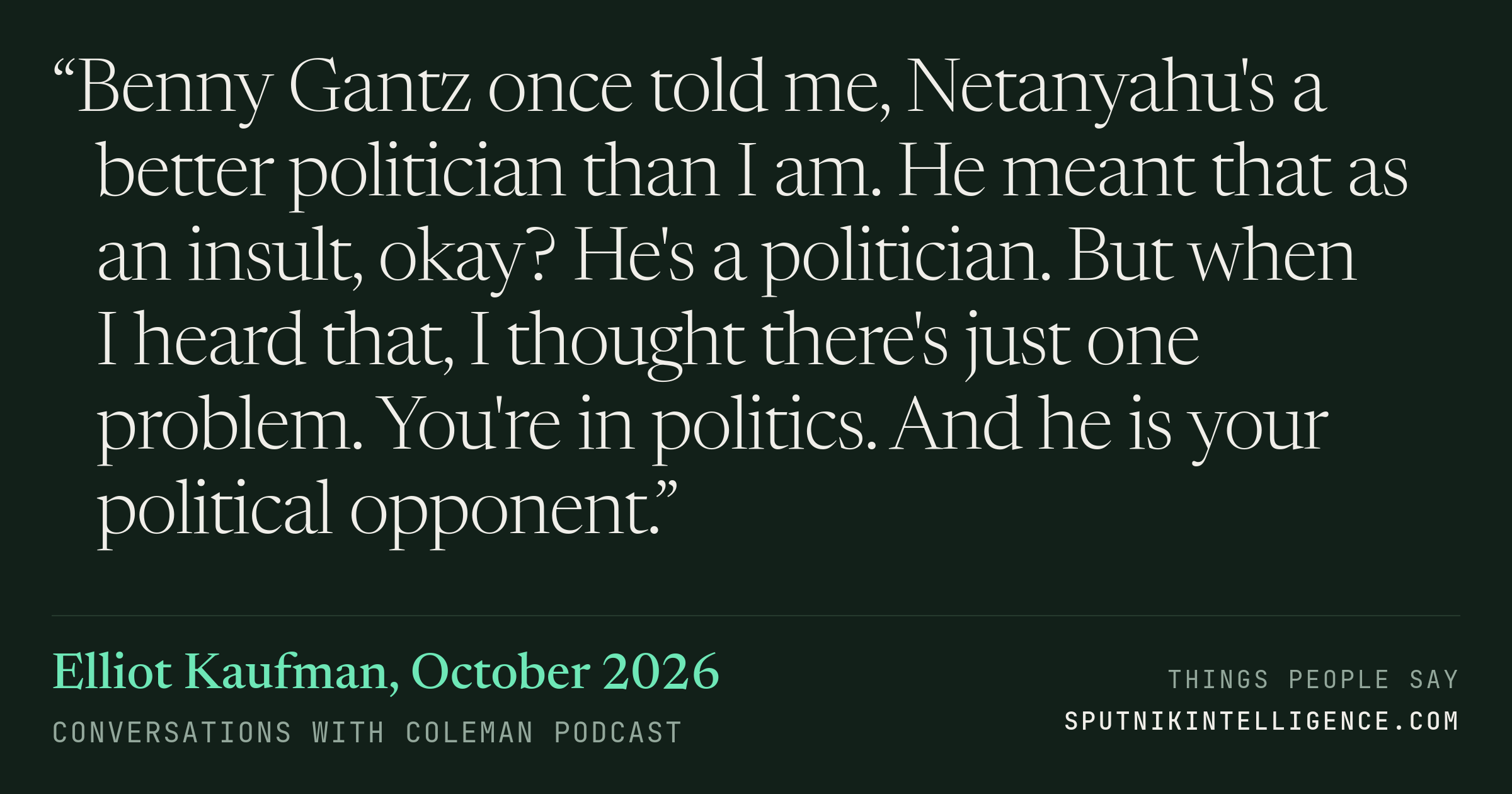
Coleman Hughes asks who Benny Gantz is and what part he played in Israel's war cabinet. Kaufman calls him a tragic figure who led the polls for much of the war and has since fallen to almost nothing.
And that is the perfect example. Iran was using Hezbollah to make Tel Aviv into Seoul, essentially. And so Israel took that out in September and late 2024. And then October 2024, it takes out crucial Iranian air defenses protecting the nuclear program, leaving that undefended for later on.
Yeah. Tell me who Benny Gantz is and what his role in general was in the Israel’s War cabinet and strategically in Israeli politics.
Benny Gantz is, in my view, a tragic figure because he was on top. You know, he had in agreement with Netanyahu at one point before the war, promising him that he would rotate into the prime minister's chair. He would become prime minister. Netanyahu broke from that agreement. And then in this war, he rallies from the opposition to patriotically, I would say, join a unity government. Netanyahu had been leading this right-wing coalition that had lost the trust of half of Israel before the war. That's no kind of government to lead a war like this. And so Benny Gantz joining, along with his, at the time, junior partner, Geidi Eisencott, allowed Netanyahu to say, I'm leading a true unity government, national governments. Netanyahu, though, immediately was using Gantz. He used Gantz at the start, knowing that Gantz and Eisencott are more cautious than Gallant to help him win that argument over Lebanon in the very first. First days of the in the very first days of the war. Later on in the war, whenever Israel’s War stalled, whether it had to do with Rafah in Gaza or Lebanon in the north, Netanyahu could always leak out, it's Gantz. He won't let me do it. He won't let us go ahead. And sometimes Gantz was more cautious, but it was always more complicated than that. Gantz is a former IDF chief. He actually beat Gallant out for that role once previously, and there were some underhanded tactics there. And so there was bad blood. What I try to tell people is that all three of that Israel’s War Room: triumvirate in every possible permutation had a reason to detest one another and did detest one another in this war. So this was no even team of rivals, okay? These were bitter enemies having to work with each other, which they did while refusing each other's phone calls and banning each other's aides from meeting rooms. And that's a big part of the story of In the War Room:. But the last thing I would say about Gantz, because for much of the war, he was leading all the polls, set to be the next prime minister of Israel, and now he's at next to nothing. He might not even make it into the parliament, the Knesset. His junior partner, Eisencott, has since become the guy, the leading Netanyahu rival. Let me tell you what happened like this. Benny Gantz once told me, Netanyahu's a better politician than I am. He meant that as an insult, okay? He's a politician. But when I heard that, I thought there's just one problem. You're in politics. And he is your political opponent. And I think what happened is that Benny Gantz was right. And Israeli liberals, the Israeli center left, came to believe that as well. That Benny Gantz, though admirable in his character in wanting to do what was right with Israel and just put the country first. And it was never entirely clear what that meant, but they liked that message. At a certain point, they realized you have to beat Netanyahu in politics. And if you won't be that guy, if you don't have what it takes, then you're useless to us. And that, in the end, is what Israeli liberals have said. And so the right vilified him. The left, the liberals, the centrists, came to think he didn't have what it took.
So he's the Ned Stark of Israeli politics, to make a Game of Thrones reference. The leader you wish you had, but who wasn't willing to do what it took to actually unseat those somewhat worse leaders. Talk to me about the role of the far right in the war. And I think it's important context for people. Something that never gets said here, and correct me if I'm wrong. The reason Netanyahu had to partner with the vile characters on the far right, Bengvir and Smotrich, is because he was backed into it. He was forced into it. Effectively, he wanted to partner with the centrist parties. But they said, no, we find you so disgusting and detestable. And God forbid we could ever serve in a government with you that on principle, we're not going to serve in your government. And so he was forced to partner with a much worse. So they basically said, we'd rather see you govern with the far right than get our hands dirty being in the same room with you. And then October 7th happens, and now who is governing as a result of that choice by the centrists, who never in any conversation I've heard get called or held accountable for that decision. Is that fair of me as a source of why Netanyahu is even with the far right to begin with? And then secondly, what has been the legacy of that partnership?
It is fair, and I think you're right. What they would say, though, is that they didn't boycott Netanyahu for no reason. That he betrayed them in this previous agreement he had with them. And so it's a bit rich for him to then come and say, work with me once again. But in terms of practical consequences, I don't see how they can argue with you there. So Netanyahu, who previously had always worked and always wanted to work with these more centrist parties, had to take on far-right partners. Now, he might have worked anyway with the National Religious Party, which had become religious Zionism led by Smotrich. That faction had become more radical in a way because its old leader, Naftali Bennett, had left it to join with the center-left and previously become a center-left leader. He took a lot of the moderates out of that movement. And so what was left was Smotrich. That changed that faction. Netanyahu might have worked with them anyway, but Ben-Gvir, he would not have and had always marginalized him. And in that, even in that election campaign, when he had to work with him, he had to, okay, had to in order to win. He wouldn't let himself be photographed with him. He didn't want to be seen shaking his hand. So it was that kind of relationship. Now, during the war, the two of them and their two factions were consistent advocates for keeping the fighting going. And in a way, for not making hostage deals. Sometimes, in certain ways, they would come around, but they thought it's wrong to make this deal with Hamas. Hamas is only making the deal because it helps Hamas. And there are arguments there, real arguments. But that was a view that was unpalatable to the vast majority of Israelis who wanted the hostages back more than anything. And so Netanyahu would, at various points, be able to use these parties as a kind of excuse. He could say, I really can't do it because then the government is going to fall. They're going to leave and then the whole thing is done. The other side will take over and will capitulate immediately. That's how he would put it. In the end, Trump would call those parties bluff at the very end. When Trump would say, here's the Gaza deal, we're moving forward with it, and you're all on board. None of those parties left Netanyahu's government in the end. They went along with it under that kind of pressure. So it could be that insufficient pressure was put on them. It could be. But what I would remind people is that for much of the war, Ben Gvir did not have the power to bring down Israel's government by himself, okay? Because Benny Gantz was there, because Gaddy Eisenkot was there. So they provided that safety blanket so as to deny Ben-Gvir that power. And then even later in the war, another Israeli politician with a small party, Guidon Sar, would end up rejoining the government for the specific reason as to deny Ben-Gvir that power. Although Ben-Gvir with Smotrich together could endanger Israel's government at certain points in the war.
Okay, so let's zoom out and talk about the core legacy of the October 7th war, including the war against Hezbollah, the war on Iran. There's the whole domino effect of things that have happened since October 7th. And I'm going to ask you the effect of that war on various particular situations. So first one is the effect of the war overall on the prospect of a two-state solution.