
NS

Nik Storonsky

Things Nik Says on Podcasts

Where to Find Them

Nik Storonsky has been a guest on Cheeky Pint , David Senra , The Twenty Minute VC (20VC): Venture Capital | Startup Funding | The Pitch and The Pomp Podcast .

Recently: “Nik Storonsky: The most uncompromising banking CEO” on Cheeky Pint (November 2026); “Competition, Intensity & Building a $115 Billion Global Bank | Nik Storonsky, Revolut” on David Senra (October 2026); “20VC: Revolut Founder Nik Storonsky on When and Where Revolut Will IPO & What Revolut Need to Do to Hit $100BN Valuation” on The Twenty Minute VC (20VC): Venture Capital | Startup Funding | The Pitch (December 2024); “#594 Nik Storonsky on Democratizing Access to Finance” on The Pomp Podcast (June 2021).

What They Said

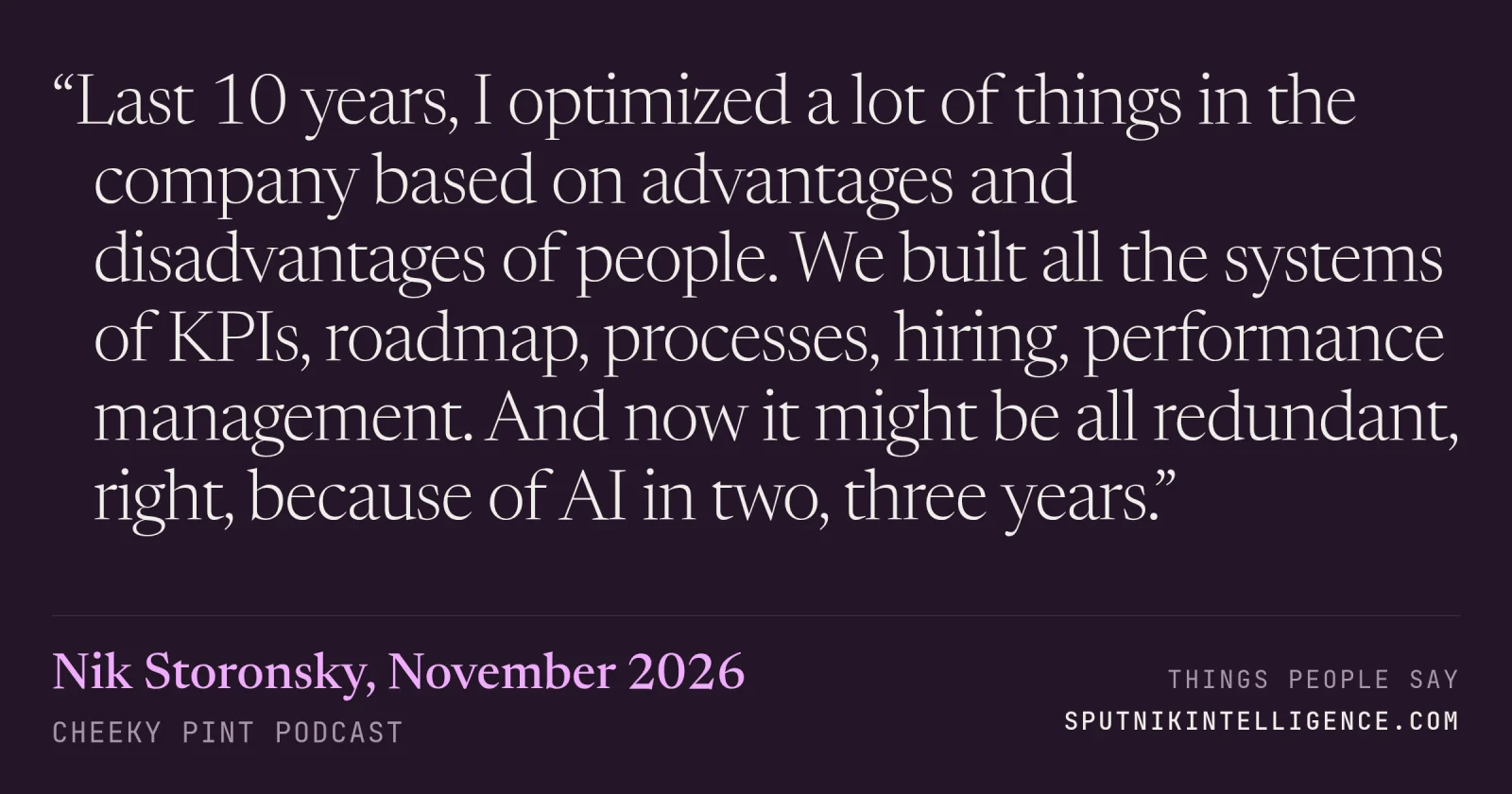
“Last 10 years, I optimized a lot of things in the company based on advantages and disadvantages of people. We built all the systems of KPIs, roadmap, processes, hiring, performance management. And now it might be all redundant, right, because of AI in two, three years.” — Nik Storonsky, Cheeky Pint

Collison asked how AI-pilled he is in running the company. Storonsky says AI now touches nearly every function and that the management systems he built around human limitations may need to be reinvented, a notable admission from a CEO known for running his company by process.

Cheeky Pint · 2026-11-10 Permalink → Listen →
Cheeky Pint Around 28:39 into the episode
Nik Storonsky

I think it's more because large and larger portion of the population started using Revolut. So people who got choned because of different reasons, they still hear about it from friends, family, and then they come back.

John Collison

I see. So you have multiple word-of-mouth kind of shots and goals. Okay, so yeah, I was curious to ask you about AI. How AI-pilled are you in how you run the company?

Nik Storonsky

Well, I started with AI about two years ago. The goal was just to optimize customer support. Translation, now it's almost in every single area of the company, obviously engineering as well, marketing. Now we're even trying to create an AI employee end-to-end. So, yes, we were very involved. And last 10 years, I optimized a lot of things in the company just based on people, based on advantages and disadvantages of people. We build all the systems of KPIs, roadmap, processes, hiring, performance management. And now it might be all redundant, right, because of AI in two, three years. So it's kind of, you know, we're all reinventing how the company should work.

John Collison

How has it changed how you hire either at an overall company level or at an individual team level? Like are the eight-person teams, should they now be three-person teams, or can just you have higher aspirations for what an eight-person team can accomplish? I

Nik Storonsky

mean, technically, one person can accomplish much more now. I would even say you don't really need to have separate entrepreneur developers, iOS developers. One front-end developer can do things. You can even have one developer covering front-end, back-end, possibly data science as well. So you can…

John Collison

But you work in this relatively standardized way of Product bets where you put a small team on something to initially test it. Has the size of that product bet initial team changed? And shouldn't it change, if not?

Speaker names come from our own diarization. The position is estimated from where the line sits in the episode.
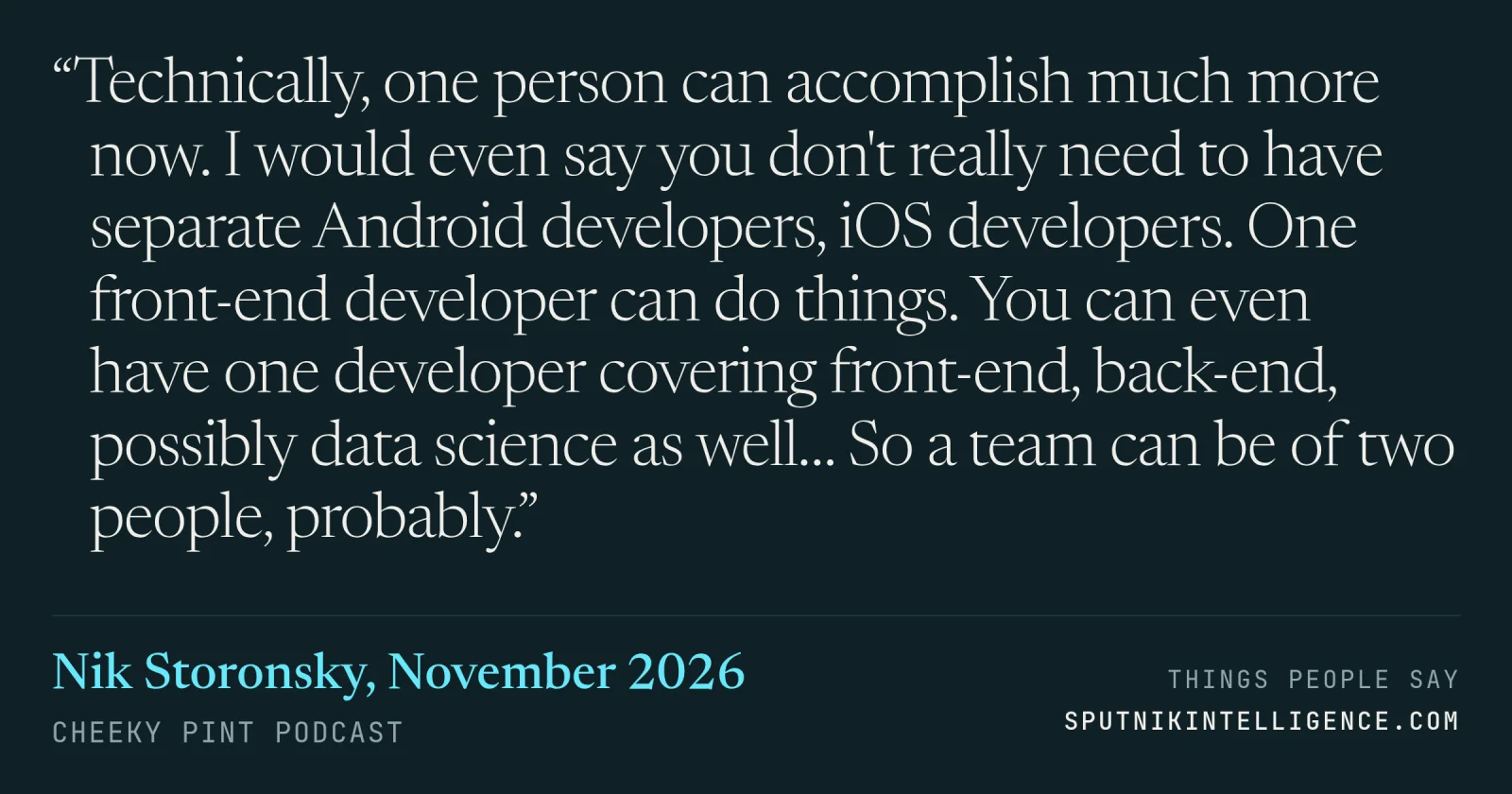
“Technically, one person can accomplish much more now. I would even say you don't really need to have separate Android developers, iOS developers. One front-end developer can do things. You can even have one developer covering front-end, back-end, possibly data science as well… So a team can be of two people, probably.” — Nik Storonsky, Cheeky Pint

Collison asked how AI changes hiring and team size. Storonsky says small teams can now do what larger ones did, though he admits Revolut still runs on specialist teams and has not changed its structure yet.

Cheeky Pint · 2026-11-10 Permalink → Listen →
Cheeky Pint Around 29:10 into the episode
Nik Storonsky

…people, based on advantages and disadvantages of people. We build all the systems of KPIs, roadmap, processes, hiring, performance management. And now it might be all redundant, right, because of AI in two, three years. So it's kind of, you know, we're all reinventing how the company should work.

John Collison

How has it changed how you hire either at an overall company level or at an individual team level? Like are the eight-person teams, should they now be three-person teams, or can just you have higher aspirations for what an eight-person team can accomplish? I

Nik Storonsky

mean, technically, one person can accomplish much more now. I would even say you don't really need to have separate entrepreneur developers, iOS developers. One front-end developer can do things. You can even have one developer covering front-end, back-end, possibly data science as well. So you can have one person doing all aspects of the product. Should probably still have a designer, although it's so much easier to design. So one developer can do a design as well. So a team can be of two people, probably.

John Collison

But you work in this relatively standardized way of Product bets where you put a small team on something to initially test it. Has the size of that product bet initial team changed? And shouldn't it change, if not?

Nik Storonsky

I mean, not yet, to be honest with you. So we're still operating in the old framework. Isn't

John Collison

that very old-fashioned of you? Yes,

Speaker names come from our own diarization. The position is estimated from where the line sits in the episode.
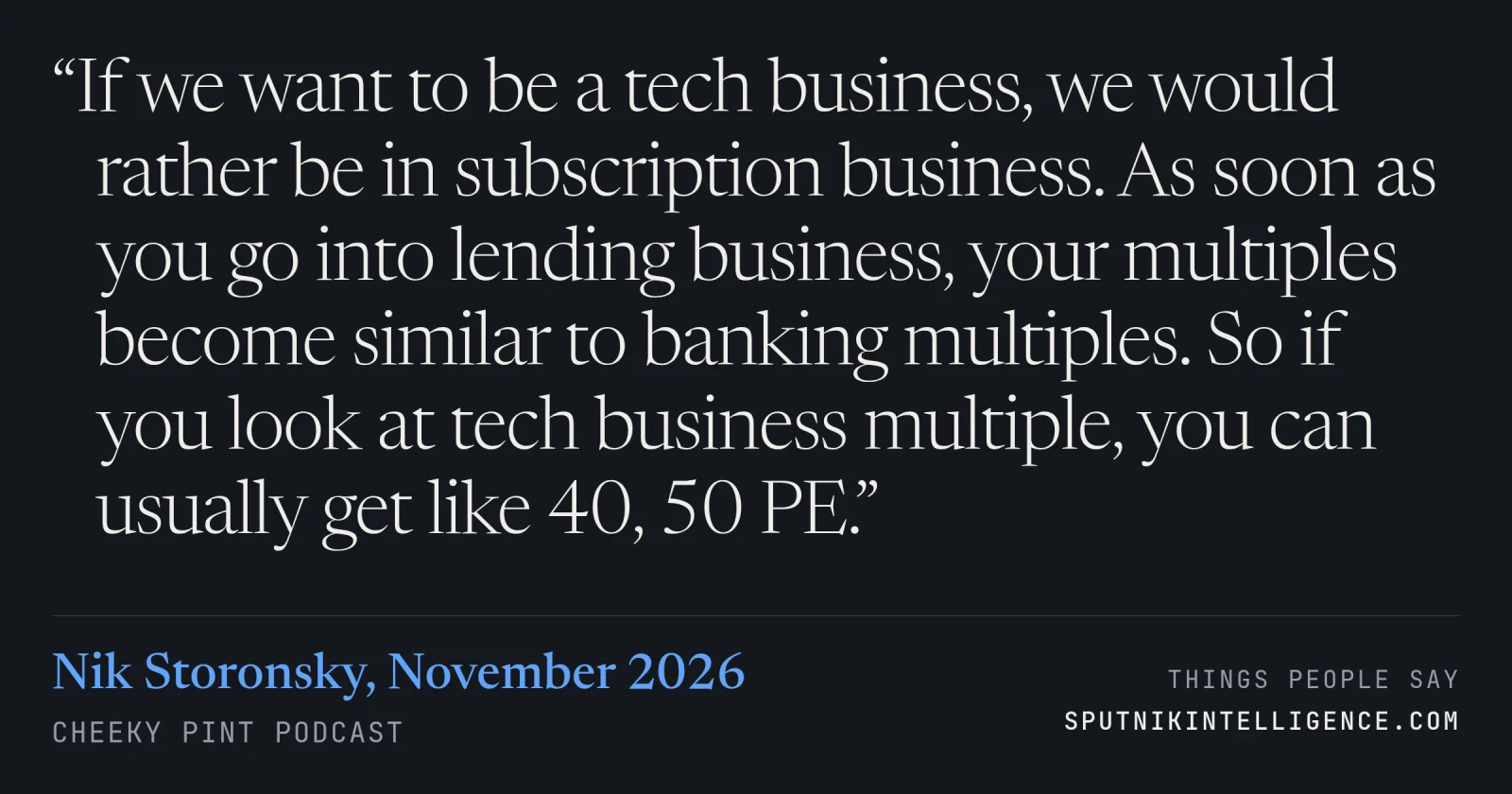
“If we want to be a tech business, we would rather be in subscription business. As soon as you go into lending business, your multiples become similar to banking multiples. So if you look at tech business multiple, you can usually get like 40, 50 PE.” — Nik Storonsky, Cheeky Pint

Asked why Revolut plans to keep lending a small share of its balance sheet, Storonsky gives a valuation argument: lending pulls a company toward bank multiples, subscriptions toward tech multiples. John Collison pushed back on this right after.

Cheeky Pint · 2026-11-10 Permalink → Listen →
Cheeky Pint Around 14:12 into the episode
Nik Storonsky

Well, I think our business model, my personal opinion, is we want to have the least amount of risk. So even if we lend, it won't be a large portion of balance sheet. So at the moment, target state is less than 10%. And then the rest we would securitize.

John Collison

Why?

Nik Storonsky

Well, first, the simpler the model, the better, from a greater point of view. Plus, again, if we want to be a tech business, right, we would rather be in subscription business. As soon as you go into lending business, your multiples become similar to banking multiples. So if you look at tech business multiple, you can usually get like 40, 50 PE. In banking business, you'll be like if you get 10 P.

John Collison

But is that because, because I'm always skeptical of multiples-based arguments, because ultimately the business is good or it isn't, and you can educate investors if the business is in fact good. Like when we started Stripe, people thought payments businesses were horrendous and deserving of low…

Nik Storonsky

I think it's more the business itself. So if you look at the credit business in banking and general credit business, so every time when you do a loan or credit card, you need to put provisions against it. And then really amount of these provisions highly depend on the models that you use, on the…

John Collison

uncertainty. You think fundamentally making your money via credit is this very cyclical profit stream that can be entirely wiped out in a downturn. It's very sensitive to you doing the math right. Whereas the nice thing about subscriptions is ultimately people are paying you this money on a…

Speaker names come from our own diarization. The position is estimated from where the line sits in the episode.
“It's similar to selling options, right? You collect premium for 10 years and then year number 11 you lose it all.” — Nik Storonsky, Cheeky Pint

John Collison had argued that subscription revenue is higher quality than lending because credit profits can be wiped out in a downturn. Storonsky agrees and gives this analogy for why Revolut wants to be a subscription business rather than a lender.

Cheeky Pint · 2026-11-10 Permalink → Listen →
Cheeky Pint Around 15:14 into the episode
Nik Storonsky

…is being pressed in, I think, by investors and generally by lower multiples because, okay, bank can produce a lot of money now from credit portfolio. But look, in two, three years' time, unemployment goes from 3% to 6%. And all profit is gone, right? Plus, they're losing money. So I think this

John Collison

…thing about subscriptions is ultimately people are paying you this money on a recurring basis. And yeah, in a downturn, maybe some people cancel their subscriptions, but like you can't make negative money on subscriptions. You can only shrink the book slightly. So it's much higher quality. Yeah,

Nik Storonsky

exactly. It's similar to selling options, right? You kind of collect premium for 10 years and then year number 11 you lose it all. So that's a problem.

John Collison

Okay, I want to go back to your product development methodology though. So okay, you're describing the early stages of there's some tops-down product ideas, there's some bottoms-up product ideas. They have to be validated that if it works, it can actually be interesting economically. You have a…

Nik Storonsky

So basically, it's pretty simple, right? So we've got the team, they work on the product for up to 18 months, then hopefully they'll launch the product. They'll work up to

John Collison

18 months before launching anything?

Speaker names come from our own diarization. The position is estimated from where the line sits in the episode.

Collections They Appear In