
TJ VanToll

Things TJ Says on Podcasts

Principal developer advocate at Blues with more than fifteen years of experience in web development, including work on the jQuery, NativeScript and Kendo UI teams. Hosts the Front-End Fire podcast, covering weekly news in frontend development. The show tracks topics like TanStack, AI coding agents, npm supply chain security, CSS anchor positioning and developer survey results. Writes for the Blues and Telerik blogs and maintains a personal site at tjvantoll.com.

Where to Find Them

TJ VanToll hosts and writes Front-End Fire .

Recently: “170: Tech Is Still Hiring... Just Not You” on Front-End Fire (November 2026); “169: How the Heck Do We Hire Developers in 2026?” on Front-End Fire (November 2026); “168: Are Dev Conferences Dying?” on Front-End Fire (November 2026); “166: The AI Clone Wars Continue” on Front-End Fire (October 2026); “165: Open Source Was Fun While It Lasted” on Front-End Fire (October 2026); “164: Developers Are Tired of This Sh*t” on Front-End Fire (October 2026).

What They Said

The hiring data they were discussing showed open product design roles at a record low, down 28% in a year. TJ says this matches what he sees at his own company.

Front-End Fire · 2026-11-16 Permalink → Listen →
Front-End Fire Around 11:26 into the episode
TJ VanToll

Yep.

Jack Herrington

…let's get real. Like Claude knows a whole bunch of these technologies way better than any of us do. And we've been doing this for a long time. So, you know, just let Claude handle that kind of stuff. I think the era of like that, as you say, TJ, that hybrid specialization, that's gone. That's gone.

TJ VanToll

Yeah. Well, then the third takeaway from this, this data is that demand for designers continues to hit record lows as well. Lenny says that there are only about 1,900 open product design roles at tech companies right now. It's the lowest we've seen since we started tracking and down 28% from a year ago. And this one also doesn't, this one doesn't surprise me, sadly, just because, I mean, so just speaking from personal experience from what I do at Blues, I'd say, I mean, we used to, Paige knows this, we used to have a designer on our team. But the thing is, about 75% of the things that I used to work with with a designer, I just straight up, AI could just do them now. And so we do still have a singular designer at Blues who is still very valuable. But it's just that the amount of stuff we need a designer for has just went down. So the number of jobs being available going down sadly also makes sense to me.

Paige Niedringhaus

Yeah, it makes me sad. It doesn't surprise me. I think right now, the best thing that you can do as a designer, if you are one, is to get more technical. If you can get good at working with AI to make your designs, to speed up your designs, whether it's through Figma or through Photoshop or through…

TJ VanToll

Well, and designers, I still feel like, even in an AI era, are still incredibly useful because if you've not tried this recently, it is very hard for AI to come up with a unique look for something that you're trying to build. AI loves to use the same sort of like gradient purple, blue, things that…

Jack Herrington

I mean, I think you do for like a coherent system, right? Yeah. Paige talked about like thin vertical slices. That's really cool. You know, as long as the agent is being a good steward about making sure that whatever is at the UX edge of that thin vertical slice feels like it fits into the rest of…

Speaker names come from our own diarization. The position is estimated from where the line sits in the episode.
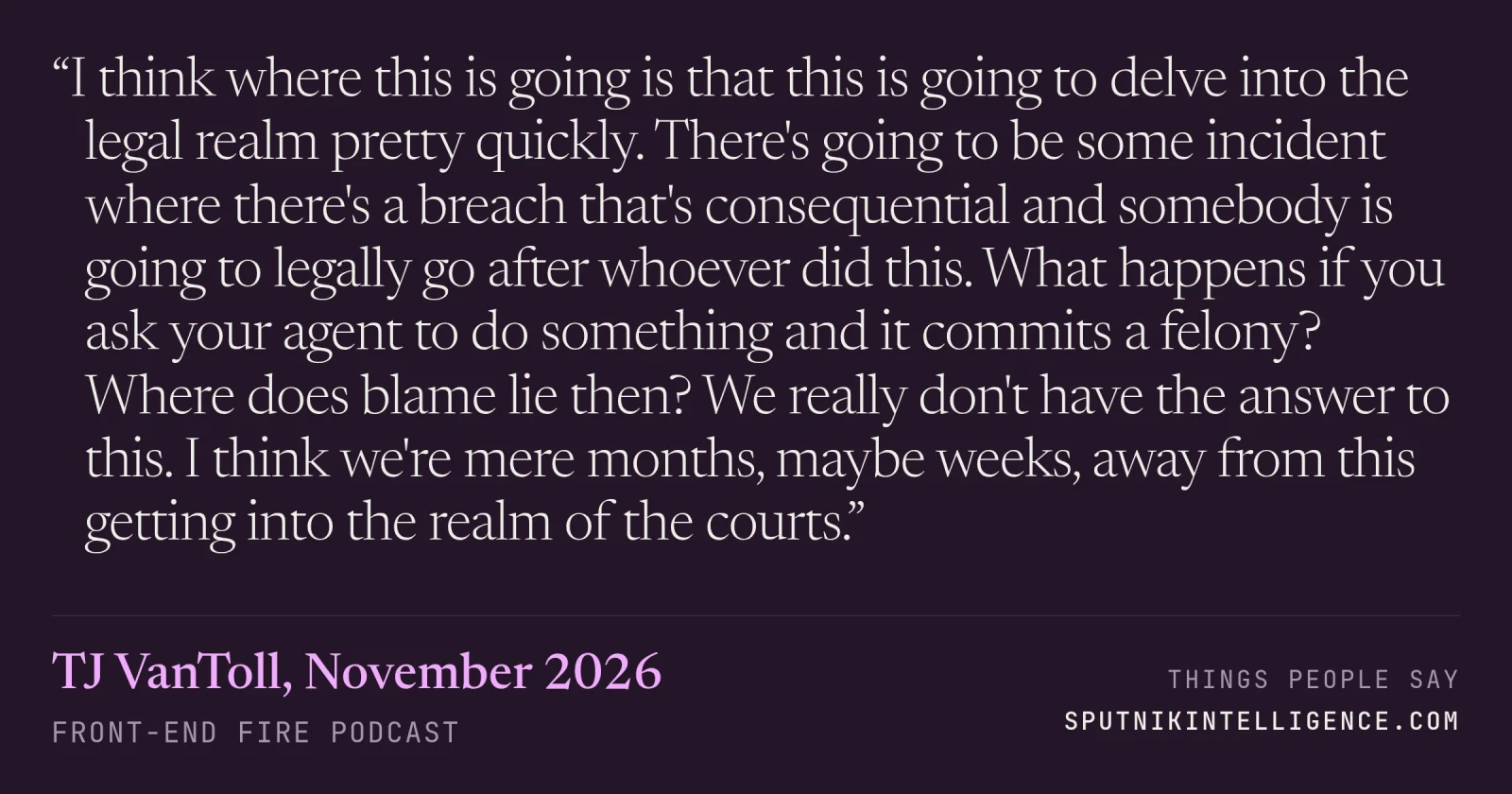
“I think where this is going is that this is going to delve into the legal realm pretty quickly. There's going to be some incident where there's a breach that's consequential and somebody is going to legally go after whoever did this. What happens if you ask your agent to do something and it commits a felony? Where does blame lie then? We really don't have the answer to this. I think we're mere months, maybe weeks, away from this getting into the realm of the courts.” — TJ VanToll, Front-End Fire

The hosts were discussing an employee whose AI agent probed a competitor's systems, and who was being held responsible for what the agent did. VanToll looks ahead to who is liable when an agent breaks the law on a user's instruction.

Front-End Fire · 2026-11-09 Permalink → Listen →
Front-End Fire Around 23:59 into the episode
Jack Herrington

…I've had it do that. It's done this for me proactively. Been like, hey, would you like me to go and like kind of multitask this across several AWS zones and do things like that? I'm like, uh, okay. You know, I mean, that's kind of hacking. I mean, like, where's the line here? Like, that's, yeah.

Paige Niedringhaus

…and found bugs and fixed the bugs and kept going. And then at the end, I just kind of reviewed it, did a couple spot checks, and we were great. I mean, that would have taken me hours to set up, find the right pieces of data, get it in the right shape. And Claude just did it all for me. Awesome.

TJ VanToll

I think where this is going is that this is going to delve into the legal realm pretty quickly. So there's going to be some incident where there's a breach that's consequential and somebody is going to legally go after whoever did this. And then this will end up in the court system to decide where we're going to have court cases where there's going to be arguments is if I ask this and my AI agent did something that is legal. We've talked about felony bench for all the felonies these models have done. Well, what happens if you ask your agent to do something and it commits a felony? Where does blame lie then? And we really don't have the answer to this. And I think we're mere months, maybe weeks away from this getting into the realm of the courts.

Jack Herrington

Oh, yeah. And it's going to end up with professional licensing and then also probably some sort of malpractice insurance like that I would have to hold as an individual developer or a company would hold for me. You know, I would have to go through certification about indemnity

TJ VanToll

from what my AI agent

Jack Herrington

does. Yeah, what is legal and ethical use of AI? You know, what can I prompt? What can't I prompt? You know, da, da, da, da, da. And then, you know, then AI companies are going to go through certification where they're like, hey, you know, we are sock, blah, blah, blah, blah, blah, whatever…

Speaker names come from our own diarization. The position is estimated from where the line sits in the episode.
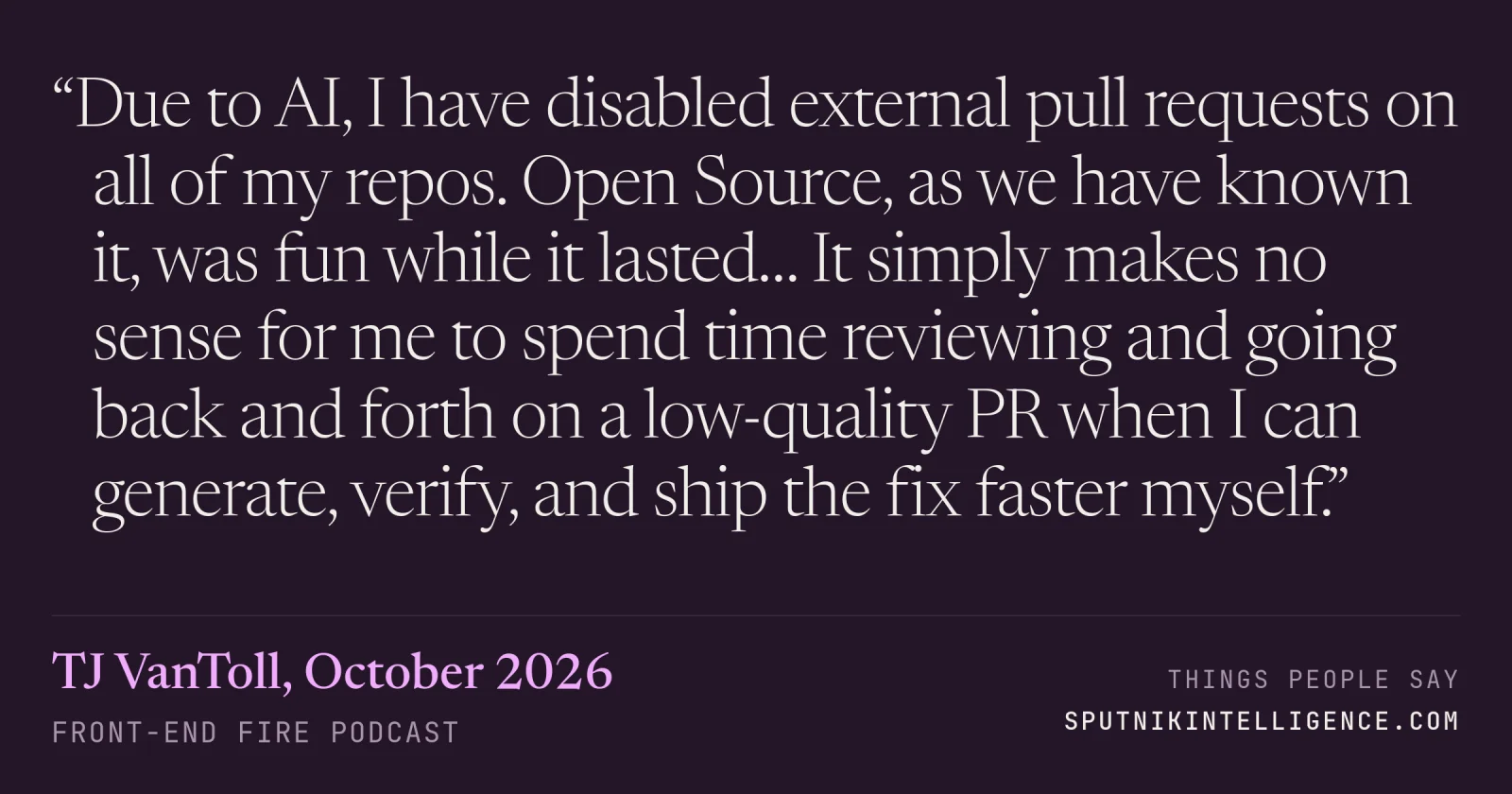
“Due to AI, I have disabled external pull requests on all of my repos. Open Source, as we have known it, was fun while it lasted… It simply makes no sense for me to spend time reviewing and going back and forth on a low-quality PR when I can generate, verify, and ship the fix faster myself.” — TJ VanToll, Front-End Fire

VanToll is reading out a post by the maintainer of a long list of widely used open source JavaScript utilities, and it gives the episode its title. VanToll adds that pull-request review has shrunk to a smoke test, and he expects bigger projects to follow.

Front-End Fire · 2026-10-12 Permalink → Listen →
Front-End Fire Around 05:01 into the episode
TJ VanToll

But as I was listening to it while editing it and I said 10 gigabytes, I felt, oh, I got to say something. So, yeah.

Jack Herrington

And there you go. When the most accurate podcast in tech, let's get on with our news. Let's do it. All right, TJ, tell us why open source was fun while it lasted.

TJ VanToll

…I have disabled external pull requests on all of my repos. Open Source, as we know, as we have known it, was fun while it lasted. I will still maintain projects and handle issues. Don't get me wrong, this isn't a dig at AI. The quality of open source contributions had been declining long before AI. AI just accelerated it while also making PR spam dramatically worse. I use AI extensively myself. It simply makes no sense for me to spend time reviewing and going back and forth on a low-quality PR when I can generate, verify, and ship the fix faster myself. And that this is ultimately about optimizing my time.

Jack Herrington

Okay. Yeah, no, I get it for sure.

TJ VanToll

Yeah.

Paige Niedringhaus

I mean, there's not a lot more to say. He kind of summed it up. If the reason for open source and what you're trying to do is put out more features that the open source community is using, then it is a lot more efficient to just have an agent go through it with you and build it the way that you…

Speaker names come from our own diarization. The position is estimated from where the line sits in the episode.

Collections They Appear In