
Jack Herrington

Things Jack Says on Podcasts

Software engineer and YouTuber known for frontend and full-stack development content, ranging from beginner tutorials to deep technical dives. TanStack maintainer and co-hosts the Front-End Fire podcast, along with PodRocket appearances and a guest spot on Whiskey Web and Whatnot. Work covers open source sustainability, React tooling, AI coding agents, local AI models and the TanStack ecosystem, and publishes both video and written content under the handle jherr.

Where to Find Them

Jack Herrington hosts and writes Front-End Fire and hosts PodRocket . They have also been a guest on Whiskey Web and Whatnot .

Recently: “170: Tech Is Still Hiring... Just Not You” on Front-End Fire (November 2026); “169: How the Heck Do We Hire Developers in 2026?” on Front-End Fire (November 2026); “168: Are Dev Conferences Dying?” on Front-End Fire (November 2026); “166: The AI Clone Wars Continue” on Front-End Fire (October 2026); “165: Open Source Was Fun While It Lasted” on Front-End Fire (October 2026); “164: Developers Are Tired of This Sh*t” on Front-End Fire (October 2026).

What They Said

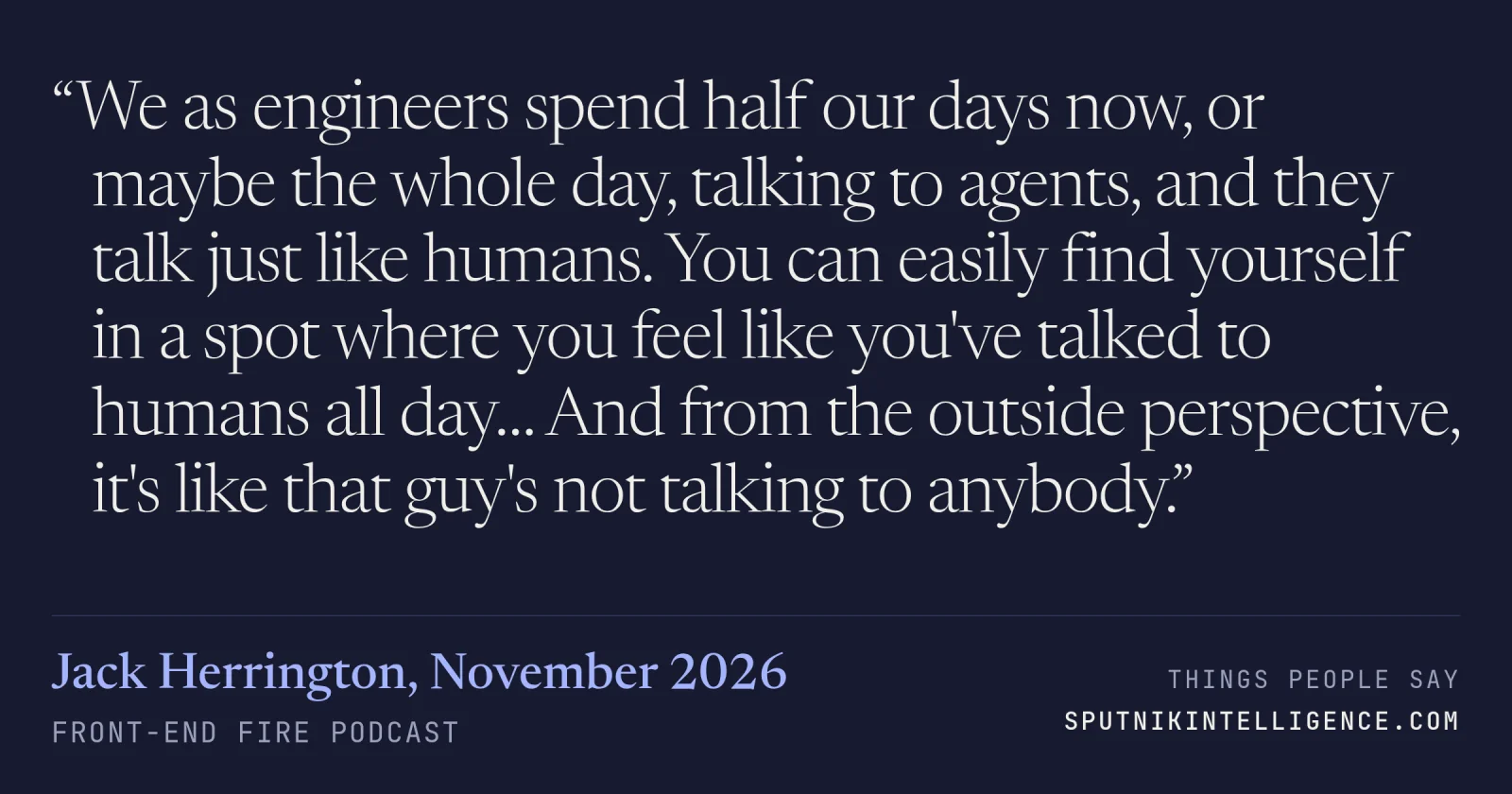
“We as engineers spend half our days now, or maybe the whole day, talking to agents, and they talk just like humans. You can easily find yourself in a spot where you feel like you've talked to humans all day… And from the outside perspective, it's like that guy's not talking to anybody.” — Jack Herrington, Front-End Fire

A co-host had said AI is making engineers more isolated because they need colleagues' help far less often. Jack adds that a day of talking to agents feels social but isn't.

Front-End Fire · 2026-11-16 Permalink → Listen →
Front-End Fire Around 17:33 into the episode
Jack Herrington

Yeah. Yeah.

TJ VanToll

…you could just go over to their desk. You just grab a quick meeting room or whatever and chat. And while that still is somewhat true, so you still need to talk to other people, come to decisions and whatnot, just the number of times that comes up, at least for me this went. I still don't think

Jack Herrington

that if they're what they're trying to solve is that communication problem and the fact that we've had, I don't know, people just don't see me talking as much. I think the, The fact that people aren't in the same office is not all of it, right? The fact of the matter is, we as engineers spend half our days now or more, or maybe the whole day, talking to agents, and they talk just like humans. And so, you can easily find yourself in a spot where it's like you think you've talked to humans, you feel like you've talked to humans all day, and all you've really done is just on no machine. And like, from the outside perspective, it's like that guy's not talking to anybody. It's like, well, I, I, I mean, I guess I'm not, but I kind of am. I don't know, it's weird, right? So, yeah,

TJ VanToll

it reminds me of when I first started remote working, and this is now a decade ago at this point, but they had paved not our road, but the one the one road we take to go absolutely everywhere. They had repaved the road. And I had mentioned to my wife, like, oh, they repaved the road. And she told…

Jack Herrington

It's kind of sad, but kind of cute all the same.

TJ VanToll

Yeah. So, I mean, I don't know. Overall on this, this data, I can't say I'm surprised that much. The degree of some of the changes surprised me a little bit. I think we were all kind of aware of some of these shifts. Engineering roles becoming more generic. Product managers being more, it's a more…

Speaker names come from our own diarization. The position is estimated from where the line sits in the episode.
“Claude knows a whole bunch of these technologies way better than any of us do, and we've been doing this for a long time. So just let Claude handle that kind of stuff. I think the era of that hybrid specialization, that's gone. That's gone.” — Jack Herrington, Front-End Fire

The hosts were reading hiring data showing front-end and mobile engineer listings shrinking while generic titles grow. A co-host had just said she has Claude change the infrastructure repo for her features without needing to know Terraform.

Front-End Fire · 2026-11-16 Permalink → Listen →
Front-End Fire Around 11:01 into the episode
Paige Niedringhaus

…though, like for us, Infra lives in its own repo that's not part of our main web app. I have that repo locally. So I can just tell Claude, go look in the repo, look at what's already there, adjust it so that my new feature can be deployed to staging. And it does. And I don't need to know Terraform.

TJ VanToll

Yep.

Jack Herrington

Yeah. And that's the thing. That's kind of the common thread is like, you don't need to know X. It's like, let's get on, let's get real. Like Claude knows a whole bunch of these technologies way better than any of us do. And we've been doing this for a long time. So, you know, just let Claude handle that kind of stuff. I think the era of like that, as you say, TJ, that hybrid specialization, that's gone. That's gone.

TJ VanToll

Yeah. Well, then the third takeaway from this, this data is that demand for designers continues to hit record lows as well. Lenny says that there are only about 1,900 open product design roles at tech companies right now. It's the lowest we've seen since we started tracking and down 28% from a year…

Paige Niedringhaus

Yeah, it makes me sad. It doesn't surprise me. I think right now, the best thing that you can do as a designer, if you are one, is to get more technical. If you can get good at working with AI to make your designs, to speed up your designs, whether it's through Figma or through Photoshop or through…

TJ VanToll

Well, and designers, I still feel like, even in an AI era, are still incredibly useful because if you've not tried this recently, it is very hard for AI to come up with a unique look for something that you're trying to build. AI loves to use the same sort of like gradient purple, blue, things that…

Speaker names come from our own diarization. The position is estimated from where the line sits in the episode.
“What happens when Anthropic decides, one, we want to reduce our running costs, and two, we want to make sure that the agents are efficient? They're probably going to follow the Chinese models, which are pretty much competitive. They're just thinner and don't need as much horsepower. I really get the feeling we're going to be driving through some of these places in Texas and be like, what's that? Oh, that's a defunct data center, from back when we thought we needed massive data centers.” — Jack Herrington, Front-End Fire

After VanToll noted that anti-data-center measures did well in the US elections, Herrington predicts some of the big data center build-out will end up unused, because leaner models need far less compute.

Front-End Fire · 2026-11-09 Permalink → Listen →
Front-End Fire Around 40:48 into the episode
Jack Herrington

Yeah, exactly. Everybody wants the

TJ VanToll

best, though. I mean, we're all guilty of this. When I'm doing my development, would a lower end model do most of it fine? I mean, probably, but am I using Opus 5.5 anyways? You better believe I am. And so I'm complicit in all of this because it helps me do my job better. And

Jack Herrington

sure, but what happens when Anthropic decides, oh, yeah, well, one, we want to reduce our running costs. And two, we want to make sure that the agents are efficient. And, you know, they're probably going to go and follow the Chinese models, which are pretty much competitive. It's just they're just thinner and they don't need as much horsepower. And so I just really get the feeling we're going to be driving through some of these places in Texas or whatever, you know, and be like, what's that? Oh, that's a defunct data center when we were back in the days when we thought we needed massive data centers.

TJ VanToll

Yeah, but I think that's what capitalism in competition is for. If Opus gets so bloated and so expensive and they can't source data centers, then they're going to have to adapt to that and people might move to OpenAI. I think this will end up working out. That's the one good thing we have going for…

Jack Herrington

I remember.

TJ VanToll

So I'm hesitant to make any sort of predictions, but I do feel good about the fact that there's a competitive landscape in all of this.

Speaker names come from our own diarization. The position is estimated from where the line sits in the episode.
“I've essentially been through the great reset at this point. Everybody is back at the starting point again. I see a lot of people talk about having traditional coding interviews, with no coding agent, just prove your skill at coding. I don't think anybody wants that anymore. They want to see how you handle your horde. Everybody at this point is going to have a horde of agents behind them, and how well you can manage the horde to do your bidding is the new skill in 2026 and beyond.” — Jack Herrington, Front-End Fire

The hosts were discussing how to hire developers now that AI is part of the job. Herrington argues the thing to test in interviews is no longer coding by hand but how well someone directs agents.

Front-End Fire · 2026-11-09 Permalink → Listen →
Front-End Fire Around 06:19 into the episode
TJ VanToll

That's a really good point. I mean, we talk about juniors, but I mean, what do we do and do interview senior people nowadays? Exactly. We're still at the

Paige Niedringhaus

entire playing field

Jack Herrington

has flipped. How does that, you know, like I was thinking about this morning, I've essentially been through like the great reset at this point. Like everybody is back in, you know, kind of whatever, you know, the starting point again. And what's interesting to me is I see a lot of people talk. About, like, what about having coding interviews that are traditional, like just straight up coding interviews? Like, you don't even use a coding agent, just kind of prove your skill at coding or something like that. You're kind of trying that. And I don't think anybody wants that anymore. Like, they want to see how you handle your horde, right? Everybody, right, at this point is going to have a horde of agents behind them. And how well you can manage the horde to do your bidding for you is the new skill in 2026 and beyond.

Paige Niedringhaus

Yeah. What you're suggesting is what we all used to complain about: where you're asked to whiteboard or write on a Google Doc some code that compiles and works and is syntactically correct, but you would never write it that way with VS Code. It would be auto formatting, it would be suggesting…

Jack Herrington

And we're going to get to a point here where it's actively bad to not use an agent. Like, I think we're already there. Yeah. I did an experiment where I took some free AI code from 2020 that I thought was really good at the time. And I was very happy with it. It was up to the coding standards of…

Paige Niedringhaus

well and i can do you one better so at the company that i work for allspice we have been hiring developers and we're hiring we're not really hiring juniors unfortunately we're we're a startup so we need people who are experienced people who have done this for a while but we so we're hiring i would…

Speaker names come from our own diarization. The position is estimated from where the line sits in the episode.
“They're trying different things to keep conferences relevant, but this is not unusual. From what I hear, coding conferences in particular are off by like 50%. But AI conferences are kicking butt.” — Jack Herrington, Front-End Fire

Jack Herrington opened the episode with a report from React Advanced in London, which he said was the least attended of the three times he has spoken there. It sets up the show's question of whether developer conferences are declining as AI changes what developers want to learn.

Front-End Fire · 2026-11-02 Permalink → Listen →
Front-End Fire Around 07:10 into the episode
Jack Herrington

I don't know. I don't know. It would have been so much better. Anyway, we've got a lot of news. We should get into it.

TJ VanToll

Start.

Jack Herrington

All right. Well, I'm going to start it off this week and I'm going to give you my background on React Advanced. So React Advanced is one of the Get Nation conferences. It's held in London at the Brewery, which is a really nice venue. It's a big venue. And I got to say, I've been there and done talks now three times. And unfortunately, this was the least attended of all of them. And it wasn't just my talk. I mean, it was like the number of seats in the room was just that much smaller. They really did a good job of like trying out different things. They actually had two rooms as opposed to one. I did a bunch of interviews there, which they're going to turn into podcasts. So I guess I cheated on you guys. Sorry about that. You know, they're trying different things to keep conferences relevant, but this is not unusual. From what I hear, coding conferences in particular are off by like 50%. But AI conferences are kicking butt.

TJ VanToll

I'm curious in terms of just the number of talks. And was it's a React conference. Were there React talks? Was everything just completely taken over by AI? I'm assuming it's some mix in between. That's a great question.

Jack Herrington

Actually, yeah. It wasn't completely taken over by AI. In fact, the first night that I got in, we were in the kind of WhatsApp speakers lounge thing talking about, you know, where do you want to go for dinner? And so I got a couple, I roped a couple of guys, you know, like, okay, let's go to dinner…

Paige Niedringhaus

And what would you say was like the amount of people who were there as this year as opposed to years past? Just like ballpark attendee numbers.

Speaker names come from our own diarization. The position is estimated from where the line sits in the episode.
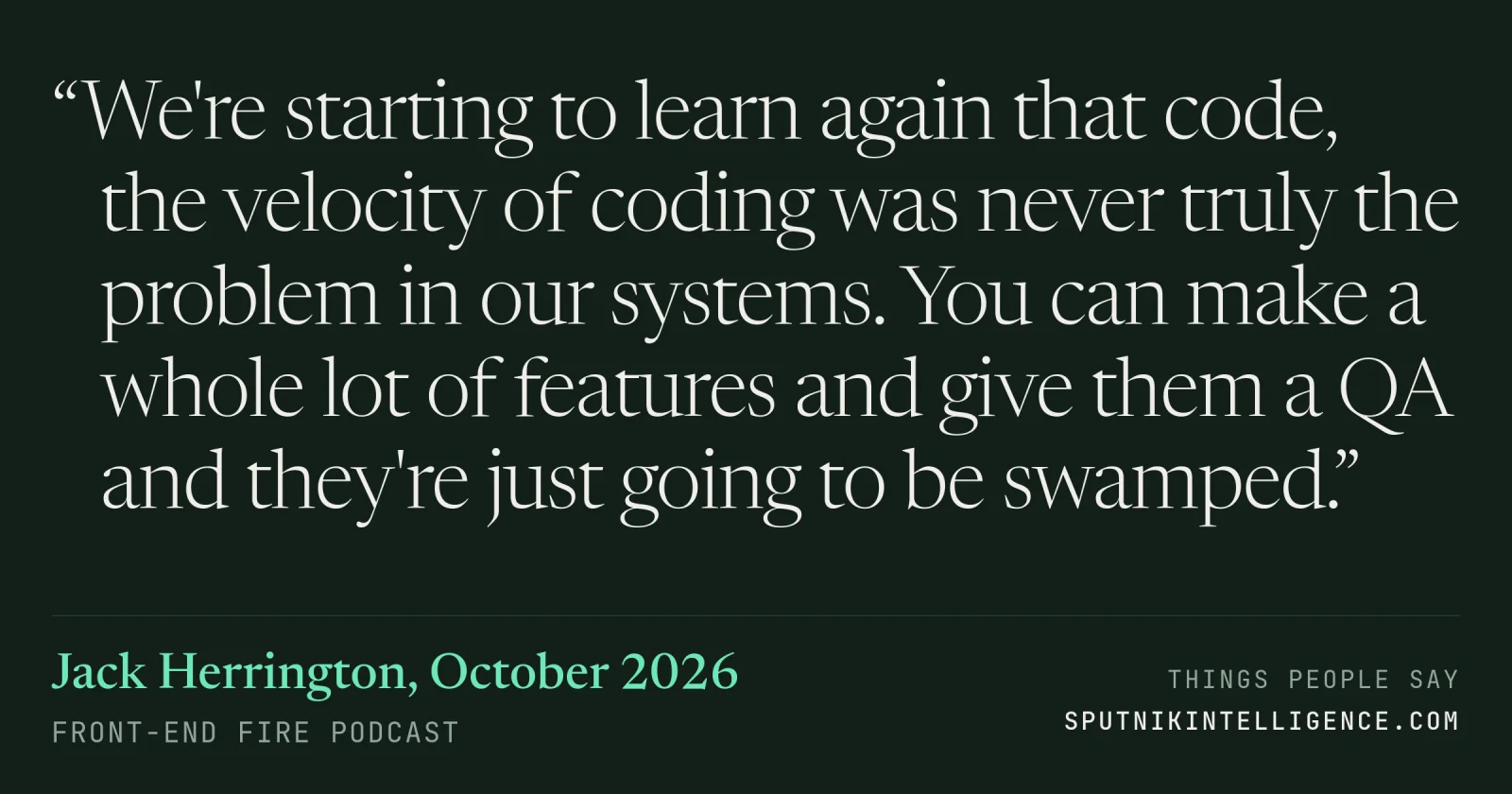
“We're starting to learn again that code, the velocity of coding was never truly the problem in our systems. You can make a whole lot of features and give them a QA and they're just going to be swamped.” — Jack Herrington, Front-End Fire

The hosts are discussing a developer survey and how job expectations have grown now that AI makes more work possible on paper. A co-host had just said people still have only so much time and focus.

Front-End Fire · 2026-10-05 Permalink → Listen →
Front-End Fire Around 26:07 into the episode
Speaker 3

But I think for all that. Oh, sorry.

Speaker 2

…people are trying to shove in as requirements than there ever was before. And it's because AI is making it possible time-wise, but people are still people at the end of the day and only have a finite amount of time and energy and focus. And that's not really being accounted for in this new era.

Speaker 3

Yeah. We're starting to learn again that code, the velocity of coding was never truly the problem in our systems. Like, you know, you can make a whole lot of features and give them a QA and they're just going to be swamped. You know, what is that going to happen? Yeah. But I think I too, am being an oldie, I'm optimistic. Like I love the idea that, you know, potentially I've been in so many companies and jobs where there's been some software, software that was created as like a spike or something like that, or like a one-off feature or something. And the team was super excited about it. They worked three months on it. They delivered it. And then they all went off and went to different places. And now it's unmaintained. Right. And I really think there's a lot of value there in AI, BISP being able to be like the lighthouse keeper that kind of keeps the light on and keeps the package JSON updated, all that kind of stuff. I never wanted to do that job. Nobody wants to do that job, but it…

Speaker 1

All right. Well, from that, speaking of things AI can fix, we have a lot of releases that we want to cover, a lot of bonus leggings. So why don't we get going?

Speaker 2

Yeah.

Speaker 1

All right, Paige, do you want to kick off the 1.0 train here?

Speaker names come from our own diarization. The position is estimated from where the line sits in the episode.

Collections They Appear In