JC

Jess Carbino

Things Jess Says on Podcasts

Where to Find Them

Jess Carbino has been a guest on The Checkup with Doctor Mike .

Recently: “Former Tinder Expert Went on 343 Dates. Here's What She Learned” on The Checkup with Doctor Mike (November 2026).

What They Said

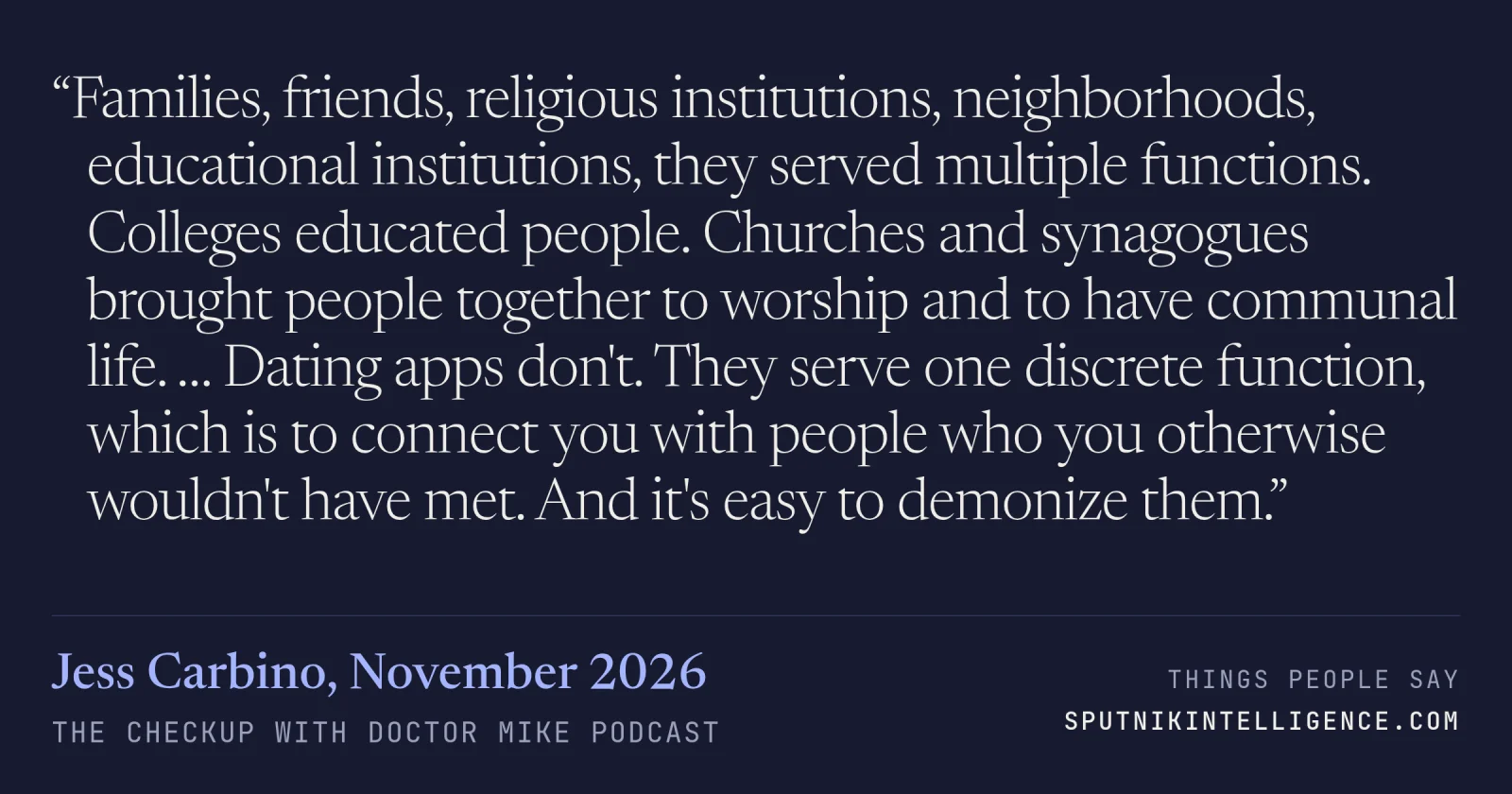
“Families, friends, religious institutions, neighborhoods, educational institutions, they served multiple functions. Colleges educated people. Churches and synagogues brought people together to worship and to have communal life. … Dating apps don't. They serve one discrete function, which is to connect you with people who you otherwise wouldn't have met. And it's easy to demonize them.” — Jess Carbino, The Checkup with Doctor Mike

Asked how dating being hard now differs from the pre-digital era, she argues that older matchmaking institutions did many jobs and carried personal ties, so people didn't blame them the way they now blame apps.

The Checkup with Doctor Mike · 2026-11-15 Permalink → Listen →
The Checkup with Doctor Mike Around 04:13 into the episode
Jess Carbino

…dating apps have made dating worse. But at the same time, you know, dating was really always hard. Like Shakespeare and Jane Austen would not have had such, you know, wide readership if they were not hard, if it wasn't hard for people to meet and to mate and to find love and to maintain it. So how

Mike Varshavski

has that hard shifted from not necessarily Shakespearean days, but pre-digital days to now?

Jess Carbino

Totally. Well, I think the thing is, is that, you know, families, friends, religious institutions, neighborhoods, educational institutions, they served multiple functions. Like colleges educated people. Churches and synagogues brought people together to worship and to have communal life. Your Aunt Susan, you know, watched you when you were a kid. Now it's a lot harder to say, oh, well, my university didn't do a good job matching me, or my aunt Susan really set me up with a bad guy. Like that's much harder to do because you have a personal connection to those things. And moreover, they serve multiple functions. Dating apps don't. They serve one discrete function, which is to connect you with people who you otherwise wouldn't have met. And it's easy to demonize them, I think.

Mike Varshavski

I see guys do this thing. It's very gym culture, bro culture, where they say, oh, it's not fair on dating apps. Women only want this small percentage of men who are in the top tier of height, money, power, et cetera. So like we have no chance. Does that bear out in evidence?

Jess Carbino

I think that's self-deception playing out at its finest. Tell me more. To be honest with you, because people are rational. As irrational as social media might portray us to be, and as irrational as what you said sounds to me or may sound to other people, fundamentally, if you look at data related…

Mike Varshavski

you think that plays out because it's so overwhelming these days with the amount of information that's being fed to us from even the simplest of things? There's constantly new phone updates. There are new stories coming from parts of the globe that we would have never heard a news story from prior…
Speaker names come from our own diarization. The position is estimated from where the line sits in the episode.
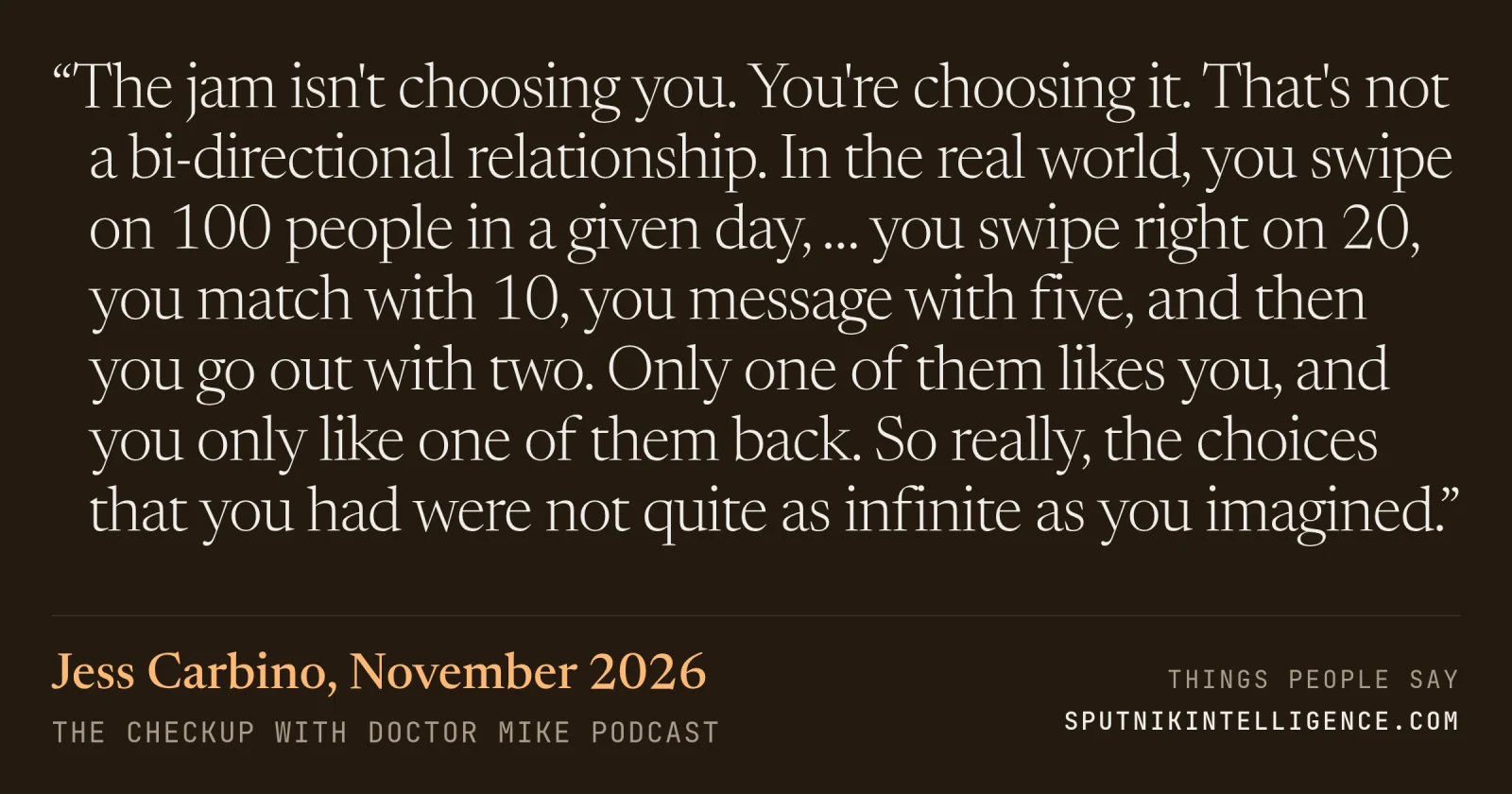
“The jam isn't choosing you. You're choosing it. That's not a bi-directional relationship. In the real world, you swipe on 100 people in a given day, … you swipe right on 20, you match with 10, you message with five, and then you go out with two. Only one of them likes you, and you only like one of them back. So really, the choices that you had were not quite as infinite as you imagined.” — Jess Carbino, The Checkup with Doctor Mike

She was arguing that people misapply the "too many choices" research to dating apps, since that research used consumer examples like jars of jam. A partner choice has to be mutual, and the funnel from swipes to a date is much narrower than it feels.

The Checkup with Doctor Mike · 2026-11-15 Permalink → Listen →
The Checkup with Doctor Mike Around 11:32 into the episode
Jess Carbino

Their early experiences make it scary. Being known was something that was probably tied up in punishment or there wasn't a reward associated with it. Like being known was dismissed, for example. Interesting. And that's something I observe all the time with patients.

Mike Varshavski

And when you say that the idea of this friction helping people grow, dating apps, much like most technological products, aim to remove friction. Are dating apps removing the good part of dating?

Jess Carbino

No, I think they introduce a lot of friction, to be candid with you. Well, because people introduce the friction. Dating apps theoretically try to remove it, but there are humans involved. They can't remove everything. And I think that's why the idea of choice and how people perceive choice on dating apps is not necessarily correct. So people have sat with me for years and said, you know, there are too many choices on dating apps, but I think they're thinking about the choice incorrectly. Because when we thought about choice in a theoretical way or when psychologists have talked about it, like Barry Schwartz, for example, or Ambody and Iengar, all those people who've written about it widely, they were using consumer-related choices. Like jars of jam was the classic example. And so when you walk into a supermarket, if you have enough money and you don't have an allergy to something, you know, the choice of jam that you make isn't going to have a huge consequence for your life like a partner would, for example. And moreover, the jam isn't choosing you. You know, you're choosing it. That's not a bi-directional relationship. And let's say in the real world, like you swipe…

Mike Varshavski

Is that why also some of the technology leads to unhappiness?

Jess Carbino

I think that could be a role in it. Technology, I think, could lead to unhappiness because it doesn't provide us with these developmental tasks that we need to engage in. We need to continue our development over time. Friction's part of that. And I think that if you're not daily or weekly engaging…

Mike Varshavski

Or just have relationships. Yeah. Because the lonely geriatric patient of mine has a higher likelihood of developing Alzheimer's, shortened lifespans, et cetera.

Speaker names come from our own diarization. The position is estimated from where the line sits in the episode.

Collections They Appear In