Philip Johnston

Things Philip Says on Podcasts

Co-founder and CEO of Starcloud, a company building data centers in orbit to ease the power bottleneck facing AI. Starcloud has launched an NVIDIA H100 GPU into orbit and partners with cloud providers such as Crusoe. Appears on Inevitable, The Information's TITV, Sourcery, Y Combinator Startup Podcast, This Week in Startups and Moonshots with Peter Diamandis, discussing orbital data centers and launch cost economics.

Where to Find Them

Philip Johnston writes Inevitable . They have also been a guest on This Week in AI (3 times) , The Information's TITV (3 times) , Sourcery (2 times) , This Week in Startups (2 times) , Y Combinator Startup Podcast (2 times) , 632nm (2 times) , Moonshots with Peter Diamandis (2 times) , Training Data and The Peel with Turner Novak .

Recently: “Why Space Will Be the Cheapest Place to Run AI | Philip Johnston, Starcloud” on The Peel with Turner Novak (November 2026); “Inside Starcloud’s $2B Space Factory” on Sourcery (October 2026); “Humanity's First Star Probe, Architect Labs Beats NVIDIA 3.4x, Musk Wants Satellites to Cool Earth | EP #285” on Moonshots with Peter Diamandis (September 2026); “Nvidia Chip Prices to Rise 17%, Starcloud CEO on Orbital Data Centers, Amazon’s Growing Importance” on The Information's TITV (August 2026); “Building the First Data Centers in Space” on Y Combinator Startup Podcast (August 2026); “Are we already in the Singularity? | E24” on This Week in AI (July 2026).

What They Said

“They said it would probably be about 75 million to 100 million dollars to get this program going. And as I say, we did it for two and a half. I can tell you what the two and a half cost us: 300 grand for the launch, a million dollars for the bus, about 500 grand for the payload, and then some overheads. … It's still operating now, by the way. We're still running government workloads on it now. … The system is just broken.” — Philip Johnston, The Peel with Turner Novak

Turner asked about a defense prime quoting Starcloud around $100 million for a satellite carrying an H100. Philip breaks down what Starcloud's first satellite actually cost, and blames cost-plus R&D culture for the difference.

The Peel with Turner Novak · 2026-11-20 Permalink → Listen →
The Peel with Turner Novak Around 17:47 into the episode
Philip Johnston

I mean, you'd have to ask them

Speaker 4

so you don't actually know.

Philip Johnston

So this was a, we had a call and we told them the specs and I said, you know, what are we looking at? And they said, well, it would probably be about 75 million to 100 million dollars to get this program going. And as I say, we did it for two and a half. I can tell you what the two and a half cost us, which was 300 grand for the launch, a million dollars for the bus, about 500 grand for the payload, and then some overheads. I mean, yeah, it's like a 60 kilogram small set that had the first H100 on board. It's still operating now, by the way. We're still running government workloads on it now. Yeah, I mean, it's just broken. The system is just broken. That's why these primes are.

Turner Novak

Isn't what's kind of happened is a lot of them have like booked capacity that they then sell out to other people. So you're probably paying a lot of like overhead bureaucracy. They're a middleman essentially managing some of these programs. Like, is that sort of part of it?

Speaker 4

It's

Philip Johnston

sort of part of it. The launch cost is reasonably well known, though. I think more of it is coming from this like cost plus on R D. And also, people just thought it was impossible to launch an H100 to run an H100 in space. So they were like, you know, the amount of RD hours we're going to need to…

Speaker names come from our own diarization. The position is estimated from where the line sits in the episode.
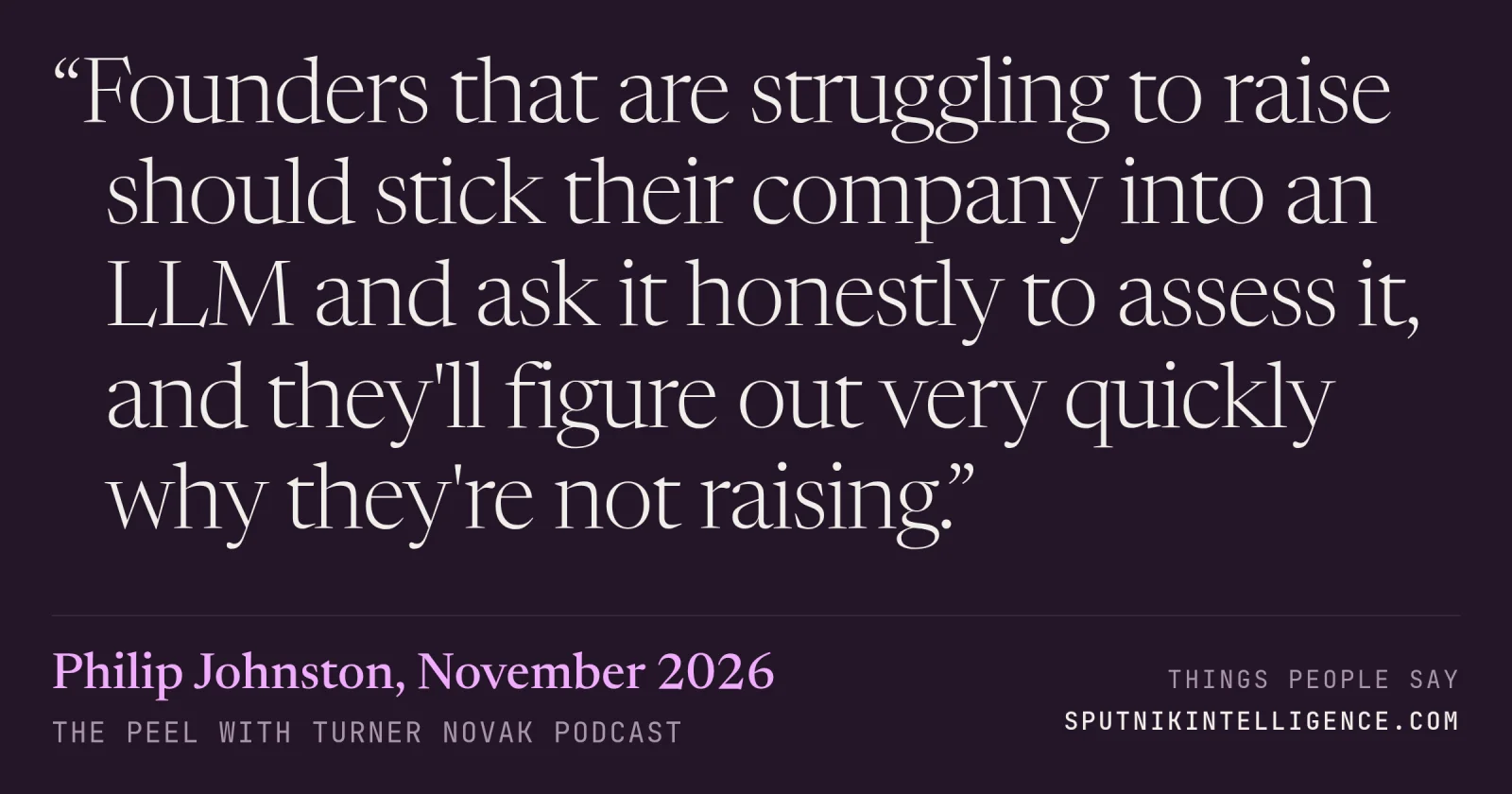
“Founders that are struggling to raise should stick their company into an LLM and ask it honestly to assess it, and they'll figure out very quickly why they're not raising.” — Philip Johnston, The Peel with Turner Novak

Turner had just said that because VCs use AI, founders may not see what investors see. Philip, who has run his own company through this test, tells struggling founders to do the same.

The Peel with Turner Novak · 2026-11-20 Permalink → Listen →
The Peel with Turner Novak Around 1:17:08 into the episode
Turner Novak

as a VC. I see this. I'm like, okay, how do

Speaker 4

I get money into this thing? Like, how do I convince, how do I get in front of them? How do I get it? That's the job of yeah. And so if I'm so so do a lot of founders like not realize this is happening right now or founders

Philip Johnston

that are struggling to raise should stick their company into an LLM and ask it honestly to assess it and they'll figure out very quickly why they're not raising.

Speaker 4

Did you do that with StarCloud? Yeah, have you done it?

Philip Johnston

Yeah, of course.

Speaker 4

What is usually the biggest thing they realize? Like, is it like, does the LLM say their market sucks or something? The

Speaker names come from our own diarization. The position is estimated from where the line sits in the episode.
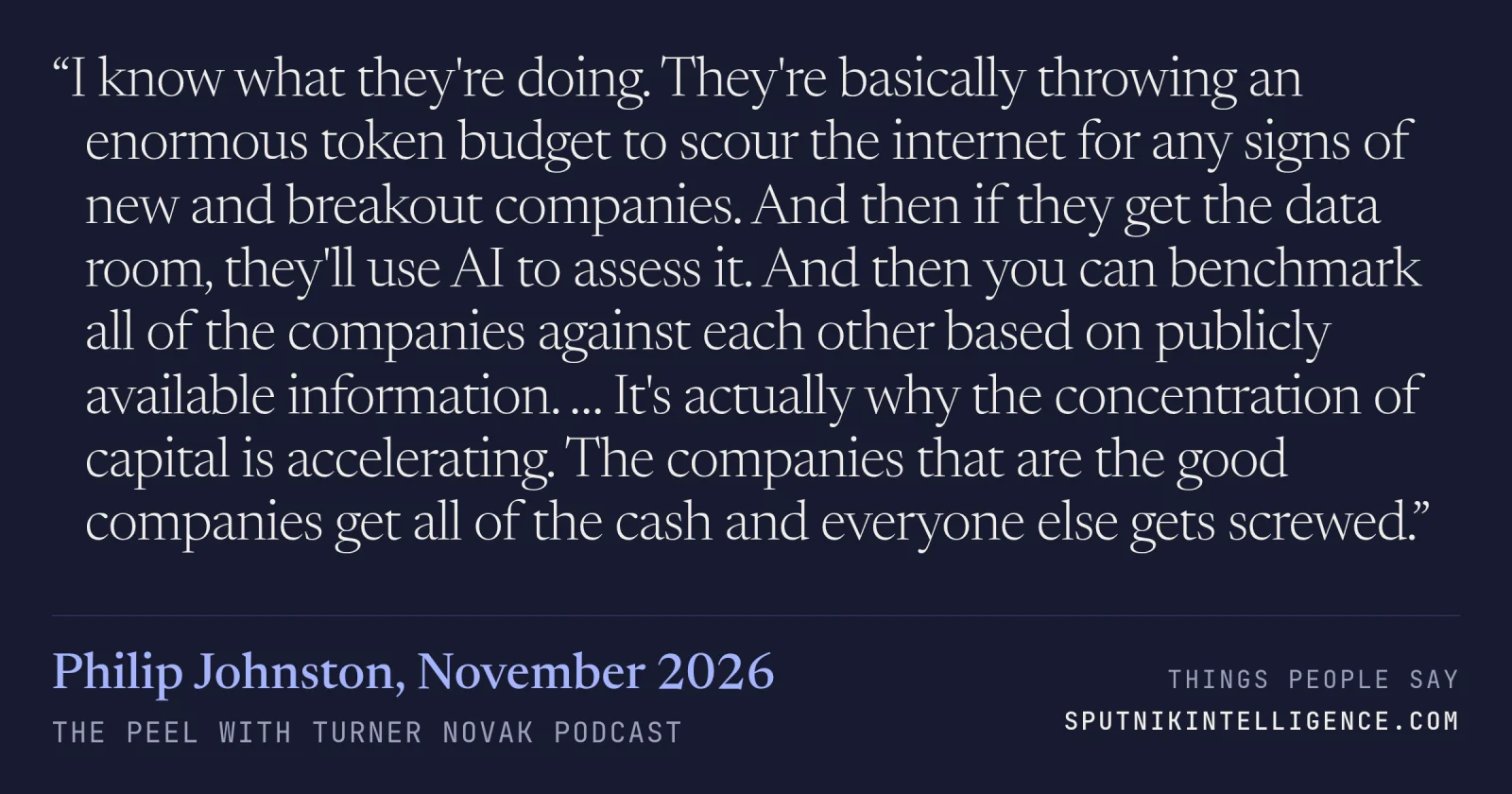
“I know what they're doing. They're basically throwing an enormous token budget to scour the internet for any signs of new and breakout companies. And then if they get the data room, they'll use AI to assess it. And then you can benchmark all of the companies against each other based on publicly available information. … It's actually why the concentration of capital is accelerating. The companies that are the good companies get all of the cash and everyone else gets screwed.” — Philip Johnston, The Peel with Turner Novak

Turner asked why Philip keeps tweeting that VCs are using AI to make investment decisions. Philip says most founders don't realize how much investors already rely on it, and links that to capital piling into a few winners.

The Peel with Turner Novak · 2026-11-20 Permalink → Listen →
The Peel with Turner Novak Around 1:14:29 into the episode
Philip Johnston

The reason I post about it is I don't think most founders realize the extent to which the VCs are using AI right now.

Turner Novak

So what do you think VCs are

Philip Johnston

doing? Well, I know what they're doing. They're using it to, they're basically throwing an enormous token budget to scour the internet for any signs of like new and breakout companies. And then they, if they need a data room and they get the data room, they'll use AI to assess the data room. And then you can benchmark all of the companies against each other based on publicly available information. And then the remaining job of the VC is like convincing the founders to take their money. But it's actually not that difficult to know which the breakout companies are just by using whatever your favorite LLM is to scour the internet for signs of it. It's not like I don't think there's a job for VCs. The founders need to trust the VC and they need to build a relationship and all this kind of stuff. But finding out which are the good companies, I don't think it's going to be that difficult very soon. It's actually why so much capital is now, is why the concentration of capital is accelerating. Like the companies that are the good companies get all of the cash and everyone else gets screwed. And if I ask any LLM which is the best

Speaker 4

like market, company, founder, etc. Yeah, they're

Philip Johnston

all not giving me

Turner Novak

the

Speaker names come from our own diarization. The position is estimated from where the line sits in the episode.
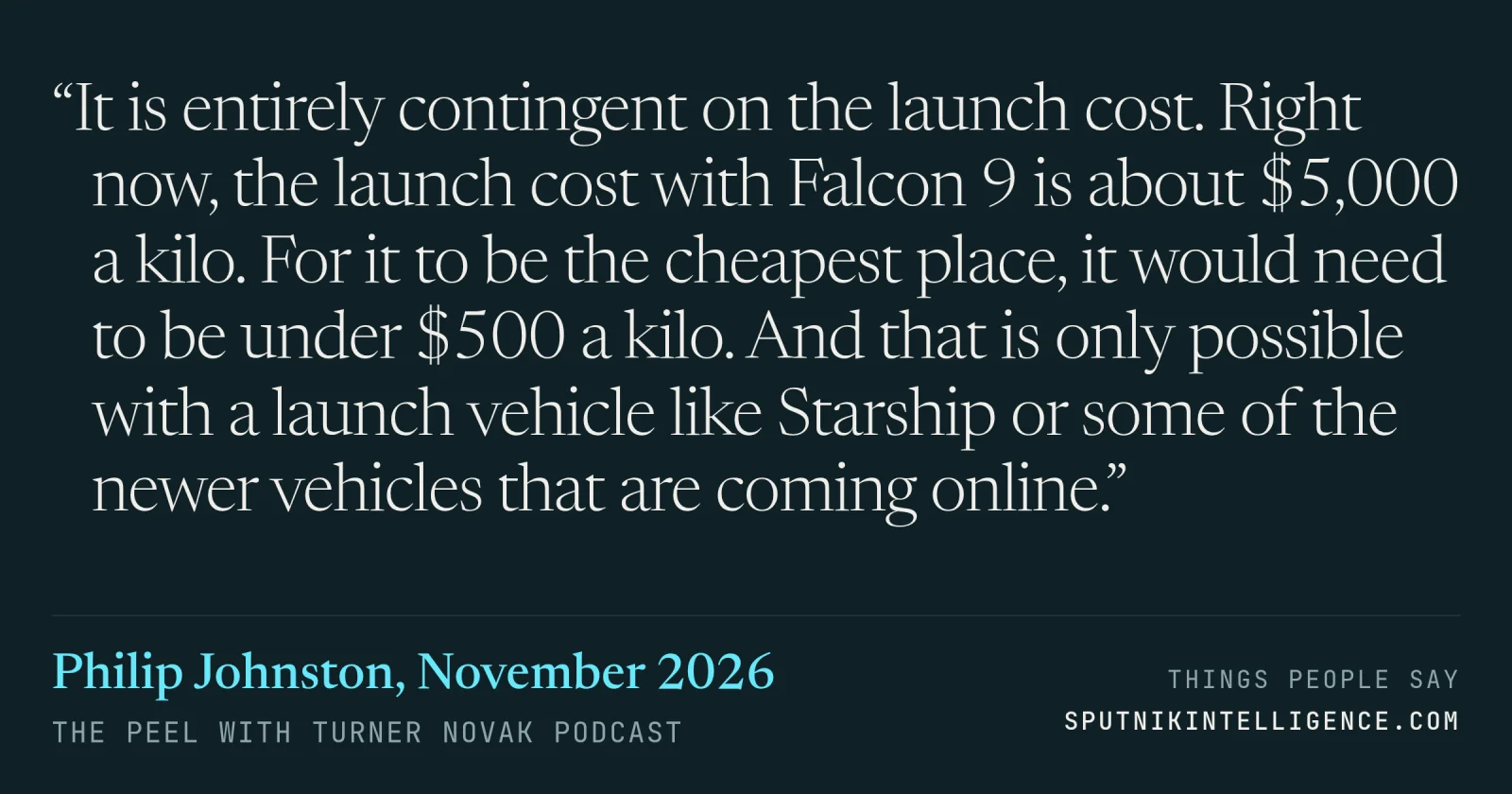
“It is entirely contingent on the launch cost. Right now, the launch cost with Falcon 9 is about $5,000 a kilo. For it to be the cheapest place, it would need to be under $500 a kilo. And that is only possible with a launch vehicle like Starship or some of the newer vehicles that are coming online.” — Philip Johnston, The Peel with Turner Novak

Philip had just said space will become the cheapest place to run AI, not that it is today. Asked why it isn't cheapest yet, he names the one condition Starcloud's whole bet depends on.

The Peel with Turner Novak · 2026-11-20 Permalink → Listen →
The Peel with Turner Novak Around 00:53 into the episode
Philip Johnston

Space Will be the cheapest place to run AI. Will be the cheapest. Right now is definitely not the cheapest place to run AI.

Turner Novak

So why is it not the cheapest right now?

Philip Johnston

So it is entirely contingent on the launch cost. And right now, the launch cost with Falcon 9 is about $5,000 a kilo. For it to be the cheapest place, it would need to be under $500 a kilo. And that is only possible with a launch vehicle like Starship or like some of the newer vehicles that are coming online.

Turner Novak

So then why are you building this company right now? Because if the cost doesn't come down, it doesn't work.

Philip Johnston

Yeah. As Wayne Gretzky used to say, and you're a Canadian. So famous Canadian quiz. Skate to where the puck's been, right?

Turner Novak

Yeah.

Speaker names come from our own diarization. The position is estimated from where the line sits in the episode.
“In space, we don't need permitted land, so your biggest cost is gone. You don't need batteries and backup power because you're 24-7 in the sun, so your second biggest cost is gone. And you need eight times fewer solar cells, because one square meter of solar panel in space produces about eight times the energy over the course of a year than one terrestrially.” — Philip Johnston, The Peel with Turner Novak

Turner Novak asked the Starcloud CEO to explain why orbital data centers make sense. Philip compares a new solar-powered project on the ground, where land, batteries and panels are the big costs, with one in orbit, where the only extra cost is launch.

The Peel with Turner Novak · 2026-11-20 Permalink → Listen →
The Peel with Turner Novak Around 03:21 into the episode
Philip Johnston

…project in space for data centers. So terrestrially, you have three big costs to do that. Number one is the cost of permitted land. And actually in North America, that can be the largest. Not too many people will allow you to cover 10 square kilometers of countryside in the US with solar panels.

Turner Novak

So it gets hard to just build it in the first place.

Philip Johnston

Yeah, permitted land for a new solar project is becoming harder to find. Number two, and it's actually linked to the energy price, obviously, because you're going to, it's based, the cost of that land is based on the discounted cash flow you're going to produce from that. And the energy price is going up. So that means the land price is going up. Number two is the cost of battery storage and backup power. So you're only eight hours a day in peak sunlight. And that means that you need to store power so you can use that at night for a data center, for example. And then the last one is the cost of the solar cells themselves. So compared to in space, so number one, we don't need permitted land. So your biggest cost is gone. You don't need batteries and backup power because you're 24-7 in the sun. So your second biggest cost is gone. And then you need eight times less solar cells because one square meter of solar panel in space produces about eight times the energy over the course of a year than one terrestrially. And so the main additional cost that we have in space versus terrestrially is the launch cost. And we are very quickly, so you can see…

Turner Novak

So what is actually the thing that is up there in space? Because I'm trying to, is it like when I think of like, like a data center, you know, building that's like floating around, like spinning and like there's like solar panels on it and like the jet engines like adjusting the trajectory. So like…

Philip Johnston

Yeah. So I can tell you what we've launched, and then I'll tell you what we're going to launch in the end state. So in November last year, we launched what we called StarCloud 1.

Speaker 3

So we can reach Star Cloud 1 over here well beyond it. Together, we take the next great leap into a bright new future. Built for all mankind. And here is where it all begins.

Speaker names come from our own diarization. The position is estimated from where the line sits in the episode.

Collections They Appear In