 Philip Johnston
Co-founder and CEO of Starcloud, a company building data centers in orbit to ease the power bottleneck facing AI. Starcloud has launched an NVIDIA H100 GPU into...
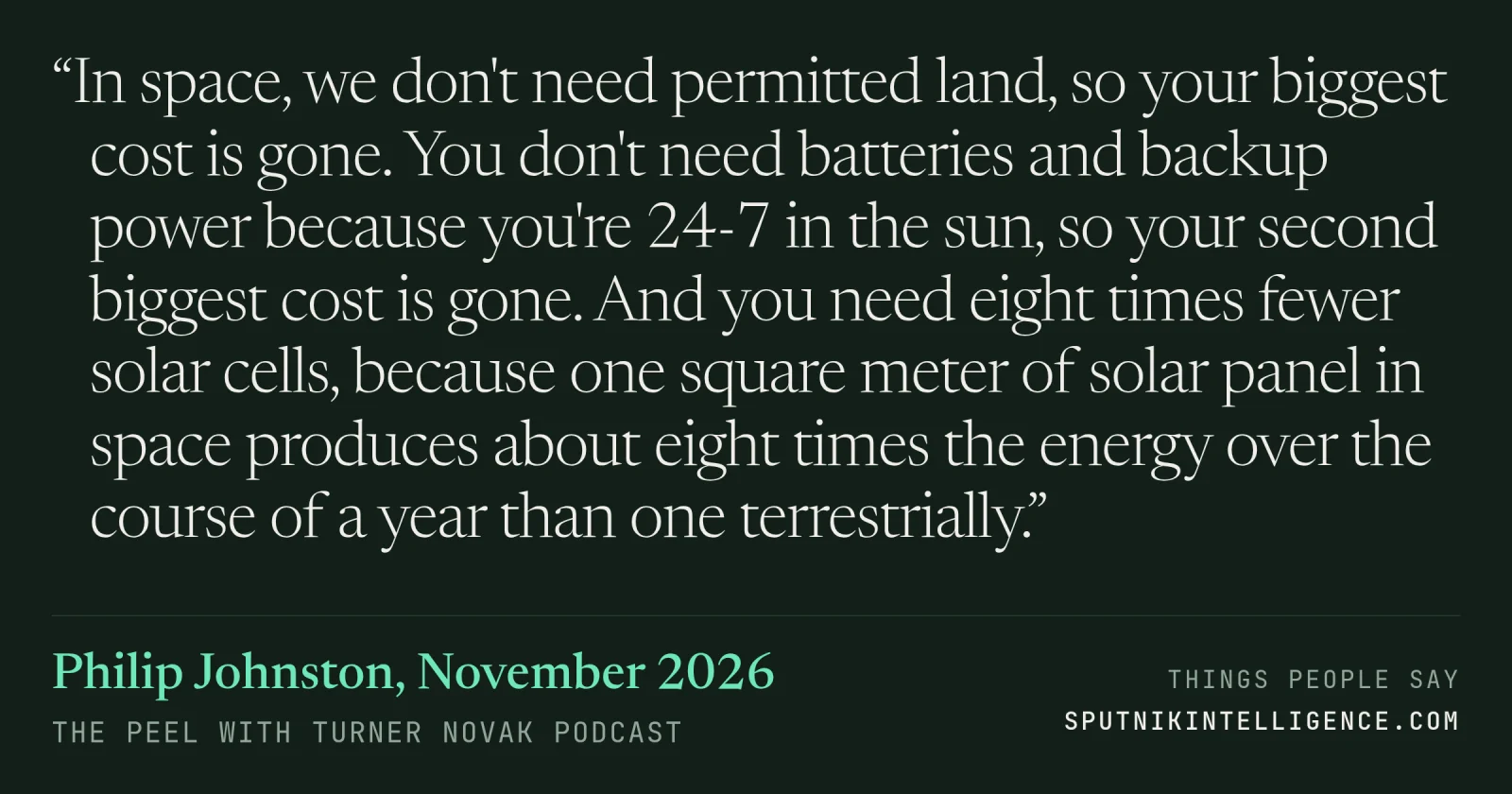
“In space, we don't need permitted land, so your biggest cost is gone. You don't need batteries and backup power because you're 24-7 in the sun, so your second biggest cost is gone. And you need eight times fewer solar cells, because one square meter of solar panel in space produces about eight times the energy over the course of a year than one terrestrially.”
The Peel with Turner Novak · Startups & Venture · November 2026
Context
Turner Novak asked the Starcloud CEO to explain why orbital data centers make sense. Philip compares a new solar-powered project on the ground, where land, batteries and panels are the big costs, with one in orbit, where the only extra cost is launch.
Transcript
…project in space for data centers. So terrestrially, you have three big costs to do that. Number one is the cost of permitted land. And actually in North America, that can be the largest. Not too many people will allow you to cover 10 square kilometers of countryside in the US with solar panels.
So it gets hard to just build it in the first place.
Yeah, permitted land for a new solar project is becoming harder to find. Number two, and it's actually linked to the energy price, obviously, because you're going to, it's based, the cost of that land is based on the discounted cash flow you're going to produce from that. And the energy price is going up. So that means the land price is going up. Number two is the cost of battery storage and backup power. So you're only eight hours a day in peak sunlight. And that means that you need to store power so you can use that at night for a data center, for example. And then the last one is the cost of the solar cells themselves. So compared to in space, so number one, we don't need permitted land. So your biggest cost is gone. You don't need batteries and backup power because you're 24-7 in the sun. So your second biggest cost is gone. And then you need eight times less solar cells because one square meter of solar panel in space produces about eight times the energy over the course of a year than one terrestrially. And so the main additional cost that we have in space versus terrestrially is the launch cost. And we are very quickly, so you can see…
So what is actually the thing that is up there in space? Because I'm trying to, is it like when I think of like, like a data center, you know, building that's like floating around, like spinning and like there's like solar panels on it and like the jet engines like adjusting the trajectory. So like…
Yeah. So I can tell you what we've launched, and then I'll tell you what we're going to launch in the end state. So in November last year, we launched what we called StarCloud 1.
So we can reach Star Cloud 1 over here well beyond it. Together, we take the next great leap into a bright new future. Built for all mankind. And here is where it all begins.
More from The Peel with Turner Novak