GI

Greg Ipp

Things Greg Says on Podcasts

Where to Find Them

Greg Ipp has been a guest on Marketplace (APM) and Marketplace .

Recently: “Spooked investors sink Big Tech stocks” on Marketplace (October 2026); “Spooked investors sink Big Tech stocks” on Marketplace (APM) (October 2026).

What They Said

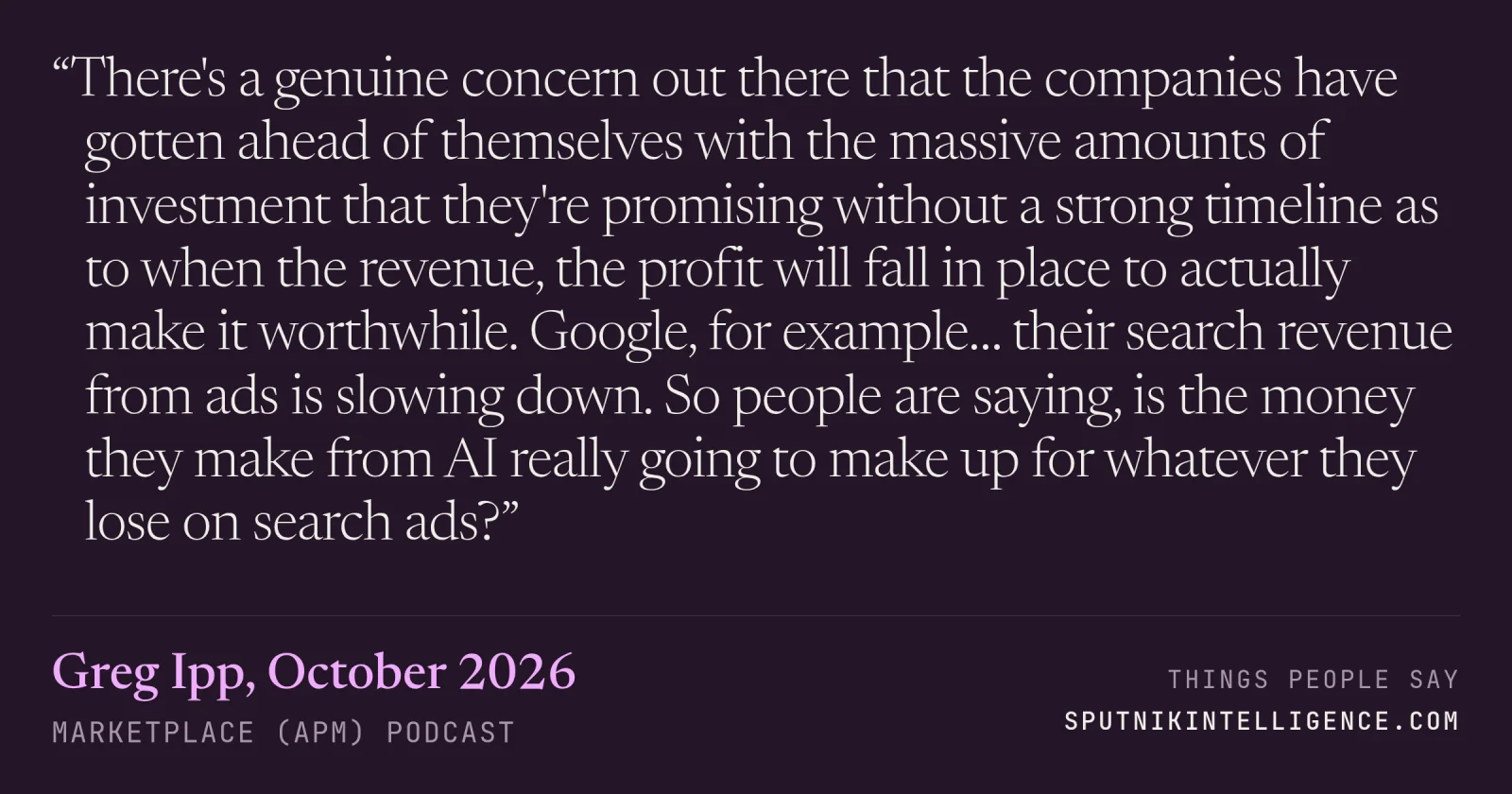
“There's a genuine concern out there that the companies have gotten ahead of themselves with the massive amounts of investment that they're promising without a strong timeline as to when the revenue, the profit will fall in place to actually make it worthwhile. Google, for example… their search revenue from ads is slowing down. So people are saying, is the money they make from AI really going to make up for whatever they lose on search ads?” — Greg Ipp, Marketplace (APM)

Ryssdal asked whether AI, which is driving part of the economy, is making markets uneasy. Ipp ties the week's tech sell-off to doubts about when AI spending will pay off, using Google's slowing search-ad revenue as the example.

Marketplace (APM) · 2026-10-30 Permalink → Listen →
Marketplace (APM) Around 07:07 into the episode
Speaker 2

That's right. And what the Fed wants to do is raise borrowing costs to make it more expensive, as you said, for people to borrow money, to use their credit card, to get a new car, to buy homes, to try to cool things down.

Kai Ryssdal

Right. Greg, we got a minute. Let's talk about artificial intelligence. We've got Kaylee Wells coming up on technology stocks, but AI is kind of driving this economy. It's driving part of what's going on in inflation. And the markets now are getting a little bit uneasy about it. It sure seems like.

Speaker 3

Yeah, I think there's a genuine concern out there that the companies have gotten ahead of themselves with the massive amounts of investment that they're promising without a strong timeline as to when the revenue, the profit will fall in place to actually make it worthwhile. Google, for example, we saw that even though they're still growing very rapidly in terms of their revenue, their search revenue from ads is slowing down. So people are saying, hmm, is the money they make from AI going to really going to make up for whatever they lose on search ads and so forth? And I think that question propagates across all these companies. And you're seeing investors who are not really asking questions about the enormous prices they were willing to pay for those companies now asking questions. We're seeing Intel down. We're seeing Google down. We're seeing, in fact, most of the big stocks that we associate with AI are actually kind of struggling this

Kai Ryssdal

year. Greg, you're up at the Wall Street Journal, Kate Davidson of Bloomberg on a Friday. Thanks you too.

Speaker 3

Thanks, guys. Thank

Speaker 2

you.

Speaker names come from our own diarization. The position is estimated from where the line sits in the episode.
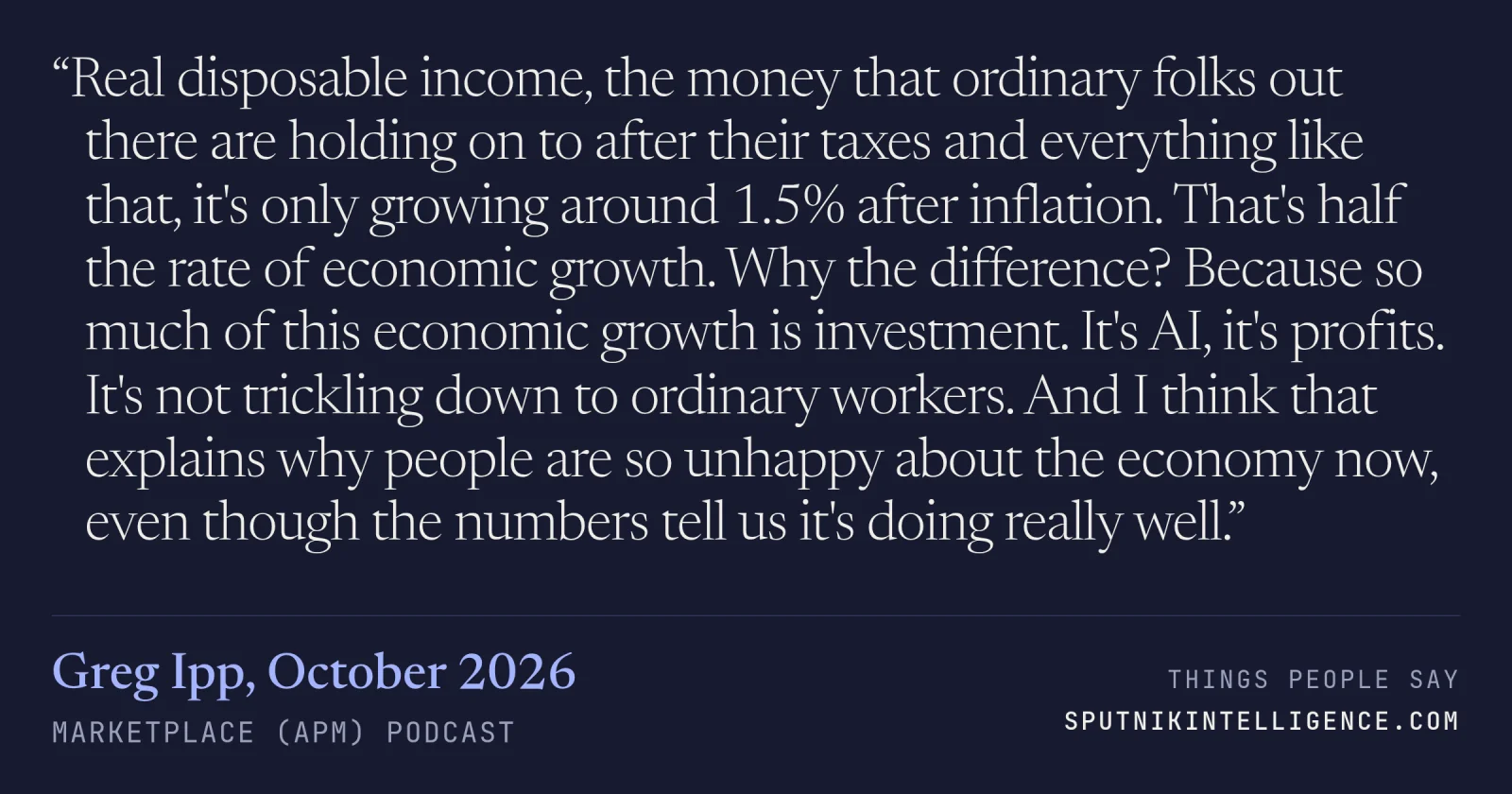
“Real disposable income, the money that ordinary folks out there are holding on to after their taxes and everything like that, it's only growing around 1.5% after inflation. That's half the rate of economic growth. Why the difference? Because so much of this economic growth is investment. It's AI, it's profits. It's not trickling down to ordinary workers. And I think that explains why people are so unhappy about the economy now, even though the numbers tell us it's doing really well.” — Greg Ipp, Marketplace (APM)

Kai Ryssdal asked about the week's GDP and inflation data. Ipp first notes a strong quarter, then looks at the income side: growth is going to investment and profits rather than household pay, which he offers as the reason for public gloom.

Marketplace (APM) · 2026-10-30 Permalink → Listen →
Marketplace (APM) Around 05:05 into the episode
Speaker 3

Yep.

Kai Ryssdal

You know, it was a great

Speaker 3

quarter for the economy, 3.4% annual rate, best in a year. If you actually look under the hood, there are some measures of demand growing around 5% best in three or four years. It's an economy that's not just strong, but it's accelerating. But, Kai, the thing that I find striking is that if you actually look at the income side of the statement, you know, where's the money going that is basically being thrown off by this fast-growing economy? Real disposable income, the money that ordinary folks out there are holding on to after their taxes and everything like that, it's only growing around 1.5% after inflation. That's half the rate of economic growth. Why the difference? Because so much of this economic growth is investment. It's AI, it's profits. It's not trickling down to ordinary workers. And I think that explains why people are so unhappy about the economy now, even though the numbers tell us it's doing really well.

Kai Ryssdal

Yeah. All right. So we'll get to AI in just a second. Kate Davidson did want to talk for a second about something the chairman mentioned a couple of three or four times in his 32-ish minutes of the press conference. He talked a lot about financial conditions and how it's tightening a little bit.…

Speaker 2

Right. There had been that idea sort of out there. And that's something that's been talked about in the past. When we have seen a run-up in yields, as we've seen this year, Fed officials have at times previously said, well, this is helpful to us. And they might have broached, a couple of them might…

Kai Ryssdal

Just so the listeners are clear, financial conditions being a tailwind means they are not restrictive enough, right? They're not holding back economic activity.

Speaker names come from our own diarization. The position is estimated from where the line sits in the episode.
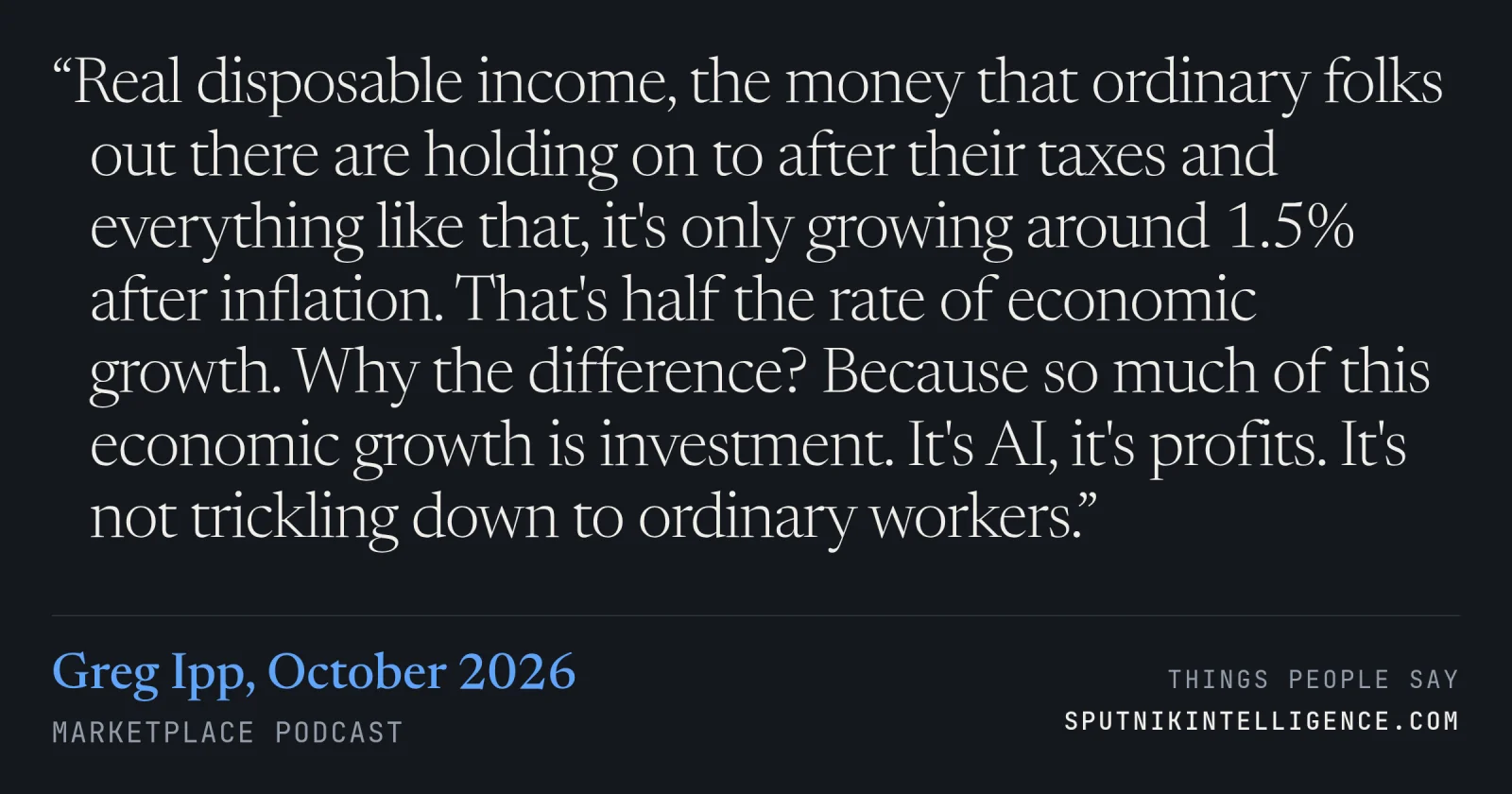
“Real disposable income, the money that ordinary folks out there are holding on to after their taxes and everything like that, it's only growing around 1.5% after inflation. That's half the rate of economic growth. Why the difference? Because so much of this economic growth is investment. It's AI, it's profits. It's not trickling down to ordinary workers.” — Greg Ipp, Marketplace

The host had noted strong GDP growth alongside high inflation. Ipp explains why a strong quarter doesn't feel strong to most people: the growth is mostly AI investment and profits rather than household income.

Marketplace · 2026-10-30 Permalink → Listen →
Marketplace Around 06:07 into the episode
Kai Ryssdal

Okay. Greg, let's talk data. GDP came out earlier this week. We got PCE at 3.6%. Economy's growing, but so are prices.

Speaker 2

Yep. You know, it was a great quarter for the economy, 3.4% annual rate, best in a year. If you actually look under

Speaker 1

the hood, there are some measures of demand growing around 5% best in three or four years. It's an economy that's not just strong, but it's accelerating. But Kai, the thing that I find striking is that if you actually look at the income side of the statement, you know, where's the money going that is basically being thrown off by this fast-growing economy? Real disposable income, the money that ordinary folks out there are holding on to after their taxes and everything like that, it's only growing around 1.5% after inflation. That's half the rate of economic growth. Why the difference? Because so much of this economic growth is investment. It's AI, it's profits. It's not trickling down to ordinary workers. And I think that explains why people are so unhappy about the economy now, even though the numbers tell us it's doing really well.

Kai Ryssdal

Yeah. All right. So we'll get to AI in just a second. Kate Davidson did want to talk for a second about something the chairman mentioned a couple of three or four times in his 32-ish minutes of the press conference. He talked a lot about financial conditions and how it's tightening a little bit.…

Speaker 4

Right. There had been that idea sort of out there. And that's something that's been talked about in the past. When we have seen a run-up in yields, as we've seen this year, Fed officials have at times previously said, well, this is helpful to us. And they might have broached, a couple of them might…

Kai Ryssdal

Just so the listeners are clear, financial conditions being a tailwind means they are not restrictive enough, right? They're not holding back economic activity.

Speaker names come from our own diarization. The position is estimated from where the line sits in the episode.

Collections They Appear In